Three polished women occupied the drawing room. Elegant. Accomplished. Each one quietly convinced she was the obvious choice for the next Mrs. Reed.
Nathaniel stood apart, watching. Tired of it all.
Every smile across the room had been rehearsed. Every compliment landed like a chess move.
On the rug nearby, his toddler sat surrounded by toys he had no interest in.
“Perhaps he’s just shy,” one woman offered.
“Or perhaps he’s being selective,” another said, laughing softly at her own cleverness.
Nathaniel said nothing.
Oliver had barely made a sound all evening.
Then everything shifted.
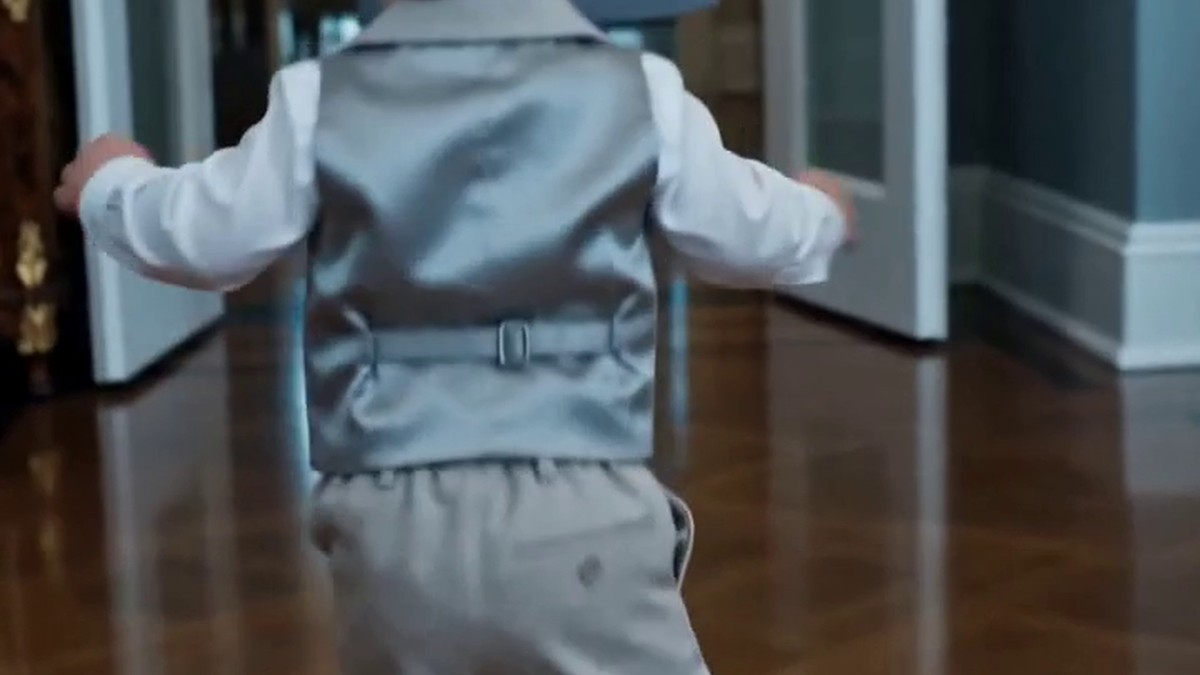
The little boy pushed himself upright.
The conversation died instantly.
The whole room held its breath.
Nathaniel moved without thinking. “Come on, buddy.”
Oliver swayed on unsteady legs, finding his balance.
All three women surged forward at once. Dropping to their knees. Spreading their arms wide. Filling their faces with warmth.
“Come here, sweetheart.”
“You’ve got this, Oliver.”
“That’s it — come on.”
The boy took his first step. Then a second.
A ripple of excitement moved through the room. One woman’s eyes were already glistening, certain the moment belonged to her.
But Oliver stopped.
Right in the middle of the rug, he simply stopped.
His gaze drifted — past the outstretched arms, past the silk, past the glittering jewelry — toward the far edge of the room.
A young housemaid stood near the doorway, holding a tray.
Grace.
She went perfectly still. Attention was the last thing she wanted.
But the instant Oliver’s eyes found her, his whole face cracked open into the kind of smile children only give to people they trust without question.
“Oliver…” she breathed, barely a whisper.
He laughed — pure and unguarded — and changed course completely.
The room fell dead silent.
One step at a time, he moved away from the women. Away from the guests. Away from everything his father had carefully arranged.
Straight toward Grace.
A spoon slipped off her tray and rang against the floor.
No one even flinched.
Every eye was fixed on the boy.
The moment he reached her, he wrapped both arms around her legs and held on.
Grace sank to her knees and pulled him close.
What came next stopped Nathaniel cold.
Oliver dropped his head onto her shoulder without a moment’s hesitation. Settled. Calm. Safe — the way a child is only safe somewhere deeply familiar.
Something shifted in Nathaniel’s expression. Slowly. Quietly.
Because a question was forming in his mind — one that should have surfaced months ago.
He looked at Grace.
And when he finally spoke, his voice was low and steady.
“When I wasn’t here… who was looking after my son?”
The color drained from Grace’s face.
And the answer she was about to give him would change everything.
The tray trembled in her hands.
Not much. Just enough for Nathaniel to notice.
Grace held Oliver against her chest, one hand pressed to the back of his head, and she didn’t look up right away. She took a breath first — the kind of breath that buys a single second of borrowed time.
“I was, sir.”
The words came out steady. Quieter than she intended.
Nathaniel didn’t move. Didn’t look away.
Behind him, the three women had risen from the rug, smoothing their dresses, recalibrating. The warmth had drained from their faces. In its place: something colder, more careful.
“You were,” Nathaniel repeated.
Not a question. A recalibration of his own.
He crossed the room slowly, and the other guests seemed to understand — instinctively, wordlessly — that they were no longer part of this conversation. One woman reached for her champagne. Another turned toward the window. The third stood very still, watching with narrowed eyes.
Nathaniel crouched down to Oliver’s level.
The boy turned to look at his father, cheek still pressed against Grace’s shoulder. He didn’t pull away. He simply looked — with the particular calm of a child who had learned that some places were safe and some were not, and who already knew the difference.
“Hey, buddy.” Nathaniel’s voice dropped. “You having a good time?”
Oliver blinked. Then he reached out and touched his father’s face — one small palm against Nathaniel’s jaw — with the uncomplicated tenderness that children deploy like weapons, without knowing it.
Nathaniel caught his son’s hand and held it there.
He was quiet for a long moment.
Then he stood.
—
“Mrs. Peel.” He addressed the housekeeper, who had materialized in the doorway with the particular gift long-serving staff develop for appearing precisely when needed. “Would you take Oliver upstairs, please.”
“Of course, Mr. Reed.”
Oliver went without protest, reaching for Mrs. Peel’s hand and glancing back only once — at Grace — before disappearing into the hallway.
The room exhaled.
Nathaniel turned to his guests. His voice was courteous. Absolute.
“Thank you all for coming. I’ll have the cars arranged.”
A beat of silence. Then the woman who had been watching with narrowed eyes — Vivienne, the sharpest of the three, the one who had said *perhaps he’s being selective* — stepped forward.
“Nathaniel.” Her voice carried just enough warmth to sound concerned, and just enough edge to be something else. “Surely you’re not ending the evening on account of—” her gaze moved to Grace, then back “—a misunderstanding.”
“There’s no misunderstanding.”
“A child attaches to the help. It happens. It means nothing.”
The word *help* landed in the room like a stone dropped into still water.
Grace didn’t flinch. She had learned, over years of standing in rooms like this one, how to make herself into something rooms moved around.
But Nathaniel heard it.
Something in his expression — already quiet, already changed — went very still.
“Vivienne.” His tone didn’t rise. Didn’t sharpen. It simply closed. “Goodnight.”
She held his gaze for three full seconds. Then she picked up her clutch from the side table — unhurried, deliberate, performing her dignity for the room — and walked out.
The other two followed without a word.
—
The drawing room emptied.
The fire in the grate ticked and breathed. The half-finished champagne glasses stood in a row on the sideboard like a small abandoned argument.
Grace was still standing near the doorway.
She hadn’t moved. Hadn’t presumed.
“Sit down,” Nathaniel said.
“Sir, I should really—”
“Grace.” He pulled a chair from beside the fireplace and set it forward, toward her. Not a command. Something else. “Please.”
She sat.
He remained standing for a moment — hands in his pockets, facing the fire — and she watched the line of his shoulders and understood that whatever was coming, he was composing himself before it arrived.
“How long?” he asked.
She knew what he was asking.
“Since the beginning,” she said. “Since you brought him home.”
He turned. “I hired a nanny.”
“Two of them.” Her voice was even. “The first left after three weeks. The second lasted five months. After she gave notice, Mrs. Peel asked me to cover the nights temporarily.” A pause. “That was eight months ago.”
A muscle moved in Nathaniel’s jaw.
“Temporarily.”
“Yes, sir.”
“Who authorized that?”
“Mrs. Peel. And then—” she stopped.
“And then.”
“And then Oliver stopped sleeping unless I was there, and no one wanted to tell you because—” she pressed her lips together briefly “—because you were in Frankfurt. And then Zurich. And then the thing in New York that took six weeks.”
Each city fell into the silence like a separate weight.
Nathaniel sat down heavily in the chair across from her. He pressed his hands together and looked at the floor.
“He said *Mama* three weeks ago,” he said quietly. “Mrs. Peel told me it was nothing. That toddlers say it indiscriminately.”
Grace went very still.
“Did she.” It wasn’t a question either.
He looked up. “Did he say it to you?”
The fire ticked.
She could lie. It would be easy. Clean. She had spent months learning to be invisible precisely so no one would ever have to make this decision, and so she would never have to sit in this chair in this room being asked this particular question.
But Oliver had walked across a rug full of silk and jewelry and rehearsed warmth, and he had walked straight to her. And some things, once seen, could not be unseen.
“Yes,” she said. “He did.”
The word dropped into the room and the room received it.
Nathaniel was quiet for a long time. Long enough that the fire shifted and resettled. Long enough that somewhere upstairs a door closed softly and the house breathed around them.
“Why didn’t you tell me?” he asked. Not with anger. With something harder to sit with than anger.
“Because it wasn’t my place,” she said. “Because I’m the housemaid. Because you were looking for someone to raise your son and I am not—” she stopped, gestured slightly at the empty room, at the ghost of the evening “—I am not that.”
“No,” Nathaniel said. “You’re the person who actually did.”
The sentence sat between them.
Grace looked at her hands.
“You should have been told,” she said. “That’s true. The situation should have been made clear to you months ago. If you want to let me go for it, I understand that.”
“I don’t want to let you go.”
She looked up.
His expression was not soft exactly — Nathaniel Reed’s face had been trained too long against softness — but it was open in a way she had never seen it. Unguarded. Like a room someone had finally agreed to unlock.
“He trusts you,” Nathaniel said. “He has trusted you, apparently, for eight months, while I have been in Frankfurt and Zurich and New York arranging things.” He paused. “What does he like? In the mornings. When he wakes up.”
The question surprised her so completely that for a moment she just looked at him.
“Oranges,” she said. “He likes peeling them himself, even though he can’t really do it yet. He likes the smell.” She stopped. “He talks to the birds out the kitchen window. He has names for them — they’re not good names, they’re just colors mostly, Blue and the Brown One — but he looks for them every morning.” She stopped again. “He likes when you read to him. He doesn’t—” her voice caught slightly, and she steadied it “—he asks for you. When I put him down. He asks.”
Nathaniel looked at her for a long moment.
Then he stood. Moved to the sideboard. Poured two glasses — not champagne, the forgotten champagne, but something amber and serious from the decanter — and brought one to her without asking.
She took it.
He didn’t sit back down. He stood by the fireplace, looking into it.
“I’ve been looking for the right person,” he said. “For two years. The right person to marry, the right stepmother, the right arrangement.” A short pause. “I’ve been looking in entirely the wrong room.”
Grace’s heart performed a strange, lurching movement she instructed it immediately to stop.
“Mr. Reed—”
“Nathaniel.”
The word fell with a particular weight.
“That’s—” she started.
“I’m not proposing anything tonight,” he said quickly, turning to look at her. “I want to be clear about that. I’m not — this is not that. I’m aware of every reason that would be inappropriate, and I am aware of the power I hold in this house and I am not — ” He stopped. Gathered himself. “What I’m saying is that I’ve spent two years looking past the obvious and I’d like to stop doing that.”
Grace held the glass in both hands.
Outside, the city moved and breathed, indifferent.
Inside the room, the fire settled low.
“He’s going to want his oranges at six-fifteen,” she said finally. “He always wakes up at six-fifteen.”
Nathaniel looked at her.
Something in him — some long-held, carefully maintained arrangement of grief and distance and performance — shifted.
“I’ll be there,” he said.
And this time, she believed him.