Champagne never stopped moving.
Millionaires shook hands, laughed too loudly, admired each other’s watches.
The bride-to-be stood at the center of it all — radiant, composed, certain of her future.
Everything was exactly as it was supposed to be.
Then a single word tore the night open.
“Mommy!”
A little girl wrenched herself free from her nanny’s grip and flew across the ballroom floor.
She didn’t see the guests.
Didn’t hear the music.
Didn’t even glance at the woman who was days away from becoming her stepmother.
She ran toward the back of the room.
Toward a woman in uniform, carrying drinks on a tray, invisible to everyone who mattered.
A maid.
The silver tray hit the marble floor.
CRASH.
The music died.
Every head turned.
The little girl had both arms locked around the woman’s waist, face buried against her, sobbing so hard her whole body shook.
“You came back. You actually came back.”
The woman went completely still.
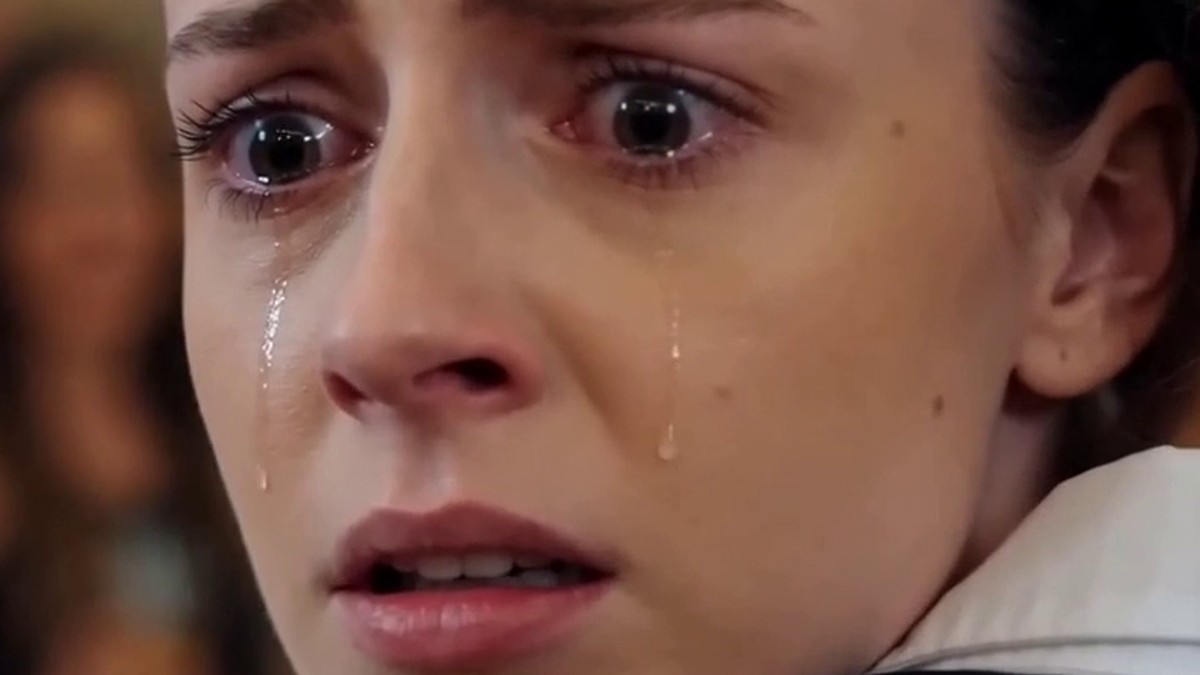
Tears broke across her face without warning.
On the other side of the room, the billionaire stood motionless.
He forgot how to breathe.
He forgot where he was.
Because the face staring back at him — trembling, tear-streaked, desperate — was a face he had last seen in a coffin.
His wife’s face.
The woman he had loved completely.
The woman he had mourned for two years.
The woman whose grave he had stood beside, his daughter’s small hand inside his, believing it was over.
The color left the future bride’s face all at once.
Guests leaned toward each other, whispering, uneasy.
Something in the room had broken. Everyone felt it.
Then the little girl lifted her head and found her father’s eyes across the crowd.
Tears were still falling.
Her voice was soft. Bewildered. Completely sincere.
“Daddy… why is everybody calling Mommy the maid?”
The room stopped breathing.
The woman in uniform dropped her gaze to the floor.
The bride-to-be took one unsteady step backward.
And for the first time all evening, something moved across her face that had nothing to do with happiness.
It was fear.
Raw. Unmistakable. Fear.
Because if the child was right — if that woman was who she appeared to be — then a lie had been living inside this family for two years.
A lie someone had carefully maintained.
A lie someone in that glittering, champagne-soaked room had known about all along.
And now a four-year-old girl had just burned it to the ground with a single word.
The billionaire moved first.
Not toward the woman in uniform.
Not toward his daughter.
Toward his fiancée.
He crossed the distance between them in five long strides, and when he got close enough to see her face clearly — really see it — something locked into place behind his eyes.
A cold, terrible certainty.
“Elena.”
His voice was barely above a whisper, but the room swallowed every other sound to make room for it.
“What do you know about this?”
Elena Vasquez had been the most composed woman in any room she’d ever entered. It was her gift, her armor, the thing men mistook for grace. She wore stillness the way other women wore jewelry.
But her stillness had cracked.
“Marcus, you’re upset—”
“Don’t.” The word landed like a door slamming. “Don’t do that right now.”
His eyes were still on her face. Reading it. The way a man reads a document he’s been handed and slowly realizes every number in it is wrong.
She looked away first.
That was all he needed.
He turned toward the back of the room.
—
The guests parted for him without being asked.
Something in the way he moved — not angry, not grieving, just *decided* — made people step aside instinctively. Champagne flutes lowered. Smiles dissolved.
His daughter was still wrapped around the woman’s waist.
The woman in uniform hadn’t moved. Hadn’t run. She stood in the wreckage of the dropped tray, silver handles and crystal scattered across the marble, and she kept her face turned down and her arms very carefully at her sides. Like someone who had practiced not reaching back. Like someone who had learned, the hard way, what it cost to reach.
Marcus stopped three feet away.
The distance felt enormous.
“Look at me,” he said quietly.
She didn’t.
“Vivienne.”
Her name. Her real name. The one he hadn’t spoken in two years because speaking it felt like reopening the wound by hand.
Her chin lifted.
And there she was.
Thinner than he remembered. A scar along her jaw that hadn’t been there before. Her hair pulled back severely, no jewelry, no softness, nothing that might catch the light and make someone look twice. She had made herself invisible. She had worked very hard at it.
But her eyes.
He had forgotten nothing about her eyes.
“Marcus.” Her voice was barely sound. “Please don’t make a scene.”
“A *scene*.” He exhaled — something between a laugh and something that wasn’t a laugh at all. “My daughter just recognized her dead mother at my engagement party, and you’re asking me not to make a scene.”
“I can explain—”
“You’re going to.” He looked at their daughter, still pressed against Vivienne’s side, gripping the cheap polyester uniform with both fists. A four-year-old who had trusted her own eyes when every adult in her life had told her a different story. “But not here.”
—
They used his study.
His assistant cleared the room in under two minutes. The nanny took Sophie — still tearful, still clinging, finally coaxed away with a whispered promise that Mommy wasn’t leaving, wasn’t going anywhere, that everything was going to be okay, *sweetheart, I promise* — and the door closed behind them.
Three people remained.
Marcus, standing by the window with his back to the room.
Elena, near the door, very straight, very still.
Vivienne, in the chair across from his desk, her hands folded in her lap like she was waiting to be sentenced.
Maybe she was.
The silence lasted long enough that it became its own kind of pressure.
Then Marcus turned around.
“The accident.” His voice was controlled with effort. “They told me you didn’t survive. There was an identification—”
“There was.” Vivienne’s voice was steady now. The composure of someone who had rehearsed this moment and still found it unbearable. “Someone else died in that car. The identification was…” She stopped. Pressed her hands flat against her thighs. “It was arranged.”
“*Arranged.*”
“Marcus—”
“By whom?”
Silence.
He looked at Elena.
She didn’t move. Didn’t deny it. Didn’t reach for the performance that had gotten her through every other difficult moment in her elegant, calculated life.
Because there was nowhere left to go with it.
“How long,” Marcus said, “have you known she was alive?”
Elena lifted her chin. The old composure settling back into place, but different now — brittle, transparent, like glass you could see the cracks in. “I found out eight months ago.”
“Eight months.” He repeated it slowly, turning the number over. Feeling the weight of it. Eight months ago, he had still been grieving. Eight months ago, Elena had moved from friend to something closer, her hand on his arm at dinners, her voice soft and reasonable in his ear, *you can’t be alone forever, Marcus, Sophie needs a mother, you need to start again—*
“You knew she was alive,” he said. “You knew. And you said nothing. You let me believe—” His voice fractured on the last word. He stopped. Let the silence rebuild itself. “You let my daughter believe her mother was dead.”
“She *was* dead.” Elena’s composure broke open on that word, and what came out wasn’t cold — it was hot, desperate, something she’d been keeping sealed for a very long time. “To you. To this family. She chose to leave, Marcus. Whatever her reasons—”
“They weren’t your reasons to keep from me.”
“She was gone—”
“She’s *here*.” He crossed to his desk, put both hands on the surface, leaned forward until he was close enough that Elena had to hold her ground to stay in the room with him. “She is standing forty feet from this office in a maid’s uniform at my engagement party, and my daughter recognized her in five seconds. *Five seconds*, Elena. How long did you think this could last?”
Elena closed her eyes.
When she opened them, the fight had gone out of them.
“I loved you,” she said quietly. It wasn’t a defense. It was just a fact, said by someone who finally understood that a fact can be true and not change anything at all. “I genuinely loved you. I thought if she stayed gone—”
“Get out.”
She absorbed that.
Then she picked up her clutch from the side table, smoothed the front of her dress with both hands, and walked out of the study without another word.
The door clicked shut behind her.
—
The silence that followed was a different kind.
Softer. Heavier. Full of everything that hadn’t been said yet.
Marcus stood behind his desk.
Vivienne sat in the chair, her hands still folded, looking at a point on the floor somewhere between them.
“Why?” he asked at last.
She didn’t misunderstand the question.
“The accident wasn’t an accident.” She said it plainly, the way you say something you’ve said many times in your own head and learned to carry without flinching. “Someone tried to kill me. I didn’t know who. I didn’t know how close they were to us — to *you*. And Sophie—” Her voice dipped on their daughter’s name, the only place where her steadiness failed. “She was three years old and she was in the house and I didn’t know who I could trust.”
“You could have trusted me.”
“I know that now.”
“You should have known it then.”
“Yes.” Simple. Absolute. No argument. “I should have.”
He moved around the desk.
Not quickly. The way a person moves when they’re not sure their legs will do what they’re told, when the ground beneath them has shifted too many times in one evening to feel solid anymore.
He stopped in front of her chair.
She looked up at him.
Two years of grief. Two years of telling his daughter that Mommy was in the stars, Mommy is watching you, Mommy loves you even from far away. Two years of standing at a grave that was someone else’s, letting himself believe in an ending that was never real.
He didn’t know what he felt.
He knew what he saw.
The scar along her jaw. The cheap uniform. The deliberate plainness of someone who had spent two years making herself small so no one would notice her, while also — *while also* — finding her way back into his house, into his life, close enough to see their daughter grow, even if she couldn’t hold her.
“You got a job here,” he said slowly. “You came back here. You took a job as a maid in my house.”
“I needed to see that she was okay.” Her voice was very quiet. “I told myself it would only be a few weeks. Just to see. Just to make sure she was—” She stopped.
“And then you couldn’t leave.”
She didn’t answer.
She didn’t have to.
Marcus crouched down in front of the chair until they were level, until he could see her face the way he’d memorized it a long time ago, in a life that had felt, for two years, like it belonged to someone else.
“The person who tried to kill you,” he said. “Did you find out who it was?”
“Eventually.”
“Are they handled?”
Something moved across her face. “Yes.”
He held her gaze for a long moment, reading what was behind it. Then he nodded. Just once.
He reached out and took her hands — still folded, still careful — and uncurled them gently, the way you unfold something fragile.
“I have to cancel an engagement,” he said.
“Marcus—”
“I have to cancel an engagement,” he repeated, steady, “and then I am going to go get our daughter. And she is going to want to sleep between us tonight, and probably for several nights after that.” He paused. “Is that going to be a problem for you?”
Vivienne looked at him for a long, long moment.
For the first time that evening, she wasn’t bracing for impact.
“No,” she said. “That’s not going to be a problem.”
—
Sophie fell asleep between them just before midnight.
One hand fisted in her mother’s hair.
The other wrapped around her father’s wrist.
Her breathing evened out slowly, the shuddering hiccups of too much crying fading into something quiet and deep and safe.
Marcus lay in the dark and looked at the ceiling.
Vivienne lay very still on the other side of their daughter, her eyes open, watching the window.
“There’s a lot to figure out,” he said.
“I know.”
“It won’t be simple.”
“I know that too.”
A long silence. The good kind, now. The kind that holds instead of presses.
“You should have told me,” he said again.
“I know.” She turned her head and looked across the small sleeping body between them. “I’m going to spend a long time making up for that.”
He looked at her.
“Yeah,” he said quietly. “You are.”
But the way he said it — the warmth just under the surface of it, rough and imperfect and real — sounded less like a sentence and more like a beginning.
Outside, the last of the party guests filtered into the night.
The chandeliers went dark.
The champagne went flat.
And in an upstairs room, a family that had been broken in pieces for two years lay together in the quiet, held in place by a four-year-old girl who had refused to let a single word — *maid*, *gone*, *dead* — mean more than what her own heart already knew.
Her mother had come back.
That was enough.
That was everything.