Business travelers. Tourists. Hotel staff threading between guests like they’d done a thousand times before.
Then it all went still.
An eighty-one-year-old woman reached out and seized a waitress by the wrist — and held on.
“Help me.”
Two words. Barely a whisper.
But the terror underneath them killed every conversation in the room.
Clara dropped to her knees without thinking. She didn’t ask permission. She just went down to the woman’s level and stayed there.
The woman’s sons moved in fast. Too fast.
“She doesn’t understand what she’s saying,” one of them said. His voice was smooth. Practiced.
The old woman turned her head slowly and looked straight at him.
“Yes. I do.”
Tears broke loose and tracked down her face.
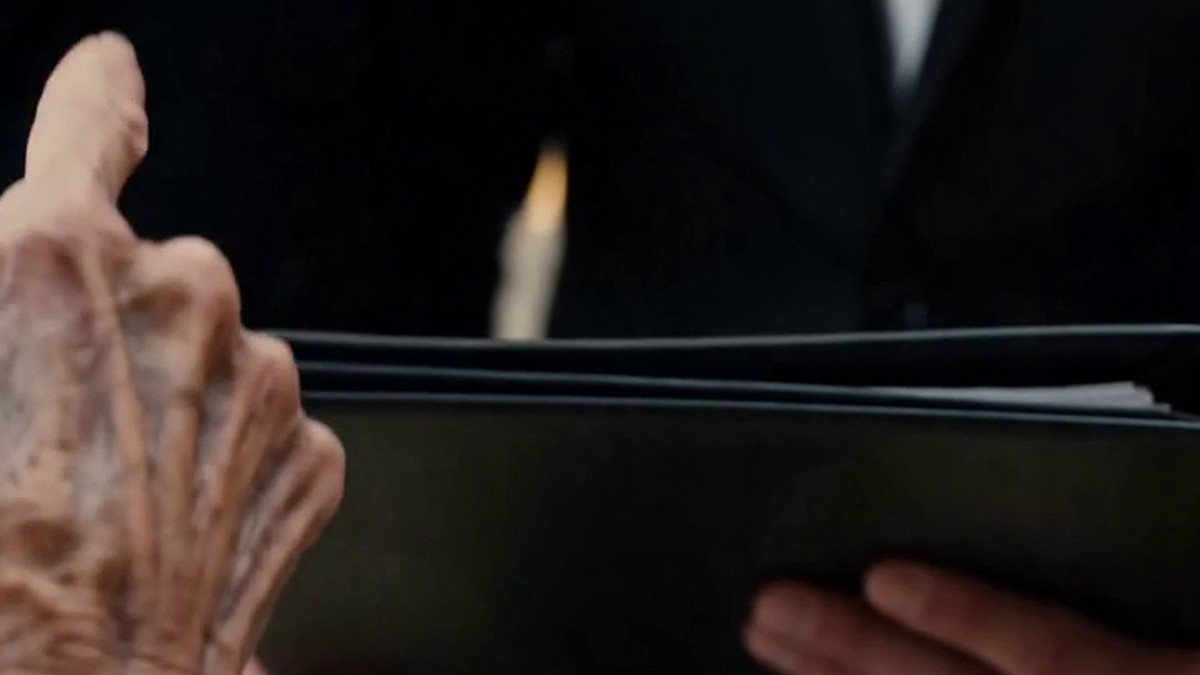
Near the elevator bank, an attorney shifted his weight and suddenly found the thick folder tucked under his arm extremely interesting. He studied it like it contained the secrets of the universe.
Clara watched him. So did the hotel manager.
The woman lifted one trembling hand and pointed at those documents.
“They want my signature.”
Silence pressed down on the room like a physical thing.
Clara didn’t move. Didn’t flinch. Didn’t let the sons crowd any closer.
Some time passed.
Eventually, the old woman was settled near a window — blanket across her shoulders, late light falling soft on her face. The sons had retreated to the far end of the lobby, heads bent together, voices sharp and low. The attorney stood alone, saying nothing.
Then the woman opened her purse.
Slowly. Deliberately. The way you handle something you’ve carried a long time.
She pulled out a folded piece of paper. The creases were deep. The edges worn. This note had been opened and refolded more times than anyone could count.
She pressed it into Clara’s hands.
Her eyes filled all the way up.
“I wrote this before I left home this morning.”
Clara looked down. On the front of the envelope, in handwriting that trembled but did not waver, were a few words.
And when she read them —
she understood.
This was never just about a house.
👇 Full story in the first 𝘾𝙊𝙈𝙈𝙀𝙉𝙏𝙎. 👇
The envelope read: *If something happens to me today, please call this number. I am not confused. I am afraid.*
Clara’s throat closed.
She looked up at the woman — really looked at her. The careful hair. The good coat, slightly too warm for the season, like she’d dressed deliberately that morning. Like she’d known she might need to look credible. Like she’d planned for someone not to believe her.
“What’s your name?” Clara asked.
“Evelyn.” A breath. “Evelyn Marsh.”
“Evelyn.” Clara folded her hands over the note. “I’m not going anywhere.”
—
The older son crossed the lobby in long strides.
He was perhaps fifty-five. Silver at the temples. The kind of tan you get from a boat, not a yard. He smiled the way men smile when they’ve spent decades being told their smile works.
“I apologize for this.” He addressed Clara like Evelyn wasn’t sitting three feet away. “She has episodes. The doctors have documented it. We’re just trying to get her home safely.”
“Episodes,” Evelyn repeated quietly.
She didn’t say it bitterly. She said it the way you repeat a word in a foreign language — carefully, to make sure you’ve heard it right.
The hotel manager, a compact woman named Diane who’d run this lobby for eleven years and seen most of what a lobby can show you, stepped closer. Not in front of Clara. Beside her.
That mattered.
The second son appeared at the edge of the group. Younger. Less polished. His eyes moved constantly — to the door, to the attorney, to his phone — and never once to his mother’s face.
The attorney hadn’t moved. He was still holding that folder with both hands like it might float away if he loosened his grip.
Clara stood up slowly.
“Evelyn.” She kept her voice even, unhurried. “Is there someone I can call for you?”
The older son exhaled. “There’s really no need to —”
“I wasn’t talking to you.”
The lobby went quiet again.
Evelyn reached into her purse a second time. Her movements were deliberate, almost ceremonial. She produced a phone — small, old, the kind with large buttons — and found a contact without hesitating.
“Margaret,” she said. “My daughter. They told me she couldn’t come today.” A pause weighted with something ancient and heavy. “They told me she didn’t want to.”
Clara took the phone.
—
Margaret answered on the second ring.
She’d been waiting, it turned out, for six hours.
She’d been told the signing was at a different hotel. A different city. She’d driven two hours in the wrong direction before something made her pull over and call a number she’d written on a Post-it and stuck to her dashboard three weeks ago — the number of an elder law attorney, a woman she’d found at the bottom of a very long internet search at two in the morning, afraid for her mother and not yet sure why.
“Is she safe?” Margaret’s voice cracked straight down the middle.
“She’s safe,” Clara said. “She’s here. She’s asking for you.”
The sound that came through the phone then was not quite a word.
Clara carried the phone to Evelyn and pressed it into her hands.
What passed between them in the next thirty seconds was private. But Evelyn’s spine, which had been curved inward all afternoon like something bracing for impact, slowly straightened.
—
The older son tried twice more.
Once to suggest that Clara was interfering in a family matter. Once to remind Diane — with a smile thinning toward something else entirely — that his family were loyal guests, long-standing, that this kind of scene was not good for anyone.
Diane looked at him for a moment.
“I’ll keep that in mind,” she said.
And did not move.
The attorney finally spoke. His voice was smaller than Clara expected. He was perhaps forty, with the look of a man who’d talked himself into something gradually, one small step at a time, until he’d looked up and found himself somewhere he didn’t recognize.
“I didn’t know,” he said. Not to the sons. Not to Diane. To the floor, mostly. “I was told she was fully —” He stopped. Restarted. “I was told this was straightforward.”
No one answered him.
He set the folder down on a side table. Carefully. Like setting down something that had gotten very heavy.
He didn’t pick it up again.
—
Margaret arrived at seven forty-three.
She was still in her coat when she came through the revolving door, still scanning the lobby with that particular frantic focus of someone who has been frightened a long time and is only now allowing themselves to feel it.
Evelyn raised one hand.
Margaret crossed the room in seconds and went down to her knees — exactly the way Clara had, earlier, without thinking, because sometimes a person’s body knows before their mind does that this is where they need to be.
They held each other without speaking.
The older son started to say something. Margaret looked up at him over her mother’s shoulder, and whatever was in her face made him stop.
The younger son was already at the door.
—
Later — much later, after statements had been given, after Margaret’s attorney had made several phone calls, after the unsigned folder had been photographed by three different people and the elder law attorney had sat down with Evelyn for a quiet, careful hour — Clara slipped back to work.
The lobby had resumed its ordinary hum.
Business travelers. Tourists. Hotel staff threading between guests.
Diane appeared at Clara’s elbow and handed her a glass of water without comment.
Clara drank it.
“She knew,” Clara said after a moment. “She planned the whole thing. She knew exactly where she was and exactly what she was doing.”
“Yes,” Diane said.
“They were counting on no one listening.”
Diane looked across the lobby — at the empty chair by the window, the folded blanket, the late light that had shifted now to something dimmer and cooler.
“Most of the time,” she said, “they’re right.”
—
Evelyn sent a note two weeks later.
A handwritten card — the same deliberate, trembling script from the envelope. Three lines.
*You stayed on the ground with me.*
*That was the whole thing.*
*That was everything.*
Clara read it twice. Then she folded it along its crease and put it in her coat pocket, the inside one, close.
Some things you carry.