Nathaniel Whitmore was three floors up, in the wood-paneled study, trying to end a grinding phone call with board members demanding his presence in Chicago by sunrise. The scream was a woman’s — sharp, compressed, over almost before it began. Not the sound of surprise. The sound of a body recognizing mortal danger a half-second before the mind catches up.
He let the phone fall without a word.
By the time he reached the landing, the silence that replaced the scream was somehow worse. No footsteps scrambling. No voices calling out. Nothing but the soft drone of the heating system and, drifting up from the entrance hall far below, the patient ticking of the grandfather clock.
Then he looked down.
His mother was at the foot of the marble staircase.
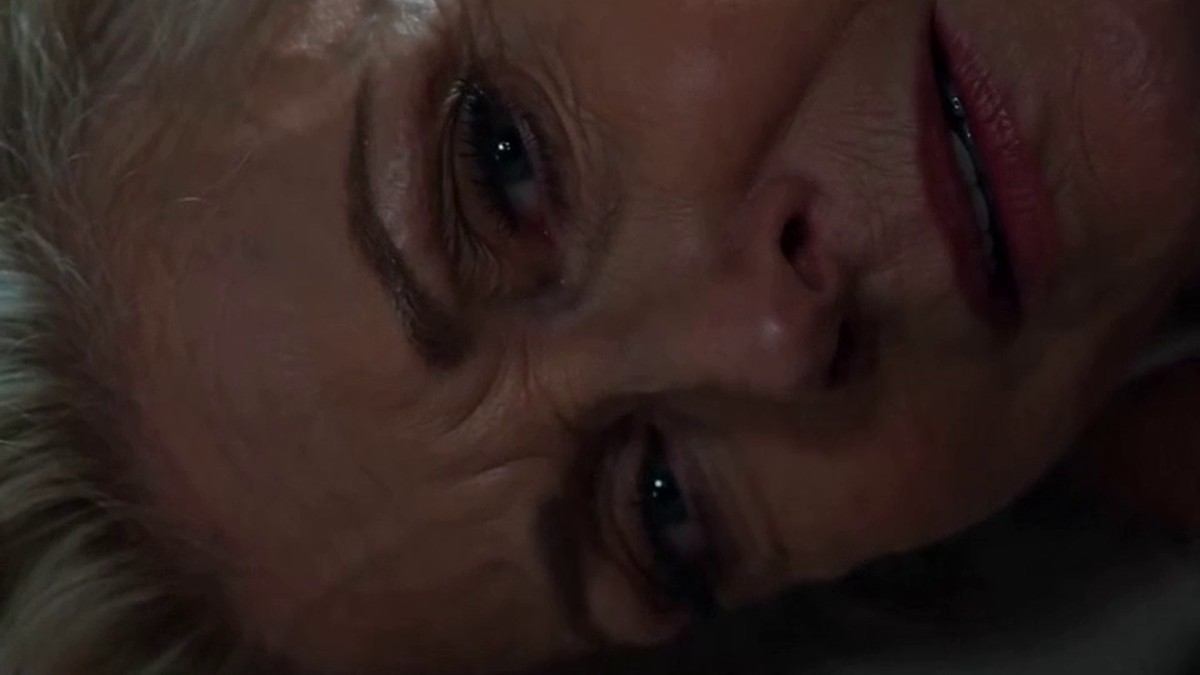
Margaret Whitmore — sixty-four years old, proud as a courthouse and considerably more intimidating — lay collapsed against the lowest step, one hand twisted at an angle that made his stomach drop. Her silver hair had broken free from its tight knot. Her cane lay three steps above her, tilted sideways as though it had been swept out of reach. One slipper sat abandoned on the marble. Her eyes were open, glassy, and burning with something that had nothing to do with pain.
At the top of the stairs stood Vivien Cole. Nathaniel’s fiancée.
Her hand was pressed flat against her mouth. Her blue eyes were stretched wide. The diamond on her ring finger caught the chandelier light and held it, impossibly steady in a room that felt like it was coming apart.
“She fell,” Vivien breathed. “Nathaniel — she just fell.”
He didn’t respond. He took the stairs two at a time, his dress shoes sliding on the polished marble, his pulse hammering so hard in his throat that for one nauseating moment the world went muffled around him.
“Mother.” He dropped to his knees beside her. “Don’t move. Look at me.”
Margaret turned her head, just slightly. Pain crossed her face like weather — and behind it, something harder. Something older.
Rage.
“I didn’t fall,” she said.
Three words. Barely above a whisper. Carved in granite.
Then her eyes closed.
Vivien was crying before the ambulance arrived. She cried the way certain people cry in front of cameras — beautifully, almost without sound, one hand trembling at her lips, the other pressed against her sternum as though sorrow had left a physical wound there. She told the paramedics she had been walking directly behind Margaret. She said the cane had slipped. She said she had lunged to catch her but there simply hadn’t been time.
“She’s always been so stubborn about that cane,” Vivien said, voice fracturing on cue. “I begged Nathaniel to have handrails installed. She refuses to hear it.”
Nathaniel absorbed every syllable as if receiving it through water.
His mother was conscious again by the time they loaded her onto the stretcher. Her jaw was locked. Her eyes found his across the room.
“I didn’t fall,” she said again.
This time, Vivien’s crying stopped.
Not for long. Half a breath. A blink arriving a beat too late. Then the tears resumed, fluid and seamless as rain sliding down glass.
Nathaniel saw it.
At the hospital, the doctors used the word lucky with the quiet confidence of men who dealt in worse outcomes daily. Fractured wrist. Two bruised ribs. A hairline fracture at the hip. No cranial bleeding. No spinal damage. Painful and serious, they said — but survivable.
Lucky.
Nathaniel had built one of the most formidable private logistics companies on the Eastern Seaboard by treating luck as a fiction. What other people called luck, he called an unexamined pattern. He believed in timing, in motive, in the geometry of risk and consequence. Luck was the story you told when you hadn’t done the work of paying attention.
But sitting beside his mother’s hospital bed as the clock pushed past four in the morning, the word kept circling him like something that wouldn’t land.
Lucky she survived the fall.
Lucky the damage wasn’t worse.
Lucky his fiancée had been standing right there.
Or not lucky at all.
The thought arrived so coldly, so cleanly, that the shame of it was almost physical.
Vivien had been in his life for three years. She was twenty-nine, polished, composed, and socially precise in ways that had once felt like shelter. She knew every birthday, every name, every dietary restriction, every investor’s wife, every charity Margaret openly despised and every one she quietly funded. She knew the exact bourbon his late father had kept behind the library’s false panel. She never raised her voice. She never miscalculated a room. She understood his schedule, his silences, and the particular weight of loneliness that settles on men who inherit power before they’ve finished growing into themselves.
Nathaniel had not fallen for her quickly. He didn’t move quickly on anything unless money or blood demanded it. But over time he had let himself believe something — two things, really. That Vivien loved him. And, more dangerously, that she loved the life surrounding him without needing to absorb it entirely.
He drove back to the estate at dawn.
The Whitmore property spread across twelve acres on the edge of Greenwich — white stone, black shutters, a winter-gray lawn that rolled away toward bare treelines. The house was too large for three people and too old for real comfort. Margaret called its drafts and creaking character. Nathaniel called it an infrastructure problem. Vivien called it romantic.
That morning, it felt like a place where something had been done and not yet named.
Vivien was in the kitchen when he walked in. Cream sweater, hair combed smooth, untouched coffee cooling in front of her. She rose the instant she saw him.
“How is she?”
“Stable,” he said. “She’ll be there for several days at minimum. They want to monitor the hip.”
Vivien exhaled — relief performed precisely at the right volume. “Thank God.” She moved toward him. “You must be exhausted. Come sit. Let me make you something.”
“I’m fine.”
He wasn’t fine. He was watching her the way he watched prospectus documents when something in the numbers had decided to lie quietly and wait.
“Vivien.” He set his keys on the counter. A small sound. Very deliberate. “Walk me through last night again.”
Something changed in her face. Not much. A recalibration so minimal most people wouldn’t have caught it. Vivien was good. She was, he was beginning to understand, exceptionally good.
“I already told the paramedics everything,” she said softly.
“Tell me.”
She did. The account was identical to the one she had given four hours earlier. Every inflection in the same place. Every hesitation landed exactly where it had landed the first time. It was, he realized, the account of someone who had rehearsed it — not in the hours since the fall, but before it.
He didn’t say this.
He thanked her and went upstairs.
—
Three days. That was how long Margaret Whitmore spent in Greenwich Hospital before she was transferred home with a physiotherapist, a night nurse, and a fury so concentrated it seemed to raise the ambient temperature of whatever room she occupied.
She waited until the nurse had gone down the hall before she looked at Nathaniel with the directness she’d always deployed like a scalpel.
“Sit down,” she said. “And close the door.”
He did both.
“I have been thinking about how to tell you this for six months,” Margaret said. “I put it off because I was afraid of what you’d think of me for knowing and saying nothing. And then that woman put her hand between my shoulder blades and pushed, and I decided my pride could go to hell.”
The room was very still.
“She pushed you,” Nathaniel said.
“With three fingers. Small push. Efficient.” Margaret’s good hand lay flat on the blanket. “She knew exactly what she was doing, Nathaniel. You don’t give someone a small push unless you’ve calculated precisely how small it needs to be.”
He said nothing. Somewhere in the hallway the physiotherapist laughed at something on her phone.
“Six months ago,” Margaret continued, “I asked my attorney to begin a quiet review of the estate’s asset structure. Nothing alarming — I simply wanted to understand how the charitable trust operated in the event of my death and yours. Within a week, Charles called me.”
Charles Alderton. Margaret’s attorney for thirty-one years. A man who treated information like nitroglycerin — carefully, slowly, and never near an open flame.
“He had been approached,” Margaret said. “Informally. Someone wanted to understand, also informally, the precise sequence of inheritance should both of us die without a surviving spouse. What would happen to the company, the property, and the liquid holdings.”
“Who approached him?”
Margaret looked at him with the patience of someone who had already absorbed the worst part.
“A man named Reston. Geoffrey Reston. He told Charles he represented a private investment group exploring estate structures in the region. Charles did not believe him for eleven seconds and spent the next three months finding out who he actually represented.”
Nathaniel recognized the name the way you recognize something you’ve seen from a distance but never wanted to approach. Geoffrey Reston operated in the tertiary margins of very large money. He was the kind of man who appeared in rooms only briefly and whose name turned up later in the documentation of things that had gone quietly, irreversibly wrong.
“Vivien,” Nathaniel said.
“The connection is not direct. It is never direct with people like that. But it is there, and Charles has documented it.” Margaret paused. “There is also the matter of the life insurance policy.”
He went still.
“Three months after your engagement, a policy was taken out on your life. Two million dollars. The beneficiary designation is a holding company registered in Delaware.” Her voice didn’t waver. “The holding company has one director.”
“Tell me the name.”
“Vivien Cole.”
—
He didn’t go back to the main house immediately.
He stood in the frost-stiff garden at the side of the property for a long time, hands in his coat pockets, watching his breath disappear into the gray winter air. His mind was doing what it always did with consequential information — not reacting, but mapping. Laying it flat. Tracing the geometry.
Three years.
She had spent three years in this house. At his table. In his bed. Learning every room, every trust document, every frailty. His mother’s stubborn hip, which everyone knew gave her trouble on stairs. The grandfather clock’s tick in the entrance hall, which meant you could hear it throughout the house and could also gauge, by its absence, how far from the hall you were. The servants’ Tuesday evenings off, which left the estate down to three people after seven o’clock.
She had been efficient.
She had been, he thought, extraordinary.
And it was that — the cold, almost architectural precision of it — that finally cracked something open in his chest. Not betrayal, exactly. Not yet. Something older and quieter. The recognition of having been studied.
He went inside.
Vivien was in the sitting room. She had the particular self-possession of someone who had decided that looking comfortable was itself a form of control. She’d changed into a dark cashmere dress. A glass of wine sat half-finished on the side table. She looked up at him with eyes that were warm and attentive and absolutely unreadable.
“How is she?” she asked.
“Telling stories,” he said. He took off his coat and sat down across from her — not beside her, as he usually would. Across. The width of the coffee table between them. “You know how she is.”
Vivien smiled faintly. “I know exactly how she is.”
The sentence settled into the room and neither of them moved.
Nathaniel looked at the ring on her finger. He had spent four months choosing that ring. He had spent thirty years building everything it represented access to.
“Geoffrey Reston called me this afternoon,” he said.
He had not spoken to Geoffrey Reston. He had not spoken to anyone since leaving his mother’s room. But he needed to watch what happened to Vivien’s face when she heard the name in his voice, and so he threw it like a stone into still water and watched the surface.
What he saw was not panic. Panic was for amateurs.
What he saw was a blink — one single blink arriving a quarter-second late — and then the resumption of perfect stillness.
There it was.
“I don’t think I know him,” she said.
“No,” Nathaniel agreed. “I didn’t think you would.”
He stood. He crossed the room to the window. Outside, the lawn had gone silver-gray in the early dark, the bare treeline black against a sky the color of old iron.
“I want you to listen to me carefully,” he said, without turning around. “Because I’m only going to say this once, and I’d like us to be honest with each other for the first time, if that’s possible.”
Silence behind him. Then the small sound of a wine glass being set down.
“I know about the policy,” he said. “I know about Reston. I know about the Delaware company. And I know what my mother said to you at the top of those stairs — because she told me what she told you, three seconds before you put your hand on her back.”
The silence extended.
“You have two choices,” Nathaniel said. “The first one ends with Charles Alderton walking a completed criminal referral across a desk tomorrow morning. The second one ends with you leaving this house tonight with your things and a signed agreement that is, given the circumstances, far more generous than you deserve. You will not contest it. You will not contact Reston regarding what you know about this family’s affairs. You will be gone, and you will stay gone.”
He turned around.
Vivien was standing. The warmth was gone from her face. What replaced it wasn’t ugliness, exactly — it was precision. The same precision he had mapped in the architecture of three years. She was, stripped of performance, someone who calculated everything and felt very little, and looking at her now was like finally seeing a building’s bare structure after the facade had been removed.
She was, he thought, probably the most dangerous person he had ever let inside his house.
“You’d really choose her over me,” Vivien said. “After everything she’s done to keep you small.”
The observation was offered not as a wound but as a tool — a last lever to try. He recognized it for what it was.
“Yes,” he said simply. “I really would.”
Something flickered across her face. Not hurt. Something more complex — the brief, involuntary surprise of a chess player who had not accounted for a particular move.
Then it was gone.
She picked up her wine glass. Finished what was in it. Set it back down with the same unhurried deliberateness she brought to everything.
“I’ll need an hour,” she said.
“You’ll have it.”
—
She was gone in forty minutes. No drama. No tears — not the real kind, and apparently she had decided the performed kind no longer served. A hired car came to the service entrance. Two bags, both of them packed with a speed and completeness that told him they had been mostly packed for a while — contingency plans, exits pre-mapped. She walked through the kitchen and out into the winter dark without looking back.
Nathaniel watched from the window until the car’s taillights disappeared through the gate.
Then he called Charles Alderton anyway.
Not to retract the agreement. To complete it — to make it binding, documented, and airtight in the way all things concerning this family’s assets needed to be. And to have Reston’s connection to the Delaware company formally on record. Not as a threat. As weight. The kind of weight that reminded men like Reston that quiet problems could become very loud ones if they failed to remain solved.
Charles asked no questions he wasn’t supposed to ask. He had been doing this for thirty-one years.
—
He was at his mother’s door by nine.
She was sitting up in bed, the night nurse dismissed for the moment, a library book open in her lap that she was clearly not reading. She looked up when he knocked.
“She’s gone,” he said.
Margaret studied his face for a long moment with the thoroughness of a woman who had always known her son better than he knew himself and had never once let him off the hook for it.
“How are you?” she asked.
It was not the question he had expected.
He sat in the chair beside her bed — the one that was too small and slightly crooked, the one he had sat in a hundred times since childhood when the world had been too large and this room had been the right size.
“I’m not sure yet,” he said honestly.
Margaret nodded. She reached across and put her hand — the good one, not the bandaged one — over his.
“That’s the right answer,” she said.
Outside, the wind moved through the bare treelines with a sound like the whole winter exhaling. The grandfather clock began to strike the hour somewhere three floors below, each tone carrying cleanly up through the old house and finding them here, in the small room, in the pool of lamplight.
Nine strikes.
Then silence.
The patient, unhurried kind.