His clothes were in pieces. His face was smeared dark with soot. His hands — small, filthy, trembling.
She looked down at the sandwich in her white-gloved fingers.
Then she walked toward him.
“Here. Take it.”
The boy looked up at her the way someone looks at a thing they’ve stopped believing in.
Slowly, carefully, he reached out with both hands.
“Thank you,” he said — barely a sound.
The girl sat down right next to him. Didn’t think twice about the grime on her clean white coat. For one quiet moment, that alley felt like somewhere safe.
Then a voice tore through everything.
“No! Get away from him — now!”
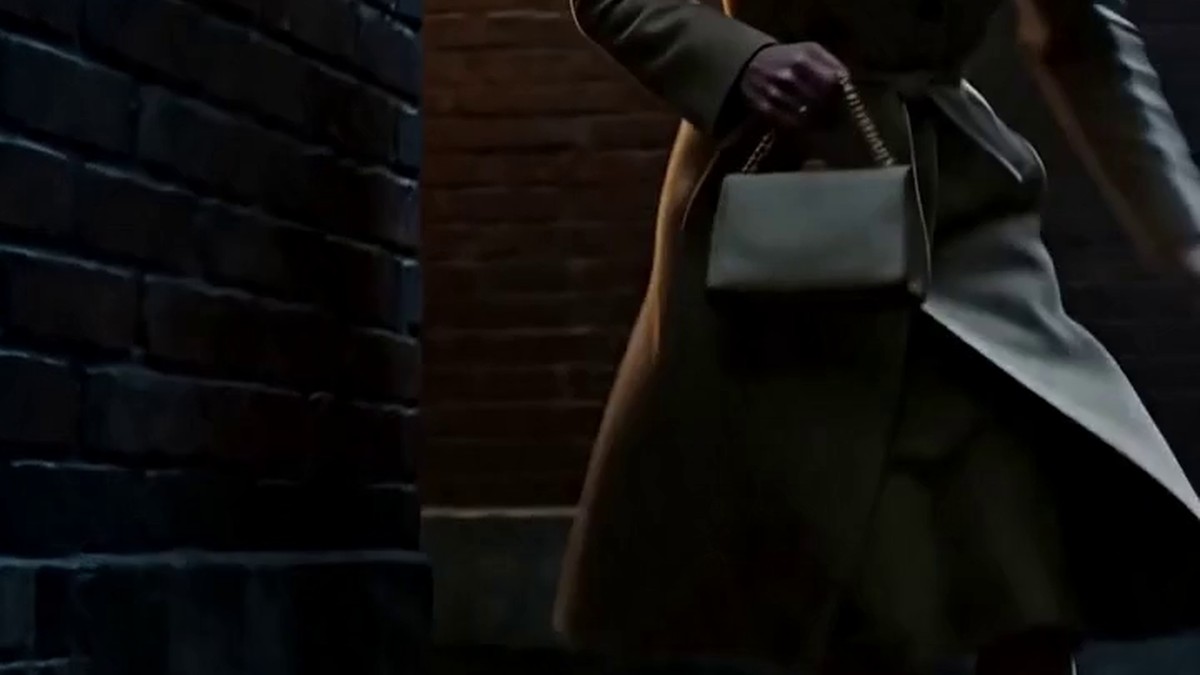
Her mother came flying around the corner, heels cracking against the pavement, her tan trench coat whipping behind her. She seized her daughter by both shoulders and yanked her back hard.
The boy went completely still. Sandwich still in his hands.
“Mom, he’s hungry!” the girl cried out.
Her mother wasn’t hearing it.
She was staring at the boy’s face.
He raised his eyes to hers.
Blue eyes. Steady and lost all at once.
The fury left her — not slowly, but all at once, like something unplugged.
Her handbag dropped from her fingers and hit the pavement.
The boy stared back at her, confused, searching.
Then his lips began to shake.
“Mom?”
The woman’s knees hit the ground.
She didn’t answer him right away.
She couldn’t.
Her hands came up first — reaching, then stopping just short of touching his face, hovering in the cold air like she was afraid he might vanish if she made contact. Like he was a flame she’d been searching for in the dark and now couldn’t trust her own eyes.
“Daniel.” Her voice broke on the single word. Cracked clean through.
The girl in the white coat stood frozen two steps behind her mother, sandwich wrapper crinkling softly in the wind. She was seven years old and she understood nothing and she understood everything.
The boy — Daniel — had gone rigid. His whole body was a held breath.
Three years.
That’s how long his mother had been carrying his school photo in her wallet, the edges worn soft from how many times she’d taken it out. Three years of posters peeling off telephone poles in the rain. Three years of a bedroom kept exactly the way he’d left it, the soccer cleats still caked with mud by the door, because touching them felt like giving up.
Three years since the night he’d walked to the corner store and didn’t come back.
He was eleven then.
He was fourteen now, and he looked forty.
She was in this neighborhood for the same reason she came every Saturday — a coat pocket full of flyers, his school photo reproduced in black and white, the ink starting to bleed at the edges from how many times she’d folded and unfolded them. This street. The one two blocks over. The rail yard on the far end. She’d been working her way outward for months, methodical, refusing to stop.
“Mom.” He said it again, louder this time, like testing whether the word still worked.
She closed the distance between her hands and his face.
The touch unlocked something.
He folded forward into her and made a sound that wasn’t crying and wasn’t anything else with a name — just the sound of something that had been clenched for three years finally, finally letting go. His thin shoulders shook under her arms. The sandwich fell into the dirty snow. Her white-gloved hands pressed the back of his head, holding him the way you hold something you thought the world had swallowed.
“I’ve got you.” She was rocking slightly without knowing it. “I’ve got you. I’ve got you. I’ve got you.”
The little girl sat down on the cold pavement.
Nobody told her to. She just sat, and watched, and said nothing, because some moments are too large for a seven-year-old to stand up inside of.
—
Later — much later — there would be questions.
The police report, the hospital intake, the social worker with the soft voice and the clipboard. Later there would be the story, told in pieces across weeks: the man who had taken him, the warehouse near the rail yard where Daniel had recognized the skyline through a gap in the corrugated wall and understood, for the first time, that he knew roughly where he was. The other boys. The long nights of waiting, of counting footsteps in the dark, of a plan assembled in whispers. The morning one of them worked a rusted door hinge loose and eased it open into gray winter light. Daniel running. Not looking back. Later there would be a court case and a verdict and a sentence and a news segment that lasted four minutes and moved on.
But that was later.
Right now there was only the alley.
A mother on her knees in the grime, holding what she’d lost.
A boy breathing in the smell of her coat — that same perfume, three years later, unchanged — and understanding for the first time that he had actually survived.
And a little girl in a ruined white coat who had given away half her lunch.
After a long while, Daniel pulled back just enough to look at his mother’s face. His blue eyes moved over her the way you re-read a letter you’d memorized by heart.
“You look the same,” he said.
She laughed — a broken, wet, real laugh. “I look terrible.”
“No.” He shook his head once, slow and certain. “You look exactly the same.”
She pressed her forehead to his.
The little girl reached over and picked up the fallen sandwich from the snow. She brushed it off carefully, then set it on Daniel’s knee without a word.
He looked down at it. Then at her.
“What’s your name?” he asked.
“Sophie.”
“Sophie.” He said it like he was committing it. “You sat down next to me.”
She shrugged one small shoulder. “You looked cold.”
His jaw tightened for a second. He nodded.
“Yeah,” he said. “I was.”
His mother made a sound beside him — not quite words. She pulled both of them closer, one arm around her son, one hand finding the top of Sophie’s head, and the three of them sat there in that alley in the gray winter light, strangers and family all at once, while the city moved on loudly around them and none of it touched them.
—
Sophie would grow up.
She’d study social work. She’d drive a beat-up Honda with a cracked dashboard and too many coffee cups in the cupholder. She’d sit across from kids in fluorescent-lit offices and learn how to recognize the way they looked at things they’d stopped believing in.
She’d think about the blue-eyed boy in the alley sometimes. Not every day. But on the days it mattered.
And she’d remember what it felt like to just sit down next to someone.
No hesitation. No calculation.
Just: *you look cold. Here.*
That was the whole thing, really.
That was always the whole thing.