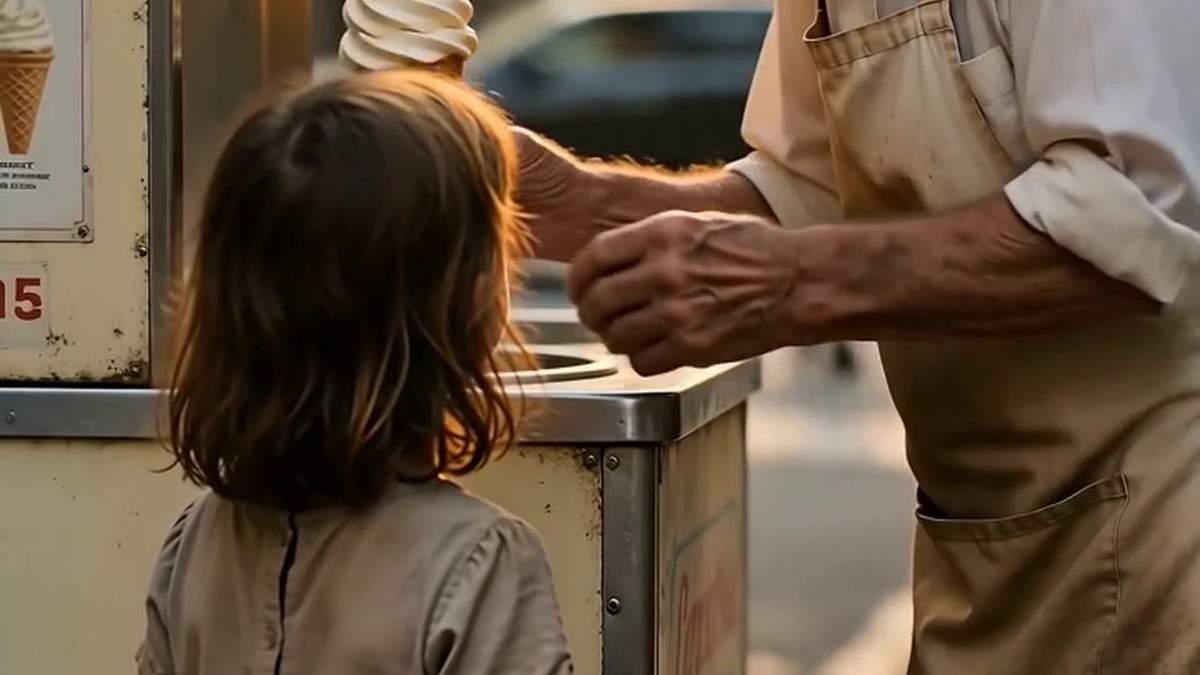
Tears slipped silently down her face as she stood next to an old ice cream cart at the edge of a loud, indifferent street. Cars blurred past. People rushed by with shopping bags and glowing phone screens, sealed inside their own little worlds. And the little girl just stood there — small, hungry, invisible. Her faded clothes drooped off her thin frame. Her eyes stayed locked on the soft-serve machine like it was a star she could see but never touch.
“I want an ice cream,” she whispered.
Almost no one heard her. Those who did looked away. Poverty made people uncomfortable, like it might be catching. She opened her small hand to show what she had — two coins, barely worth anything, resting in her palm like a confession.
Behind the cart stood a young vendor. His apron carried the stains of a long day and his eyes held the weight of someone who’d been on his feet for too many hours. But when he looked at her — really looked — something inside him came undone.
He studied the coins. Then her face, streaked with dried tears. Her voice cracked when she admitted she was still hungry.
Those words didn’t ask for anything. They just landed.
He turned to the machine without a word. The soft whir of vanilla ice cream spiraling into a cone drifted out over the noise of the street. He kept going, building it up and up, until the swirl stood taller than her little fist. Then he knelt down and eased it into her trembling fingers.
She went completely still.
She looked at him like kindness itself had blindsided her — like she’d been bracing for the world to say no and it had said yes instead. A single tear dropped from her chin and landed on the melting ice cream.
“One day I’ll pay you back,” she whispered.
He smiled and told her she didn’t owe him a thing.
She shook her head with a gravity that didn’t belong on a child’s face. A private promise. Then she turned and walked away, holding that cone in both hands like it was something sacred.
—
Years went by. The city shed its skin and grew a new one.
Buildings rose. Old storefronts vanished. Seasons turned over one after another without slowing down for anyone. The ice cream cart aged alongside its owner — paint peeling, wheels worn, paint bleached pale by years of sun and weather. The young vendor was no longer young. He stood at the cart one evening near closing time, counting a thin fistful of coins, shoulders curved inward like a question mark. Business had been gutting him for a while now.
The streetlights blinked on.
That was when the black car appeared.
It glided to the curb and stopped. The kind of car that makes people turn their heads. A driver got out, walked around, and opened the rear door with practiced ease. A woman stepped out — long coat, quiet confidence, the kind of presence that commands a room without demanding it. She looked like someone who had fought hard to get where she was.
But her eyes were already wet before she reached the cart.
The old vendor looked up, expecting a polite transaction. Instead she walked straight toward him, no hesitation, no greeting. She opened her purse and set something on the counter — a small square of folded paper, worn soft at the creases, handled carefully over many years.
He picked it up. Unfolded it slowly.
The handwriting was a child’s — uneven, deliberate, earnest.
*One day I’ll pay you back.*
The street vanished.
He was back there in an instant. A little girl. Two coins. Vanilla ice cream melting in shaking hands. The woman stood across from him with tears streaming freely now, and she told him simply that she had come back.
He looked at her the way you look at something you thought was gone forever. Past the expensive coat and the jewelry and the composed posture, he finally found her — the girl from years ago, still living somewhere behind those eyes.
His knees nearly gave out. He gripped the counter.
She told him he was the first person who had ever treated her like she mattered. Around them the city kept grinding along, oblivious. Neither of them noticed.
She and her mother had gone two days without eating before he handed her that cone. She never forgot it — not because of the ice cream, but because of what it meant. Someone had seen her. Someone had decided she was worth something.
He shook his head and said it was just ice cream.
She shook hers back and said it was hope.
A long, warm silence settled between them.
Then she reached into her bag again. She placed a folded set of documents on the counter.
He stared at them, confused.
She told him they were ownership papers for the vacant shop right next to the cart. She’d bought it that morning. He shouldn’t have to stand outside in the cold anymore. That was what she said. Years ago, he gave a little girl something when every other person in the world looked straight through her. Now it was her turn.
The vendor’s tears came without any effort to stop them.
People had started gathering nearby, drawn to the scene unfolding beside the weathered old cart. The woman stepped around the counter and pulled him into a hug, and he held on. For the first time in a long time, he didn’t look like a man worn down by years of small earnings and cold nights.
He looked like someone who had just been reminded that his life had mattered.
The city lights glowed around them as a promise made by a child was finally, quietly kept.
And somewhere in that warm moment, a question drifted through the night air without asking to be answered:
*How many lives have already been changed by a small act of kindness — without the person who gave it ever knowing?*
The crowd that had gathered didn’t drift away. Not yet.
They stood in a loose, awkward half-circle — a man in a delivery jacket, two teenagers with their phones finally dark in their pockets, an older woman with grocery bags at her feet, a construction worker still dusty from the day. Strangers. The kind who pass each other a thousand times and never once make eye contact. But something had nailed them to that spot, and none of them could quite say what.
Maybe it was the hug. Maybe it was the documents sitting on the counter of a battered ice cream cart like a deed to a second life. Maybe it was just the vendor’s face — open and wrecked and grateful in the way that faces rarely get to be on a public street.
The woman stepped back first. She pressed the back of her hand to her cheek, composed herself the way someone does when they’ve prepared for a moment but still didn’t quite survive it. She looked at the small crowd. She didn’t seem embarrassed. She seemed like someone who had learned, somewhere along the way, that being witnessed wasn’t the same as being exposed.
“He fed me when I had nothing,” she said.
She didn’t raise her voice. She didn’t need to. The street had gone strangely quiet, the way streets sometimes do when something real is happening on them.
“I was seven,” she continued. “My mother was sick. We had left everything we knew to come to this city, and this city had no interest in us whatsoever.”
The vendor was quiet beside her. He had one hand still resting on the counter, steadying himself.
“I stood there—” she nodded toward a spot on the pavement, a few feet from where the cart now sat, “—right there. I had two coins. I was crying. I didn’t even know I was crying.”
The delivery man shifted his weight. The teenagers had stopped looking at each other.
“Every single person who passed me that day looked through me,” she said. “Except him.”
She turned toward the vendor then, and her composure slipped again, just slightly, like a picture frame knocked a half inch out of alignment. Something honest beneath it.
“You looked at me,” she told him. “You actually looked.”
He opened his mouth. Closed it. Tried again.
“I gave you ice cream,” he finally managed. His voice was rough. “It wasn’t — it was just what I had.”
“I know,” she said. “That’s the point.”
—
Later, after the crowd dissolved back into the city’s bloodstream, after the driver had loaded the documents safely into the car and her assistant had texted three times asking about a dinner reservation she had no intention of keeping — they sat on the low concrete step at the base of the vacant shop’s door.
The shop her name was now on the deed of. His shop, as of tomorrow morning.
The vendor held a cup of coffee she’d sent the driver to find. He turned it in both hands without drinking it, watching the steam.
“I thought about you,” he said, “more than you’d think. For a while after, I kept expecting to see you come back around. Then the years got heavy and I figured — ” he stopped. “I figured I’d made it into something bigger in my head than it was.”
“You hadn’t,” she said.
“No.” He looked down the street. “I guess not.”
She had built a company that sourced food — specifically, sustainable food distribution to underserved neighborhoods in four cities. She hadn’t told him that part yet, and she considered not telling him at all. It felt like information that would change the texture of the moment, make it about trajectory instead of truth. But he asked, simply, what she did, and she answered.
He was quiet for a moment.
“The hungry ones,” he said.
“The hungry ones,” she agreed.
He nodded slowly, like something was assembling itself inside him that he didn’t have words for yet.
“My mother used to say—” she paused, turned the thought over. “She used to say that when someone shows you what mercy looks like, you spend the rest of your life trying to remember the shape of it, so you can pass it on the right way.” She looked at him. “I’ve been trying to remember the shape of it for twenty-three years.”
The vendor set the coffee cup down on the step beside him. He pressed his palms flat on his knees.
“Your mother,” he said carefully. “Is she—”
“She’s in the car.” A small smile. “She refused to get out. She said this was mine to do alone.”
He turned to look at the black car, idling twenty feet away. Through the tinted rear window, nothing was visible. But he raised his hand anyway.
A moment passed.
And then, from inside the car, a hand appeared against the glass.
—
He unlocked the vacant shop with the key she’d had made, and they stood together in the empty room.
It smelled of old wood and dust and the ghost of whatever business had lived there last. The floors were scuffed, the walls bare. A single bulb hung from the center of the ceiling and swayed almost imperceptibly in a draft from somewhere.
But it was warm. And it was his.
He walked to the middle of the room and stood there. The woman leaned in the doorway and let him have the silence. Outside, the city moved. Inside, a man stood in the center of his own future and tried to remember how to breathe inside a good thing.
“I don’t know how to accept this,” he said, without turning around.
“You accepted two coins,” she said. “Same principle.”
He laughed. It was sudden and unguarded and it changed his whole face — knocked twenty years off him in an instant. She smiled watching it.
He turned around.
“I’m going to need a bigger machine,” he said. “If I’m going inside.”
“I know a supplier,” she said. “He owes me a favor.”
—
The night finished the way the best nights do — without ceremony, without a clean bow. The driver took her home. The vendor locked up the shop, tucked the key into his front pocket, and pushed his old cart the four blocks home through the cooling dark, the wheels rattling their familiar complaint against the pavement.
But he walked differently.
It wasn’t the shop. It wasn’t the documents or the car or even the hug, though all of it had landed somewhere deep and irrevocable. It was the thing she’d said on the step.
*Someone showed you what mercy looks like, and you spend the rest of your life trying to remember the shape of it.*
He had given a child ice cream because he couldn’t do anything else. Not because he was noble. Not because he had extra. Because she was there and she was hungry and something in him had refused to look away. He hadn’t thought of it as mercy. He hadn’t thought of it as anything except the only available human response to a seven-year-old with two coins and tears on her face.
But it had been a shape. And she had carried it for twenty-three years.
And now she had handed it back to him.
He stopped at the corner where the streetlight buzzed and flickered its age. He looked back down the block at the vacant shop — his shop — dark in the row of lit windows. Just a door, a sign bracket with nothing on it yet, a future waiting to be named.
Tomorrow he would go to the city office. He would file the paperwork. He would stand inside those walls and try to figure out what it meant to begin again at his age, in his body, with his particular collection of worn years.
But tonight, on this corner, under this stuttering light, he let himself feel it without explaining it.
Someone had seen him too.
All those years of early mornings and cold evenings and thin coin-counts at the end of long days — someone had looked at all of it and decided it had amounted to something. Not in spite of its smallness, but because of it.
He reached into his pocket and touched the key.
Then he walked home.
—
Somewhere across the city, in the back of a black car moving through lit streets, a woman sat beside her mother — her mother who had held her hand through the years that nearly broke them both — and didn’t say anything for a long time.
Her mother spoke first.
“Did it feel the way you thought it would?”
She considered the question honestly.
“No,” she said. “It felt better. It felt like something finished.”
Her mother took her hand. Outside, the city scrolled past in its beautiful, brutal, indifferent way — full of people rushing somewhere, sealed inside their own worlds, missing each other completely.
And yet.
And yet there were also moments happening in it right now that neither of them could see. Small moments. A word said softly. A door held open. A meal shared without counting the cost. Actions so minor they wouldn’t survive in any newspaper, wouldn’t trend anywhere, wouldn’t be remembered past Tuesday.
Except by the person they happened to.
Who might carry the shape of them for twenty years.
Who might, on a certain evening on a certain street, hand them back.
The car moved on through the night. The city held its noise and its light and its ten thousand invisible kindnesses, buried like seeds in the concrete, waiting patiently for the ground to soften enough to let them through.