Luggage wheels clattered against polished floors. Gate announcements bounced off high ceilings. Travelers surged forward with their eyes fixed on somewhere else entirely.
And right in the middle of that relentless current…
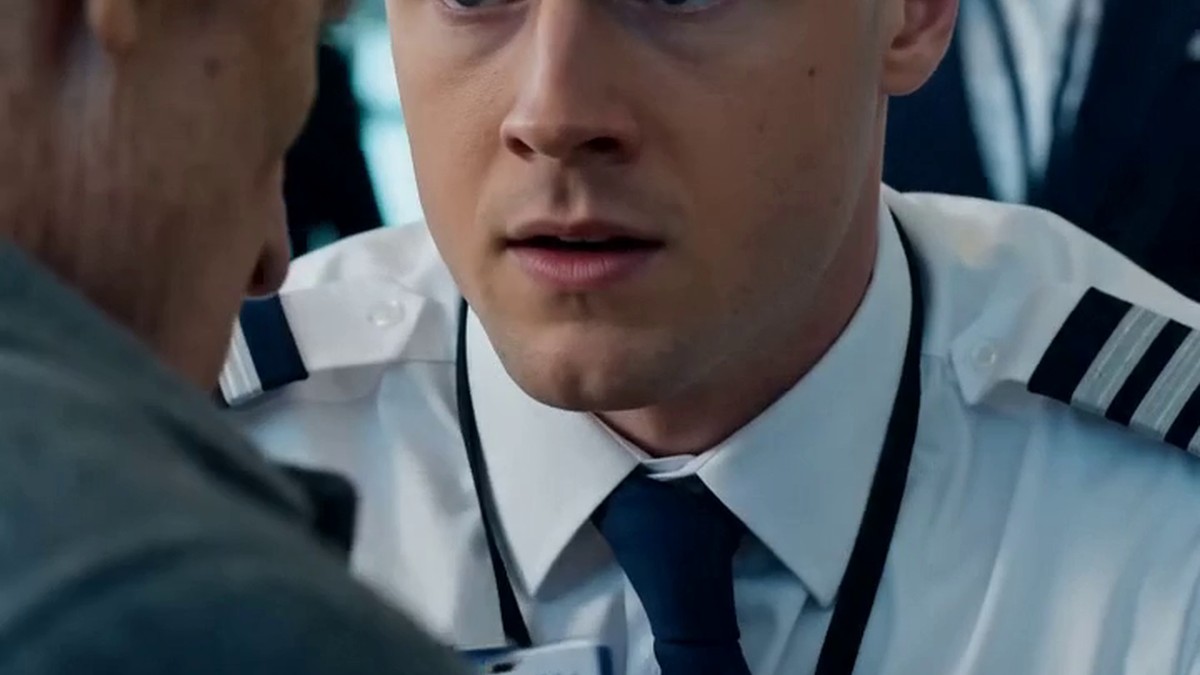
Twenty-year-old Ethan Brooks guided a mop bucket through the corridor near Gate C14. Night shift. Blue uniform worn soft at the elbows. Reflective vest. Work shoes that had already started separating at the soles, like they were tired too.
Passengers moved around him the way water moves around a stone.
They noticed the clean floors.
Never the hands that made them that way.
Then the cough hit him.
Low. Wet. The kind that sounds like it costs something.
Across the waiting area, an elderly man stood alone beside a row of seats, both hands wrapped around a small travel bag like it was the only thing keeping him vertical. He’d opened his wallet. Counted what was inside. Stared toward the terminal with an expression Ethan couldn’t quite name.
Then his legs quit on him.
Ethan didn’t think. He left the mop where it stood and crossed the distance in seconds, catching the man by the shoulders before the floor could.
“Easy, sir. I’ve got you. I’ve got you.”
The old man tried to respond. A second cough swallowed whatever he meant to say.
Ethan looked up. Scanned the crowd.
“Someone — can anyone help here?”
Eyes landed on him briefly.
Then slid away.
An airline employee at a nearby counter suddenly found something important to examine on her screen. A businessman in a gray suit glanced at his watch. The crowd kept its rhythm without missing a beat.
Ethan spotted an empty wheelchair near the passenger assistance desk and broke into a run toward it.
“Ethan.”
One word. Flat and certain.
Supervisor Lisa Turner stood between him and the chair, arms crossed, jaw set.
“He needs help,” Ethan said, already moving around her.
“Passenger assistance handles that.”
“There’s nobody here, Lisa.”
“Then get on the radio and call them.”
“He can’t wait for the radio.”
Her eyes went cold. “That is not your job.”
Ethan glanced back at the old man, still fighting to hold himself upright against the seat’s armrest.
He turned back to Lisa.
“Maybe it should be somebody’s.”
He went around her, grabbed the wheelchair, and rolled it back at a near-jog. He lowered the man into it carefully — both hands steady, no rushing — then pulled a water bottle from his own backpack and pressed it into trembling fingers.
Slowly, breath by breath, the man steadied.
“Thank you, son,” he said quietly. Like the words cost him something to get out.
Lisa appeared at Ethan’s shoulder before he could answer.
“You walked away from your station.”
“He nearly went down face-first.”
“I don’t care. Back to work. Now.”
Ethan didn’t move.
The terminal did something unusual then. It got quiet. Not silent — airports don’t do silent — but a pocket of stillness had formed around them. A handful of passengers stood watching, bags in hand, going nowhere.
Lisa held his stare.
“Do you understand what you’re putting at risk right now?”
Ethan reached up. Unclipped his airport ID badge. Set it down gently on the arm of the wheelchair, right next to the old man’s hand.
Then he looked at her straight.
“If that’s the price for what I just did…”
“…I’ll pay it.”
The old man slowly lifted his eyes. His hand moved to his coat pocket. He drew out his phone, pressed a single contact, and held it to his ear.
He said very little.
But when the call ended, something in the air around him had shifted completely.
The man who’d been trembling in a folding chair thirty seconds ago now carried himself like someone who had never once in his life been powerless.
The old man lowered the phone.
He didn’t look at Lisa first. He looked at Ethan.
“How long have you worked here, son?”
“Two years,” Ethan said. “Tonight might be the last night.”
“What’s your full name?”
Ethan told him.
The old man nodded slowly, as though he was filing it somewhere permanent. Then he turned his gaze — unhurried, weightless, the kind of look that doesn’t need to prove anything — toward Lisa Turner.
“And you are the supervisor.”
It wasn’t a question.
Lisa straightened. Her voice found its professional register. “Sir, I apologize for any inconvenience. Our passenger assistance team will be with you shortly, and I want to assure you that the situation is completely—”
“The situation,” the old man said, “is that I collapsed in this terminal. And the only person in this building who moved toward me instead of away from me was a young man with a mop.”
Silence.
The pocket of stillness around them had grown. Six passengers had become twelve. A woman with a rolling carry-on stood with her hand frozen on the handle. Two teenagers had stopped mid-scroll, phones still in hand but forgotten. Even the gate agent at C14 had drifted three steps forward without seeming to notice she’d done it.
Lisa’s jaw tightened. “Sir, our employee acted outside his designated—”
“Your employee,” the old man said, “acted like a human being.”
He reached into his coat pocket again. Not for the phone this time. He produced a small leather bifold and removed a business card from it with the careful precision of a man whose hands had steadied back into something like certainty. He held it out toward Lisa.
She took it.
Watched her expression change.
It didn’t collapse dramatically. It didn’t need to. It was quieter than that — a slow rearrangement, like furniture being moved in a darkened room. Color drained from just below her cheekbones. Her eyes tracked from the card to the old man’s face and back again, as though one of them might contradict the other.
They didn’t.
The name on the card was Robert Calloway.
Chairman Emeritus, Calloway Aviation Group — the holding company that owned, among other things, this airport’s primary operating contract, two regional carriers, and the janitorial services firm that employed Ethan Brooks on a night shift at Gate C14.
Nobody standing in that terminal needed to know the specifics to feel the shift in gravity.
Robert Calloway rose from the wheelchair.
Slowly. With effort. But under his own power.
“I’ve been traveling through this terminal twice a month for eleven years,” he said, to no one in particular and everyone at once. “I fly commercial. No announcements, no escorts, no fanfare. I like to see how things actually run.”
He adjusted his coat.
“Tonight I learned something.”
He picked up Ethan’s badge from the arm of the wheelchair. Held it for a moment. Then held it out to Ethan.
“This belongs to you.”
Ethan looked at it. Then at the old man. Something moved behind his eyes — not relief exactly. More like the feeling of a breath you’ve been holding without realizing it.
He took the badge.
“Sir, I—”
“Don’t thank me yet.” Calloway almost smiled. Almost. “I have some calls to make that are going to be considerably longer than the last one.”
He looked at Lisa one more time. Not with cruelty. With the specific patience of someone who has already decided what happens next and sees no urgency in announcing it.
“The floors are clean,” he said. “I’ll give you that.”
Then he turned and walked — steadier with every step — toward the far end of the terminal, where a man in a dark suit had appeared from a side corridor and was moving quickly in his direction. Someone from the call, clearly. Someone who’d been in the building the whole time.
Lisa stood motionless.
The badge was back on Ethan’s chest.
She looked at it. Looked at him. The architecture of authority she’d built around herself in the last five minutes had gone quietly structural — all the load-bearing walls suddenly visible because they were the only things still standing.
She opened her mouth.
Then closed it again.
What came out of her, finally, was not an apology — it was something smaller and harder to look at. “You should have called it in, Ethan.” Her voice had lost its edge, but she said it anyway, like a person who needs to hear themselves say a thing one last time before they stop believing it. “That’s all I’m saying.”
Then she picked up her radio, said something clipped and administrative into it, and walked back toward the counter.
Ethan watched her go.
He understood, in the way you understand things about people you’ve worked alongside for two years, that Lisa wasn’t cruel — she was frightened, and frightened people make rules into walls. That didn’t make what she’d done right. It just made it human.
Around him, the terminal exhaled and resumed its motion — luggage wheels, gate announcements, the relentless current of people going somewhere else. The twelve witnesses drifted back into the flow, carrying what they’d seen the way you carry something fragile: carefully, privately, aware of the weight.
The woman with the rolling carry-on caught Ethan’s eye as she passed.
She didn’t say anything.
She didn’t need to.
He stood there alone for a moment beside the empty wheelchair and the water bottle the old man had left behind. He picked it up. Capped it. Tucked it back into his bag.
Then he walked back to his mop.
The floors weren’t going to clean themselves.
But something else had shifted tonight, in the way things shift when one person chooses not to look away — quietly, without announcement, in the middle of a crowd that was looking everywhere else.
Two weeks later, Ethan Brooks received a letter.
Not an email. A letter, on heavy cream stationery, with a return address he recognized immediately.
It told him that a new position had been created within the company’s operations development program — a role focused on frontline service standards, built partly on the argument that the people closest to the work were the ones best positioned to improve it. It told him the salary. It told him the start date.
He read those lines twice. Then sat with the paper in his hands for a long moment, aware of something that wasn’t simple happiness — it was closer to vertigo. Two years of invisible work, and now this. He didn’t know yet whether he was the right person for the job. He didn’t know whether the offer came with strings he hadn’t seen. He knew only that a man he’d never met had collapsed in an airport corridor, and that he’d moved toward him instead of away, and that this — all of this — had followed from that single unremarkable decision.
At the bottom of the letter, in handwriting that belonged to someone who had learned to write before keyboards existed, were eleven words:
*The floors were clean. So was your conscience. — R.C.*
Ethan read it twice at his kitchen table, in the blue pre-dawn light, still in his work clothes from the night shift.
Then he set it down flat.
Looked out the window at the lightening sky.
And for the first time in a long while, he let himself think about what came next — not what he’d been given, but what he intended to do with it.