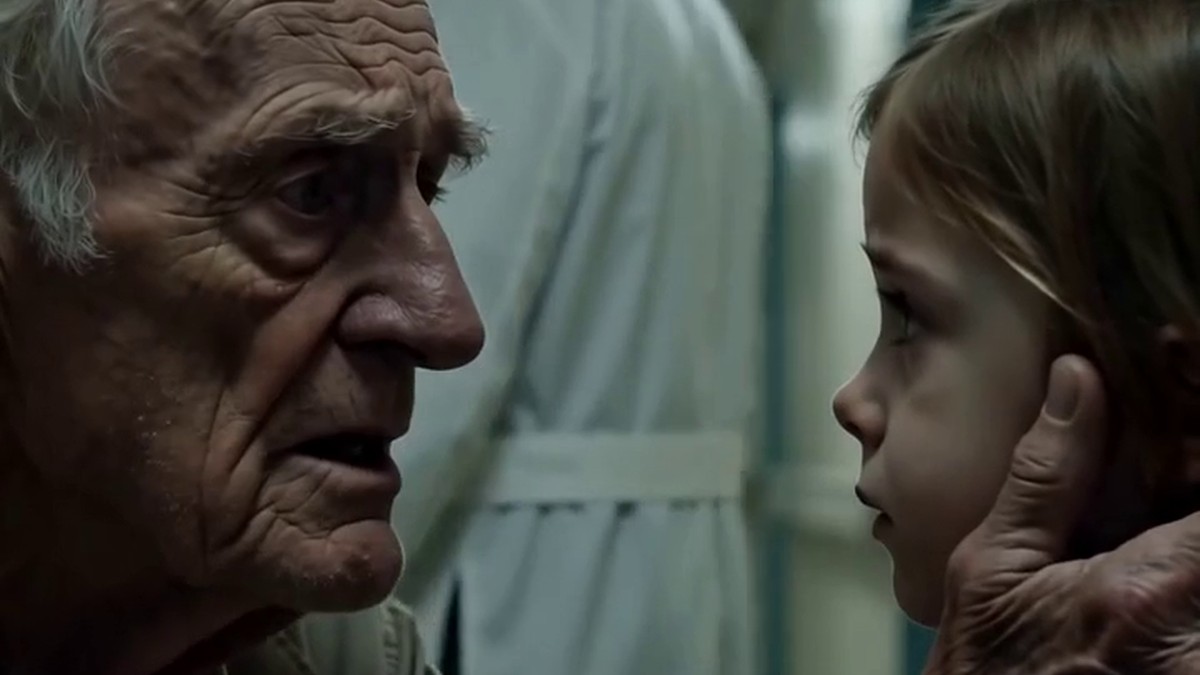
— No payment, no procedure. That’s our policy.
— She’s eleven years old. Her heart—
— I’m truly sorry, sir.
— Grandpa… are they going to make me better?
— We’ll find a way. I promise you that, sweetheart.
— Sir — wait. Doctor. I know your shift just ended, but that little girl—
— What’s her name?
— Lily. Lily Simms.
— Simms. — A beat. — Did you just say Simms?
— Yes. Is something wrong?
— What street did you grow up on?
— I — Archer Road. Over in Claremont. Why are you looking at me like that?
The doctor didn’t move. He stood in that corridor under the buzzing fluorescent light, staring at the old man the way you stare at something you buried a long time ago and never expected to see again clawing its way back up through the dirt.
He looked away first. Pressed his fingers against the bridge of his nose. When he looked back, something had shifted in his face — not certainty yet, but the first uneasy edge of it, the feeling of a word you can’t quite place but know you’ve heard before.
“Archer Road,” he said, very quietly. “Number fourteen?”
The old man blinked. “Fourteen-A. The apartment above the laundry. But how could you possibly—”
“Your name.” The doctor took one step forward. His voice had lost its clinical flatness. Something raw had moved in underneath. “Tell me your name.”
“Harold. Harold Simms.”
Daniel stood very still. He was looking at Harold the way you look at a sum you’ve worked out twice and gotten the same impossible answer both times — not trusting it yet, checking it again.
“Mr. Simms.” He exhaled slowly. “My name is Daniel Cho. In 1987, I was eight years old, and I was standing on the rail of the Claremont overpass in the middle of January. I had been standing there for forty minutes. And a man in a gray coat who smelled like machine oil walked past, and then he stopped, and then he came back, and he sat down on the cold concrete next to me and said, *I got nowhere to be either. Mind if I keep you company?*”
Harold stared. His mouth opened. Nothing came out.
“He stayed for two hours,” Daniel continued. “He never told me to get down. He never called for help. He just talked to me. About nothing. About everything. About how his wife made soup that tasted like summer even in January, and how his daughter had just learned to tie her shoes, and how the pigeons on that bridge were probably the ugliest pigeons in the state of California.” A broken sound came from somewhere in the doctor’s chest — half laugh, half something that hurt. “When I finally stepped off that railing, he walked me home without asking where I lived, like he already knew. He left without giving me his name.”
Harold’s hand had moved to his mouth. His eyes were glistening under the fluorescent light.
“I’ve thought about that man my whole career,” Daniel said. “Tried to remember details. The coat. The smell of machine oil. He had a way of talking about ordinary things like they were worth staying around for.” He stopped. “It was you, wasn’t it.”
It wasn’t a question. But he waited for the answer anyway.
“Son—” Harold’s voice cracked. “I never knew if you — I thought about you for years. I looked. I never found you.”
“I became a cardiologist,” Daniel said. “Because of that night. Because whatever kept me going — I wanted to give it to someone else.” He paused. “I’ve been giving it to someone else for twenty-two years.”
The corridor was silent except for the distant sound of a monitor beeping somewhere deep in the ward, a steady pulse, a heart doing its stubborn work.
—
Daniel moved fast.
He caught the administrator before she reached the elevator, and what passed between them was not a conversation so much as a declaration. Harold heard the words *pro bono* and *my personal file* and *today, not tomorrow*. He heard a silence on the administrator’s end that lasted long enough to mean something. And then he heard her say, flatly, “Room 4. I’ll have the forms ready in ten minutes.”
Lily was still in the plastic chair at the end of the corridor, her small legs not quite reaching the floor, swinging gently. She had found a paper cup somewhere and was blowing across the top of it to make a sound like a foghorn. When Harold crouched down in front of her, she stopped.
“Grandpa.” She looked at his face carefully, the way children do when they need to read the truth off the bones of you. “You’ve been crying.”
“Old men do that,” he said. “Don’t worry about it.”
“Is it bad news?”
He took both her hands in his. They were so small. Her pulse fluttered in her thin wrist like something trapped.
“It’s the opposite of bad news,” he said.
She considered this. “How opposite?”
“Pretty far opposite. We’re talking the other end of the whole entire universe.”
She almost smiled. “The doctor—”
“His name is Daniel. He’s going to help you.” Harold’s jaw tightened. He held on. “He’s been waiting to help you for a very long time. He just didn’t know it yet.”
Lily looked past Harold’s shoulder, and Harold turned to see Daniel standing a few feet back, clipboard in hand, watching the girl with an expression that had nothing professional in it anymore. Just a man looking at the reason. The whole complete reason.
“Hi,” Lily said.
“Hi, Lily.”
“Are you actually going to fix my heart?”
Daniel walked over and crouched down to her level. He looked at her the way you look at something you want to get exactly right.
“Yes,” he said. “I’m going to fix your heart.”
“How do you know you can?”
He glanced at Harold. Something passed between them — the kind of thing that doesn’t need words because it’s been living in the silence for thirty years already.
“Because someone fixed mine first,” he said. “And I’ve been practising ever since.”
—
The surgery took six hours and fourteen minutes.
Harold sat in the waiting room for all of it. He didn’t sleep. He drank four cups of coffee that tasted like warm cardboard, and he stared at the floor tiles, and he thought about a bridge in January, and a thin gray coat, and how you never know — you *never* know — which moment is the one that changes the whole shape of the future. How the smallest thing you do can travel forward in time like a stone thrown in still water, the rings going out and out and out until they reach the far shore years later, and you’re not even there to see it.
He thought about Lily’s mother, gone three years now, and how she used to say that everything in their family happened for a reason, and how he used to argue with her about that because he was a practical man who believed in cause and effect, not providence. He sat in that plastic chair and considered revising his position.
At 11:47 p.m., Daniel came through the double doors. He was still in scrubs. His eyes were tired and absolutely certain.
“She’s in recovery,” he said. “The procedure went as well as it possibly could have. Her heart is—” He stopped. Started again. “Her heart is strong, Mr. Simms. It just needed a little help finding its rhythm.”
Harold stood up. He was not a man who hugged strangers. He stood up and he put his arms around Daniel Cho and he held on, and Daniel let him, and in that empty waiting room at midnight the two of them just stood there for a moment — the old man and the boy from the bridge — holding up something between them that didn’t have a proper name.
—
Six weeks later, Lily Simms ran across a park lawn in Claremont. Not fast — not yet — but she ran. Her breath came in visible puffs in the cool morning air, and she pumped her arms, and she did not stop at the bench where Harold was watching; she ran straight past it and all the way to the fence at the far edge, and then she turned around and yelled, *Did you see that?*
“I saw it,” Harold called back.
She ran back. She wasn’t even breathing that hard.
“Daniel said I’ll be able to swim by summer,” she said, landing next to him on the bench.
“I know.”
“He said maybe even competitive.” She seemed to be still testing the shape of the word *competitive*, whether it fit in her mouth yet, whether it belonged to her. “Is that true?”
“He’s a good doctor,” Harold said. “He doesn’t say things he doesn’t mean.”
Lily pulled her knees up to her chest and looked out at the park. The trees were just beginning to come back. That thin green light that February sometimes offers you like an apology — *I know I’ve been hard, but look, here’s what’s coming.*
“Grandpa,” she said.
“Yeah.”
“How did you find him? The right doctor?”
Harold was quiet for a moment. He watched a pigeon strut across the path in front of them with all the confidence of something that knows exactly where it belongs.
“I didn’t,” he said finally. “He found us.”
Lily thought about this. She had the patience for thinking, this girl. Always had.
“Like it was supposed to happen?”
“Something like that.”
She leaned against his shoulder. He put his arm around her and felt her heart beating — steady now, rhythmic, doing its work without complaint — and he thought about cause and effect and providence and how maybe, in the end, the distance between those two things is smaller than he’d always supposed. Maybe they’re just different names for the same stubborn human reflex: stopping when you don’t have to. Turning back. Sitting down on the cold concrete next to someone and saying,
*I got nowhere to be either.*
The pigeons moved on. The morning got warmer. And Lily’s heart kept beating, all the way to summer.