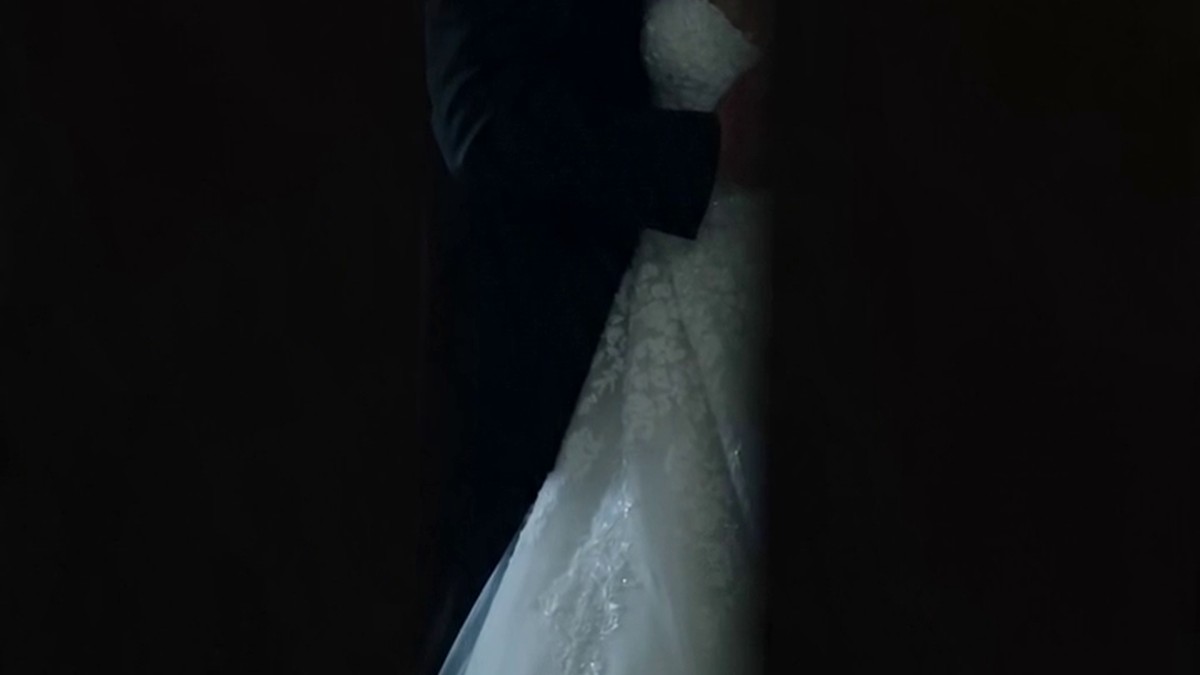
Faint music floated up from the ballroom below.
Guests laughed.
Champagne glasses rang against each other.
Everything sounded like a fairytale in full bloom.
Until the groom’s mother appeared at the end of that hallway.
She’d only come to look in on the bride — a quick check before the ceremony pulled everyone into its current.
Her fingers reached for the brass doorknob.
Then she noticed.
The door hadn’t latched.
A thin sliver of space remained where it should have closed.
Almost involuntarily, her eye found that gap.
And the breath left her body and didn’t come back.
The bride stood near the vanity, white gown luminous under the soft light.
But she wasn’t alone.
Her arms were wrapped around the groom’s father.
Not loosely.
Not by accident.
Not the way you hold someone who is grieving.
The way you hold someone you shouldn’t.
The mother’s hand snapped to her mouth.
*”Oh… my God…”*
Less than a whisper. Barely sound at all.
She stumbled backward until the cold hallway wall caught her by the shoulders.
Her legs threatened to fold beneath her.
Inside the room…
Neither of them had any idea they’d been found.
For a stretch of seconds that felt geological…
She stood there, eye pressed to that narrow strip of reality, trying to talk herself out of what she was seeing.
Then —
The bride slowly raised her face.
Their eyes connected through the crack in the door.
Every trace of warmth drained from the bride’s expression.
The groom’s father turned.
His face went to stone.
Nobody spoke.
Nobody moved.
The silence pressed against the walls like something physical.
And then the mother’s lips parted — just barely — and she asked one trembling question in a voice she almost didn’t recognize as her own.
“How long?”
Just two words. But they landed like a verdict.
The bride — Mara, twenty-six, radiant until thirty seconds ago — let her arms fall from Daniel’s waist. Daniel, the groom’s father. Fifty-three. Silver at the temples. A man who had given the toast at his son’s engagement party seven months ago and cried real tears.
Neither of them answered.
Which was itself an answer.
The question had knocked something loose in her chest, some last internal wall she hadn’t known she was leaning against — and in the silence that followed, the shock didn’t deepen. It clarified. It went cold and clean and certain, the way water goes still just before it freezes. She felt her legs steady beneath her. She felt her hands stop trembling.
She pushed the door open with one hand, the brass knob cold and indifferent against her palm, and stepped into the room like someone walking into a burning building because there was no other choice.
Her name was Patricia. She had been married to Daniel for twenty-nine years before he walked out. She had rebuilt herself from the rubble of that departure — quietly, without spectacle, the way strong women often do their most important work. She had made peace with him for their son’s sake. She had sat across holiday tables from him and kept her voice pleasant. She had believed, somewhere deep and foolish, that he had simply grown. Changed. Become someone different than the man who had broken her.
Now she understood she had been wrong about that, too.
Mara finally spoke. Her voice was controlled in a way that told Patricia this moment had been rehearsed — not today, but in her head, many times, for many months.
“Patricia. Please let me explain—”
“Don’t.” The word came out quiet. Surgical. “Don’t do that to me. Don’t make it smaller than it is by explaining it.”
Daniel stepped forward, jaw set, and Patricia turned her eyes on him. He stopped. Something in her expression stopped him the way a wall stops a car.
“You couldn’t help yourself,” she said to him. “Even now. Even *here*. Your son is downstairs right now asking the caterer whether the flowers got put on the right tables because he wants everything to be perfect — *for her* — and you couldn’t—”
Her voice broke on the last syllable.
She pressed her lips together and looked at the ceiling and breathed.
Below them, the string quartet shifted into something sweeping and inevitable. Forty-seven people in formal wear were waiting for a ceremony to begin.
One of them was her son.
His name was Caleb. He was thirty-one years old, and he wore his heart on the outside of his body in the way only genuinely good people do.
—
Patricia had always loved that about him — the unguarded quality of him, the way he moved through the world without armor. He’d called her three weeks ago just to tell her about a documentary he’d watched and thought she’d like. He’d left a voicemail — an actual voicemail, in this decade — that lasted four minutes and ended with *love you, Mom, I mean it.*
She stood in the bridal suite and tried to figure out how to save him from what was on the other side of this moment.
There was no way to do it.
There was only the moment itself.
“He deserves to know,” she said. Not to Mara. Not to Daniel. To herself, perhaps. To whatever remained of her composure.
“Patricia.” Daniel’s voice dropped into the register she remembered — placating, a little condescending, the tone he’d always used when he thought she was overreacting. “Let’s be adults about this. Let’s think about what walking downstairs and saying something actually accomplishes. Versus—”
“Versus *what*, Daniel?”
He didn’t have an answer.
“Versus him marrying her?” She laughed. It wasn’t a kind sound. “Versus him spending his life with someone who has been—” She stopped. Looked at Mara. “How long?”
A silence.
Then, quietly, Mara said: “Eight months.”
The room contracted.
Eight months meant the engagement party. Eight months meant the night Caleb had called Patricia, voice cracking with happiness, to tell her Mara had said yes. Eight months meant every family dinner since, every seating arrangement, every moment the four of them had occupied the same room.
Patricia picked up her small clutch purse from the chair near the door. Her hands were very steady now. The shaking had passed through her and come out the other side as something colder and cleaner.
“I’m going to go get my son,” she said.
—
The ballroom doors were propped open at the far end of the entrance hall.
She found Caleb near the coat check, laughing at something the best man had said, boutonniere perfectly straight, face open and undefended and completely unaware. He was the most vulnerable thing she had ever seen.
He looked up when he heard her heels on the marble. Took in her expression. And his smile didn’t fade so much as dissolve — slowly, like something water-soluble hit by rain.
“Mom?”
She didn’t say it in front of the best man.
She touched Caleb’s arm and led him a few feet away, into the alcove beside the coat check where the noise from the ballroom became a muffled hum, and then she turned to face him and she told him the truth. All of it. Simply. Without softening it into something more bearable, because there was no more bearable version of it.
She watched his face.
She watched him try to keep up with what the words meant.
She watched the moment understanding arrived.
—
He went upstairs.
She couldn’t stop him. She didn’t try. Some things a person has to see with their own eyes before they can begin to believe them, and she understood that more than anyone.
She stood at the bottom of the staircase and listened.
She heard his footsteps on the landing.
She heard the door.
She heard nothing for a long time — and silence, she knew, was the loudest thing there was.
Then she heard his voice. Not the words. Just the timbre of it — the low, fractured register of a man who has been answered by the truth when he was still hoping for a different truth.
Then Daniel’s voice.
Then nothing again.
—
Caleb came back down the stairs eleven minutes later.
His boutonniere was gone. His jacket was still on. His face had rearranged itself into something she didn’t quite recognize — older, maybe. Or more accurate. Like a photograph that had been slightly out of focus and had finally, unfortunately, sharpened.
He walked past the ballroom doors without looking in.
He stopped when he reached her.
They stood together in the alcove for a moment, not speaking.
“I’m sorry,” she said. Because there was nothing else that was true.
“Don’t be sorry.” He exhaled slowly through his nose. “You didn’t do this.”
“I know. But I’m still sorry it happened.”
He nodded. Looked at the floor. Looked back up.
“I need you to go tell the guests,” he said. “I can’t — I don’t want to walk in there right now.”
“I’ll do it.”
“Just tell them it’s off. You don’t have to say anything else. They’ll figure it out.”
“Okay.”
“And Mom.”
“Yeah.”
“Thank you for coming upstairs.”
She took his face in her hands — her son, her thirty-one-year-old son with his father’s jawline and his own particular brand of goodness — and she held it for just a moment. Long enough for him to feel it.
“Always,” she said.
—
She walked into the ballroom alone.
The string quartet was mid-phrase when she raised one hand. The music stuttered and stopped. Forty-seven faces turned toward her.
She stood at the front of the room beside an arch of white flowers that nobody would be standing under today. She kept her shoulders back. Her voice came out clear and without tremor.
“Thank you all so much for being here. I’m afraid there’s been a change, and the ceremony will not be taking place this afternoon. I know this isn’t the news any of you expected, and I’m so grateful for your love and your presence. Caleb is okay. Please take care getting home.”
That was all she said.
The room did what rooms full of people do when the unthinkable has just walked in wearing a modest dress and sensible heels — it erupted in a low wave of gasps and whispered questions and chairs scraping back.
She didn’t stay for any of it.
—
She found Caleb outside, sitting on the low stone steps that led to the parking lot, jacket folded beside him, face turned up toward a sky that had gone the pale gray of late afternoon. His phone was in his hand. He wasn’t using it.
She sat down next to him.
The music from inside had stopped.
Cars were beginning to move in the lot.
After a while, he said, “I keep waiting to feel something different than what I feel.”
“What do you feel?”
“Mostly just tired.” He paused. “Is that wrong?”
“No,” she said. “That’s what the truth does, when you’ve been carrying something heavy and you finally set it down. Even if you didn’t know you were carrying it.”
He was quiet for a moment.
“Did you know? About them, I mean. Before today.”
“No.” She said it clearly, because it was true, and because he needed to hear truth from someone right now. “I had no idea.”
He nodded slowly.
A car pulled out of the lot. Someone’s grandmother, still in her hat.
“I’m gonna be okay,” he said. Not to convince her. Just to hear himself say it, she thought.
“I know,” she said.
“Eventually.”
“Yes. Eventually.”
The stone was cold beneath them and the light was failing and somewhere inside, forty-seven people were collecting their gifts and their unanswered questions and their untouched champagne. Somewhere inside, Mara was removing a dress she wouldn’t be wearing back down the aisle. Somewhere inside, Daniel was standing in a room with his choices and whatever remained of his justifications.
Out here, there was just Caleb.
And Patricia.
And the kind of quiet that comes after something breaks — not peaceful, not comfortable, but honest.
She reached over and put her hand over his.
He turned his palm up and held on.