Nobody moved.
Marianne Whitaker stood in the center of the bridal suite, a strip of pale fabric twisted in her grip. Across from her, Evelyn Moore pressed the torn edge of her sleeve against her arm — and that’s when the light found it.
A gold bracelet. Sliding into plain view.
Marianne’s expression cracked before her mind could catch up.
She knew that bracelet. Not the way you know a piece of jewelry. The way you know something that once meant everything.
She had worn it on her twenty-fifth anniversary. Her husband had smiled when he clasped it around her wrist. Three months later, he told her it was gone — lost somewhere on a business trip, gone for good, what a shame.
And here it was. Warm on another woman’s skin.
When Marianne finally spoke, her voice had the texture of shattered porcelain.
“Stay away from my husband.”
Evelyn Moore did not flinch. Her eyes were glassy, her chin raised like a shield.
“Then ask him,” she said quietly, “why he keeps finding his way back.”
The bride turned slowly. Lily Moore looked at her mother’s wrist, then at Marianne’s face, then back again — putting together something she didn’t want to understand.
“Mom.” Her voice was barely a sound. “Where did that bracelet come from?”
The doorway.
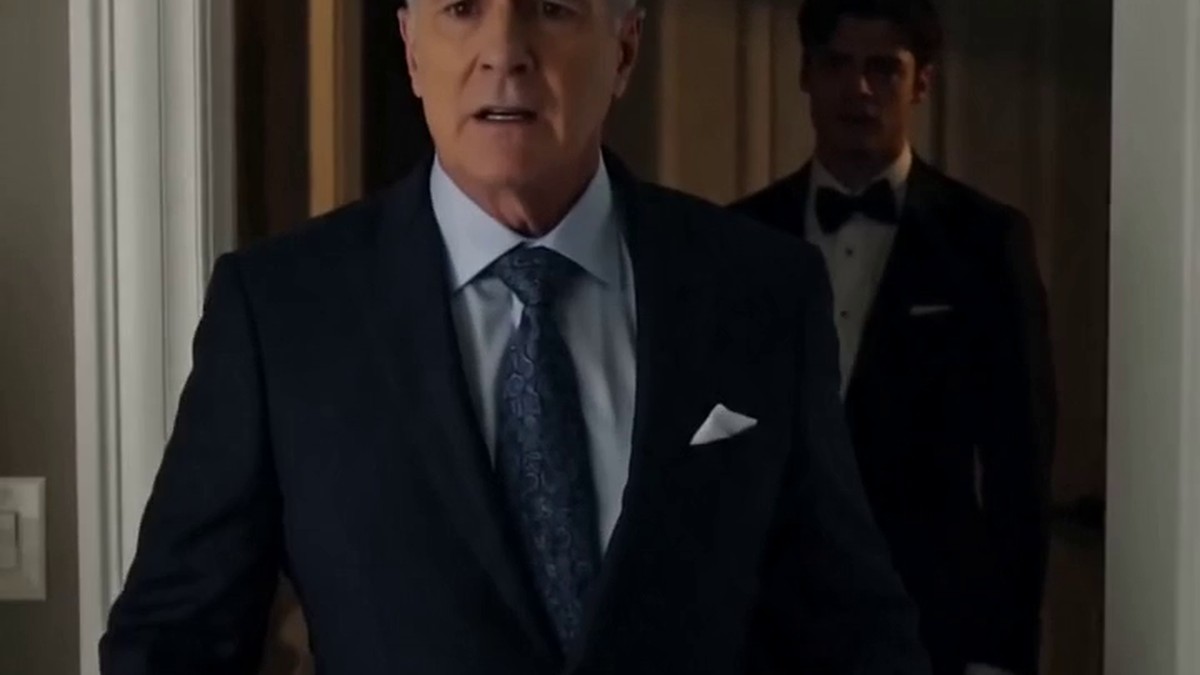
Richard Whitaker had been standing there long enough to hear all of it. His face had gone the color of old ash. Behind him, half-hidden in the hall, stood his son — Ethan, the groom, the man who was supposed to be getting married in two hours.
Nobody had heard them arrive.
Richard stepped forward. One step. Then stopped.
“I gave it to her.”
The room contracted around those five words.
Marianne stared at him — really stared — like she was seeing the architecture of twenty-five years rearranging itself in real time.
“You gave her my anniversary gift.”
Not a question. A verdict.
And in the doorway, Ethan stood perfectly still, watching the two families he’d grown up believing in collapse into something unrecognizable — and realizing, with cold and terrible clarity, that the lie hadn’t started today.
It had been here the whole time.
Long before the wedding. Long before the invitations. Long before anyone said *I do* or *I will* or *I promise.*
The only question left — the one that would determine everything — was whether he and Lily were willing to let betrayal become the foundation they built their life on.
They weren’t.
The silence lasted maybe three seconds.
Then Ethan walked into the room.
Not the way someone walks into a room when they’re uncertain. The way someone walks in when they’ve made a decision they can’t take back. He moved past his father without looking at him, crossed the suite in six deliberate steps, and stopped beside Lily.
He didn’t touch her. He just stood there. His shoulder close enough to hers to mean something.
“How long?” he said.
The question was aimed at his father, but it landed on everyone.
Richard’s jaw tightened. His hands moved uselessly at his sides. He was a man who was very good at managing appearances — Ethan had always known this without being able to name it — and right now the machinery behind his eyes was working hard, cycling through options, calculating damage.
“Ethan, this isn’t—”
“How long.”
Not a question anymore.
Richard Whitaker looked at the floor. Then, with the particular defeat of a man who has run out of angles, he said, “Seven years.”
Someone made a sound. Maybe Marianne. Maybe Lily. It came from the direction of both of them and it was not quite a word.
Seven years.
Ethan did the arithmetic without wanting to. He was twenty-nine. He had been twenty-two when this started. He’d been in his last year of college, calling home on Sundays, believing in the version of his parents his childhood had assembled — the anniversary dinners, the held hands across restaurant tables, the bracelet his father had given his mother with that particular smile.
That smile.
He looked at his father now and searched for it and found something else entirely.
“Did you know?” Lily asked. She wasn’t looking at Ethan. She was looking at her mother.
Evelyn Moore had not moved from her position near the window. The torn sleeve hung loose. The bracelet caught the morning light in small, indifferent flashes.
“Lily—”
“Did you know he was married. Before.” Lily’s voice was very controlled. The kind of control that costs something. “Before me and Ethan. Before the engagement. Did you know what you were — what this was.”
The pause that followed was its own kind of answer.
“I knew,” Evelyn said.
The word fell into the room like something dropped from a height.
Lily turned away. Just slightly. The way you turn from something that has burned you.
Marianne had not spoken since her husband’s confession. She stood where she’d been standing, the strip of torn fabric still in her hand, and she looked like a woman watching a building she’d lived in for decades quietly and systematically come apart at its seams. Her face had passed through rage and grief and landed somewhere that had no name — a cold, clear place on the other side of both.
She set the fabric down on the edge of the vanity. Carefully. Like she was setting down something much heavier.
Then she picked up her purse.
“Marianne.” Richard stepped toward her.
“Don’t.” She didn’t raise her voice. She didn’t need to. “Don’t follow me into the hall. Don’t come home before I’ve had time to call Daniel.” Daniel was their attorney. Had been their attorney for eighteen years. Richard knew the name.
He stopped.
She walked to the door, paused there, and looked back once — not at Richard. At Lily.
“I’m sorry,” she said. “Not for what happened in this room. For what was already true before any of us walked into it.”
Then she was gone. Her heels on the marble floor of the corridor, even and unhurried, fading until they were nothing.
—
The room reset itself in her absence.
Richard Whitaker stood in the center of it, diminished. The suit he’d paid twelve hundred dollars for looked like something borrowed. He kept moving his mouth slightly, as if words were forming just below the surface and failing to break through.
Ethan finally looked directly at him.
“I need you to leave.”
“Son—”
“I’m not doing this with you here. Whatever comes next — me and Lily figure that out ourselves.” He held his father’s gaze. “You don’t get input on that. Not today. Maybe not ever.”
Richard opened his mouth. Closed it. There was a version of him that would have argued, that would have assembled some architecture of justification. That version seemed unavailable.
He walked out.
The door swung shut behind him with a sound that was almost gentle, which made it worse somehow.
—
Three people left in the room now. Ethan. Lily. And Evelyn Moore, who had not left, who was still standing at the window with her torn sleeve and the bracelet that had started all of it.
Lily looked at her mother for a long moment.
“Take it off,” she said.
“Lily—”
“The bracelet, Mom. Take it off and put it on the table.”
Something moved across Evelyn’s face. Old stubbornness. The familiar architecture of a woman who did not like being told. But whatever she found in her daughter’s expression was stronger than habit.
She unclasped it. Set it on the vanity. The sound it made was almost nothing.
“I didn’t want you to find out,” Evelyn said. “I want you to understand that. Whatever you think of me right now, I never wanted this to touch you.”
“It’s been touching me for seven years,” Lily said. “I just didn’t know.”
She picked up the bracelet, crossed to the small decorative trash bin near the door — the kind hotels put in bridal suites — and dropped it in. It made a bright, hard sound against the metal lining.
“I love you,” she said to her mother. “And I can’t talk to you right now. Go back to your room. I’ll find you later when I can — when I can figure out what later looks like.”
Evelyn gathered herself, which was its own kind of dignity, and left without a word.
—
The door closed again.
Lily and Ethan stood in the wreckage of what the morning had been supposed to be. White dress. Florist gardenias on the side table, already opening. Two hours until a ceremony that now existed in a kind of suspended state.
Lily sat down on the edge of the bed.
Ethan sat beside her.
For a while neither of them said anything. The city moved outside the windows, indifferent, and the gardenias kept opening whether anyone asked them to or not.
“I don’t want to cancel it,” Lily said finally. Her voice was hollowed out but steady. “I want to be clear that it’s not — that I’m not saying that. I’m saying I don’t know how to walk down an aisle in two hours and pretend this morning didn’t happen.”
“We don’t pretend,” Ethan said.
She looked at him.
“We postpone,” he said. “We go out there and we tell the people we actually love that we need more time. Not because of us. Because of them.” He nodded toward the door, toward the direction their parents had gone. “And then we take the time. And then we decide.”
“Decide what.”
“Whether we’re going to let what they built — what they wrecked — determine what we build.” He turned toward her fully now. “Because I don’t think it has to. I think we’re different people than they were. I think we can be.” He paused. “But I need you to think it too. Not because I told you. Because you do.”
The gardenias sent their scent across the room, thick and sweet and completely unconcerned.
Lily sat with it for a long moment. Whatever she was weighing, she weighed it carefully.
“Come here,” she said.
He leaned in and she pressed her forehead against his. Not a kiss. Something older than a kiss. The kind of contact that means *I see you* and *I’m still here* at the same time.
Outside, the city turned in the late morning light.
Inside, two people breathed the same air and chose, quietly and without ceremony, to still be on the same side.
The wedding did not happen that day. The guests were told — kindly, briefly, by Ethan himself, who stood in the doorway of the reception hall and spoke without apology. There were murmurs. There was a photographer who didn’t quite know what to do with her hands. There was an aunt who cried, though nobody was entirely certain for which family.
But Lily and Ethan stayed in the suite. They ordered room service. They talked for five hours about things they’d never quite gotten around to, the way people do when the structure of ordinary life has temporarily blown away.
They got married four months later. Small. Thirty people. No one’s parents in the wedding party.
Marianne filed in January. Richard signed in March.
Evelyn Moore and Lily found their way back to each other slowly, over the course of a year and several very difficult phone calls, the way people do when love is real but complicated and neither person is willing to let it go entirely.
None of it was clean.
None of it was what the invitations had promised.
But it was true — and the truth of it held, the way things do when they’re built on ground that’s actually been tested.
And that, in the end, turned out to be enough.