The ballroom glowed.
White roses cascaded from towering arrangements.
A string quartet looped the same delicate melody again and again, as though beauty alone could smother what was building in the air.
Everything was flawless.
Everything except him.
I stood in the bridal suite with my bouquet crushed in both hands, knuckles pale against the stems. My reflection watched me from the mirror like a stranger.
Six separate fittings for that gown.
My maid of honor had fixed my veil that very morning, her fingers trembling, telling me through happy tears that I looked like something out of a dream.
Penelope.
My best friend since we were twenty years old.
The woman who held every secret I had ever trusted to another person.
The woman who planned my bridal shower.
The woman who swore she’d stand at my side when I made my promises.
At first, I refused to let the fear in.
Maverick was nervous — that was all.
Dead phone battery.
Traffic.
His father needed something.
Maybe.
Maybe.
Maybe.
I fed myself comfortable lies because the true answer was something I couldn’t yet afford to look at directly.
At 1:45, my coordinator Linda came through the door moving fast.
Her headset sat crooked in her blonde hair.
The smile she was wearing cost her something.
“Amy.” Her voice was measured. “We’ve run into a small issue.”
My mother swung around.
“What kind of issue?”
Linda looked at me and only me.
“The groom is running a bit late.”
I checked the clock.
Fifteen minutes to the ceremony.
“Late from where?” I asked.
She hesitated.
One beat. Maybe two.
That tiny pause said more than any sentence could.
“We’re… still working on that.”
The walls moved closer.
I called him.
Nothing.
I typed: *Where are you?*
Silence.
Called again.
Voicemail.
Downstairs, the quartet played on — cheerful and absolutely merciless.
At 2:00 on the dot, Linda came back.
She didn’t even try the smile this time.
“We can’t reach him,” she said quietly.
“Or his best man.”
My mother pressed a hand flat against her chest.
On the other side of the room, my cousin Emma stood rigid beside the mirror. The blood had left her face entirely. Her eyes kept sliding toward the door.
Then the thought arrived.
Not slowly.
Like something falling.
“Where is Penelope?”
The room went silent.
Emma swallowed.
“She stepped out about twenty minutes ago. I figured she was checking on the flowers.”
I looked at the chair where Penelope’s lavender clutch had been sitting all morning.
Empty.
Her phone charger.
Gone.
The cold moved through me from the hands outward.
I dialed her.
Voicemail.
One absence can be an accident.
Two can be bad timing.
But your groom and your maid of honor, both unreachable, both gone, on the afternoon of your wedding?
That isn’t coincidence.
That is a decision someone made.
“The hotel,” I said.
My mother blinked at me through the start of tears.
“What?”
“Penelope stayed at the Millbrook Inn last night.”
My own voice surprised me. It was level. Almost surgical.
“If Maverick isn’t here — and Penelope isn’t here — then that’s where they are.”
“Amy.” My mother reached for my arm. “There has to be something else going on.”
I looked down at what I was wearing.
The lace. The pearls. The dress I had imagined myself in a hundred times, standing beside a man who loved me.
Then I gathered the heavy skirt in one hand.
“There isn’t.”
I walked to the door.
Before I reached it, Aunt Rose stood up from the velvet sofa.
Eighty-two years old.
Barely clearing five feet.
Navy silk, diamond earrings, a handbag she gripped like a weapon.
Her eyes had the focused quality of someone who has already seen every version of this story.
“I’m coming with you.”
Not a question. Not an offer.
A statement that closed the matter entirely.
“No bride faces something like this by herself.”
Ten minutes to the Millbrook Inn.
It felt like crossing an ocean.
My father’s hands were locked on the steering wheel so hard the tendons showed. My mother cried without sound in the passenger seat. Aunt Rose sat pressed against me in the back, holding my hand with a grip that said *I’ve got you* without using a single word.
Nobody said the word that was filling the car.
*Affair.*
The inn looked like a postcard.
Red brick. Ivy climbing the walls. Window boxes full of color.
A place engineered for romance.
I hated it on sight.
I walked through the lobby in my wedding dress and the room simply stopped. Conversations ended mid-sentence. The receptionist’s mouth opened and didn’t close. A bellhop forgot what his hands were for.
I didn’t slow down.
Room 237.
The honeymoon suite.
That morning, Penelope had pressed a spare key into my palm with a grin. *Just in case I lose mine.*
I had laughed.
Now the key felt like it weighed something.
I stood outside the door.
Listening.
Only my own pulse answered.
Aunt Rose touched my elbow.
“Open it.”
I did.
The room was dim. Heavy curtains swallowed most of the afternoon light. A black suit jacket was slung across the edge of the bed — Maverick’s, the one chosen for today. His good shoes on the floor nearby.
Across the carpet, pieces of purple satin lay scattered where they had fallen.
Penelope’s bridesmaid dress.
Behind me, my mother made a sound that had stopped being a sob.
Then I saw them.
Maverick.
Penelope.
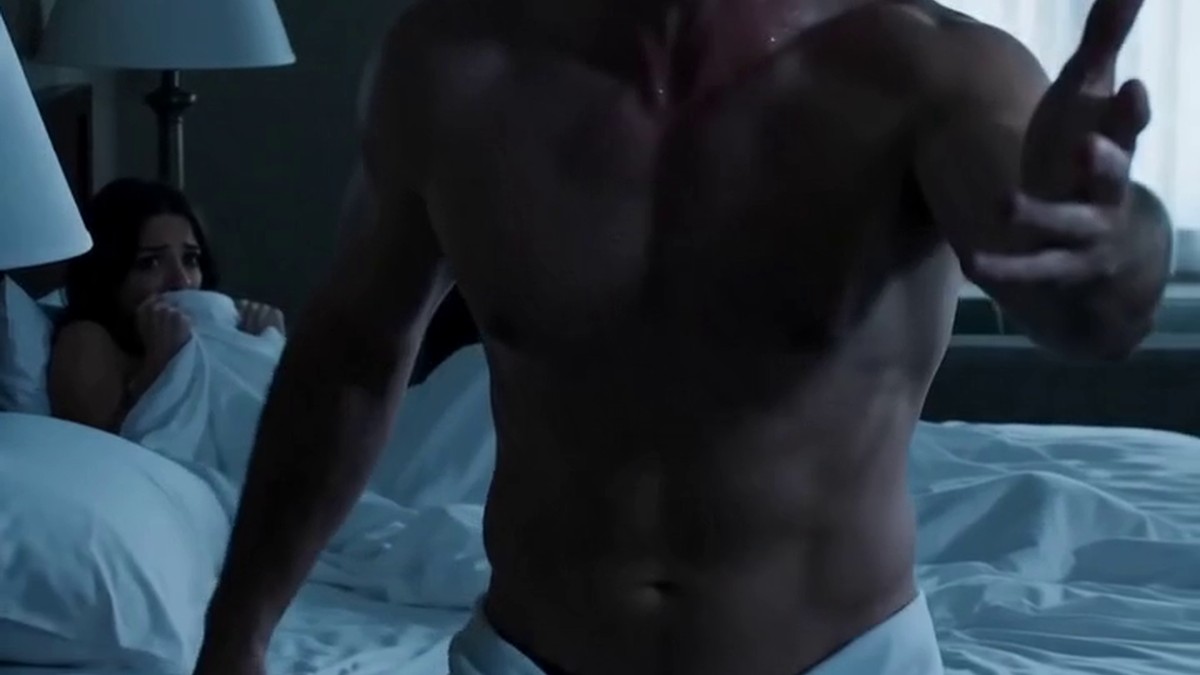
Tangled together under white hotel sheets.
Asleep.
For one suspended moment everything stopped — the ballroom, the flowers, the vows, the years, the future I had been building — and then it all fell.
Maverick’s eyes opened.
He found me in the doorway.
Veil still on. Bouquet still in my hands.
The color left his face like something being switched off.
“Amy—”
He lurched upright.
“I can explain—”
Penelope woke with a sharp cry, snatching the sheet up around herself.
“It’s not what you think—”
I looked at them both.
No tears. No screaming. No shaking.
Just a cold so complete and so sudden that it felt like the inside of me had been rearranged.
The kind of cold that comes after something breaks past the point of repair.
“Explain.” My voice was barely there. “Explain what, exactly?”
Maverick’s mouth moved.
Nothing came through it.
Penelope couldn’t lift her eyes from the mattress.
The purple satin lay across the floor like a signed confession.
I reached into the hidden pocket in my gown and pulled out my phone.
I kept my eyes on Maverick.
“Dad.”
“Call his parents.”
“Call his sister.”
“Call his godfather.”
“Tell them to come to Room 237.”
He was out of the bed in an instant.
“Amy — please — don’t—”
“We can talk. Just us. We don’t need to do this.”
I looked at him.
Then at her.
Then at the floor.
And something like a smile found my face.
A quiet, terrible smile that I didn’t entirely recognize.
“Privacy?”
I pressed another contact.
Mrs. Bennett picked up on the second ring.
Warm. Unsuspecting. Happy.
“Mrs. Bennett,” I said, watching the last of the color drain completely from Maverick’s face.
“You should come to the Millbrook Inn. Room 237.”
I let a beat pass.
Then I said the sentence that leveled whatever was left standing.
“Bring the whole family.”
I stepped back from the door.
Not to run. Not to collapse.
Just to let the room breathe around what I’d done.
Maverick stood at the foot of the bed, still in his undershirt, still reaching toward me with one hand like he could physically pull back the last ninety seconds. His face had gone the color of old candle wax.
“Amy. *Please.*”
I folded my hands over the bouquet. The roses were starting to brown at the edges where my grip had crushed them. I noticed that and filed it away somewhere quiet.
“You have about fifteen minutes,” I said.
“I’d suggest putting some clothes on.”
—
Aunt Rose had positioned herself in the corner armchair the way generals position themselves on hills — with full sightlines and absolute authority. She hadn’t said a word since we’d entered. She didn’t need to. Her presence alone was a kind of verdict.
My mother stood in the doorway, one hand flat against the frame, the other pressed to her mouth. Her mascara had tracked two thin lines down her cheeks and dried there like something fossilized. She was staring at Penelope the way you stare at a bad accident — unable to stop, unable to look away, unable to believe the geometry of destruction.
Penelope had wrapped the hotel sheet around herself and retreated to the far side of the bed. Her hair was down. Her mascara was worse than my mother’s. She was crying in the specific, heaving way of someone who understands that crying might be the only card she has left to play.
I watched her cry and felt nothing recognizable.
Not anger. Not grief.
Something colder. Something that had no word yet.
“Amy.” Her voice broke on the second syllable. “I never wanted you to find out like this.”
I turned to look at her fully.
“How did you want me to find out?”
She opened her mouth.
Closed it.
The sheet slipped slightly at her shoulder and she clutched it back up.
“I know there’s nothing I can—”
“How long?”
The question landed flat and hard in the middle of the room.
Maverick flinched.
Penelope’s crying stuttered to a halt.
“How long,” I said again.
Not a question the second time. A door I was holding open, giving them one chance to walk through it with whatever dignity they still possessed.
Maverick looked at the floor.
“Eight months.”
My mother made the sound again — the one that had stopped being a sob. A small, airless sound, like something structural giving way.
Eight months.
Eight months of bridal appointments and seating charts and cake tastings. Eight months of him holding my hand across restaurant tables, telling me he couldn’t wait. Eight months of her adjusting my veil, zipping my dress, asking me how I felt about forever.
Eight months.
I counted backward through it the way you count backward through a fire, trying to find where it started.
“The engagement party,” I said.
It wasn’t a guess.
Maverick’s jaw tightened.
There it was.
The engagement party. The champagne and the fairy lights and the speech he’d given with tears in his eyes, telling three dozen people that I was the best thing that had ever happened to him.
Eight months ago.
“We tried to stop,” Penelope said. “We tried so many times. It just—”
“Don’t.” Aunt Rose’s voice came from the corner. Small and absolute.
“Don’t tell her it just happened.”
The room went still.
Aunt Rose uncrossed her ankles. She didn’t stand up. She didn’t need to.
“Things fall off tables. Pipes burst. Cars skid on ice.” Her eyes moved between Maverick and Penelope with an expression that had no heat in it whatsoever, only precision. “This? You chose. Every single morning for eight months, you woke up and you *chose.* Don’t you dare tell this girl it just happened.”
Nobody spoke.
Outside in the corridor, a door opened somewhere down the hall.
Then footsteps.
—
The Bennetts arrived first.
His mother, Caroline, came through the doorway in her mother-of-the-groom dress — pale gold, pearl buttons, the single strand of white pearls she’d worn at her own wedding and told me, laughing, over dinner one night, that she planned to pass down to her daughter-in-law.
She stopped three steps into the room and the scene assembled itself for her in pieces.
The scattered dress on the carpet. The two sets of shoes. Her son at the foot of the bed in yesterday’s undershirt. The girl in the sheet.
Me in the doorway in my wedding gown.
She put one hand on the wall.
His father, Gerald, walked in behind her and went completely rigid.
His sister Kayla was last. Twenty-four years old, sharp and perceptive, the person who had texted me six weeks ago to say she was *so excited* to have a real sister. She took one look at the room, one look at Maverick, and her face did something that moved through disbelief and landed directly in grief.
“Mav.” Her voice was barely sound. “What did you do.”
Maverick turned to his family and whatever composure he’d been assembling fractured completely.
“Mom. I’m sorry. I’m so sorry. I never meant for—”
“Don’t.” Caroline held up one hand.
She looked at me.
Not at her son. Not at the room. At me.
“Amy.” Her voice had the quality of someone spending enormous effort to keep it level. “I am so sorry. I am so deeply, terribly sorry.”
Something in my chest moved.
I hadn’t expected that.
Somehow, standing in the wreckage of everything I’d built, his mother looking at me with that expression — *I see exactly what my son has done and I am not going to pretend otherwise* — was the thing that finally found the edges of my composure.
I pressed my lips together.
Held it.
“Thank you,” I said. “For coming.”
—
My father appeared in the doorway behind the Bennetts.
He had been downstairs in the lobby, on the phone, doing the quiet, catastrophic work of calling people. Telling them. The reception was cancelled. The ceremony would not be happening. Three hundred people were going to leave a ballroom tonight carrying a story about someone else’s worst day.
He took one look at the room, one look at his daughter, and crossed it in four steps.
He put both arms around me from behind and held on.
My father, who had not hugged me like that since I was small enough to sit on his shoulders. Who communicated love through practicality and presence and showing up, always, without fail.
I felt the bouquet finally give way in my fingers.
Petals scattered across the carpet.
I let them.
—
Maverick made several more attempts.
He wanted to talk. He wanted to explain. He wanted, I think, for this to become a negotiation — something that could be discussed and shaped and possibly survived.
Gerald Bennett took his son by the arm and steered him firmly toward the corridor.
“You don’t get to negotiate with her today,” he said quietly. “You don’t get anything from her today. Do you understand me?”
I didn’t hear Maverick’s answer.
I was watching Penelope.
She had dressed, finally, in yesterday’s clothes — jeans and a wrinkled blouse, the lavender bridesmaid dress still pooled on the floor like something shed. She stood near the window with her arms wrapped around herself, not looking at anyone.
She had stopped crying.
I wasn’t sure if that was better or worse.
We had been friends for fourteen years.
I had a box in my closet at home that held birthday cards from her. Photographs. A handwritten list she’d made me when I was twenty-three and going through the worst six months of my life, titled *Things That Are True* — small, specific, handwritten reminders that I was loved and not alone.
Fourteen years.
I crossed the room toward her and she looked up.
Her eyes were swollen. Her face was a ruin. She looked, for one second, like the girl I’d known at twenty — before careers and distances and this man had accumulated between us.
“Pen.”
She flinched at her own name in my mouth.
“I don’t have anything to say to you today,” I told her. “Maybe not ever. I don’t know yet.”
She nodded.
Her chin was trembling.
“But I need you to know—” my voice dropped to something meant only for her, “—that I would have done anything for you. If you had come to me and told me the truth, even the ugly truth, I would have found a way to survive it. What I can’t survive is this.”
I gestured, once, at the room.
At all of it.
“Being the last to know.”
Penelope pressed her hand over her mouth.
A single sound escaped through her fingers.
I turned away.
—
Aunt Rose stood and took my arm.
She didn’t say anything. She simply steered me toward the door with the efficient grace of someone who had waited her entire life to be useful for exactly this kind of moment.
My mother fell in on my other side.
My father followed, one hand at my back.
In the corridor, the afternoon light came through a window at the end of the hall and lay across the carpet in long, amber rectangles. The inn was quiet. Somewhere down the hall, someone’s television murmured through a closed door.
I looked down at my dress.
Six fittings.
The lace. The pearls. The train that brushed the corridor carpet behind me.
I had imagined this day so many times that the imagining had become its own kind of reality — a parallel life I’d been living in my head alongside the actual one. The vows. His face. The moment when the distance between what I hoped for and what I had would finally, permanently close.
It wasn’t grief I felt, exactly.
It was larger than that and stranger.
It was the particular vertigo of a future disappearing. Not in pieces. All at once.
We reached the elevator.
Aunt Rose pressed the button.
The doors opened.
I stepped inside and turned around and caught my reflection in the mirrored elevator doors — veil crooked now, roses gone, eyes dry and enormous in a face I barely recognized.
The doors closed.
“What do I do now?” I asked.
The question wasn’t for anyone specifically. It was just the question.
My mother slid her arm around my waist.
Aunt Rose, still holding my other arm, looked at my reflection in the mirror.
She was quiet for a moment. Considering.
Then she said, with absolute certainty, “Now you go home.”
A beat.
“And in the morning, you start building the life you should have been building all along.”
The elevator descended.
The lobby came up beneath us, full of light.
I straightened my spine.
I thought about three hundred people in a ballroom, waiting. The string quartet, still looping its delicate melody. The white roses still cascading from their arrangements, perfect and indifferent.
I thought about eight months. A lavender dress on a hotel floor. A handheld list titled *Things That Are True.*
I thought about the key still in my palm.
I set it on the small elevator shelf as the doors opened.
Left it behind.
Walked out into the light.