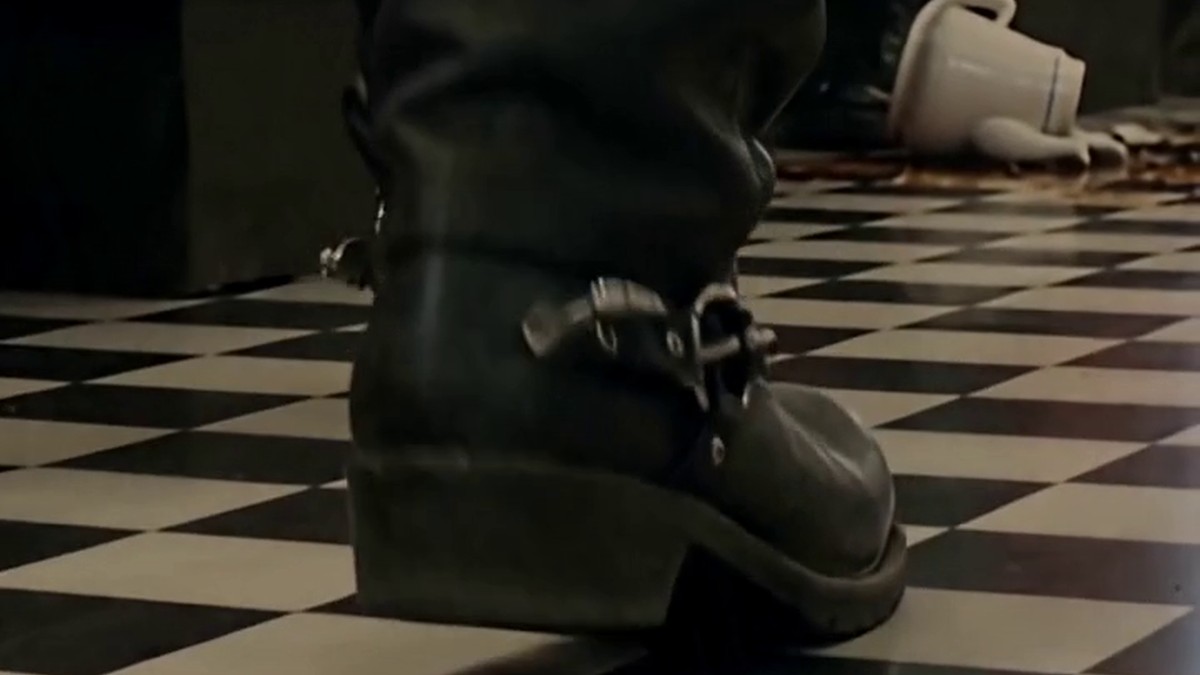
Dark liquid sprayed across the police sergeant’s sleeve and splattered over the elderly waitress’s legs.
She flinched, then dropped to her knees, cheeks burning, gathering broken shards with trembling fingers.
The officer stared down at his ruined uniform and let out a long, slow breath.
The whole place went dead silent.
In the corner booth, a massive biker stopped moving — fork suspended in midair, halfway to his mouth.
His black leather vest let out a low creak as he rose from his seat.
The waitress looked up at him and breathed, “Please. It was my fault.”
He was already moving.
Heavy boots struck the checkered tile one deliberate step at a time.
Forks stopped scraping. Voices dissolved. Every head turned.
The sergeant squared his shoulders, working hard not to show what his eyes gave away. But the biker was enormous — standing over him like a wall that had grown legs.
Coffee still glistened on the officer’s cuff.
Glass caught the light between their feet.
The biker closed the distance until barely an inch separated them.
His eyes were glacier-cold. His voice was something else entirely — measured, low, and absolute.
“That’s my mother.”
Something moved across the officer’s face.
Not fear.
Recognition.
He looked past the biker’s shoulder at the old woman still crouched on the floor — and his lips parted slowly, like a man staring at something he had buried a long time ago.
The waitress had stopped picking up the glass.
Her hands rested flat on the tile, and she was looking up at the two men with an expression that had nothing to do with broken crockery. Something older lived in her face now. Something that had been waiting.
“Tommy,” she said softly. Not to the biker.
To the sergeant.
The officer’s jaw worked without producing sound. His hand drifted to his belt — not for his weapon, just for something to hold onto. Something solid in a room that had suddenly stopped making sense.
“Mrs. Callahan,” he finally managed.
The biker turned his head. Slow. Deliberate. He looked at his mother the way men look when they realize a story they thought they knew has chapters they were never shown.
“You know him.”
It wasn’t a question.
She pushed herself up from the floor. Nobody helped her — not because they didn’t want to, but because the air in that diner had become something you moved through carefully, the way you move through a room where a candle is burning near a curtain.
She was small. She’d always been small. But she straightened her apron with the particular dignity of a woman who has outlasted harder things than this moment, and she looked at her son with eyes that were asking him, without words, to be patient.
“Sit down, Ray.”
“Mom—”
“Sit. Down.”
Ray sat.
Not because he was told. Because something in her voice had weight that his size couldn’t argue with. He lowered himself back into the booth, and the vinyl exhaled beneath him, and his enormous hands settled on the table like two animals being kenneled.
The sergeant — Tommy, she’d called him Tommy — hadn’t moved. He was still standing in the spilled coffee, glass at his feet, staring at a woman he clearly hadn’t expected to ever see again.
She pulled a clean rag from her apron and held it out to him.
“Your sleeve,” she said.
He took it. His fingers weren’t steady.
The diner breathed again, slowly. Forks returned to plates, but no one ate. They just needed something to do with their hands.
—
She poured two cups from a fresh pot and carried them to Ray’s booth. Set one in front of her son. Set one across from him. Then looked at Tommy, still anchored to the middle of the floor.
“You going to stand there all night, or are you going to come explain yourself?”
He came.
He sat across from Ray, and the booth that had looked oversized before now seemed like something built for children. Ray watched him the way a dog watches a stranger — not with aggression anymore, but with a kind of focused stillness that was almost worse.
She sat at the end. Referee. Witness. The reason for all of it.
“Twenty-two years,” she said. She wasn’t talking to either of them specifically. She was talking to the table, to the coffee, to the accumulated weight of it. “I wondered if this would ever happen.”
“Mom.” Ray’s voice was careful now, stripped of the thunder. “Who is he?”
She wrapped both hands around her mug.
“He’s the boy who found your father,” she said. “The night your father died.”
—
The diner had a clock above the pie display. Old analog, the kind with a second hand that hitched slightly every time it passed the twelve. In the silence that followed her words, everyone in the place could hear it.
*Hitch. Tick. Hitch. Tick.*
Ray’s eyes moved from his mother to the man across from him with the slow, tectonic inevitability of a landslide. Twenty-two years of a story he’d been told were rearranging themselves in real time behind his face.
“He fell,” Ray said. Flat. Reciting. “Dad fell. Ice on the loading dock.”
Tommy looked down at his coffee.
That was enough.
“No,” Ray said.
“Ray—” his mother started.
“No. Say it. Say it out loud. Look at me and say it out loud.”
Tommy looked up. Whatever he’d been carrying, he’d been carrying it long enough that it had changed the shape of him — not on the outside, not where Ray had been ready to hit him, but somewhere behind the eyes, where things go when they don’t have anywhere else.
“He didn’t fall,” Tommy said.
The clock hitched.
“I was nineteen. Rookie. I was the first car on scene.” He turned the coffee mug in a slow circle. “Your father was already gone when I got there. And the man standing over him — the man who’d pushed him — was Captain Devaney.”
The name landed like a stone into still water.
“He told me what it would mean for me if I wrote what I saw. What it would mean for my mother. I had a mother too, Ray.” He said it without excuse, just fact, just the geography of what had trapped him. “I wrote what he told me to write. And I have been writing it over and over again every single day since.”
Ray’s hands were flat on the table. Pressing down. Like he was trying to keep the table from rising.
“You let him walk.”
“Yes.”
“You let him walk and my mother cleaned floors for twenty years and I—” His voice fractured. Just once. He sealed it back up with the practiced efficiency of a man who’d learned early that fractures cost you. “I grew up thinking my father was clumsy.”
“I know.”
“Don’t.” Ray’s finger came up. “Don’t you sit there and tell me you know. You don’t get that.”
“You’re right.” Tommy didn’t flinch from it. “I don’t.”
—
She reached across and put her hand over Ray’s. Her fingers were thin. The knuckles were the knuckles of someone who had washed an enormous number of dishes and never once asked to be recognized for it.
“I knew,” she said quietly.
Both men looked at her.
“Not right away. But I knew.” She kept her eyes on her son. “A woman knows when the story she’s been handed is too neat. Too clean. Your father was careful on ice. He’d worked that dock for eleven winters.” She paused. “I went to see Tommy about eight years after. I found him. I sat across from him the same way I’m sitting now.”
Ray stared at her. “Eight years.”
“You were fourteen. You had just made the football team. You were finally sleeping through the night.” She said it simply, without drama, the way mothers account for the impossible calculations they make in silence. “What was I going to do, Ray? Burn your life down for a truth that wouldn’t bring him back?”
Ray pulled his hand away. He looked at the window. The dark parking lot. His bike sitting under the yellow lamp.
Nobody spoke.
The clock hitched.
Then Ray said, “Devaney.”
“Retired,” Tommy said. “Three years ago. Lives out on Mercer Road. The old property with the—”
“I know where it is.”
Tommy went still.
“Ray.” His mother’s voice was iron wrapped in cloth. “Look at me.”
He didn’t want to. But he did.
“I didn’t keep this from you so you could go do something that puts you in a cell. I kept it so you could live.” Her eyes were dry. They had been dry for twenty-two years. She had used up whatever was going to come out a long time ago, somewhere private, somewhere none of them could see. “Your father would not spend one second of peace knowing you traded your life for his.”
“Then what?” His voice broke open completely this time, and he let it. The diner let him. “Then what do we do with it? Where does it go?”
She looked at Tommy.
Tommy looked at his coffee for a long moment. Then he reached into his jacket and placed a manila envelope on the table between them. It was worn at the corners. The edges were soft with handling.
“I wrote down what I saw,” he said. “The real report. I’ve rewritten it probably forty times over the years. This is the last version.” He pressed it flat with his palm. “I’ve been too afraid to do anything with it. But I’ve been too much of a coward to destroy it.” He slid it across the table. Not to Ray. To her. “It’s yours. It was always yours. I just didn’t have the guts to bring it until tonight, and I wasn’t even planning on tonight — I just came in for coffee, and then—”
He stopped.
Looked at the floor where the pot had broken.
For the first time, something almost like dark humor moved across Ray’s face. Not a smile. Just the ghost of one.
“She does that,” he said. “Drops things at exactly the wrong time.”
“The right time,” she corrected.
—
She held the envelope without opening it. She’d likely never open it in private, Ray thought. She would do it with a lawyer, or with whoever needed to see it, in a room with proper lights and a proper record being kept. She was that kind of woman. She had always been that kind of woman.
He looked at Tommy across the table.
Tommy looked back.
There was nothing clean between them. There would never be anything clean between them. But there was something — some thin, insufficient, necessary thread of shared weight. Two people who had both loved the same woman’s grief from different distances and carried it badly.
“You’re going to have to testify,” Ray said.
“I know.”
“Devaney has people.”
“I know.”
“It won’t be easy.”
“Ray.” Tommy met his eyes directly. “Nothing about this has been easy for twenty-two years. At least if it’s hard now, it’s hard for the right reason.”
Ray was quiet for a moment.
Then he picked up his coffee cup and drank. It had gone lukewarm. He drank it anyway.
—
The diner settled back into itself slowly, the way a river settles after a stone. Conversations resumed in low registers. Someone’s pie arrived. The cook put on a new pot.
She cleared the table around them without being asked, the way she’d cleared a thousand tables — efficient, quiet, present without being intrusive. But when she passed her son, she put her hand briefly on top of his head, the way she must have done when he was small, and he let her.
He closed his eyes for just a second.
Outside, the parking lot light buzzed against the dark. The motorcycle waited. The patrol car waited. Two different directions, two different lives, parked three spaces apart.
They would leave separately. There was no version of this where they walked out together. But the envelope sat on the table between coffee cups and crumbled circumstances, and it was real, and it was enough to begin with.
She refilled Tommy’s cup without asking.
He didn’t deserve it.
He took it anyway, with both hands, the way a person takes something they’ve needed for a very long time and had no right to expect.
“Thank you,” he said.
She looked at him for a moment — not warmly, not coldly, just with the clear-eyed precision of a woman who has measured a lot of things and doesn’t waste accuracy.
“Don’t thank me,” she said. “Do better.”
She walked back to the counter.
The clock above the pie display ticked on, and for once, it didn’t hitch.