Every inch of it was designed to intimidate. Crystal chandeliers hung overhead like frozen explosions, throwing light across marble floors so polished they turned every guest into a ghost of themselves. The tables wore silk the color of fresh snow, glowing gold beneath carefully aimed light.
Tonight wasn’t simply a wedding.
It was an announcement.
The Hayes family — built on generations of business influence and closed-door decisions — joining itself to the Sinclairs, whose political reach ran deeper than any election cycle could reveal. Every person holding a champagne flute understood what this room required of them.
Flawlessness. Nothing less.
And yet — quietly, without ceremony — imperfection had slipped inside.
A cleaning woman moved through the ballroom.
Gray uniform. Sensible shoes. Hair pinned back without vanity or effort. She worked her mop across the marble in slow, patient arcs, lifting away the traces of spilled drinks and muddy footprints left behind by people who never looked down.
Nobody noticed her.
That was the point.
Nearby guests shifted their chairs slightly as she passed. A frown here. A soft, dismissive laugh there — as if her very existence in that room was a kind of minor inconvenience, like a smudge on an otherwise clean window.
She didn’t slow down.
Quiet. Methodical. Invisible.
She kept moving until she reached the central aisle — the open stretch of marble connecting the head table to the dance floor.
That was where it happened.
Sudden. Brutal. Unmistakable.
A hard shove.
Her body met the marble with a sound that cracked through nearby conversations like a stone through still water. The mop flew from her hands, skidded across the floor, and left a dark smear trailing behind it.
She lay still.
Not because she was dazed.
Because she chose to be.
The ballroom locked up. Every head turned.
Standing above her — the groom’s mother. Silver gown. Spine straight. Expression carrying not one grain of remorse. She looked down at the woman on the floor the way someone looks at a stain they’ve just noticed on their favorite coat.
She pointed.
“Watch where you’re going.” Her voice dropped, then rose deliberately. “Mop the floor properly, you servant!”
A few gasps scattered through the room like startled birds.
Others smiled carefully — the practiced smile of people who want to pretend they saw nothing.
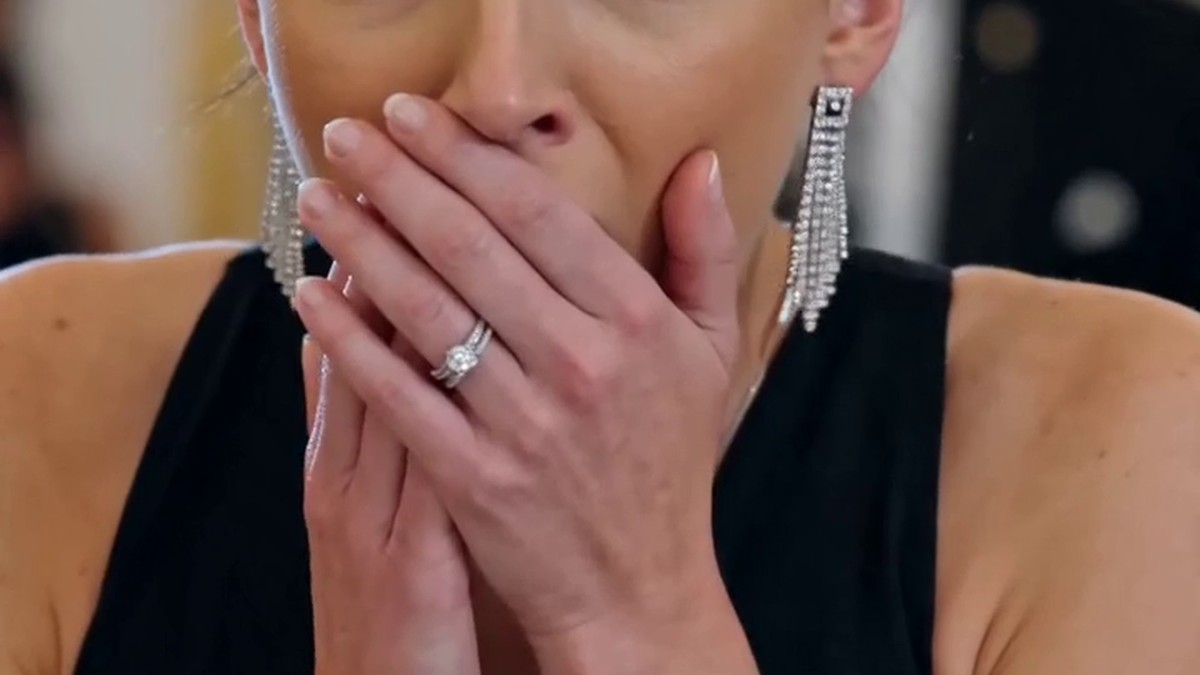
The bride, positioned near the stage, lifted her fingers to her lips. Not in horror. In something closer to entertainment. She watched the fallen woman with eyes that barely tried to conceal their contempt.
Beside her, the groom stood perfectly still.
Silent.
Unmoving.
Not yet.
The cleaning woman pressed her palms against the cold marble and pushed herself up. In the polished floor beneath her, a warped reflection looked back — disheveled, damp, unremarkable.
But when she finally raised her head—
something left the room.
Not anger. Not shame.
Absence. Like a door closing softly somewhere deep inside her.
The mother-in-law advanced, each heel strike against the marble landing like punctuation. “People like you,” she said, voice low and precisely aimed, “need to understand where they belong.”
The cleaning woman said nothing.
Her eyes dropped slightly.
Not in surrender.
In assessment.
Then the unexpected happened.
The groom turned.
Slowly at first — the way a man turns when he’s afraid of what he’ll see.
Then all at once.
The color left his face in a single, visible wave. The champagne glass in his hand tilted. He didn’t notice. His gaze locked onto the woman on the floor and it held there — not with confusion, not with curiosity — but with the specific, gut-level recognition of someone who knows they are out of time.
His mouth opened.
Nothing came out.
The entire room felt the shift before anyone could name it.
“Why are you looking at her like that?” The bride’s voice carried a new edge now. Unease replacing amusement.
He didn’t answer.
He moved.
One step. Then another. Then faster — past the stunned clusters of guests, past the stage, past the wedding itself — until he reached her.
And then he didn’t kneel.
He dropped.
Both knees hit marble with enough force that glasses trembled on nearby tables. It was not graceful. It was not composed. It was a man surrendering to gravity and truth at the same time.
A sound moved through the ballroom — not quite a gasp. More like an entire room forgetting to breathe.
The bride’s expression collapsed.
The mother-in-law went rigid.
And the groom lowered his head toward the woman on the floor.
His voice came out fractured. Barely held together.
“Madam Chairwoman…”
The words landed in the room and detonated in slow motion.
People heard them. Repeated them silently. Still didn’t understand — not fast enough.
The cleaning woman didn’t flinch. She looked at him with the patience of someone who has never needed urgency. Then, without hurry, she placed one hand on the floor and rose.
Deliberately. Fully. As though the marble had been a chair she’d simply chosen to sit in for a moment.
She straightened the collar of her stained uniform.
One small gesture.
It rearranged the entire room.
What had been confusion became something colder. Heavier. The kind of dread that sets in when people realize, all at once, that they have misread every single thing.
Power doesn’t enter with fanfare. It doesn’t need to. It waits — patient and still — until the moment it chooses to be seen.
Her eyes moved through the ballroom.
Slowly. Deliberately.
Faces that had laughed. Faces that had turned away. Faces that had watched her hit the floor and done nothing.
Not one of them could hold her gaze now.
She stopped at the mother-in-law.
Then the bride.
When she spoke, her voice carried no fury. No performance. It arrived soft and measured — and hit harder than anything loud ever could.
“This wedding is canceled.”
One second passed.
Then another.
Nobody breathed. Nobody moved. The chandeliers kept throwing their fractured light across the marble, indifferent.
The bride’s lips parted. No sound followed.
The mother-in-law stood as though something invisible had struck her — though not a single thing had touched her body.
The groom kept his head down.
Not from shame.
From the certainty of a man who had known this ending the moment he watched her fall.
The cleaning woman stepped forward. The marble beneath her feet no longer reflected humiliation.
It reflected something else entirely.
“I want—”
She stopped.
Not from hesitation.
She simply didn’t need the sentence finished yet. The room would wait. The room had no other choice.
And in that suspended, airless silence — everyone who had been so certain they knew what kind of woman stood before them finally understood.
She had never been ordinary.
Not for a single second of her life.
She let the silence finish its work.
Then she spoke.
“My name,” she said, “is Eleanor Voss.”
She said it the way someone sets down something heavy — carefully, deliberately, without drama.
It was enough.
On the far side of the ballroom, a man in a charcoal suit went the color of paper. He was Richard Hayes — patriarch, architect of tonight’s alliance, the man who had spent fourteen months arranging this room, these guests, this evening. His champagne glass found the table by instinct. His hand didn’t follow it. It stayed in the air a moment, suspended, as if the rest of him hadn’t caught up yet.
His wife seized his arm.
He didn’t feel it.
Eleanor Voss.
The name moved through the room in waves — first the inner ring, the ones who recognized it instantly, whose faces changed the way faces change when the ground shifts underfoot. Then outward. To the ones who had to think. Who searched their memory, arrived at the answer, and wished they hadn’t.
Chairwoman of the Voss Group.
Forty-one billion dollars in assets across three continents. Twelve senators who owed their careers to decisions made in her offices. The woman whose single signature could open or close a market the way other people opened or closed a door.
She hadn’t been cleaning the floor.
She had been reading the room.
The mother-in-law — Catherine Sinclair, a woman who had never once in sixty-three years of living been truly afraid of anything — felt fear arrive now as a physical thing. Cold. Specific. Settling in the chest just below the sternum where it couldn’t be ignored or managed away.
She tried her voice.
“Mrs. Voss, I—”
“I know what you are,” Eleanor said.
Not loud. Not sharp. The way a surgeon says *I see it* — right before the incision.
“I’ve known for longer than you’d like.”
Catherine’s jaw closed. The sentence she’d prepared went somewhere else.
Eleanor turned to the room at large. She didn’t raise her voice. She didn’t need to. Every person in that ballroom had already learned in the last four minutes that the woman in the gray uniform commanded attention the way gravity commanded everything else — without effort, without announcement, as a simple function of what she was.
“The Hayes-Sinclair acquisition,” she said. “The one this wedding was intended to celebrate.” She let a beat pass. “It’s been under review.”
Richard Hayes made a sound. Not a word. A sound — involuntary, the kind a man makes when something he has built for a decade begins to tilt.
“My firm holds thirty-one percent of Hayes Pacific,” Eleanor continued. “As of Monday morning.” Another pause — not for effect. For precision. “The paperwork cleared at noon today.”
The room recalculated.
You could see it happening. The math running across faces. The implications arriving in sequence — first the business reality, then the personal one, then the understanding that everything tonight had been built on a floor that had just become open air.
The bride’s name was Constance Sinclair. She was twenty-eight years old and she had been told, for as long as she could remember, that she was the most important person in any room she entered. Tonight she had watched a cleaning woman get shoved to the ground and felt something like satisfaction.
Now she stood at the altar end of the ballroom — white dress, carefully styled hair, a face designed for occasions like this — and she felt, for the first time in her memory, genuinely small.
“You came here,” Constance said, and her voice came out thinner than she intended. “Like this. On purpose.”
Eleanor looked at her.
“I came here,” she said, “because I was invited.”
A breath moved through the room.
“I received an invitation to this wedding three weeks ago. From the groom.” Her eyes moved briefly to where he still knelt on the marble. “Delivered by hand. With a note.”
Nobody spoke.
“The note asked me not to come.” Eleanor’s voice didn’t change. “It said the families wouldn’t understand. That the timing was wrong. That he needed more time to — ” she paused, not searching for the word but choosing whether to use it — “manage the situation.”
The groom’s shoulders dropped another inch.
His name was Daniel Hayes. Thirty-two years old. He had met Eleanor Voss four years ago when she had quietly funded a startup he’d built from nothing, backed it when every other firm had passed, and sat across from him in conference rooms for two years while he grew something real. He had called her the most brilliant person he had ever met. He had said it to colleagues, to friends, to his mother — who had laughed and asked if that meant she was available for dinner.
He had laughed too.
He wasn’t laughing now.
“Stand up, Daniel,” Eleanor said.
Her voice hadn’t changed. It was the same voice she’d used on the marble floor — patient, measured, carrying nothing extra. But it landed differently now that the room knew what it was attached to.
He stood.
He was taller than her by eight inches. It didn’t register.
“I didn’t engineer this,” he said. It came out low. Aimed at her rather than the room. “My family arranged the engagement before — ”
“I know what your family arranged.”
He stopped.
“I also know what you arranged.” She looked at him without cruelty, which was somehow worse than cruelty would have been. “You had two years to tell them the truth. Two years to bring this to the surface. You chose to send a note.”
His mouth tightened.
She didn’t look away from him. “I didn’t come here to ruin your evening, Daniel. I came here because you sent a note to a woman asking her to stay away from a room she had every right to enter.” A pause. Clean and precise. “And I wanted to see if you would recognize me when I was wearing gray.”
The breath Daniel Hayes took was audible across twelve feet of marble.
He had known her for four years. Had worked beside her, argued with her, learned from her. Had trusted her above every person in his professional life.
And when she had crossed the floor of his wedding reception in a uniform and sensible shoes—
It had taken him four minutes.
Four minutes of watching her mop the marble before something in him had broken through the surface of what he expected to see and recognized what was actually there.
Four minutes.
She watched his face do the accounting.
“The wedding is canceled,” she said again — but this time it was quieter. Not a decree. A fact being gently confirmed for the benefit of everyone who still needed to hear it.
Richard Hayes found his voice from across the room. It came out stripped of its usual authority — thin, careful, the voice of a man who has just discovered the building he owns is standing on someone else’s land.
“Mrs. Voss. If we could speak privately — there are arrangements, financial considerations that — ”
“Your attorneys will receive documentation tomorrow morning.” Eleanor turned toward him. “Everything will be handled correctly. Nothing will be hidden. The process will be transparent and fair.” A pause. “Which I understand is not how your family typically prefers to operate.”
Richard Hayes’s jaw locked.
His wife put her hand on his arm again. This time he felt it.
Catherine Sinclair had not moved since the moment Eleanor’s name had entered the room. She stood exactly where she had stood when she’d pointed her finger downward at the woman on the floor. The silver of her gown caught the chandelier light. Her spine was still straight — the posture of a woman who had spent sixty years insisting on it — but something beneath the posture had gone soft and uncertain, the way a wall looks when the foundation has shifted.
Eleanor crossed the marble toward her.
Slow. Unhurried.
The chandeliers threw both their shadows long across the floor — one silver, one gray — and for a moment they moved in parallel, the way things do before one of them stops.
Eleanor stopped.
Catherine Sinclair had pushed her to the ground. Had stood above her and pointed and told her, in front of two hundred people, to learn where she belonged.
Eleanor didn’t mention any of it.
She didn’t need to. The room had seen it. The room would carry it. In every conversation these guests would have tomorrow, and next week, and next year, that image would sit in the center of the story — Catherine Sinclair pointing downward, and Eleanor Voss choosing not to point back.
“The mop,” Eleanor said quietly, “is still in the aisle.”
She gestured toward it — barely. A slight movement of her eyes.
Catherine Sinclair looked.
The mop lay where it had fallen. The smear of its trail cut across the polished marble in a dark arc, visible from every table in the room.
Nobody moved to clean it up.
Nobody was going to.
Eleanor let the silence hold for exactly as long as it needed to. Then she turned away from Catherine Sinclair — turned her back, which was its own statement — and walked toward the ballroom’s main doors.
She walked the same way she had mopped. Quietly. Methodically. Without hurry.
At the edge of the dance floor she paused.
Not because she had forgotten something.
Because she chose to.
She looked back — not at the mother-in-law, not at the bride, not at the groom still standing pale and still in the center of the room.
She looked at the chandeliers.
They were extraordinary things. Crystal cut so fine it could turn a single bulb into a galaxy. Designed to make everyone beneath them feel the weight of the room’s beauty, its permanence, its importance.
She had been in a hundred rooms like this.
Had built half of them.
She lowered her gaze to the marble. To her own reflection, warped and soft in the polished surface — gray uniform, sensible shoes, hair still pinned back without vanity or effort.
Unremarkable.
She almost smiled.
Then the doors opened for her — held by the same young attendant who had watched her mop the floors all evening without a second glance — and she walked out.
The Grand Aurelia Ballroom stood behind her: two hundred guests, three hundred thousand dollars of silk and crystal and carefully aimed light, the collapsed architecture of an alliance fourteen months in the making.
And a mop in the middle of the aisle.
She didn’t hear anything from inside.
Silence — the particular kind that doesn’t come from nothing happening, but from too many things happening at once, all of them too large for sound.
The night air outside was cool. Late autumn doing its quiet work on the city.
Her car was waiting — it had been waiting since eight o’clock, her driver reading a paperback without the engine running — and when she reached it he stepped out and opened the door without a word, the way he had been doing for eleven years.
She paused before getting in.
She looked down at her hands. There was a faint redness on her palms where they’d met the marble. Fading already. By tomorrow it would be gone.
She got in the car.
Her phone had seven missed calls. Three from her general counsel, two from board members, one from a journalist she’d been expecting to hear from since Monday, and one from a number she didn’t recognize — Daniel Hayes’s new cell, probably. The old one she’d blocked three weeks ago when the note arrived.
She set the phone face-down on the seat beside her.
Outside the window, the city moved past in its usual way. Lit windows. Yellow cabs. People on sidewalks with their collars turned up against the cold, going about the ordinary business of their ordinary lives, none of them watching.
She had spent thirty years building things in rooms that people assumed she hadn’t been invited to enter. Had sat in chairs that weren’t offered. Had held ground in spaces designed to make her feel the precise dimensions of her own smallness.
She knew what it cost.
She also knew what it was worth.
The car moved through an intersection, and the ballroom disappeared behind her — those frozen explosions of chandelier light fading into the general glow of the city — and Eleanor Voss let herself, in the privacy of the back seat, exhale.
Long. Complete. The kind of breath that carries something out of the body that has been held there too long.
She picked up her phone.
Opened her email.
Typed four sentences to her legal team, sent them, and closed the screen.
Then she looked out the window again.
The city looked exactly as it always had.
Only the room she’d left behind had changed — permanently, irrevocably, in the way that rooms change when the wrong assumptions are finally, publicly, and completely corrected.
She hadn’t gone there to prove anything.
She’d gone because someone had told her to stay away.
And Eleanor Voss had never, in sixty-one years of living, taken that particular instruction from anyone.
The car moved on.
The night received her quietly, without ceremony.
The way it always had.