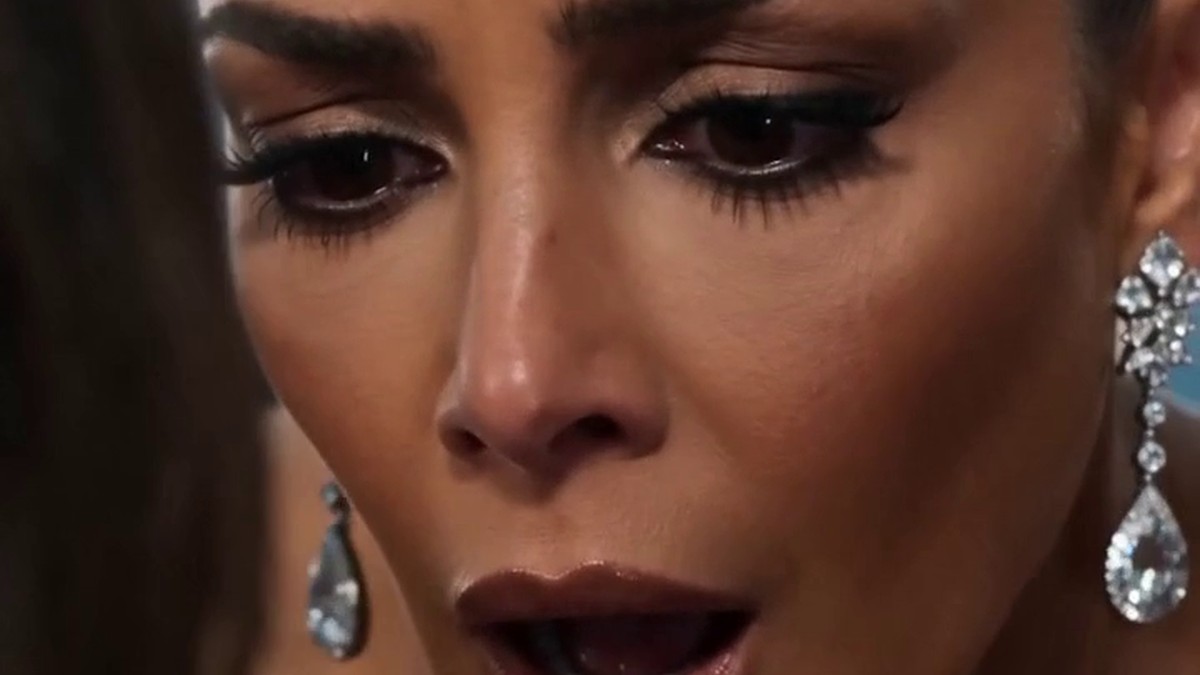
The red carpet was its own universe that night. Lights blazed. Shutters fired like small explosions. Gowns caught the glow and threw it back. A well-known actress moved through it all with the ease of someone who had learned, long ago, to perform being comfortable.
Photographers hollered her name. She gave them the angle they wanted.
Then, at the velvet rope, a security guard stepped sideways — blocking a child. Small. Ragged at the edges. The kind of kid nobody on a red carpet was supposed to see.
“Don’t let her near me,” the actress said. Reflexive. Eyes still forward.
The girl didn’t run.
She stood with the stillness of someone who had been turned away before and had decided, this time, not to flinch.
Then, slowly, she lifted her wrist.
Dangling from it was a hospital baby bracelet — the kind they put on newborns. Faded. Tied to her wrist with a pink ribbon so worn it had gone gray at the knot.
The actress turned.
She looked at the bracelet. She didn’t move.
“My mother told me you’d recognize my name,” the girl said. Barely above a whisper.
The actress crossed the distance between them in two steps. Leaned in. Read the handwriting curled around the tiny band.
Her breath left her like something had knocked it loose.
“I wrote this,” she said. Her voice cracked on the last word. “The night they took my baby away from me.”
The cameras were still rolling. Nobody spoke.
Tears broke across the girl’s face — not dramatic, not performed. Just quiet and real and devastating.
“Then why,” she asked, “did everyone tell me you never wanted me?”
A long silence opened between them — the kind that swallows sound whole. Then the actress straightened, slowly, and took the girl’s hand. Not to lead her anywhere. Just to hold on.
The actress’s publicist was already moving — heels sharp against the carpet, hand raised, a practiced smile deployed like a weapon. This was her job. Containing moments before they became stories.
“Ms. —”
“Don’t.” One word. Flat and final.
The publicist stopped.
The actress hadn’t looked up. She was still crouched at the child’s level, one hand hovering near the bracelet as if she were afraid to touch it, afraid it might dissolve. The cameras kept firing. The shutters kept exploding. The whole glittering machine kept grinding forward, because that’s what the machine does — it doesn’t pause for anything human.
But she had gone somewhere else entirely.
—
Her name was Wren. The girl. She said it quietly when the actress finally asked, in a voice that suggested she’d practiced saying it out loud to strangers and still hadn’t gotten comfortable with the exercise.
“Wren,” the actress repeated.
Something moved across her face. Private. Enormous.
“That was the name I —” She stopped. Pressed two fingers to her mouth. Started again. “That was the name I chose. Before they told me I didn’t get to choose anything.”
Wren watched her with eyes that were doing the same inventory adults do when they don’t trust a situation — cataloging exits, measuring sincerity, looking for the thing that’s about to go wrong. She was eleven. She had an eleven-year-old’s body and something ancient living behind her eyes.
“My mom got sick,” Wren said. “She’s been sick for a while. She said before it got worse I needed to know.” A pause. “She said you were the only one who’d understand why she took me.”
The actress went very still.
“Took you from where?”
“From the hospital.” Wren’s chin came up a fraction. “She was a nurse. She said a girl came in young and alone and signed papers she didn’t understand because everyone in that room was telling her what to do. She said she watched them hand that girl a pen and she knew it was wrong.” Her voice held steady. “So she took me home instead.”
—
Inside the lobby of the theater — away from the cameras, away from the light — they sat on a bench near a coat check that wasn’t running yet. The actress’s manager stood twenty feet away, speaking rapidly into a phone. Her publicist stood thirty feet in the opposite direction, speaking into a different phone, her voice controlled in the way of someone managing a disaster that had not yet fully declared its size.
Neither of them came closer.
The actress had both hands wrapped around a paper cup of water that a terrified assistant had produced and she hadn’t drunk. Wren sat beside her with her worn-ribbon bracelet resting on her knee, not touching it, just aware of it.
“She told you everything?” the actress asked.
“Not everything. Some things she couldn’t say out loud.” Wren looked at her hands. “She wrote them down. She gave me an envelope.” She reached into her jacket — a too-large thing that had clearly belonged to someone else — and produced it.
The actress took it. Didn’t open it. Just held it.
“Is she going to be okay?” she asked. And then, before Wren could answer, she caught herself. She knew that wasn’t a fair question to put on a child. She knew exactly what it cost to be the person in the room who had to answer something like that. “I’m sorry. You don’t have to —”
“They don’t know yet,” Wren said simply. “That’s why she wanted me to find you now. Just in case.”
The paper cup crinkled slightly in the actress’s grip.
—
The envelope contained a letter, three photographs, and a folded hospital form — the original, not a copy. Official. Signed in a hand the actress recognized as her own from a long time ago, when she was twenty-two and had been in that room for six hours and had finally stopped fighting because she was exhausted and alone and had believed, truly believed, that she had no other option.
The first photograph was of a baby. Newborn. Dark-haired. Wrapped in white.
The actress made a sound she immediately tried to swallow.
The second photograph was of a woman — the nurse, presumably. Warm-faced. Tired-eyed. Holding that same baby in a different room, a kitchen maybe, light coming in through yellow curtains. She was looking at the baby the way people look at things they have decided to love all the way, consequences be damned.
The third photograph was recent. Wren, at what looked like seven or eight, missing a front tooth, standing in front of a birthday cake with her arms out like she owned the whole world.
The actress stared at that one for a long time.
“She loved you,” she said. It came out rough. “That woman. Whatever else — she loved you.”
“I know,” Wren said. “She still does.”
—
Her manager materialized at her shoulder eventually, because managers always do.
“We need to talk about what’s on those cameras,” he said quietly, crouching beside her. “The footage is already —”
“I know what it’s already doing,” she said.
“Then you know we need to —”
“I need five minutes.” Her voice didn’t rise. It didn’t have to. “I need five minutes without anyone telling me what we need.”
He withdrew.
She looked at Wren.
Wren was watching her with that careful, measuring look — the same look she’d had at the velvet rope, when the security guard had stepped in front of her and she’d decided, quietly, not to flinch. Not to run. To simply stand there and see what the world would do next.
“I have to ask you something,” the actress said. “And you don’t have to answer.”
Wren waited.
“Did you come here tonight because your mother asked you to? Or did you come because you wanted to?”
Wren considered this with the seriousness it deserved. Outside, through the lobby doors, the red carpet was still happening — still blazing, still firing, still performing its gorgeous indifferent spectacle. The machine grinding on.
“Both,” Wren finally said. “She asked me to. But I wanted to.” She paused. “I’ve wanted to for a long time. I used to —” She stopped. Started again. “I used to practice what I was going to say. Different versions. Depending on what you were like.”
“What version did you end up using?”
The ghost of something passed across Wren’s face. Not quite a smile. But something in that direction.
“I didn’t use any of them,” she said. “I just showed you the bracelet.”
—
The actress opened her mouth to say something, and then her breath caught.
Because she had looked down at her own wrist — reflex, or memory, or something older than either — and she had seen nothing there, of course. There was nothing there. There had been nothing there for eleven years.
But her wrist remembered.
She felt it like a phantom. The thin plastic. The ink in her own handwriting, curled around something impossibly small and impossibly real, the whole enormous fact of a new person compressed into a single printed name on a strip no wider than two fingers.
She had sat in that hospital room and she had written it, and then they had put it on the baby’s wrist, and then —
And then.
She pressed her hand flat against her knee and breathed.
“I want to meet her,” she said. “Your mother. I want to meet her, and I want —” Her voice broke and she let it break, because there was nobody left in this moment to perform for. “I want her to know that I don’t — I’m not angry. I need her to know that.”
Wren looked at her for a long moment.
“She’s scared you will be,” Wren said. “That’s the other reason she sent me first. To see.”
“To see what?”
“What kind of person you actually are.”
The actress laughed — short and fractured and nothing like the laugh she gave to cameras. It sounded like something breaking loose.
“And?” she said.
Wren picked up the bracelet from her knee. Held it in her palm. Looked at it the way you look at something you have carried so long it has become part of your weight — familiar, essential, the shape of an obligation you chose before you understood what choosing meant.
Then she closed her fingers around it.
“I’ll call her,” Wren said. “She’ll want to come.”
She pulled a phone from the pocket of her too-large jacket — an older model, the screen scuffed at the corners — and dialed without looking up the number. It rang twice.
Then a voice answered. Tired. Careful. Present.
Wren didn’t say much. Just: “I found her. She wants to meet you.” A pause. “Yeah.” Another pause, longer. “I think so too.”
She held the phone out.
The actress took it with both hands, the way you take something fragile. She pressed it to her ear. For a moment she didn’t speak — just listened to the breathing on the other end, the particular sound of someone gathering themselves for a thing they have waited a very long time to say.
“Hello,” the actress said finally. Her voice was steady. It surprised her. “I’m not angry. I need you to know that first.”
A silence. Then, from the other end, a sound that was not quite words and did not need to be.
—
They sat together in the quiet of the lobby while the red carpet blazed and thundered just beyond the glass doors. Two people who had been separated by a night neither of them had been old enough to fully understand, brought back together by a strip of faded plastic and a pink ribbon gone gray at the knot.
The envelope sat between them on the bench. The photographs lay open. The phone rested on the actress’s knee, the call still connected, the woman on the other end simply there — breathing, listening, present across whatever distance remained.
After a while, Wren said, “Do you actually like all of this? The cameras and everything?”
The actress thought about that honestly.
“I like the work,” she said. “The rest of it —” She glanced toward the doors. The blaze. The thunder. “The rest of it is just the price.”
Wren nodded. She seemed to find this satisfactory.
“My mom says everything costs something,” she said. “She says the only question worth asking is whether what you’re paying for is worth it.”
The actress looked at her. This girl with ancient eyes and a too-large jacket and eleven years of a life she hadn’t known was happening, growing up in a kitchen with yellow curtains, loved fiercely and completely by a woman who had once watched a terrible thing occur and had made a terrible, tender, complicated choice to stop it.
“Yeah,” she said quietly. “It is.”
Outside, someone called her name. The machine, reminding her it was still running. Still waiting. Still needing the angle it always needed from her.
She didn’t get up.
Not yet.
For now she stayed exactly where she was — on a bench beside a girl who had her eyes and her stubbornness and apparently, based on the evidence, her complete unwillingness to flinch when the world told her to — and she held the paper cup of water that had gone warm in her hands, and she let the machine wait for once.
It could have her back in a minute.
Right now, this was the only room in the world that mattered.