No one in that ballroom was ready for what came next.
The sound cut through the air like a gunshot — sharp, ugly, final. Isabella’s head whipped sideways. Her veil slid from her shoulder and caught the light as it fell. Three distinct marks bloomed across her cheek, red as a warning.
The hand that struck her didn’t belong to a stranger.
It belonged to the woman who was about to become her mother-in-law.
“A girl like you has no place in this family,” the older woman said, her voice low and deliberate, built to wound.
The guests went still.
The groom said nothing.
And in that silence, standing alone beneath a cathedral ceiling hung with crystal, Isabella understood something with cold and absolute clarity — no one in this room was going to step forward. Not for her.
So she reached into her bridal clutch.
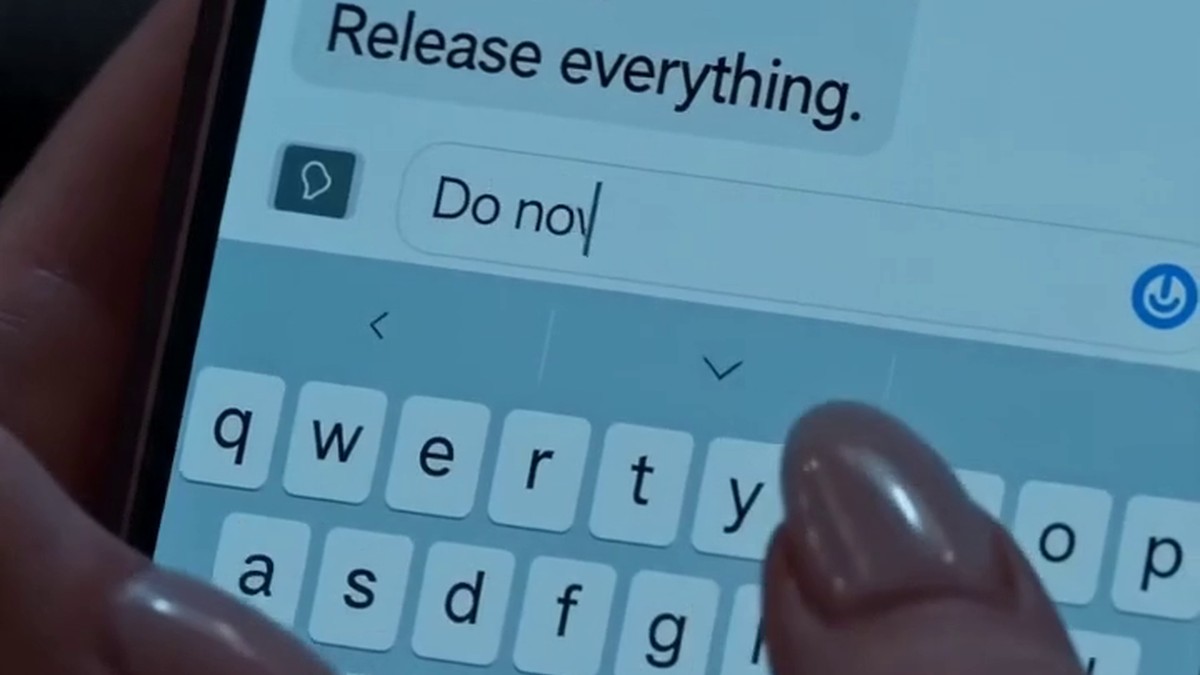
She pulled out her phone.
Six words. That was all it took.
*”Do it now. Release everything.”*
The lights dropped within seconds.
The enormous screen behind the altar blinked once, then ignited.
People shifted in their seats. Glances darted sideways. Someone near the back made a sound that wasn’t quite a word.
The groom’s father went the color of chalk.
Because what was loading on that screen had nothing to do with wedding reels or love stories or slideshow memories.
It was evidence.
Documentation of a secret that had been locked away for over two decades — buried carefully, protected by money and the quiet assumption that certain people were untouchable.
And when a face materialized on that screen — a face the room recognized — the entire wedding stopped breathing at once.
Because the people who had chosen to humiliate Isabella tonight had made one catastrophic miscalculation.
They never once asked who her family was.
She had known, walking down that aisle, that something would break before the evening was over. She just hadn’t known it would be this clean.
Isabella lowered her phone.
Her cheek still burned. The three marks were deepening now — she could feel them the way you feel a brand, heat spreading outward from the center, humiliation trying to root itself in her skin. She didn’t touch her face. She didn’t give it that.
Instead, she watched the screen.
—
The face that had appeared belonged to Congressman Harold Voss.
Not the silver-haired, flag-pin version standing twenty feet away from her right now, rigid in his tuxedo, blood draining visibly from his jaw. The face on the screen was younger — mid-forties, tan from a different decade’s summers — captured in a fluorescent-lit room that had the particular ugliness of institutional spaces. A conference room. A real estate office. The kind of place where handshakes seal things that can never be written down.
Except someone had written it down.
Everything.
The transfer of land holdings in three counties to shell companies that didn’t exist until seventy-two hours before the zoning votes. The vote records themselves. The wire transfers. The signatures — God, the signatures — and beneath each one, a timestamp, a notarized confirmation, a chain of evidence so meticulous it looked almost like love.
Because it had been, Isabella thought. Her grandfather’s love. Thirty years of careful, obsessive documentation from a man who’d watched his whole township get carved up and sold out from under people who trusted the process, and who’d had the extraordinary foresight to keep every single receipt.
She had inherited that archive eighteen months ago.
She had been waiting for a reason to use it.
—
“Turn it off.” Harold Voss’s voice came from the right side of the room — low, controlled, but with something cracked underneath it. He was moving toward the AV tech stand near the side wall, and his certainty of movement, that politician’s ease, was already faltering. His feet knew where they were going but his face had stopped agreeing.
“Mr. Voss.” Isabella spoke clearly, into the silence. “That’s being streamed live to four journalists and a federal inbox. Turning off the projector won’t help you.”
He stopped.
The room didn’t breathe.
His wife — Eleanor Voss, the woman whose hand had just left its signature across Isabella’s cheek — turned from the altar with an expression Isabella had never seen on another human face. It wasn’t anger. It was something far more primal. The look of someone watching walls come down that they built their entire life inside.
“You little —”
“Careful,” Isabella said. “You’ve already hit me once tonight. In front of four hundred people and, as of forty seconds ago, a live stream.”
Eleanor’s mouth worked without sound.
The groom — Marcus, her almost-husband, the man she had chosen nine months ago because he’d been kind, or she’d believed he was kind, which she now understood were not the same thing at all — Marcus was still standing where he’d been standing when his mother struck her. He hadn’t moved. Hadn’t spoken. His boutonniere was slightly crooked.
Isabella looked at him with something that wasn’t quite grief and wasn’t quite relief but lived exactly between them.
“Marcus.”
He finally met her eyes.
“Say something,” she said. Not demanding. Almost gentle. A final offer.
He looked at his father. Then at his mother. Then back at Isabella with an expression she would carry for a long time afterward — not because it was cruel, but because it was nothing. A perfect, terrible nothing. The face of a man choosing, in real time, and the choice requiring no visible effort whatsoever.
He straightened his jacket.
He said nothing.
—
That was when David walked in.
He came through the main doors at the back of the ballroom — her brother, six-foot-two, with their grandfather’s same unhurried stride and the particular calm of a person who has done something irreversible and is at peace with it. He was still in his car coat, which meant he’d driven straight from the filing office.
He walked the full length of the aisle without rushing.
When he reached her, he didn’t speak either. He just offered his arm.
She took it.
—
“You can’t just —” Harold Voss found his voice again, too loud for the room, the acoustics of a cathedral ceiling throwing it back at him from all directions. “This is defamation. This is theft of private documents, this is —”
“It’s your signature,” Isabella said, without turning around. “You signed it. Multiple times. In front of witnesses you subsequently paid very well to forget.” She paused at the end of the aisle and looked back at him, once, the way you look back at a house you grew up in and are glad to leave. “The U.S. Attorney’s office got the full package at nine-fifteen this morning. The journalists have the summary. What’s on that screen right now is just the part everyone gets to see for free.”
The congressman’s face had completed its journey from chalk to something grayer, more permanent. The flag pin on his lapel caught the chandelier light as his chest rose and fell.
His wife had sat down. Not on a chair. Just — down, onto the altar steps, tulle pooling around her ankles, her hand finally, slowly, covering her mouth.
The guests didn’t speak. Four hundred people sat in absolute suspension, like a frame of film held under a lamp.
Marcus hadn’t moved.
Isabella held his gaze for one last second.
Then she walked out with her brother.
—
The night air outside the cathedral was cold and clean and tasted like November.
She stopped on the stone steps and breathed it.
Her cheek had moved past burning into something duller, settled. She pressed her fingers against it now — finally allowed herself that — and felt the warmth radiating off the skin, proof that it had happened, proof that she had survived it happening.
“You okay?” David asked.
“Ask me in a week.”
“You’ll be okay in a week.”
“I know.” She let out a breath. “The dress is hideous, by the way. I’ve thought so since the third fitting and I never said anything.”
David looked at her sideways. “It is pretty bad.”
“The tulle,” she said. “It’s too much tulle. Nobody needs this much tulle.”
He laughed — a short, real laugh — and then she was laughing too, not because it was funny, not exactly, but because laughter was what the body reached for when it was too full of everything else, and her body needed somewhere to put it.
Behind them, through the cathedral’s heavy doors, she could hear the murmur starting — the slow swell of four hundred people remembering how to make noise. A few phones going. Someone’s voice rising, formal, official-sounding. The sound of a life she’d almost stepped into, breaking loose from its foundations.
She had spent eighteen months deciding what to do with her grandfather’s archive.
In the end, it hadn’t been a plan that decided it. It hadn’t been strategy or calculation or any of the cold words people would use later when they wrote about it.
It had been a slap.
Three marks across her face, and the silence that followed, and the groom who looked at his mother and chose.
That was all it had taken.
She reached up and unclipped the veil — it was the only part of the dress she’d actually liked, handmade, something borrowed from her mother — and folded it carefully over her arm.
“Car’s a block down,” David said.
“Okay.”
She walked down the cathedral steps in a hideous tulle dress, veil folded against her chest, the cold November air pulling at her hair, the sound of everything collapsing quietly behind her.
And she didn’t look back again.





