Tonight was no different.
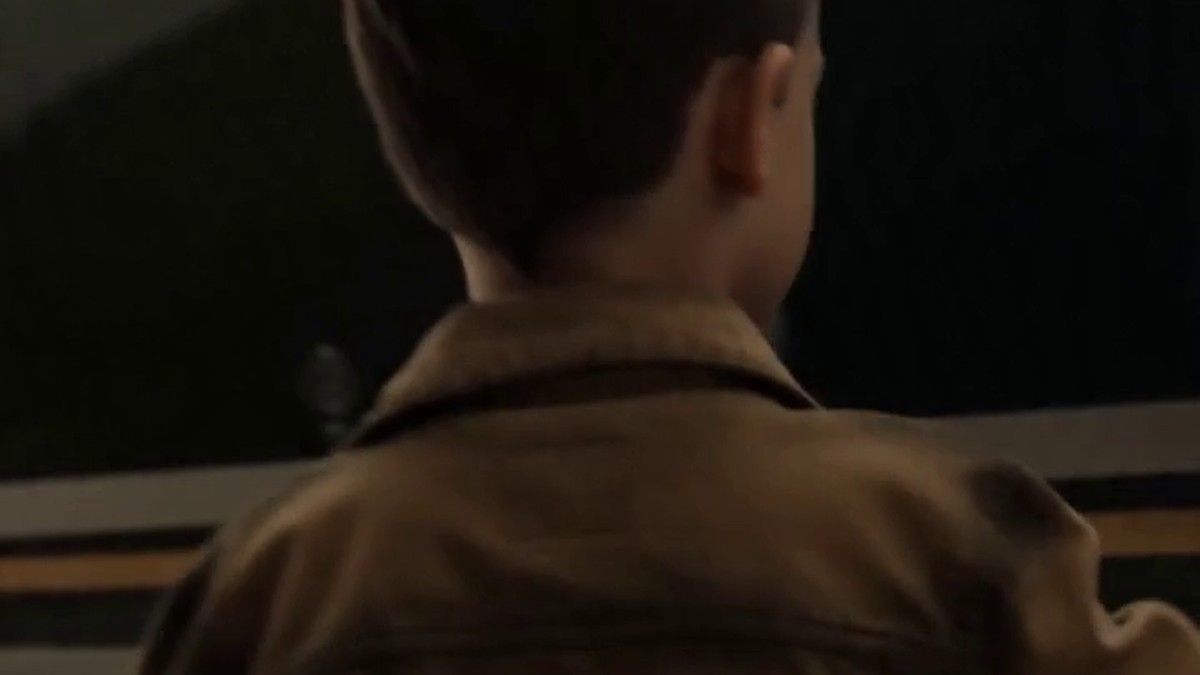
But near the terminal windows, away from the crystal and the cologne, stood a boy.
Ten years old. Maybe younger. He wore a brown jacket, faded at both elbows, and sneakers that had seen too many miles. Around him swirled the wealthiest crowd in the city. He didn’t fidget. Didn’t stare at the jet with wide eyes or reach for anything. He simply stood there — still as a held breath — and watched.
Damian noticed him.
A grin split across his face. Slow. Deliberate.
“Hey, kid,” he called out, loud enough to pull attention from every nearby conversation. “Open that jet for me — I’ll hand you fifty thousand dollars on the spot.”
The laughter came fast and hard. One man nearly choked on his drink. Someone raised a phone to record. A woman pressed her fingers to her mouth, shoulders shaking.
Damian strolled closer and dropped into a slight crouch, the way adults do when they want a child to feel small.
“Well?” he said, voice dripping. “What’s the matter — you scared?”
The boy looked at him.
No smile. No flinch. No performance.
Just a pair of steady eyes holding steady.
Then, quietly, he asked one thing.
“Are you sure?”
Three words. But the way they landed made a few people stop laughing mid-breath.
Damian smirked. “Completely.”
The boy turned toward the jet.
Studied the door.
Looked back once.
Across the terminal, an older woman went pale so suddenly it looked like the blood had been pulled from her face. Because she recognized the expression the boy wore. Not bravado. Not defiance.
Recognition.
He walked forward. No rush. No hesitation. Each step measured and certain, as if he’d rehearsed this moment — or been told about it his whole life.
He stopped beside the aircraft door and raised one hand.
Held it there for just a moment.
Then he spoke in barely a whisper.
“My mother told me you’d be afraid the day I stood right here.”
The terminal went quiet.
Not polite quiet. Not the pause between songs at a party.
Absolute quiet.
Damian’s smirk dissolved.
The boy pressed his hand to a small black panel mounted beside the door.
*Beep.*
A green light blinked on.
Nobody moved. Nobody breathed. Even the man still holding his phone forgot to press record.
Then a flat, mechanical voice emerged from the jet’s speaker system — calm and indifferent and devastating.
*”Welcome back, Ethan.”*
The room broke open.
People turned to each other. Phones dropped to sides. The laughter that had filled the space sixty seconds ago was gone as if it had never existed.
Damian’s face went the color of ash.
Because the boy had never told a single person in that room his name.
The aircraft door released with a heavy mechanical click — and began to open.
The billionaire stepped backward. Once. Twice.
“No,” he breathed. Just that.
Nearby, the older woman let go of her champagne flute. It hit the marble and exploded. Her hands trembled visibly now, fingers spread, eyes locked on the boy.
Because she knew exactly who he was.
And she knew the thing Damian Cross had spent years and money and power making sure the world never found out.
The boy stepped inside.
Everyone watched. Frozen.
Seconds later, he returned.
He was carrying a small metal box. Old. Scratched across every surface. Locked. The kind of object that looks like nothing — until you understand what’s inside it.
Damian moved without thinking.
“Give me that.” He lunged forward, arm outstretched.
The boy stepped back cleanly. His face didn’t change.
The crowd noticed.
So did the security detail near the doors.
Because Damian Cross had gone from smug to desperate in under a minute. And that kind of fear — the raw, cornered kind — spread through a room like smoke.
“What’s in the box?” someone asked.
The boy looked at Damian.
Then answered quietly.
“My father.”
Confusion. Murmurs. The billionaire looked like his legs might give.
The boy opened the box.
Inside: photographs. Documents. USB drives. And a leather journal, worn soft at the corners from years of handling.
Resting on top was a single photograph.
A younger Damian Cross. Standing beside another man. Both of them smiling. Easy. Comfortable. Like partners. Like friends.
The same man appeared in dozens of the photographs beneath.
The boy held the picture up.
“That’s my dad.”
Silence pressed down on every surface in the room.
Then the older woman stepped forward from the crowd.
Her voice broke once before she steadied it.
“His father built this company alongside Damian. From nothing.”
Gasps moved through the terminal like a current.
The boy nodded slowly. “My father designed the security system for every Cross Aviation aircraft.” He paused. “But then he found something he wasn’t supposed to find.”
Damian shook his head. His jaw was tight. “Stop. Stop talking.”
The boy didn’t stop.
“He found evidence that money was being stolen from the company.” He held up the journal. “And he wrote all of it down. Every detail. Every date.”
Damian recognized it.
He recognized it immediately, and the recognition broke something in his face — because he had been certain that journal no longer existed. Had believed it for years. Had built his certainty on top of a story about a boating accident.
Tragic.
Unexpected.
Closed.
But the journal told the story differently.
The boy’s voice stayed level, even as his eyes grew wet for the first time.
“My father told me that if anything ever happened to him, I should wait. Wait until I was old enough to understand what I was carrying.” He swallowed. “He said someday I would learn who betrayed him.”
Not a sound in the room.
Then the boy drew out one final photograph.
Damian. His father. A business contract signed between them.
And written across the bottom, in six words, in blue ink — handwriting that clearly belonged to a man who knew he was running out of time:
*If I disappear, ask Damian why.*
The billionaire closed his eyes.
Because every camera in that terminal had found him. Every investor, every reporter, every employee who’d spent years believing the story they were told — all of them were watching now. Waiting.
And for the first time in his life, Damian Cross stood in a room full of people with absolutely nothing left to stand behind.
The boy clutched the journal to his chest as the tears finally came.
“I didn’t walk in here for your fifty thousand dollars,” he whispered.
“I came for the truth.”
And as silence settled over that glittering terminal — as the billionaire stared at the evidence he was certain he’d buried — one question hung in the air, heavy and unmoving:
What is it that truly terrifies the powerful? Not the loss of money. Not the loss of status.
It’s the moment their buried secrets finally find their way home.
The security detail moved first.
Two men in dark suits peeled away from the doors and crossed the marble floor in long, measured strides. Not toward Damian. Toward Ethan.
The crowd saw it. A few people stood up straighter. Someone said, *hey* — just that, one syllable, but enough.
“I wouldn’t,” said the older woman.
Her voice carried the way voices do when they’ve spent a long time being right about things. Both guards slowed. Looked at each other. Looked back at Damian.
Damian said nothing.
That was answer enough.
The guards stopped.
—
The older woman’s name was Margaret Hale. Most people in that terminal knew her face — she had sat on the Cross Aviation board for eleven years, had been there for the initial public offering, had given a toast at the company’s fifteenth anniversary gala. Her picture hung in the lobby of the headquarters building on the fourteenth floor, framed in brushed silver.
What most people did not know was that she had worked alongside Ethan’s father before any of that.
Before the company had a name.
Before it had a terminal.
Before it had anything except two men with an idea and a third person willing to believe in it.
She walked through the crowd and stood beside the boy. Not dramatically. Not like she was making a statement. Like she was simply standing where she was supposed to stand.
She put one hand on his shoulder.
Ethan looked up at her.
“You knew him,” he said.
“Your father was the best man I’ve ever worked with,” Margaret said. Plainly. As though it were a fact she’d kept packed away for years, and setting it down in the open was the only relief she had left. “He was also the most honest.”
Damian’s voice came out low and stripped of everything that had made it impressive ten minutes ago.
“Margaret. Don’t.”
She looked at him the way you look at something you once loved and can no longer recognize.
“I’m sorry I waited this long,” she said. And it wasn’t clear whether she was speaking to Damian or to the boy or to the man who wasn’t in the room.
Maybe all three.
—
“Let me explain something,” Damian said.
He had gathered himself. You could see it happening, the way a person squares their shoulders before they lie — that half-second realignment, the jaw setting, the eyes going careful and deliberate. He was good at it. He had been good at it for a very long time.
He turned to face the room.
“I don’t know where this boy came from tonight. I don’t know who put him up to this, or what he was told, or what’s really in that box—”
“The journal has dates,” Ethan said.
Simple. No heat in it.
“It has account numbers. Wire transfers. My dad wrote down everything that moved out of the company accounts between March and September twelve years ago.” He held the journal out. “Forty-seven million dollars.”
A sound moved through the crowd. Low. Collective. The kind that has no word for it.
Damian spread his hands. “Documents can be fabricated. A child can be used. Whatever this is—”
“Then let someone look at them,” said a man near the back.
Heads turned. He was late fifties. Silver at the temples. He wore his suit the way people wear suits when they’ve been wearing them since before they were legal to drink — like a second skin, not a costume. Three people near him recognized him immediately.
Raymond Cho. Forty-year investigative career. Former federal prosecutor. Currently a partner at the kind of law firm whose name you’d know if you’d ever needed one.
He hadn’t come here for a party.
He had come because Margaret Hale had made a phone call four days ago.
“I’ve already reviewed copies,” Cho said, moving through the crowd with the unhurried authority of someone who has stood in rooms far more hostile than this one. “Forensic accountants and two former SEC investigators have as well. The originals were deposited into a court-certified evidentiary hold this afternoon.” He stopped a few feet from Damian. “Before you arrived.”
The silence had texture now. Weight and grain and temperature.
Damian’s mouth opened.
Nothing came out.
“The account numbers in that journal,” Cho continued, “correspond to three shell companies dissolved in the Cayman Islands eleven years ago. The dissolution dates are interesting. They fall within six weeks of a boating accident in the Gulf of Mexico.” He paused. “The accident that killed Daniel Reyes.”
*Ethan Reyes.*
Someone near the window said the name out loud, barely above a breath, as the pieces assembled themselves in real time. *That’s Daniel Reyes’s son.* The name rippled outward. Phones came back up — not to record a billionaire humiliating a child, but for an entirely different reason now.
Ethan stood with the journal against his chest.
He wasn’t performing anything. He wasn’t triumphant. His face looked the way faces look after something has been carried a very long time and is finally being set on the ground — exhausted, and a little raw, and quietly unshaken.
—
Damian moved.
Not toward the lawyers. Not toward the door.
Toward the boy.
There was something in his face that had gone past calculation now, past the social machinery and the practiced charm, down to the exposed wire of a man who had built his entire life on one act he couldn’t take back and had spent every day since then making sure no one would ever find out.
“Your father,” he started.
He stopped.
“Your father made it personal,” he said. “It wasn’t supposed to—” He stopped again. Tried once more. “It wasn’t supposed to go the way it went.”
No one in the room moved.
“What did you do?” Ethan asked.
“I was afraid.” The words came out of Damian Cross like something pulled through gravel. “He was going to go to the board. He was going to take everything apart. I had people depending on me. I had—” He looked around the room. At the investors. At the faces he had curated and cultivated and charmed and kept in orbit around himself for decades. “I couldn’t let it all come down.”
“What did you do?” Ethan asked again.
Quieter.
Steadier.
Damian’s eyes moved to the photograph still visible in the box — the two of them together, young and grinning, the whole future laid out somewhere behind them.
“I made a phone call,” he said. “I told someone where he’d be.”
The terminal exhaled.
Margaret’s hand tightened on Ethan’s shoulder.
Ethan didn’t look away from Damian. Not for one second. His eyes were wet but his voice was the most controlled thing in the room.
“He knew,” Ethan said. “He told my mother he knew. She said when he left for that trip, he kissed her and held on too long.” A beat. “He left me the box. Told her to give it to me when I was old enough.” Another beat. “He said to make sure I knew he didn’t run away.”
Damian Cross closed his eyes.
“He didn’t,” he said. Very quietly. “He didn’t run. He never would have run. That was—” His voice broke for the first time. Just once. Just briefly. “That was the problem.”
—
Raymond Cho stepped forward and spoke in a tone that had no performance in it at all.
“Mr. Cross. You’ll want to call your attorneys.”
“I have attorneys,” Damian said.
“You’ll want more of them,” Cho said.
The two men in the dark suits looked at each other again. This time they stepped back, away from Damian, toward the door. Not desertion — just the particular geometry of people recognizing which way the river is running.
Ethan looked at the man in front of him.
The man who had called him over as a joke. Who had crouched down to make him feel small. Who had laughed with a room full of people at a boy in a faded jacket who they assumed had nothing and was nothing and would never be anything.
The man who had made a phone call.
“I’m not going to forgive you,” Ethan said. “Not today.”
Damian said nothing.
“But I want you to know that I remember what he looked like.” The boy’s voice was level and low and it landed on every surface in the room. “I’m always going to remember what he looked like. And you’re never going to be able to forget what you did. And that’s going to have to be enough. Because that’s all I’ve got.”
He looked down at the journal.
Then he carefully, deliberately, set it in Margaret’s hands.
—
The private terminal cleared slowly, the way a storm clears — not all at once, but in stages, leaving the air different than it had been before. Photographers materialized from somewhere. Voices rose outside. Three separate networks would carry the story before midnight.
Ethan sat on a bench near the window with his metal box beside him.
Margaret sat with him.
They didn’t speak for a long time.
Outside, the black jet still sat on the tarmac in the floodlights, enormous and motionless. It had always belonged to his father’s work, Ethan thought. To the man who had designed the system that opened it. It seemed right, somehow, that it had opened for him.
“He talked about you all the time,” Margaret said eventually.
Ethan looked at her.
“He said you were going to be the most stubborn person in any room you walked into.” A short sound — not quite a laugh, something thinner and more honest. “He meant it as a compliment.”
Ethan looked at the photograph one more time. His father’s smile. Easy and unguarded, the way people smile when they think they have time.
“I know,” Ethan said.
He closed the box.
Held it in his lap with both hands.
Outside, the city pressed its lights against the glass, and a boy who had walked into a room full of people who laughed at him sat quietly with the truth his father had carried — and placed it, now, into the hands of the world.
He hadn’t come for fifty thousand dollars.
He had come for this.
For the moment the laugh stops.
For the moment the room goes quiet.
For the first honest silence in twelve years.