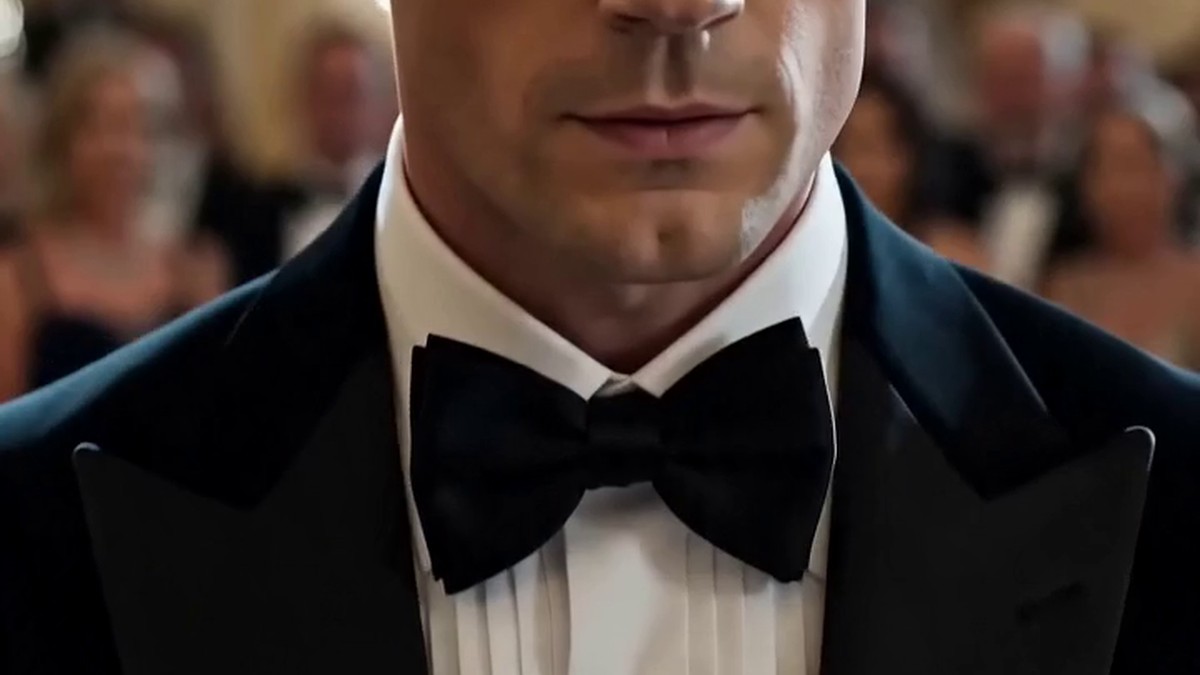
It happened in front of four hundred witnesses, twelve television cameras, three federal judges, two senators, and the woman who had just handed Vincent Caruso every reason to stop pretending he had anything left to protect.
One moment, the Halstead Grand Hotel ballroom was incandescent—chandeliers dripping light like melting stars, crystal catching fire on every surface, champagne gliding across the room on silver trays. Women draped in couture laughed just a shade too loudly beside men whose smiles had purchased juries, permits, and silence in bulk. A string quartet breathed something delicate near the marble staircase, soft enough to make the room feel, if only briefly, like it had nothing to hide.
Then Vincent descended from the second-floor corridor.
The music didn’t stop all at once.
It unraveled—one instrument going quiet, then another—as though the musicians sensed the danger before their minds caught up with it.
Vincent Caruso, the man Chicago feared out loud and obeyed in private, moved through the balcony doors with every detail of him immaculate: tuxedo flawless, black hair lacquered back, cuff links throwing cold sparks under the chandeliers. No crease. No fracture. No fury written anywhere on his face.
That was exactly what made people’s blood go slow.
If he had roared, the room would have known its lines. If he had hurled a glass, dragged his younger brother down those stairs, or humiliated his wife the crude way powerful men usually preferred, everyone would have called it passion. Temper. A man undone by pride.
But Vincent did none of it.
He moved with such glacial stillness that the man who owned half of Cook County’s private security operation dropped his gaze to the floor. A casino investor shuffled backward until a table stopped him. A state senator went silent mid-sentence and stared into his drink as though the melting ice contained instructions.
Naomi Vale stood near the center of the ballroom balancing a tray of champagne flutes and quietly calculating how many hours separated her from the studio apartment she could barely afford to keep.
She had no idea she was three minutes away from becoming the most talked-about woman in the city.
Twenty-six years old. Exhausted. Wearing someone else’s black heels, borrowed and half a size too small, that had stolen the feeling from two of her toes before the first hour was through. Her dark hair was fastened into a tidy knot. Her white service jacket had been pressed that morning over a body running on caffeine, stubbornness, and the low-grade dread that comes from a stack of bills you can’t look at directly. Folded inside her apron pocket was an invoice from St. Anne’s Oncology Center. She had been doing the same arithmetic on every break: her mother’s treatment against next month’s rent. The math never came out even.
She only looked up because the room shifted.
Vincent Caruso was walking directly toward her.
Naomi went still with the tray raised.
Of course she knew who he was. Everyone in Chicago knew—even the ones who insisted they didn’t. His name moved through courtrooms without ever appearing in the record. It drifted through city hall the way smoke finds its way under a sealed door. It surfaced whenever a waterfront business caught fire overnight, a contractor stopped returning calls, or a hospital wing received enough anonymous money to carry no name at all.
He stopped in front of her.
Dark eyes. Unreadable. Controlled to a degree that made her skin pull tight.
Naomi swallowed once. “Sir?”
For a single breath, his gaze traveled her face as if confirming she was real.
She assumed he wanted a glass of champagne.
Instead, Vincent Caruso pressed one hand to her cheek, brought his mouth down to hers, and kissed her in full view of the entire room.
The tray left Naomi’s hand without her permission.
Crystal detonated across the marble. Champagne spilled over her shoes like scattered gold. A woman gasped somewhere behind her. Someone swore. Every camera swiveled as one.
Shock seized her body for half a heartbeat.
Then fury arrived.
She drove both palms into his chest and wrenched herself away. “What in the hell is wrong with you?” she said—loud, unguarded, not a whisper.
A silence fell through the ballroom sharp enough to cut.
Nobody spoke to Vincent Caruso like that.
Nobody.
But Naomi’s pulse was hammering too hard for her to care about the rules of this room. Her lips still burned. Her face was blazing with humiliation. She turned, following the current of every stunned stare, and saw them.
Near the foot of the staircase: a beautiful blonde in diamonds, her lipstick wrecked, Vincent’s younger brother still standing close enough behind her to make the explanation unnecessary.
The wife.
And suddenly all of it assembled into something Naomi could read.
She hadn’t been kissed because Vincent wanted her. She’d been borrowed. Deployed. Used like a prop in someone else’s ruin.
The wife stared at Naomi the way people stare at the person they need to blame. The brother had gone the color of old wax. Around them, the most powerful people in the city watched with the particular stillness the wealthy save for catastrophes that haven’t landed on them yet.
Naomi stepped back from Vincent, fury outrunning every instinct toward self-preservation. “You don’t get to use me because your marriage is collapsing.”
A murmur rolled through the room like a fuse catching.
Vincent’s expression held. But something behind his eyes tightened.
For the first time all evening, he looked less like carved marble and more like a man whose grip on himself had been tested.
His wife located her voice. “Who is she?”
Naomi let out a short, disbelieving laugh. “A waitress you just watched your husband assault.”
Several guests redirected their attention to the floor. Others consulted their phones with sudden urgency. Not one person moved to help.
Then a television cameraman broke from the pack, closing the distance, and Naomi turned her face instinctively away from the lens.
That was when Vincent did something stranger than the kiss.
He stepped between her and the cameras.
When he spoke, his voice was stripped down to almost nothing—audible only to the few people standing close enough.
“Take her upstairs.”
Naomi’s stomach dropped. Two of his security men were already moving.
She stepped back. “Don’t touch me.”
The taller one stopped. Everyone in Vincent’s orbit stopped when he decided they should.
Vincent looked at her. And beneath all that calibrated, lethal calm was something she hadn’t prepared for—recognition. Not of her face. Of her name.
“Naomi Vale,” he said quietly.
Every nerve in her body locked.
She had not told him her name.
Vincent watched the fear surface in her eyes, and something in his own expression hardened into a conclusion he’d already reached.
He leaned in—close enough that the room couldn’t hear, close enough that Naomi caught the ghost of cedar, smoke, and good whiskey.
“I know exactly who you are,” he murmured.
The cold moved through her all at once.
Because there were only two kinds of men who had ever said those words to her.
Men who wanted money.
And men who knew what her father had buried with him.
Then Vincent straightened, turned toward the room, and in a voice smooth enough to stop every heartbeat in the ballroom, he said, “From this moment on, Miss Vale is under my personal protection.”
The color left his wife’s face entirely.
His brother said, “Vincent, don’t—”
Vincent never looked at him.
His eyes stayed on Naomi.
And Naomi, standing in a wreckage of broken crystal with four hundred people holding their breath around her, understood that the most dangerous man in Chicago hadn’t kissed her to punish his wife.
He had recognized her.
And whatever he knew was volatile enough that even the people who shared his blood looked frightened by it.
She didn’t go upstairs without a fight.
She made it exactly four steps toward the service corridor before Vincent’s hand closed—gently, which was somehow worse than roughly—around her wrist.
“Not that way,” he said.
“I’m not going any way with you.” She kept her voice low because the cameras were still circling, vultures that had scented the kill. “You just publicly assaulted me in front of half the city. I’m walking out that front door and you are going to let me.”
“You’ll be in someone’s car before you reach the valet stand.”
“Your someone or someone else’s?”
A muscle moved in his jaw. Almost nothing. Enough.
“Someone else’s,” he said.
She stopped pulling against his grip.
Around them, the ballroom had resumed its performance of normalcy—glasses refilling, conversations restarting in careful, cheerful voices—the particular theater of the powerful pretending they had not just witnessed something that would outlast every one of them. But Naomi could feel eyes tracking her from every angle, and she understood now with a cellular certainty that her anonymity—the invisibility she’d spent three years carefully building—had detonated like the crystal on the marble floor.
Whatever cover she’d maintained was gone.
She let Vincent guide her to the elevator.
—
The suite on the fourteenth floor smelled of old money and climate control. A bar cart. Two leather chairs. A window that showed Chicago spread out like a circuit board, all that cold electricity. Vincent crossed to the cart, poured two fingers of whiskey, set one glass on the table in front of her, and kept the other for himself.
Naomi did not sit down. She stood with her back to the window, arms crossed, still wearing her service jacket with the St. Anne’s invoice folded in the pocket like a small, private catastrophe.
“You’re not going to drink that,” he said.
“I’m not going to drink anything you pour.”
He almost smiled. It didn’t quite arrive. “Fair.”
“Tell me what you think you know.”
He set his own glass down without drinking it either and looked at her the way people look at things they have been searching for long enough that the finding is still, slightly, unreal.
“Daniel Vale,” he said.
The name hit her in the sternum.
She had not heard anyone say it aloud in three years. Not in the apartment. Not at work. Not on the phone with her mother during those terrible careful conversations where they talked around everything that mattered and called that love.
“He’s dead,” she said.
“I know.”
“Then there’s nothing to discuss.”
“Your father spent eighteen months working as a logistics analyst for a freight company in Blue Island.” Vincent’s voice was even, factual, stripped of theater. “That company moved product through three of my ports. He found something he wasn’t supposed to find—not mine, not my operation. Someone using the infrastructure I had spent fifteen years building clean. Someone who knew it was clean, which meant it made perfect cover. And before your father could bring that information to the people he was actually working for—” He paused. “He died in a car accident on the Skyway.”
The room was very quiet.
“He was FBI,” Naomi said. Not a question.
“Cooperating witness. He’d already made two deposits to a security file at the field office. Evidence so buried that even the people who wanted it gone couldn’t locate it.” He looked at her directly. “But you could. He told you where it was. Didn’t he.”
Three years of keeping the secret lived in her chest like a stone she’d grown around.
“If that were true,” she said carefully, “I would already be dead.”
“You’re still alive because nobody knew who you were. Your mother’s maiden name on the lease. Cash for everything you could manage. Different borough of the same city, same industry, no social footprint.” His eyes didn’t leave her. “You disappeared adequately. Not perfectly.”
“You found me.”
“I’ve been looking for two years.” He said it without pride. “I needed the file, Miss Vale. The people who killed your father are the same people who have spent the last eighteen months trying to dismantle everything I’ve built. They’re not my employees. They never were. They’re a separate organization that used my infrastructure as a laundry and my name as a shield, which means every charge that lands on them will be aimed at me first.” He picked up his glass again, then put it down without drinking. “I need what your father hid. Not to bury it. To surface it.”
Naomi stared at him.
“You want me to trust you,” she said flatly.
“No. I want you to survive the next forty-eight hours. Trust is a separate conversation.”
—
She had forty minutes to decide.
That was how long, Vincent told her, before the men who’d tracked her to the Halstead—not through him; through the leak inside his own organization, the one he’d been cauterizing for months—made their next move. The kiss had accelerated everything. Cameras had broadcast her face to the city. Whatever careful shadow she’d been living in had been burned off in the span of thirty seconds.
She paced the length of the suite twice while he made calls in the adjoining room, his voice low and specific, the tone of a man issuing commands in a language designed to be deniable.
She thought about her mother. About the invoice in her pocket. About the drive to Blue Island, four days after her father’s funeral, when she’d sat in a gas station parking lot for two hours before finding the nerve to open the storage unit he’d rented under a name she hadn’t recognized—and discovered, inside a green metal lockbox, a hard drive, two printed ledgers, and a handwritten note that said: *You’ll know when. Don’t let them make it never.*
She thought about three years of *never*.
Vincent came back into the room.
“They’re in the building,” he said.
And that was when his wife walked in.
—
Claudia Caruso had recovered her composure in the time it took to reach the fourteenth floor. The wrecked lipstick was fixed. The diamonds were still perfectly placed. She moved like a woman who had spent decades learning to inhabit a room as though she’d built it herself—which, in certain ways, Naomi understood now, she had.
Behind her: Marco, the younger brother, still the color of old wax, a new glass of something amber clutched in his hand like a talisman.
“Darling.” Claudia looked at Vincent with an expression that had been burnished to a high gloss, all its raw edges filed off. “Whatever you’re doing with this girl—”
“Claudia.” Vincent’s voice had one note. Final.
“I have a right to know what’s happening in my own—”
“You have been passing my port schedules to Ray Delfino’s people for eleven months.” He said it the way people say *the weather will change.* No fury. No theater. Just the fact placed on the table. “The access came through Marco’s login. Whether that was willing or not is a conversation I’ll have with him separately.”
Marco set his glass down on the nearest surface. His hand was not steady.
Claudia’s face did something complicated. The gloss cracked just slightly at the corners, the way expensive things crack—expensively, and all at once.
“You can’t prove—”
“I don’t need to prove it tonight.” He looked at his wife for a long moment, and Naomi saw it again—not the carved marble, but the man underneath it, older than his age and tired in a way that power doesn’t cure. “Tonight I need you both to sit down, stop moving, and not make any calls.”
Two of his security men materialized from the corridor. Not threatening—just present, in the way mountains are present.
Claudia sat.
Marco sat.
Naomi was still standing by the window.
—
They came at 1:40 in the morning.
Not the front door. The service corridor—the one Naomi had been trying to reach when Vincent caught her wrist downstairs. Two of them, which meant they knew the layout, which meant the leak was architectural, embedded in the operation deep enough to know things blueprints didn’t show.
She heard the door to the adjoining room go and then a sound of collision, grunt, something heavy meeting the floor. Vincent’s voice saying a single flat word. Silence.
Then Vincent appeared in the doorway with blood along his left cheekbone and his tuxedo jacket gone, and Naomi realized the moment had arrived—the one her father’s note had predicted with that terrible, patient grammar.
*You’ll know when.*
She reached into the collar of her service jacket and pulled a key on a metal chain from around her neck, where it had been sitting against her sternum for three years.
Vincent looked at the key.
Then he looked at her.
“Blue Island,” she said. “Storage unit. The lockbox.”
“You’ve been carrying that on your body.”
“Every day for three years.”
He was quiet for a moment. Something moved through his expression—not quite gratitude, not quite grief, but in the same neighborhood as both.
“The drive and the ledgers,” she said. “I made copies. Three of them. One is with someone I trust. One is in a safety deposit box in my mother’s name. And one—” She held out the key. “—is still in the lockbox.”
He didn’t take it immediately.
“Why are you giving this to me.”
It was not quite a question.
Naomi looked at him—at the blood on his face, at the wife sitting rigidly on the leather chair, at the brother who had folded in on himself like a letter nobody wanted to send—and then back at Vincent, and she gave him the only honest answer she had.
“Because my father spent eighteen months trying to get it to the right person. He ran out of time.” She pressed the key into his hand. “I’d rather not.”
—
The federal warrants hit Ray Delfino’s operation at 4:15 AM.
Naomi sat with Vincent in a room that smelled of coffee and paperwork while two FBI agents she’d spoken to exactly once—three years ago, in a parking lot, the week after her father’s funeral—walked him through what the drive contained. Outside, Chicago was doing what Chicago always does: absorbing the catastrophe, redistributing the consequences, keeping its expression neutral.
She watched Vincent sign documents she didn’t fully understand, his handwriting clean and precise, each signature placed exactly where it was supposed to go.
Claudia was in another room. Marco was already talking to a federal attorney who had arrived looking exhausted and unsurprised. The security men stood in corridors. Everyone was performing their assigned role in the wreckage.
At some point one of the agents brought Naomi a badge lanyard to wear, which she put on with the specific unreality of someone watching their own life occur.
Just before five, Vincent sat down across from her with two cups of coffee, and the morning light coming through the window hit the side of his face and showed her all the years inside it.
“Your mother’s treatment,” he said.
She looked up.
“I will make the call.” He set the coffee in front of her. “Not as payment. Not as purchase. Because a man who works for me for eighteen months and does the right thing at the cost of everything is owed something by me that I should have found a way to give three years ago.” He paused. “I owe the living what I failed to give the dead.”
Naomi looked at the coffee for a long time.
Then she looked at him.
“You don’t get to buy absolution,” she said.
“I know.”
“But the call—” She pressed her fingers briefly to her eyes. “Make the call.”
—
Later—days later, when the cameras had moved on and the warrants had become records and the Caruso name had survived its latest season of fire by the same mechanism it always had, which was by proving useful to people who preferred controlled chaos to uncontrolled—a reporter called Naomi’s cell phone with a question about the kiss.
She was standing outside St. Anne’s Oncology Center in the thin March sun, waiting for her mother, drinking terrible vending machine coffee that tasted like the best thing she’d ever had.
She told the reporter she had no comment.
She told the reporter this twice, which was once more than the reporter deserved.
Then she hung up and watched her mother come through the glass doors blinking in the brightness, a little slower than she used to be but upright—resolutely, stubbornly upright—and Naomi thought about the key that was no longer on the chain around her neck, the lockbox that was now evidence in three separate proceedings, the invoice in her pocket replaced finally by something that read *Paid*.
She thought about her father, who had looked at something he wasn’t supposed to find and had kept looking anyway, because that was the kind of man he was—the kind who couldn’t stop even when stopping was the safer thing, the smarter thing, the thing that might have let him live.
She thought about a ballroom full of powerful people staring at the floor.
She thought about the way Vincent Caruso had stepped between her and the cameras.
*You’ll know when. Don’t let them make it never.*
She crossed the parking lot and met her mother halfway.