Ten minutes later, the diner had never been so quiet.
Every Tuesday at noon, he claimed Booth Seven like it belonged to him.
Same black coffee.
Same window.
Same weathered cane leaning against the seat beside him like an old friend.
Nobody knew his story.
Only that voices dropped a little lower whenever he walked through the door.
Then six motorcycles tore into the parking lot.
The entrance didn’t open — it exploded.
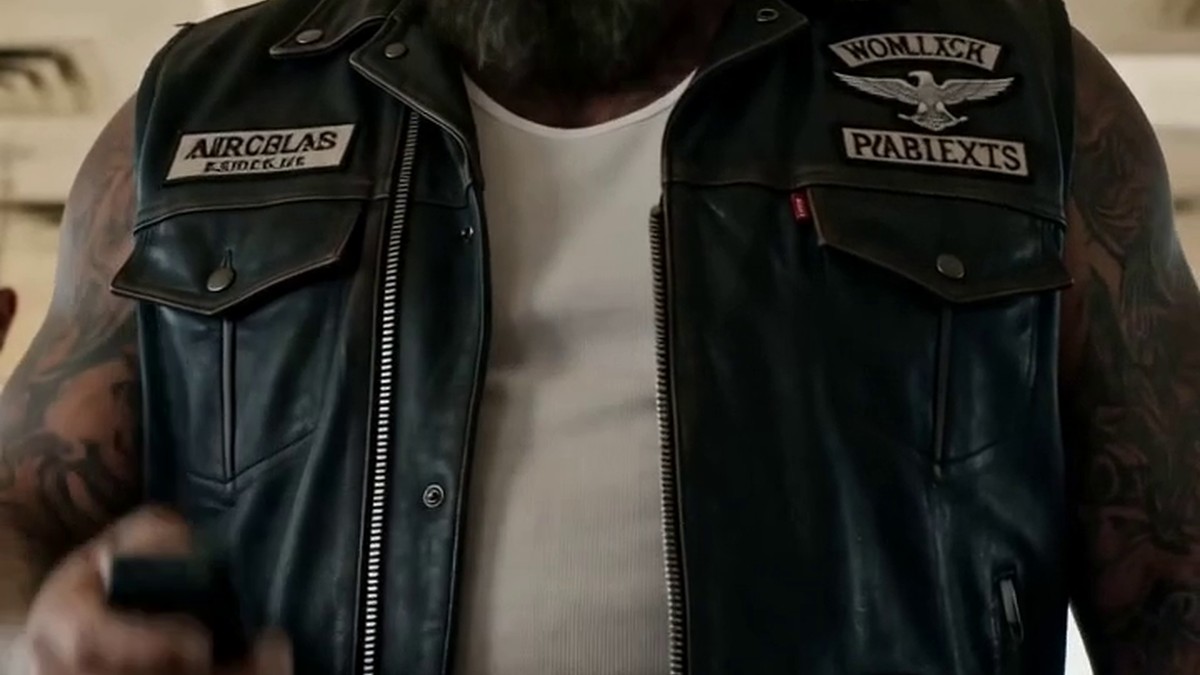
Leather jackets.
Steel-toed boots.
The kind of laughter that wanted an audience.
These were men who fed on other people’s unease.
Their leader locked onto the old man the moment he stepped inside.
He crossed the room without a word and snatched the cane clean off the seat.
Coffee went sideways.
A glass hit the floor.
The place erupted.
Phones came out.
The whole thing was already being recorded.
But the old man didn’t flinch.
Didn’t raise his voice.
Didn’t reach for what had been taken.
He just looked — carefully, precisely — at something peeking out beneath the biker’s collar.
A silver hawk patch, worn and faded.
The moment he saw it, something shifted behind his eyes.
Slowly, he reached into his jacket and produced a small black device.
The laughter got louder.
“Ordering a pizza, old timer?”
He pressed a single button.
Then spoke three words, low and even:
“Bring him here.”
Within minutes, black SUVs with government plates had sealed off the parking lot.
Men in dark suits moved through the diner entrance with practiced urgency.
Then they saw the old man — and stopped cold.
Every one of them saluted.
The grin drained from the biker’s face like color from a wound.
The old man stood slowly, crossed the floor, and fixed his eyes on that patch.
When he spoke, his voice carried no anger.
Just weight.
“Forty years ago, I put my son in the ground. He was wearing that patch.”
The room held its breath.
Because in that moment, everyone understood.
The old man was never the victim here.
He was the reason men in suits came running.
The biker’s hand went slack.
The cane fell.
It hit the linoleum with a crack that echoed like a gunshot in the silence.
Nobody moved to pick it up. Not even the old man.
He kept his eyes on the patch — that silver hawk, tarnished at the edges, the stitching frayed in ways that only time and hard miles could manage. His jaw worked once, slowly, like he was chewing on something he’d been saving for forty years.
“Where did you get that?” he said.
Not a question. Not really.
The biker — whose name, it would later turn out, was Dale Pruitt, forty-three years old, two priors, the kind of man who’d built his whole identity on never backing down — opened his mouth. Nothing came out.
One of the suits stepped forward. Young, clean-shaved, the kind of posture you don’t get at a desk job.
“Sir.” The word came out careful, almost reverent. “Do you want us to—”
“No.” The old man raised one hand. Flat. Final. “I want him to answer me.”
Dale’s crew had gone very still. The laughter was gone like it had never existed. Two of them had already drifted toward the door, stopped only by the quiet, immovable presence of three federal agents blocking the exit without having been asked.
Dale looked around the room. Looked at the phones still raised, still recording, all of them suddenly feeling like weapons pointed the wrong direction. Looked at the suits. Looked at the old man’s face.
And something happened to him.
Not softening, exactly. More like collapsing — the way a wall doesn’t crumble but just drops, all at once, when the foundation gives.
“I bought it,” Dale said. “Swap meet. Out of Flagstaff. I don’t—” He swallowed. “I didn’t know what it meant.”
“Flagstaff,” the old man repeated.
“Three, maybe four years ago. Guy was selling old military gear. Said it was surplus.” Dale’s voice had lost its shape. “I thought it looked cool. That’s all. I swear to God, that’s all.”
The old man said nothing for a long moment.
He bent down — slowly, because the knee didn’t cooperate like it used to — and picked up the cane himself. Set it against his palm. Straightened.
“His name was Robert,” the old man said. “Robert Cole Maddox. First Recon. He was twenty-two years old.” He paused. “He loved bad coffee and terrible music and he could fix any engine you put in front of him.” Another pause, longer this time. “They gave me his personal effects in a box. That patch was supposed to be in it. It wasn’t.”
The room understood something then.
The old man hadn’t been looking for trouble today. He’d been looking for this. Maybe not consciously. Maybe just the way a man who has carried something long enough starts to see its shape everywhere he goes.
And today, purely by the ugly accident of a bully choosing the wrong target, the shape had walked through the door.
One of the suits — older than the others, gray at the temples, the one who’d been hanging back near the entrance — stepped forward now. He crouched briefly, said something into his phone, clipped it back to his belt.
“Sir,” he said to the old man. “The vendor in Flagstaff. We can have a name within the hour.”
The old man looked at him.
“I know you can, Harris.”
Harris nodded once and stepped back.
Dale Pruitt stood in the middle of the diner with his hands at his sides and the silver hawk on his collar and the expression of a man who had spent his whole adult life performing toughness and had just understood, for the first time, what the real thing looked like.
“I’m sorry,” he said.
It came out rough, unpolished. No performance in it. Maybe the most honest thing he’d said in years.
The old man studied him.
Not with contempt. Not with the boiling grief you might have expected. With something harder to name — the particular weariness of a man who has seen so much go wrong in the world that even this, even now, doesn’t fully surprise him.
“Take it off,” he said.
Dale reached up and unclipped the patch from his collar with fingers that weren’t quite steady. He held it out.
The old man took it. Turned it over once in his palm. The silver hawk caught the afternoon light coming through the diner window — Booth Seven’s window, the same one he sat at every Tuesday — and for just a second it looked almost new.
He closed his hand around it.
“Go home,” he said to Dale. “All of you. Go home and be better than you were this morning.”
It was not a threat. It was not mercy, exactly.
It was just the verdict.
Dale’s crew moved toward the door. Dale himself lingered a half-second longer, like he wanted to say something else, like there was a version of this moment where he could make it mean something beyond his own humiliation. Then he followed them out.
The SUVs stayed.
Harris stayed.
The diner stayed absolutely, completely silent — the kind of silence that happens after something real, not just dramatic, has occurred.
The old man walked back to Booth Seven.
He sat down.
He looked at the overturned coffee cup, the spill already starting to dry at the edges, and he signaled to the waitress — Jenny, who had been standing behind the counter with both hands pressed flat on the surface and had not moved in four minutes — and he said, quietly, “Could I get a refill, sweetheart?”
Jenny said yes in a voice that was barely there.
She brought the coffee.
Her hand shook a little as she poured.
The old man wrapped both hands around the cup and looked out the window at the parking lot, where the motorcycles were pulling out one by one, where the black SUVs sat patient and dark, where the ordinary Tuesday afternoon was slowly, carefully reassembling itself around the hole that the last ten minutes had torn through it.
Harris came and stood near the booth. Not in it. Beside it.
“Do you want us to pursue it further, General?”
The title landed in the room like a stone dropped in still water. A few people flinched at the ripples.
The old man — General Maddox, though he hadn’t used the rank in eleven years, though he’d walked away from all of it when there was nothing left he wanted from it — kept his eyes on the window.
In his closed fist, the silver hawk pressed its edges into his palm.
“Find out how it got to Flagstaff,” he said. “Find out where it’s been. And then—” He stopped. Breathed. “And then bring me that information and nothing else. No arrests. No action. Just the truth.”
“Yes, sir.”
Harris left.
The diner began, slowly, to exhale.
Someone put a phone away. Then another. Then the low murmur of human beings who have witnessed something they don’t have words for started up again, tentative at first, the way sound returns after a loud noise.
General Maddox opened his hand.
Looked at the patch.
Forty years was a long time to wonder where something had gone.
Forty years was a long time to sit in Booth Seven every Tuesday, drinking bad coffee, watching the door, not knowing what you were waiting for and not being able to stop.
He set the patch on the table.
He straightened it with one finger until the hawk was centered, wings level, the way a soldier arranges things out of habit, out of respect, out of the need to make order where order is possible.
Then he picked up his coffee.
Outside, the last motorcycle was gone.
The afternoon light fell through the window the same way it always did.
He was still the first one in and, he suspected, the last one out.
Same as every Tuesday.
Some things, you keep showing up for.
Even when you can’t explain why.
Even until the day they finally make sense.