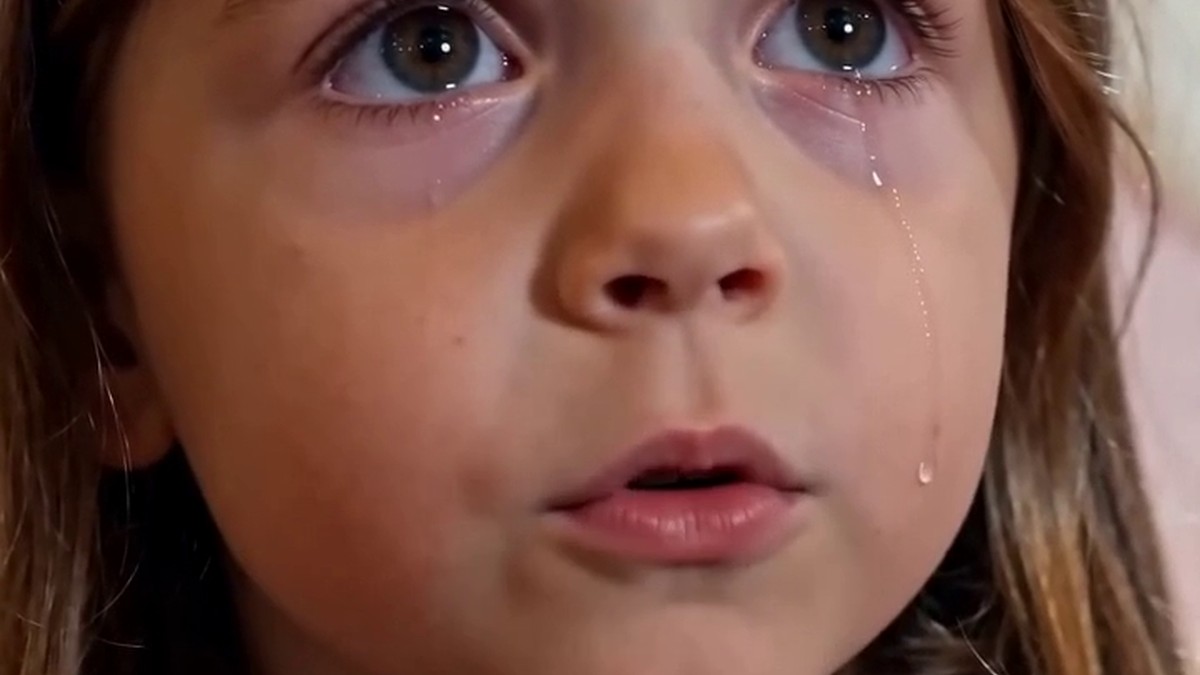
Chandeliers dripped crystal above the crowd, roses bloomed thick on every table, and a towering birthday cake presided over the room like a throne beneath a waterfall of gold. Hundreds of impeccably dressed guests filled the hall with laughter and the soft percussion of applause as the evening climbed toward its peak.
Then a little girl walked in.
Eight years old, maybe less.
A dress the color of pale lavender.
A white cardigan, neatly buttoned.
Gray sneakers — worn down, scuffed at the toes, quietly out of place.
She moved toward the cake with the careful reverence of someone approaching something almost too beautiful to be real. She stopped just in front of it and looked up, mouth slightly open, eyes enormous with wonder.
For a few seconds, nobody saw her.
Then a security guard drifted over, his expression soft with practiced patience.
“Hey there, sweetheart. I’m sorry — this area isn’t open to guests your age.”
The girl looked up at him and nodded, composed.
“I know. I just wanted to see it.”
Conversations nearby tapered off.
Heads turned.
Hands found phones and lifted them almost unconsciously.
The hostess of the evening — Rebecca — crossed the floor toward her. Polished. Poised. Carrying the faint edge of someone accustomed to having things resolve quickly.
“You’ll need to head back, okay, honey?”
The little girl’s eyes went glassy.
“But…” Her voice was barely above a whisper. “Today is my birthday too.”
The silence that fell was the kind that has weight.
Guests glanced at one another, something uneasy moving between them. Still, the guard placed a gentle hand on the girl’s shoulder and steered her toward the exit.
She looked back once.
Just once.
At the cake.
Then she was gone.
The pianist found his keys. The room exhaled and moved on.
That’s when the enormous LED screen at the back of the stage stuttered.
The slideshow — the one everyone had been expecting — vanished mid-frame. A murmur ran through the crowd. Equipment failure, people assumed. Someone would fix it.
But nothing was broken.
A new image materialized, slow and deliberate, filling every inch of the screen.
The little girl.
Captured exactly as she had stood only minutes before — lavender dress, white cardigan, worn gray sneakers, face tilted up in awe.
A wave of whispers rolled across the ballroom.
Rebecca turned and looked at the screen. The certainty drained from her face like color from a photograph left too long in the sun.
Beneath the image, text appeared in tall, luminous gold letters.
**HONORED GUEST**
Nobody moved.
The security guard stood perfectly still, as though the floor had locked around his feet.
The little girl — still near the exit — turned back and stared at the screen, her expression unreadable, lost somewhere between confusion and something she didn’t yet have a word for.
The presentation shifted to its final slide.
One sentence. Nothing more.
***”Every unforgettable celebration begins with someone whose kindness is worth remembering.”***
The champagne flute slipped from Rebecca’s fingers.
It hit the marble and burst apart in a bright, ringing shatter.
And the room — the glittering, golden, magnificent room — stayed absolutely silent.
The silence lasted exactly five seconds.
Then a man rose from the far end of the head table.
Seventy, maybe older. White hair swept back from a broad forehead. A dark suit that had been expensive long ago and worn into something better than expensive — worn into character. He moved without hurry, the way people move when they’ve stopped trying to impress anyone.
Every head tracked him.
He walked to the center of the stage and stood in front of the microphone for a moment without speaking, looking out at the room with the kind of calm that only comes from having survived things.
“Her name,” he said, “is Maya.”
His voice carried without effort. A voice from a time before microphones had to do all the work.
“She is eight years old today.”
He let that sit.
“Her mother worked for this foundation for eleven years. She was the one who sorted the donor lists, who answered the phones when no one else would, who remembered every volunteer’s name and wrote them birthday cards by hand.” He paused. “Her name was Diane. And fourteen months ago, she died.”
The word *died* landed on the room like something dropped from a height.
Rebecca had not moved. Her eyes were fixed on the old man with an expression that had passed through humiliation and arrived somewhere further, somewhere rawer.
“I invited Maya tonight,” the man continued. “I invited her because her mother loved this organization and because this child has no one left to take her anywhere nice. I put her name on the guest list myself.” He looked directly at Rebecca then, not with anger — with something more difficult to receive than anger. “Apparently there was some confusion about that.”
The security guard — whose name was Daniel, who had a daughter of his own, who had thought he was doing the right thing — looked at his shoes.
“Maya.”
The old man turned toward the exit.
The girl was still there, half in and half out of the doorway, holding the edge of the door frame with one small hand like she was deciding whether to stay or flee. She had heard everything. Her face was very still, the way a child’s face goes still when they’re holding something large inside and aren’t sure it will fit.
“Will you come back in?”
She didn’t move right away.
The room didn’t breathe.
Then, quietly, she stepped back inside.
She walked through the parted crowd — all those silk gowns, those tailored suits, those people who had paid thousands of dollars to be here tonight — and they moved for her without anyone deciding to. She walked the way she had walked in the first time, with that same careful reverence. Not performing anything. Not punishing anyone. Just walking.
When she reached the old man, he crouched down to her level.
“Happy birthday, Maya.”
She looked at him for a long moment. Then she looked at the cake.
“It’s very tall,” she said softly.
Something broke open in the room. Not loudly. Quietly. The way ice thaws — not all at once, but in the slow relinquishing of things held too long.
Someone started clapping.
Then someone else.
Then the whole room, rising to its feet in the strange, slightly desperate way that people applaud when they are clapping for themselves as much as for anyone else — trying to buy back something they’d spent too quickly.
—
Rebecca didn’t clap.
She stood where she’d been standing, her champagne flute in pieces at her feet, her hands at her sides, and she watched the little girl look up at the birthday candles with her mouth slightly open and her eyes enormous with wonder.
She had seen that face. She had looked right into it.
And she had said: *head back, okay, honey.*
There’s a particular kind of shame that doesn’t announce itself loudly. It doesn’t make you cry or shout or fall to your knees. It settles. It finds the places you thought were solid and makes them feel provisional. She stood very straight because she didn’t know what else to do with her body, and she watched Maya lean in close to read the little placard she hadn’t noticed before — the one the old man must have placed there himself, she realized now, when she’d been busy at the other end of the room.
The placard read: *For Diane. And for her daughter, who has her mother’s eyes.*
Rebecca pressed her hand to her mouth.
—
They sang to Maya.
Not everyone, at first. A few voices at the edges, then more, then the whole room lifting the old song into the chandelier light, and Maya stood in front of the enormous cake with her hands clasped in front of her and her chin tucked slightly down, and she was smiling — really smiling now, not the contained, careful expression of earlier but something helpless and unguarded, the smile of a child who has been surprised by joy when she had not expected to feel it tonight.
She blew out the candles on the third try.
The room cheered.
The old man — his name was Arthur, and he had known Diane for all eleven of those years, had been to her funeral, had driven Maya and her grandmother home afterward in his car and said very little because there was nothing to say — Arthur watched the girl’s face in the candle smoke and felt the particular grief of someone who has outlived people who should have outlived him.
But also something else.
He felt the room.
The way it had changed.
A ballroom full of people who had arrived tonight thinking about the food, the connections, the photograph for the social page — and had instead been handed a moment they would carry for years. Not because of the crystal or the roses or the gold. Because of a little girl in gray sneakers who had looked at a beautiful thing and not asked for it, only looked.
*I just wanted to see it.*
That was all.
And she had seen it.
—
Later, when the cake had been cut and the glasses refilled and the music started again, Rebecca found her way to the edge of the room where Maya was sitting in a chair that was slightly too large for her, working through a piece of cake with great seriousness.
She stood there for a moment, not sure what to do with her hands.
Maya looked up.
For a beat, neither of them spoke.
“I’m sorry,” Rebecca said finally. The words came out smaller than she’d intended. Quieter. More honest, maybe, for that reason. “I didn’t know. And I should have — I should have just —” She stopped. Started again. “I’m sorry.”
Maya considered her with those enormous eyes.
“It’s okay,” she said.
She meant it. That was the thing Rebecca would turn over later, driving home in the dark with the city lights smearing past the windows — the girl *meant* it. There was no performance in her, no calculation. She was eight years old and she had buried her mother and she had been turned away at the door on her birthday, and she looked at the woman who had turned her away and she said *it’s okay* as simply as if commenting on the weather.
Rebecca didn’t deserve it.
But she received it.
She sat down in the chair next to Maya without asking if she could, and after a moment she said: “What did you wish for? When you blew out the candles?”
Maya took another careful bite of cake.
“I wished that my mom could see how tall the cake was,” she said.
Rebecca pressed her lips together hard.
“She would have loved it,” she managed.
“I know.” Maya scraped a little frosting from the plate. “She loved anything gold.”
—
The party wound down the way parties do — slowly at first, then all at once. Coats retrieved, cars called, the long process of leave-taking that is really just reluctance dressed in pleasantry. The roses were still red. The chandeliers still dripped their light. The broken champagne flute had been swept away so thoroughly it might never have existed.
But something was different in the room.
Something had been rearranged that no one could have pointed to exactly.
Arthur walked Maya out to where her grandmother waited in an old sedan at the curb, the engine running, the heater going against the spring chill. The grandmother — a small woman with gray hair and tired eyes that lit up sharply when she saw the child — opened the car door and pulled Maya into a hug that said everything words couldn’t.
“How was it, baby?”
Maya climbed in and buckled herself with practiced competence.
“The cake was very tall,” she said.
And then, after a pause, as the door closed and the window fogged slightly with their warmth:
“And they sang to me.”
Arthur stood on the curb and watched the sedan pull away. He watched it until the taillights disappeared around the corner, two small red lights swallowed by the dark.
Then he stood there a moment longer.
The city around him was doing what cities do — indifferent, continuous, blazing with its own concerns. But he was thinking about a woman named Diane who used to write birthday cards by hand. He was thinking about the way her daughter had walked into a glittering room and asked for nothing except to see something beautiful.
And had, in the end, been seen.
He turned up his collar against the night air and went back inside.
Behind him, the street was quiet.
And the evening — the gold and the crystal and the roses, the laughter and the music and the terrible, accidental grace of one small child in gray sneakers — the evening had already become a memory. The kind that doesn’t fade. The kind that finds you years later at odd moments, in the middle of ordinary days, and asks you, gently but without letting go, what kind of person you are when no one is watching.
What kind of person you choose to be when the door is yours to open.
And closes so quickly.