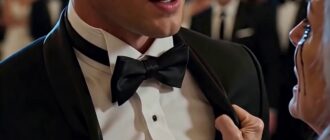
Crystal chandeliers threw fractured light across every surface. White roses flanked the marble aisle in perfect formation. Billionaires, celebrities, and corporate royalty occupied every table, their laughter smooth and effortless, the way money always sounds.
Tonight was supposed to be flawless.
Elena stood at the heart of it all — breathtaking in ivory silk, a diamond necklace worth more than most people’s lifetimes resting cool against her collarbone. Beside her stood Julian Vane. Chiseled. Commanding. The sole heir to a financial dynasty that had survived three generations and two recessions.
Everything was exactly as it should be.
The guests. The cameras. The champagne catching the chandelier light just so. The five-tier cake waiting in elegant silence at the far end of the room.
Julian rested a hand against Elena’s waist, his touch deliberate, possessive.
“Ready, my queen?”
She smiled. Of course she was.
Then the ballroom doors swung open.
At first, nobody reacted. Late arrivals happened. But something about this woman stopped the room cold before she’d taken three steps. Her dark coat was soaked through, rain still dripping from the hem. She wasn’t smiling. She carried no gift.
She hadn’t been invited.
Her eyes moved through the crowd without hesitation and landed on Elena like a knife finding its mark.
With every step forward, the warmth seemed to bleed out of the room. The string quartet lost its nerve mid-phrase. Conversations collapsed into silence. Even the photographers let their cameras drop.
She raised one hand and pointed directly at the bride.
Seven words. Quiet. Absolute.
*”Don’t cut the cake. It’s not yours.”*
The ballroom stopped breathing.
Elena’s smile dissolved. Julian’s jaw locked tight. A nervous laugh stuttered through the crowd — someone desperate to call it a prank, someone else ready to blame jealousy.
But the woman wasn’t done.
She reached into her bag slowly, deliberately, and produced a sealed envelope. She held it the way people hold things they’ve been waiting a long time to put down.
The moment Julian’s eyes found that seal —
the color left his face entirely.
He knew it. Recognized it instantly. And whatever recognition did to him, it wasn’t relief.
Because the woman standing in that rain-soaked coat hadn’t walked through those doors to ruin a wedding.
She had come to detonate a secret — one buried deep enough that the Vane family had believed it was gone forever.
They were wrong.
The woman didn’t move toward them. She didn’t have to.
Julian took one step forward, and then stopped. Something internal — instinct, guilt, raw animal fear — anchored his feet to the marble floor. His hand had fallen away from Elena’s waist without either of them noticing.
“Who is she?” Elena’s voice was barely sound. More like a shape her mouth made.
Julian didn’t answer.
That was its own kind of answer.
The woman walked the remaining distance herself, heels quiet against the marble, rain still tracking behind her in thin dark lines. Up close she was younger than she’d seemed in the doorway — late thirties, maybe, with the kind of face that had been beautiful before something hollowed it out. Sharp cheekbones. Eyes the color of old amber. A scar, thin as thread, tracing the edge of her jaw.
She stopped three feet from Julian and held out the envelope.
“Take it,” she said. “Or I read it out loud.”
Someone in the crowd made a sound. A glass was set down too hard. The photographers had recovered their nerve and were raising their cameras again — because this was something, this was *definitely* something — and Julian Vane, sole heir to three generations of invincible money, was standing in his own wedding reception looking like a man watching a building fall.
He took the envelope.
Elena watched his hands. They weren’t steady.
“Julian.” Her voice had changed. Stripped clean of the performative sweetness she’d been wearing all evening. “Look at me.”
He didn’t. His eyes were on the seal — dark red wax, pressed with a signet ring she didn’t recognize. His thumb moved across it once, the way a person touches something they hoped they’d never have to touch again.
“I think,” he said quietly, “we should step outside.”
“I’m not going anywhere,” Elena said.
“Elena—”
“I’m not going anywhere,” she said again, louder this time, and something in her tone made Julian close his mouth. Beside her, her mother had appeared from somewhere, gripping Elena’s arm — *come away, sweetheart, not here, not in front of everyone* — but Elena didn’t move.
The woman in the wet coat watched all of this with the stillness of someone who had rehearsed this moment so many times that the reality of it barely touched her anymore.
“Open it,” the woman said to Julian. “Or I will tell them what it says without the paper.”
“Who *are* you?” someone called from the crowd. A man’s voice, impatient, proprietary — one of Julian’s people, a lawyer probably, already calculating.
The woman didn’t turn around.
“My name is Mara Vane,” she said. “His wife.”
The room detonated.
Not loudly. That was the strange thing. It detonated in whispers, in pulled breath, in the specific electric shock of three hundred people recalibrating everything they thought they knew simultaneously. The string quartet, who had been frozen in place for the last four minutes, finally set their instruments down. One of the photographers actually said *Jesus Christ* out loud.
Elena turned to look at Julian.
And Julian Vane — the chiseled, commanding, dynasty-inheriting Julian Vane — finally looked at her.
“It was before,” he said. “It was before us.”
“How far before?” Her voice was calm. Clinical. The calmness of someone who has gone past the place where screaming would help.
“Seven years. We were — it was a different time, I was—”
“Are you *divorced*?”
Silence stretched.
Mara answered for him.
“He filed,” she said. “Three times. I withdrew the petition three times because I kept believing him when he said we could fix it. And then I stopped hearing from him.” She paused. “Fourteen months ago. Around the time he met you.”
Elena looked at the envelope in Julian’s hand. He hadn’t opened it. He was gripping it now like if he held it tightly enough it might disappear into his palm.
“What’s in it?” she asked.
He said nothing.
“What’s *in the envelope*, Julian?”
“The marriage certificate,” Mara said. “The original. Plus documentation from the county clerk’s office confirming no divorce decree has been filed or finalized in the state of New York or anywhere else.” She reached into her bag again — Julian flinched, actually flinched — and produced a second document, this one loose, unfolded, offered directly to Elena. “This is a statement from my attorney. You can call him. His number is on the card.”
Elena took it. She looked at it for a long time.
Around them, the wedding was dissolving the way expensive things dissolve — not with a crash but with a slow, irreversible seeping away. Guests were whispering to each other, pulling out phones, doing the math. Somewhere toward the back, someone was already leaving. A few more followed. The efficient, silent exit of people who understand that there is no version of this evening that ends well, and who have other places to be.
Julian’s lawyer had materialized at his elbow. Murmuring. *Julian, we should — Julian, there are ways to — Julian, if we just—*
“Stop.” Julian said it like a door slamming.
He stood there in his perfectly fitted tuxedo, under the fractured light of the chandeliers, and for a moment Elena thought she saw something honest move across his face. Not remorse exactly. More like the expression of a man who has been running a very long race and has just, finally, hit the wall.
“I was going to fix it,” he said. Quietly, almost to himself. “I kept thinking there was time.”
“Time,” Elena repeated.
“I know how that sounds.”
“Do you?”
She took the envelope from his hand. He didn’t resist. She broke the seal herself — the red wax cracking cleanly — and unfolded the paper inside. She didn’t read the whole thing. She didn’t need to. The names at the top were enough. *Julian Arthur Vane* and *Mara Celeste Vane, née Holloway.* County clerk’s stamp. Date of marriage. All of it exactly as described.
She folded it back up.
She held it for a moment, feeling the weight of it — the absurd, ordinary weight of paper that had just rearranged her entire life — and then she set it down on the nearest table, next to someone’s half-empty champagne flute and an untouched bread roll, like a receipt she no longer needed.
She looked at Mara.
Mara looked back.
“I’m sorry,” Elena said. “That you had to come here. That it got this far.”
Something shifted in Mara’s expression. Very slightly. The armor staying on, but something behind it shifting. “I didn’t come here for him,” she said. “I came so you’d know before it became something you couldn’t undo.”
“I know.” Elena paused. “Thank you.”
Julian started to say something. Elena held up one hand — not dramatically, just firmly, the way you stop traffic — and he went quiet.
She turned to face the room. Three hundred people in their finest, watches and diamonds and old money and new, every one of them watching her. The cameras. The flowers. The five-tier cake, still waiting in elegant silence, still exactly where it was supposed to be.
She reached up and unclasped the diamond necklace.
It came away in her hands — cool, impossibly heavy, a fortune in stones — and she set it on the table next to the envelope without ceremony.
“I think,” she said, to the room, to no one in particular, to all of them, “that’s enough for tonight.”
She walked out the way Mara had walked in. Not fast. Not fragile. One foot in front of the other, chin level, ivory silk sweeping the marble behind her. The crowd parted without being asked.
At the ballroom doors she paused, just for a second.
The chandeliers threw their fractured light. The roses stood in perfect formation. The champagne had gone still in all the glasses.
Then she pushed through the doors and disappeared into the corridor beyond, where the hotel was quiet and the rain against the tall windows was the only sound in the world — steady and indifferent and clean, washing everything down to whatever was real underneath.
Behind her, someone finally started talking.
Then someone else.
Then all three hundred of them at once, and the noise of it rose through the ballroom of Le Grand Hotel like a tide coming in, filling all the space where a wedding used to be.