The father’s voice barely rose above a murmur. The entire ballroom heard it anyway.
Beneath a canopy of gold chandeliers, a barefoot boy stood motionless — one hand lifted halfway toward the girl sitting in the wheelchair, then frozen there, suspended in the air.
Dust on his cheeks. A shirt two sizes too large. Pants that ended above his ankles. His bare feet against the polished floor looked like a mistake someone had forgotten to correct.
He didn’t move closer.
He let his hand fall.
“I won’t hurt her,” he said. Quietly. Simply.
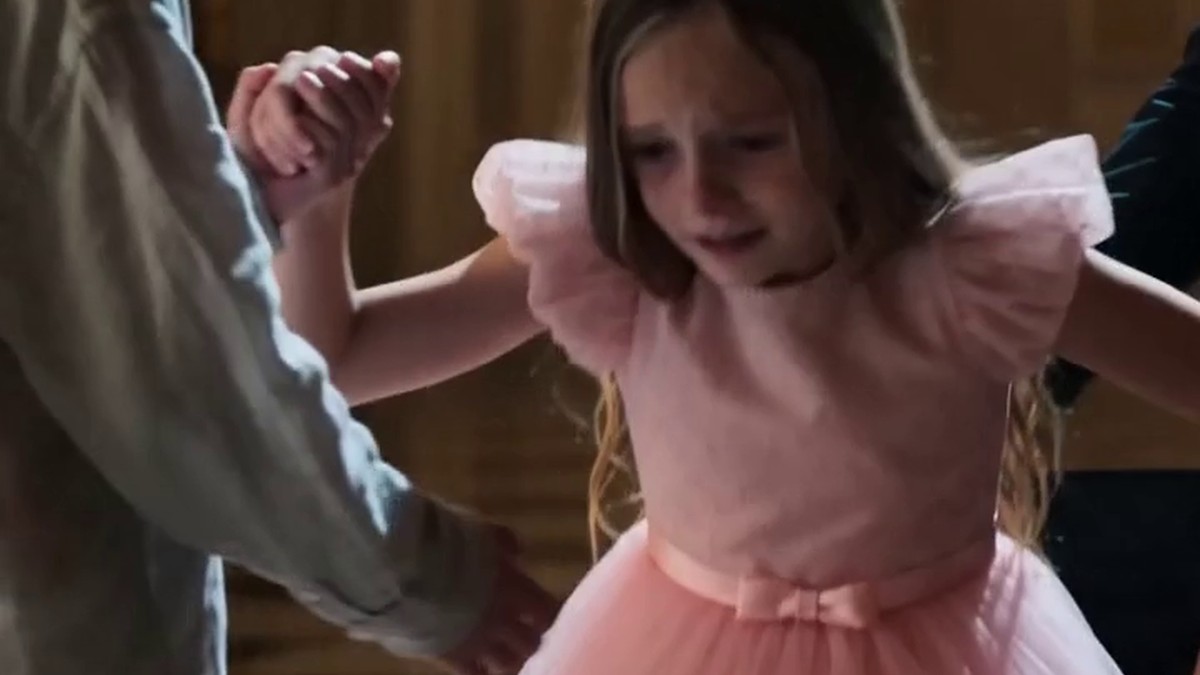
The girl watched him from her chair, her pink dress arranged carefully over her knees. There was an exhaustion in her face that had no business belonging to a child — the kind that settles in when the world has already written the ending to your story without asking you.
The boy turned toward her father.
“Can I ask her something?”
The father said nothing.
Then the girl gave one slow nod.
The boy looked only at her. Not at the crowd, not at the father, not at the room.
Only at her.
“Do you want to try?”
The silence that followed had weight.
The girl’s fingers curled tight around the arms of her wheelchair.
Her eyes went wide.
Fear.
And underneath the fear — something else. Something stubborn and bright.
Her father breathed, “No… please, no.”
But her hand reached out.
The boy took it in both of his. Gently. Like he was holding something that mattered.
Then she pushed herself up.
Her legs shook violently beneath her. Her whole body trembled. For one terrible second she tipped — and the boy caught her, braced her, held firm.
A woman somewhere in the crowd let out a sharp breath.
The father’s hand flew to his mouth.
His daughter was standing in front of him. Standing. For the first time in years.
He couldn’t find air.
“How…”
She looked back at him through tears, a small, trembling smile breaking through.
And the boy said softly, “Because she asked me to come.”
The father didn’t move. Couldn’t. His hand stayed pressed against his mouth like he was afraid of what might come out if he let go — a sound too raw for a ballroom, too private for chandeliers and pressed tuxedos and women in gowns who were already reaching for one another’s arms.
His daughter stood.
Shaking. Leaning into the boy’s shoulder. But standing.
Her name was Clara. She hadn’t stood unassisted in four years. Not since the accident that took her mother and left her with a spinal injury the doctors described in careful, measured language designed to protect everyone from hope.
Her father — a man named Richard Alderton, who had built a shipping empire through sheer refusal to accept that anything was impossible — had accepted this. This one thing. He had accepted it because the alternative was to watch his daughter’s face every time the hope didn’t hold. He had decided, quietly and alone, that hope was the cruelest thing left in the world.
So he had hired therapists who were also realists. He had bought the best wheelchair money could manufacture. He had arranged this benefit gala in Clara’s honor — raising money for pediatric rehabilitation — and told himself this was enough. This was love. Keeping her safe inside the possible.
He had not counted on the boy.
—
No one knew quite how he’d gotten in.
The Alderton Benefit Gala had a guest list, a security detail, valet parking. There were no barefoot boys in oversized shirts in the lobby, or if there were, someone was supposed to have redirected them very politely to somewhere else.
But somehow he had come through, moving along the wall the way certain people move through crowded spaces — not invisibly exactly, but *quietly*, with the particular stillness of someone who has learned that stillness is a form of safety.
Clara had seen him first.
She’d been parked near the window, watching the city below because the conversations inside had stopped interesting her sometime around the third round of champagne toasts. She’d been thinking about her mother. She did that at events like this — found a corner, looked at something far away, and let herself think about her mother in peace.
Then she’d felt someone looking at her.
Not the way people usually looked. Not the pitying slide of the eyes, the quick assessment of the chair and then the deliberate glance away. This was different. Direct. Curious. Like she was a person who might have something interesting to say.
She turned.
He was standing near the service door, eating a dinner roll he had clearly taken from a passing tray. When she caught him staring, he didn’t look away. He just chewed slowly, considering her, and then walked over.
“Does the chair bother you?” he’d asked.
She blinked. “Does your shirt fit you?”
He looked down at it. “It was my brother’s. He’s bigger.”
“Where is he?”
“Gone.”
She let that settle. She recognized the particular weight of that word — gone — and didn’t press it.
“The chair doesn’t bother me,” she said. “People’s faces when they see the chair bother me.”
He nodded. That made sense to him, clearly.
“Can you feel your legs?”
“Some. Not all.”
“Do you want to stand?”
She opened her mouth. Closed it. Something tightened in her chest.
“My doctors say —”
“I didn’t ask your doctors.”
The directness of it hit her like cold water. Not unkind. Just clean. Like he’d cut through years of careful language in one sentence.
“I don’t know,” she said honestly.
“That’s different from no,” he said.
Her fingers had curled around the armrests then. The same way they did now. And she had nodded, slow, once — and then her father had appeared from across the room and the whole ballroom had pivoted toward them and the boy’s hand had frozen in midair.
—
Now she was standing.
Shaking and upright and *standing*, her grip on the boy’s arm so fierce her knuckles had gone white, and she didn’t care, she didn’t care — she could feel the floor through the thin soles of her ballet flats, distant and imprecise but *there*, a pressure, a reality, solid and cold and real. She’d worn them tonight on a private kind of faith, the same faith that had been pulling her out of bed for months, alone in her room, working at this quietly while her father was away, not wanting him to watch her fail. She hadn’t known what would finally make it hold. She knew now: it was someone standing in front of her who simply believed she could.
“Papa,” she said.
Richard Alderton crossed the floor in four steps and took his daughter’s face in both hands and looked at her the way a man looks at something he had quietly grieved and cannot quite believe is still alive.
He was shaking too, she realized.
She’d never seen her father shake.
“How are you —” His voice broke apart. He tried again. “Clara, how are you standing?”
“I’ve been trying,” she said. “In my room. When you’re not home. I’ve been trying for months.” She pressed her hand against his chest. “I didn’t want to tell you in case I couldn’t do it in front of you. I didn’t want to see your face if it didn’t work.”
He made a sound then. The sound he’d been holding behind his hand.
It wasn’t the sound of a shipping magnate. It was the sound of a father who had been alone with his fear for a very long time.
He pulled her carefully, carefully into his arms, and she let him hold her weight, and he held it — all of it, gladly, trembling — and the boy took one quiet step back and let the space belong to them.
The crowd had gone entirely silent.
Then a woman near the back began to clap — one of those single slow claps that means something — and it spread, and the room filled with sound, and nobody spoke because nobody needed to.
—
Later, after the gala’s formal program dissolved and the guests migrated into smaller, quieter conversations, Richard Alderton found the boy sitting on the ballroom steps outside the main doors, eating a second dinner roll.
He sat down beside him.
For a moment, neither of them spoke. The corridor was marble and quiet. Somewhere inside the string quartet started again, something low and sweet.
“Who are you?” Richard asked.
The boy thought about it. “Marcus.”
“Where are your parents, Marcus?”
A pause. “My mom works nights. My brother used to walk me home from school.” He looked at the roll in his hands. “He doesn’t anymore.”
Richard absorbed this. He was a man practiced at reading between the lines of what people said and didn’t say.
“How did you know she could stand?”
Marcus glanced up at him. He had very direct eyes — the color of creek water, brown and clear at the same time.
“I didn’t,” he said simply. “But she did. She just needed someone to ask.”
Richard was quiet for a long moment.
He thought about all the things he had decided on Clara’s behalf. All the careful structures he’d built to protect her from hoping for something that might not come. He’d called it realism. He’d believed, sincerely, that it was love.
He wondered now what four years might have looked like if someone had asked her sooner.
“Where do you live?” he said finally.
Marcus told him a neighborhood. One Richard knew only as a name on a logistics map, a postal code, a route.
“Are you hungry?”
The boy looked at the dinner roll.
“I mean properly,” Richard said. “There’s a kitchen through those doors with enough food for three hundred people, and at this point we’ve all had enough champagne that no one is paying attention.”
Something shifted in the boy’s face. Not quite a smile, but something in that direction.
“Yeah,” he said. “I’m hungry.”
—
Clara found them there twenty minutes later, her wheelchair back beneath her because standing took everything she had and she’d spent that freely tonight. She rolled up beside them at the small service table where Marcus was working through a plate of things with the focused seriousness of someone doing important work, and her father was watching him with an expression she hadn’t seen on his face in years.
Something open. Something without walls.
“You left,” she said to Marcus.
“Didn’t want to be in the way.”
“You weren’t.”
He looked at her. She looked at him.
“You’ll fall down,” he said. “Probably more than once. Before you don’t.”
“I know.”
“Okay.” He picked up his fork. “Then you should probably practice tomorrow.”
Her father made a soft sound that might have been a laugh. She wasn’t sure she’d ever heard him laugh quite like that before — unguarded, a little helpless, real.
“He’s right,” Richard said. He looked at his daughter. “We should have been practicing.”
Clara reached across the table and set her hand on her father’s. His closed over it immediately, reflexive and tight.
“We can start now,” she said.
Outside the tall windows the city moved through its ordinary night, indifferent and bright. Inside, a boy finished his dinner. A man held his daughter’s hand. And somewhere in the distance the string quartet played on — low and sweet and, for once, exactly right.