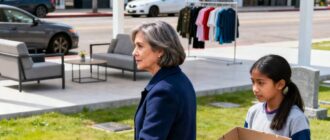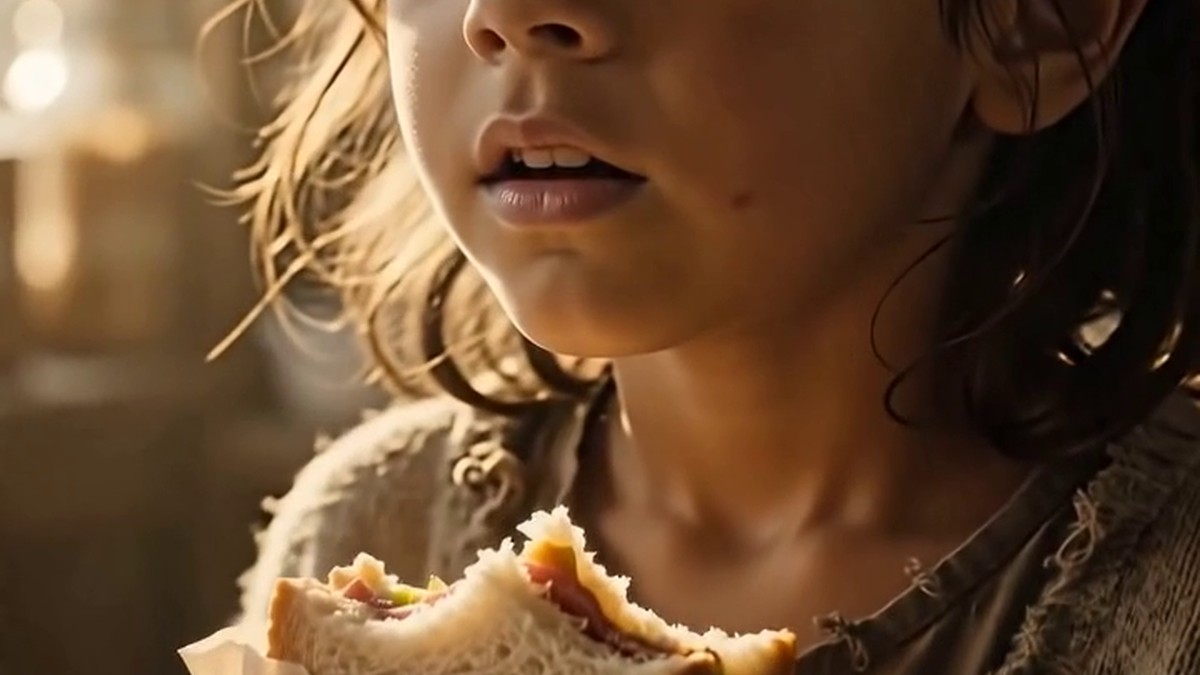
The little girl’s voice was barely a breath. A whisper swallowed by the cold air of the shop.
Her sweater was the color of a sky that had given up. Faded. Threadbare at the elbows.
The old shopkeeper studied her face and felt something twist behind his ribs.
“Please.”
Just that one word. But it carried the weight of everything she didn’t have.
No coins. No mother waiting at home. No father coming to find her. Nothing but empty hands and a hunger that had settled deep into her bones.
His eyes drifted to the counter.
One sandwich left. The last one.
He turned the thought over slowly. If he gave it away, his own supper would be silence and an empty stomach. The shelves would stare back at him like an accusation.
He looked at her again.
Those eyes.
He reached for the sandwich without another thought.
He wrapped it carefully — the way you’d wrap something that mattered — and placed it in her small, outstretched hands.
She clutched it to her chest like it was made of gold. Like it was the most precious thing she had ever been given.
Maybe it was.
She lifted her gaze to meet his, and what he saw there wasn’t just gratitude. It was something fiercer. Quieter. A flame burning steady behind still water.
“Someday I will repay your kindness, sir.”
He smiled. Reached out and patted her head gently.
*Sweet child,* he thought. *Brave, hungry, sweet child.*
He assumed it was the kind of promise only starving children make — sincere in the moment, dissolved by time.
He had no way of knowing.
No way of knowing that twenty years later, that girl would walk back through his door — and that the promise she’d made over a single wrapped sandwich would reshape the entire course of his life.
👇 Who did that little girl become — and how did she keep her word?
👇 The story continues in the comments.
Twenty years is long enough to forget a face.
But some things don’t forget you.
—
The shop had shrunk, somehow. Or maybe the world had grown larger around it, leaving the little storefront marooned between a chain pharmacy and a coffee franchise that played ambient music too loud. The hand-painted sign above the door had faded to ghost letters. The awning sagged on one side like a tired shoulder.
Inside, the old man — not quite so old now as he felt — was counting receipts that barely added up to anything. His glasses had a crack in the left lens he kept meaning to fix. His hands moved slowly over the numbers. He was behind on rent. Two months. Soon to be three.
The bell above the door rang.
He didn’t look up right away. Force of habit. Finish the column first.
“Mr. Harlan.”
His name. Said like someone who’d been practicing it. Like they wanted to get it exactly right.
He looked up.
A woman stood in the doorway. Thirty, maybe thirty-one. A dark coat, well-cut but not showy. Her hair pulled back. Her posture — there was something in her posture, a quiet steadiness, like someone who had learned stillness the hard way.
He didn’t recognize her.
And then he did.
Not all at once. The way you recognize a song from childhood — first just a feeling, then a melody, then the words coming back to you from somewhere you thought was sealed.
Those eyes.
That same flame. That same still water.
“I told you I’d come back,” she said.
—
Her name was Mara.
He learned this in pieces, the way you learn anything that matters — slowly, with long silences between.
She sat across from him at the little table he kept near the window, the one where he ate his lunch alone most days, and she told him what had become of her. Not boasting. Not performing. Just telling.
After that winter — the winter of the sandwich, she called it, which almost broke him — she’d been taken in by a teacher who noticed she was coming to school wearing the same clothes in both September and March. The teacher had asked the right questions. A foster family followed. Then a scholarship. Then a university she’d worked nights to afford anyway, because the scholarship only went so far.
Now she ran a clinic. A real one, on the east side of the city where clinics didn’t tend to survive. She’d built it from grant money and stubbornness and the particular ferocity of someone who remembered what it was to have nothing.
Harlan listened. He turned his cracked glasses over in his hands.
“Why are you here, Mara?” he finally asked. Not unkindly.
She looked at the shelves. He watched her take in the gaps in the inventory, the handwritten price tags, the cooler with the flickering light he’d been nursing along for two years.
“My administrator called the building,” she said. “Trying to find a location for a satellite pharmacy. A dispensary for our patients — people who can’t easily travel. We need ground-level retail space in this neighborhood.” She paused. “Your landlord told him you’re two months behind.”
The silence between them had weight.
“I’m not here to pity you,” she said quickly, reading something in his face. “I want to make you a proposal.”
—
He almost said no.
That’s the part nobody talks about — how pride is the last thing the poor hold onto, and sometimes the most expensive.
He sat with her proposal for a week. She’d offered a partnership, a fair one: the clinic would lease half his floor space for the pharmacy operation, enough to cover his rent and then some. He’d keep the shop. The neighborhood would gain a resource it desperately needed. Everyone moved forward.
Simple. Clean. Good.
And yet.
He kept circling back to a version of himself he wasn’t sure he could stomach — the man who needed to be rescued. Who gave one sandwich twenty years ago and now collected on it like interest.
He told his sister about it on a Sunday phone call. She lived in Portland and had better sense than him.
“Thomas,” she said — she was the only one still alive who called him that — “that little girl didn’t come back to save you. She came back because you gave her something when she had nothing, and she built a life, and now she’s inviting you to be part of what she built.” A beat. “Those are different things. You understand the difference?”
He did. He just needed someone to say it out loud.
—
He called Mara on a Tuesday.
She picked up on the second ring, like she’d been waiting — though he guessed she always picked up fast, the kind of person who moved toward things rather than away from them.
“I want to do this right,” he said. “Whatever we sign, I want it to be a real agreement. Fair on both sides. Not charity.”
“I wouldn’t have it any other way,” she said. And something in her voice — not triumph, not relief exactly, but something settled, something resolved — made his eyes sting unexpectedly.
He blinked it away. Old men and their embarrassing eyes.
—
The first day the satellite pharmacy opened, he stood behind his counter and watched.
It was a Thursday in March — cold like that long-ago winter, but bright. The kind of morning where the sunlight is thin and honest and doesn’t pretend to be warm.
A woman came in with two young children, a prescription clutched in her hand. She was wearing a sweater that had seen better years. Her eyes moved carefully around the space, the way people move when they’re not sure yet if they’re welcome.
Mara was there herself. She stepped out from behind the partition and greeted the woman by name — she’d called ahead, Harlan realized. She knew her patient was coming. She’d looked up her file, remembered her name.
He watched the woman’s shoulders drop — that particular lowering, the release of tension you’ve been holding so long you forgot it was there.
Something twisted behind Harlan’s ribs. The same spot as before. Twenty years and the same exact place.
He turned back to his counter. Receipts to count. Inventory to update. A cracked lens to finally, maybe, get fixed.
—
Mara stopped by his end of the shop on her way out, pulling on her coat.
“How does it feel?” she asked.
He looked around at the space. Fuller now. Purposeful.
“Different,” he said. Then: “Better.”
She nodded. Moved toward the door.
“Mara.”
She turned.
He didn’t have a speech. He’d never been good at speeches. So he just said the thing that was true.
“You didn’t owe me anything. You know that.”
She looked at him for a long moment. That still water. That flame.
“I know,” she said. “That’s exactly why I came back.”
—
The bell rang when she left.
He stood in his shop — smaller and larger than it had ever been — and listened to it fade.
Outside the window, the morning was doing what mornings do. Moving forward. Carrying everything along with it.
He reached under the counter and pulled out his order ledger. Started a new page.
Turned out, it wasn’t the end of anything.
It was the beginning of what the sandwich had always been pointing toward.