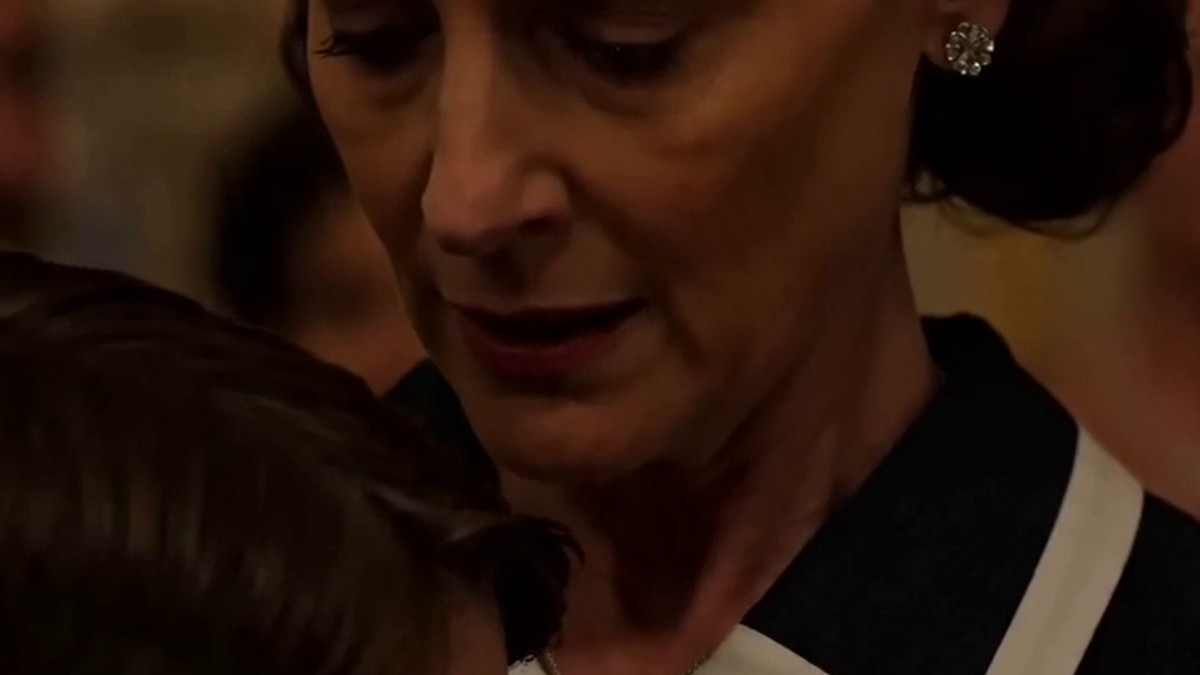
One sentence from a small, shaking boy transformed a glittering celebration into something no one in that room would ever forget.
Seconds earlier, the mansion had been breathing — music humming through the walls, crystal glasses catching the light, voices layered over voices in easy conversation. Then the sound collapsed. All of it, gone. And in the silence that followed, you could almost hear the guests’ hearts knocking against their ribs.
They told themselves they’d misheard.
Then the boy said it again.
He was pressed hard against the nanny’s body, fingers curled into the fabric of her dress like he was holding on against a current. His face was buried in her shoulder. When he finally lifted it, his cheeks were wet and his voice barely made it past a whisper.
“She’s my real mommy.”
The air left the room.
Across the hall, his mother stood perfectly still. The color slid from her face the way water drains from a broken glass — fast, then completely gone. What replaced it wasn’t grief. It was fury.
“What on earth are you saying?” She moved toward him, arm extended, ready to take him back.
He twisted away.
“You’re not my mommy.” The words came out ragged and absolute. “She is.”
The father crossed the floor in three measured steps. His face had moved through confusion and arrived somewhere colder, somewhere sharper. When he spoke, his voice was almost gentle.
“Enough.”
He wasn’t looking at his son.
Every person in that ballroom followed his gaze to his wife.
The nanny hadn’t moved. She stood beneath the weight of all those staring eyes, visibly hollowed out, one hand resting carefully on the boy’s back. She looked down at him and softly said the only thing she could think to say.
“Sweetheart. You’re confused.”
He shook his head so hard it looked like it hurt.
“No.” His voice cracked. “I remember you. I remember your voice.”
The whispers started low and built fast, rushing through the crowd like something catching fire. Phones appeared in quiet hands. People leaned toward each other without looking away from the center of the room.
The husband had not blinked. Had not moved. His eyes stayed fixed on the woman he had married.
“What did you do?” The question came out barely above a murmur.
She made herself laugh. It didn’t hold. “He’s a child. He doesn’t understand what he’s saying. This is — it’s nothing.”
Then the boy’s arm shot out, one small finger pointing directly at the pendant resting against the nanny’s collarbone.
“That necklace. It’s the same one.”
Her hand moved to it before she could stop herself, fingers closing around the pendant, eyes going wide with something that looked less like recognition and more like dread.
“I’ve always had this,” she said. The words came out fractured. “I’ve always —”
“Where did you get it?”
The husband’s voice cut across hers. Quiet. Exact. The voice of a man building a case.
Before she found an answer, a sound came from the back of the room. A chair scraping stone. An old man rising slowly, one hand pressed to the table to steady himself. His face had gone the color of ash.
When he spoke, the whole hall leaned in.
“That necklace.” He paused, as though the words required effort to surface. “It belonged to a young woman. One who disappeared. Seven years ago.”
The silence that fell then was different from the one before. This one had weight. It pressed down on shoulders, filled lungs, made the room feel half its size.
The nanny stopped breathing.
The boy pulled himself closer to her, arms tightening around her like he already understood — the way children sometimes understand things before the words exist for them — that something was about to break open.
And then the husband turned toward the door and spoke four words in a voice so measured, so devastatingly calm, that it silenced even the whispers.
“Bring me the birth records.”
The doors at the far end of the ballroom opened before anyone could react.
Two men entered — the kind of men who don’t get introduced at parties. Dark suits. Measured steps. They moved with the particular stillness of people who have spent years waiting in rooms like this one for exactly this kind of moment.
The crowd parted.
The nanny watched them come and felt something inside her chest unlock — not relief, not terror, but something older and more precise. Recognition. The way a body remembers a fall even before it lands.
Her name wasn’t Clara.
It had never been Clara.
—
Her real name was Mara Voss, and she had been twenty-three years old when they took her son.
Not stolen. Nothing so crude. Just — arranged. Rearranged. The way powerful people rearrange things when a young woman has no money, no family, and the terrible misfortune of carrying a child that a powerful man has already decided belongs to him.
She had spent five years not knowing if the boy was alive.
Then she had spent two years getting close.
The necklace had been her mother’s. The only thing she’d managed to keep through everything that came after — the legal pressure, the threats, the apartment that stopped being hers one Tuesday morning when she came home to find the locks changed and a folded document on the doorstep. She had pressed the pendant between her palms in a parking garage on the worst night of her life and made herself a promise so quiet it had no words. Just a direction. Just forward.
She had taken the nanny position knowing he wouldn’t recognize her.
He’d been eighteen months old when they separated. She hadn’t counted on the body’s memory — the way a child can carry a voice in the deep tissue of themselves, below language, below reason. The way love, when it’s the first love, doesn’t need a face.
He had known her from the sound of her breathing.
—
“The birth records.” The husband said it again, softer this time, and one of the men in dark suits produced a leather folder and placed it on the table beside him without ceremony.
He opened it slowly.
The ballroom had gone so quiet that the turning of each page was audible. The husband’s jaw worked once, tightened, released. Whatever expression he’d arrived at the table with had dissolved into something she hadn’t seen on him before.
Not anger. Not the cold calculation he wore like a second suit.
Something worse. Something that looked almost like the first stages of understanding.
“There’s a second name,” he said. Not to her. Not to anyone in particular. “On the original hospital filing.”
He looked up then.
For the first time all evening, his eyes moved past his wife and landed — and stayed — on the woman who was not Clara.
“Mara Voss.” He read the name like he was testing the weight of it. “Who is Mara Voss?”
—
The wife moved first.
It was a desperate thing, that movement — not elegant, not calculated, just pure panic wearing heels. She stepped forward and placed her hand flat on the folder, voice already climbing.
“That document is — it’s outdated. It’s a clerical error from a clinic that no longer exists. I can explain every single—”
“Take your hand off the table.”
The husband didn’t raise his voice. He didn’t need to. The room itself seemed to constrict.
She didn’t move her hand.
He looked at it. Then he looked at her. And something passed between them — seven years of marriage, compressed into a single second of unbearable clarity — before he said, very quietly, “How long have you known?”
The silence stretched.
The wife’s composure cracked the way ice cracks. First a single fracture, nearly invisible. Then all at once, spreading from the center outward, everything unstable.
“I protected this family,” she said. Her voice had thinned to something unrecognizable. “I protected you. What she was — what she would have raised him to be, without resources, without connections, without — you have no idea what I did to keep this family together.”
“You kept my son from his mother.” The words came out of Mara before she had decided to speak them. She didn’t shout. She didn’t need to. Seven years of waiting had given her voice a gravity she hadn’t known she possessed. “You told me he died.”
The intake of breath from the crowd was collective and involuntary.
Even the husband went still.
“You told me” — her voice caught, steadied — “that he didn’t survive. That there were complications. You had a doctor there. You had paperwork. I held a death certificate with his name on it and I—” She stopped. Pressed two fingers to her lips. Continued. “I buried an empty box.”
The boy had both arms locked around her waist now. He didn’t understand the words. He understood everything else.
—
The wife said nothing.
That was the most damning thing she could have done. In a room full of witnesses, with phones recording and crystal going warm in untouched hands, she said absolutely nothing.
She looked at Mara. Her expression moved through several things rapidly — contempt, calculation, the ghost of something that might have been guilt if it had anywhere to go — and then it settled into a blankness that was its own kind of confession.
The old man at the back of the room lowered himself back into his chair. His eyes were closed.
He had known the girl. He had warned someone — the husband, perhaps, or the husband’s father — and been ignored the way old men with inconvenient memories are always ignored. He had spent seven years carrying the weight of something he hadn’t been able to stop. Watching the boy grow up in photographs on holiday cards. Waiting for exactly this room, exactly this moment, without knowing if it would ever come.
He looked at Mara now with the expression of a man who has just set something very heavy down.
—
The husband closed the folder.
He held it for a moment, one hand flat on the cover. Then he passed it to one of the men in dark suits and turned to face the room.
“I’d like to ask our guests to give us privacy.” His voice was controlled in the way of a man controlling a great deal. “There are cars waiting.”
The crowd began to move. Not in the festive way crowds move at the end of a good evening — not with lingering goodbyes and the pleasant reluctance of a party that went well. They moved the way people move away from an accident. Quickly. Without looking directly at what they were leaving behind.
Within four minutes, the ballroom held only five people.
The husband. The wife. The old man. The boy.
And Mara.
—
What happened next was not elegant. It didn’t have the shape of justice the way justice looks in stories, clean and declarative and quick.
It was long. It was lawyered. It involved rooms that smelled of old paper and offices where people spoke in careful language designed to mean as little as possible. It involved the husband sitting across from Mara in a conference room six weeks later, not as an adversary — or not only as an adversary — but as a man trying to locate the edges of something he’d built his life inside without knowing its true dimensions.
He had not known.
That was the thing Mara had to sit with — the thing that didn’t fit cleanly into the version of events where her grief had a single, clear face attached to it. He had not known about the clinic, the paperwork, the box she’d buried on a Thursday in November with her mother and no one else in attendance. His wife had been very careful about what she’d shared with him and what she’d simply managed.
He had not known. But he had also not asked.
And that was its own kind of knowing.
—
The boy’s name was Eli.
She learned it the way she learned everything about him in that first year — in pieces, in glimpses, in the patient accumulation of ordinary moments that she had been denied and now held onto with both hands.
He liked the window seat. He was afraid of drains. He had a habit of narrating his thoughts aloud when he thought no one was listening, a low continuous murmur while he drew or built or turned rocks over in the yard. He couldn’t sleep without some kind of sound in the background — a fan, the radio on low, the specific quality of a voice he trusted in the next room.
She understood that last one.
She let him hear her. Every night, moving through the apartment, making tea, the ordinary sounds of a life being lived in proximity to his. She narrated quietly to herself — groceries, weather, the small tedious logistics of being a person — and she listened for the shift in his breathing that meant his shoulders had dropped and his fists had uncurled and he’d found the place where sleep was waiting.
She sat outside his door sometimes, back against the wall, mug going cold in her hands, and let herself cry without sound. Not from sadness — or not only. From the strange excess of it. From the weight of what had been returned to her and what could never be returned and the impossible coexistence of both of those things inside a single human chest.
—
The wife faced consequences. They were significant. They were not enough. They were what the law had room for, which is not the same as what the moment deserved, and Mara made her peace with that distinction slowly, imperfectly, over the course of years.
The old man came to see her once, in the apartment, a few months after everything. He brought nothing with him. He sat at her kitchen table and drank the tea she put in front of him and said that he was sorry, that he had tried to raise an alarm and been made to understand that raising alarms was not something he was permitted to do. He said it without self-pity. Without asking for absolution.
She poured him more tea.
They talked about the boy. About the way he laughed. About the particular face he made when he was concentrating on something difficult, lower lip tucked inward, brow slightly furrowed — an expression, the old man said, that he had seen before.
“On his mother,” he said.
He meant her. He had always meant her.
—
Eli was nine the first time he called her Mom.
It happened the way the most significant things happen — without ceremony, without preparation, in the middle of something utterly ordinary. He was looking for his shoes. She was standing in the kitchen with her back to him.
“Mom, have you seen my—”
He stopped.
She stopped.
They both stood very still in the way of people who know that the wrong response will break something, and she turned around carefully, the way you approach something rare, and he was looking at her with those eyes that were so entirely his own, uncertain and searching and almost braced.
She didn’t say anything.
She just opened her arms.
He crossed the kitchen in three steps and pressed his face into her shoulder, and she held him — the way she had held him in that ballroom, the way she had held an idea of him for five years when she had nothing else — and felt the exact specific weight of him, this child who had found her by sound, by instinct, by some deep animal certainty that lives below the reach of anyone’s interference.
The shoes stayed lost.
Neither of them went looking.