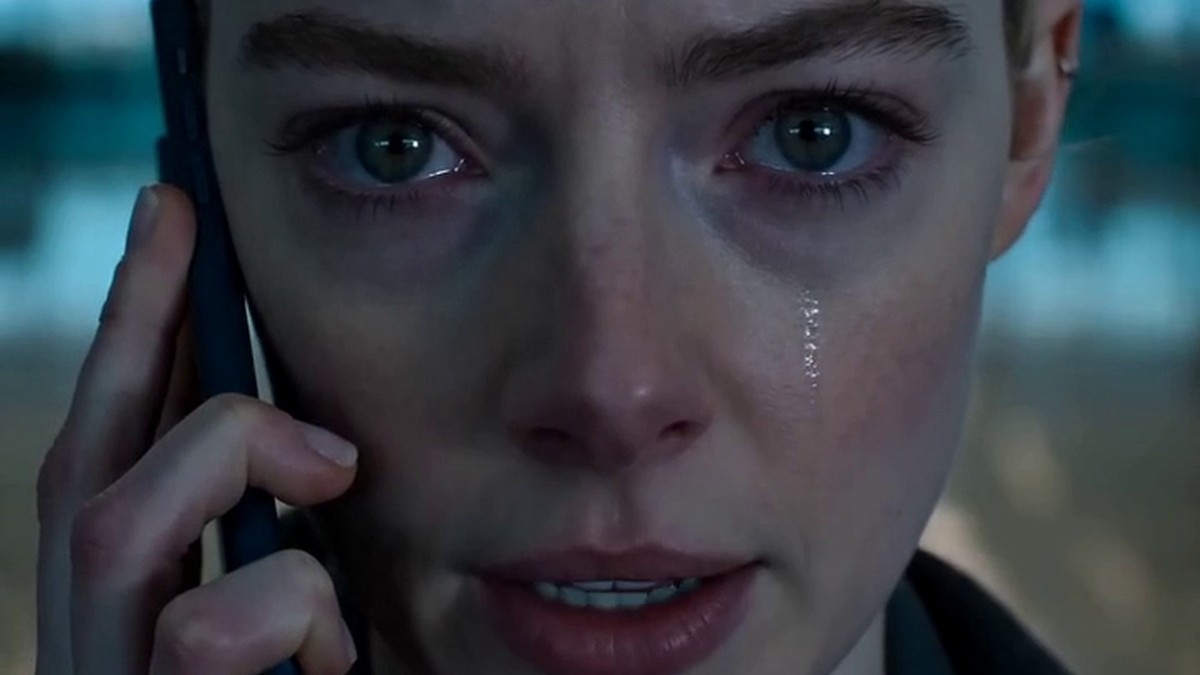
He was standing in the middle of a departure terminal with someone else on his arm.
And just like that, every story she’d ever believed about him collapsed under its own weight.
No confrontation. No tears. No shattered dishes on the floor.
Just silence — the kind that doesn’t echo, it *settles*. Like smoke filling a room.
Because Cassandra didn’t look like a woman who’d been blindsided.
She looked like a woman who’d just watched the last puzzle piece click into place.
The deception didn’t sting the way new wounds do.
It felt worn in. Practiced. Like lines delivered from memory.
And when she stepped back from that glass railing, something had already shifted behind her eyes.
Not grief.
Strategy.
One call was all it took.
One name spoken into the right ear.
And a file that certain people had worked very hard to keep buried.
Now Nathan isn’t just a man who got caught in a lie.
He’s a man tangled in something far older than this moment — something he never once thought to warn her about.
And the cruelest detail of all?
He sees exactly what’s coming.
The question was never *if* Cassandra would move.
It’s how much she’s willing to let burn before she strikes the match.
—
The file had a name on the cover page.
Not Nathan’s. Someone else’s. Someone who’d been careful for fifteen years to keep his name out of rooms like the ones Nathan frequented, out of conversations like the ones Nathan had been having in airport lounges and private dining rooms and places that don’t show up on any public record.
Cassandra had found it six months before the airport.
She hadn’t done anything with it yet.
That was the part Nathan would never fully understand — that she’d known, and she’d waited, and she’d watched him continue to perform. The morning coffee. The hand on the small of her back in public. The way he said *I love you* with such practiced ease it sounded almost like a reflex, like blinking, like breathing.
She’d waited because she needed to understand the full shape of the thing before she touched it.
And now she did.
—
His name was Elliot Voss.
Mid-fifties. Silver hair he wore like a credential. The kind of man who walked into a room and everyone immediately understood that he cost something. He sat across from Nathan at dinner tables and across from senators at fundraising events and the overlap between those two worlds was, apparently, the thing certain people had spent a great deal of money to prevent from becoming public.
The file documented eight years of it.
Wire transfers that took three steps to trace but could be traced. Meetings that appeared as conference calls in Nathan’s calendar. A property in the name of a shell company registered in Delaware that both men’s fingerprints were on, metaphorically speaking.
And one woman — the woman at the airport, arm tucked into Nathan’s — who turned out to be not a romantic complication but a courier. A thread. A loose end that Elliot Voss had been pulling gently, carefully, for longer than Cassandra had been in the picture.
Her name was Diane. Mid-thirties, unremarkable in the deliberate way of someone trained to be overlooked — the kind of woman who could carry an envelope through a crowded terminal and leave no impression behind except a faint smell of cedar and the memory of a gray coat. Cassandra had seen her face in a photograph tucked into the file, a candid shot taken from distance: Diane standing outside a parking structure, looking at her phone, shoulders slightly forward, like someone carrying weight she hadn’t agreed to carry.
She’d been a distraction. A very deliberate one.
Cassandra had to sit with that for a moment when she finally understood it. She’d been inserted into Nathan’s life not because he’d chosen her, but because Voss had decided she was useful. A respected surgeon. Clean record. No political associations. A woman whose proximity made Nathan look stable, grounded, above reproach.
She had been cover.
And the anger that moved through her when she understood it was not the hot, thrashing kind. It was cold and exact, like a scalpel finding a plane of tissue.
—
She made two calls.
The first was to a journalist she’d known in residency — a woman who had gone sideways from pre-med into investigative reporting and who had, over the past decade, developed a reputation for being very patient and very accurate.
The second was to a federal attorney she’d been introduced to at a hospital benefit three years prior, who had pressed her card into Cassandra’s hand with the specific instruction: *If you ever see something that doesn’t add up, I’d like to hear about it.*
Cassandra had kept the card in the inner pocket of her work bag.
She hadn’t known why at the time.
She did now.
—
Nathan came home on a Tuesday.
He didn’t know she’d been at the airport. She hadn’t told him. She’d returned to the hospital, finished her shift, sutured a man’s abdomen with the same steady hands she always had, and gone home to make dinner like nothing had changed.
Because nothing had. For her. It had changed months ago.
He set his bag down in the entryway. Said something about his flight being delayed. Poured himself two fingers of scotch without offering her any, which was its own small telling detail, and settled onto the couch with the particular ease of a man who believed he was safe inside his own home.
“Long trip?” she asked.
“The usual.” He picked up his phone.
She sat across from him in the chair she always chose — the one that faced the door, a habit she’d developed without naming it — and watched him scroll.
“Who’s Elliot Voss?” she said.
The scrolling stopped.
It was a small movement, barely perceptible. Just a thumb going still. But she was a surgeon. She read stillness for a living.
Nathan looked up slowly. The performance was good — a small furrow, a head tilt that suggested confusion. “Where did you hear that name?”
“Does it matter?”
“Cass—”
“I’d like you to think,” she said, “very carefully before you choose a direction here.”
The room was quiet. The ice in his glass shifted.
He put the phone face-down on the cushion beside him. She watched him decide something — watched him cycle through his options with the efficiency of a man who had made calculations in tight moments before. Watched him land somewhere she hadn’t quite predicted.
He leaned forward. Elbows on knees. And when he spoke, the performance dropped entirely.
“How much do you have?”
Not *I don’t know what you’re talking about.* Not *you’ve got it wrong.* Just — how much.
“Enough,” she said.
“Cass, there are people involved in this who are—” He stopped. Pressed his mouth together. “This isn’t the kind of thing you want to be near. You understand? Whatever you think you’re going to do with it—”
“I’ve already done it.”
Silence.
“The journalist has her copy,” Cassandra said. “The federal attorney has hers. I want you to understand that the thing you’re about to ask me not to do has been done. And I want you to understand that I made sure of that *before* this conversation, specifically so that threatening me right now would be pointless.”
Nathan stared at her.
And for one unguarded moment, something moved across his face that was not anger, not calculation — something that looked almost like recognition. Like he was seeing her clearly, possibly for the first time, and understanding what kind of person had been sitting across from him all these years.
“You’ve been planning this,” he said.
“I’ve been *careful*,” she said. “There’s a difference.”
—
Elliot Voss arrived unannounced on a Thursday morning.
She’d expected that. Men like him didn’t make appointments for conversations like this.
He was courteous in the particular way that carries an edge beneath it — the way that says *I’m choosing to be pleasant and I’d like you to register that I’m choosing it.* He sat in her kitchen without being invited to sit. He accepted the coffee she didn’t offer. He had the kind of stillness that came from decades of controlling rooms.
“You’re a surgeon,” he said, as though considering her from a new angle.
“Yes.”
“Precise. Patient.” He turned the coffee cup in his hands. “I can respect that.”
“I’m not interested in your respect.”
A small smile. “No. I don’t suppose you are.” He set the cup down. “What are you interested in?”
“I want Nathan out of my life cleanly,” she said. “No complications. No contested assets. No pressure, direct or indirect, on any person I care about. And I want Diane moved far enough away from anything that might land on her that she’s not collateral damage in whatever comes next.”
Voss tilted his head. “The courier. That last part is interesting.”
“She didn’t choose this any more than I did. I’ve seen her file. She was recruited when she was twenty-six and broke and didn’t fully understand what she was agreeing to. That’s not a crime. That’s a mistake made under pressure, which is something different.”
“You don’t know the full extent of what she carried.”
“I know enough.” Cassandra folded her hands on the table. “I’m not asking you to protect her forever. I’m asking you to make sure what happens next isn’t about punishing someone who was used. I have enough additional documentation to make that a reasonable exchange.”
Another silence. He was recalculating — she could see it, the way she could see when a patient was adjusting to unexpected news.
“The file you sent to the attorney,” he said. “There was a second source referenced. Someone internal.”
“Yes.”
“I’d like to know who.”
“I know you would.”
Voss held her gaze. His expression didn’t change, but something behind it shifted — she could see him arriving at arithmetic. The internal source was more dangerous to him than anything Cassandra could publish. Whoever was feeding documents from inside his operation represented a live exposure, a continuing wound. She was a problem he could manage. The source was a problem that could manage him.
Accepting her terms cost him almost nothing. Refusing them and pushing her toward the attorney — or worse, toward her journalist — cost him everything he’d spent fifteen years building, and still left the internal source intact and unknown.
The math was not complicated. Men like Voss did not get where they were by ignoring math.
“That’s your leverage,” he said.
“That’s one piece of it.”
He studied her for a long moment. Outside, a car passed. The refrigerator hummed. He picked up the coffee cup again, drank, and set it down with a kind of finality that signaled he’d arrived at a decision.
“You’re going to be fine,” he said, which was not what she’d expected him to say.
“I know,” she said.
He left without the name.
—
Nathan was gone within the week.
Not dramatically. Not in the way she’d once imagined it might go, in some younger version of herself — no raised voices, no items thrown, no scene that would require witnesses. He packed efficiently, which told her everything she needed to know about how long he’d been prepared to leave. He paused in the doorway of the kitchen on his way out, bag over his shoulder, and looked at her the way people look at something they’ve lost before they’ve officially lost it.
“You could have just left,” he said.
“I could have,” she agreed.
“Why didn’t you?”
She considered the question. Not because she didn’t know the answer, but because she wanted to give him the honest one.
“Because I was cover,” she said. “And I wanted whoever used me to know that I saw it. All of it. And that it cost something.”
He nodded slowly. Almost like he understood. Almost like he’d expected nothing less.
The door closed.
—
She stood in the kitchen for a while.
The morning light came through the window at the angle it always did — gold and slightly dusty, landing on the counter where she made her coffee every day, where she’d stood a hundred times without thinking about it. The room looked exactly the same. Everything did.
That was the thing about this kind of ending.
It didn’t look like damage from the inside. It looked like a cleared surface. Like space.
She breathed in.
Then she picked up her phone, texted her journalist contact a single word — *clear* — and poured herself a second cup of coffee.
She had a surgery at nine.
Steady hands. Clean margins. The sure and careful knowledge of where to cut, and where to stop.
She had always been good at that.