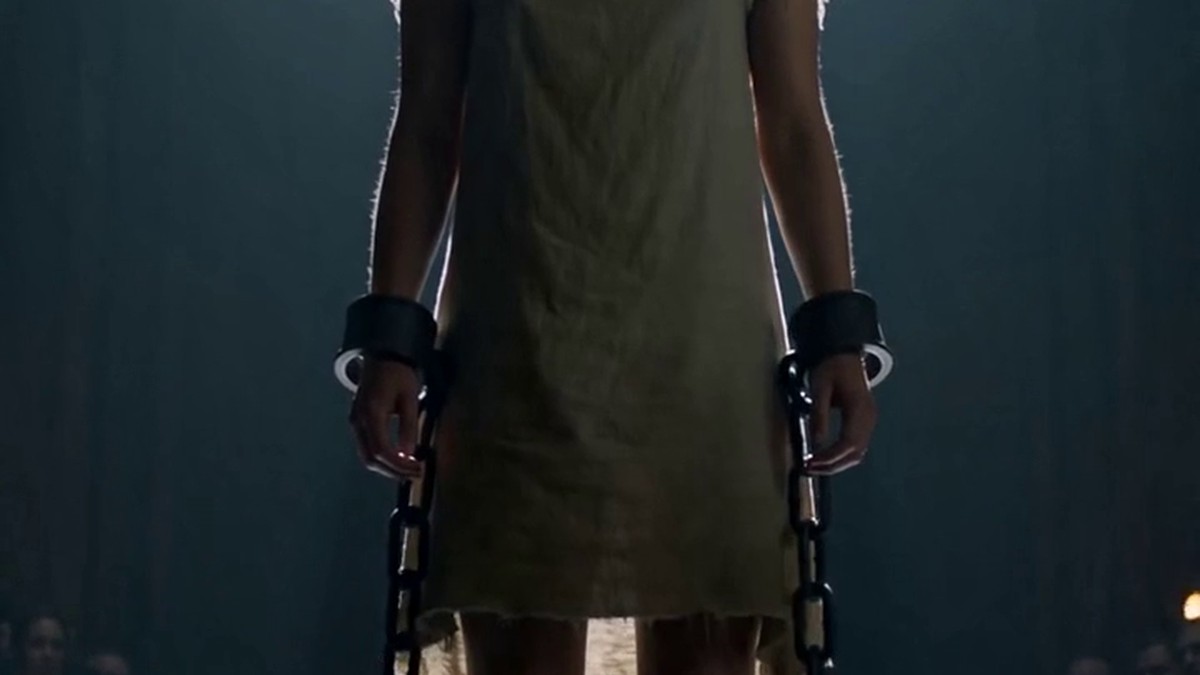
“She won’t survive a single minute!”
The voices hissed from the dark — chains clanking, faces twisted into something ugly and eager.
She knelt. Alone. And stared them all down.
The King leaned forward. “Your last words?”
The silence stretched tight as a wire.
They wanted collapse. They wanted her on her knees, weeping, begging.
What they got was different.
She stood.
Her eyes didn’t waver. Not once.
“You already know what’s true,” she said — voice flat, cold, sharp as a blade drawn slow.
The room erupted. Laughter. Mockery. The kind that bites.
“She’s gone mad!” the King snarled, and every word dripped with disgust.
But something shifted in her gaze. A flicker. Quick and dangerous.
“You didn’t lose the truth,” she said quietly. Almost gently. “You buried it.”
The laughter died.
Just — stopped.
The King’s face went rigid. The carefully held mask slipped, just a fraction.
“Watch yourself,” he said, voice tightening. “You’re standing at death’s door.”
She smiled. Slow. Like she’d been waiting for exactly this moment.
This wasn’t a plea for mercy.
This was a reckoning.
The truth he had pressed down for so long was clawing its way back up — and no throne, no chains, no crown could hold it under any longer.
His eyes went wide as it surfaced. His voice cracked mid-sentence — “What have you—”
The word died in his throat.
The throne room went absolutely still.
Not the silence of submission. Not the silence of a crowd waiting to watch something break. This was the silence of a room that had just realized it was standing at the edge of something it couldn’t walk back from.
She let it breathe. Let it settle into every corner, every crack between the stones.
Then she spoke.
—
“Seventeen years.”
Her voice carried without effort. The kind of voice that doesn’t need volume because it already owns the space.
“Seventeen years since you signed the decree. Since you put your seal on a document that said my father was a traitor.” She took one step forward — the chains between her wrists pulled taut, sang a low metallic note. “A document you wrote yourself. In his name. With his hand forced around the quill.”
A sound from the left. Lord Cassen — the King’s oldest counsel, the one who’d stood at his right shoulder for three decades — shifted his weight. Barely. But she caught it.
She always caught it.
“That’s a lie,” the King said. His voice had dropped to something dangerous and low. “That’s a fantasy spun by a grieving child who never learned her place.”
“I was eight,” she said. “Children remember things they’re not supposed to. They hide in cupboards. They hold their breath and they *listen*.”
She turned her gaze — slow, deliberate — to Lord Cassen.
“Don’t they, my lord?”
The color drained from his face like water from a cracked jug.
The room noticed. Of course it noticed. These were people who had built their entire lives on reading the weight of a silence, the angle of a glance. Every advisor, every courtier, every general in golden epaulettes — they all saw Cassen’s face go white, and they began to understand that something in this room was not what they’d been told.
—
“Remove her,” the King said.
No one moved.
It was a small thing. Barely a moment’s hesitation. But in a room full of men who had spent their careers anticipating the King’s every word, who leapt at the softest suggestion from that throne — the pause was enormous.
“I said *remove her.*”
“With what proof?” she asked. Calm. Almost academic. “The proof is already in this room, Your Majesty. It’s been here the whole time. You just kept everyone too afraid to look at it.”
She reached into the folds of her torn sleeve — and two guards lunged forward.
She didn’t flinch.
“It’s paper,” she said quietly.
They stopped.
She drew it out slowly. Folded. Old. The edges browned with time and handling. She held it up between two fingers like an offering, and even from across that long stone floor the King’s eyes locked onto it with the particular, sick recognition of a man seeing a ghost.
“I was in the cupboard,” she said again. “When you came to see my father. When Lord Cassen held his wrist. When you pressed the seal.” She lowered the paper slightly, then spoke to the room rather than to the King alone. “The royal seal on this document was pressed twice — once cleanly, once at an angle, because my father’s hand jerked when Cassen tightened his grip. Any master of records in this kingdom will tell you that a man signs his own name once, and steadily. And there is something else.” Her eyes moved to Cassen. “The marginal notation in the lower left corner — the hand that confirmed receipt of the order — is Lord Cassen’s. His own writing. Attesting to a coercion he swore before this court never took place.” She let that settle. “I kept this for seventeen years. I didn’t know if I’d ever be able to use it. I didn’t know if I’d survive long enough.” A beat. “But here we are.”
—
Lord Cassen broke first.
It wasn’t loud or dramatic — no confession flung into the rafters, no collapse to his knees. It was quieter than that, and somehow worse. He simply turned toward the King, and the look on his face said everything a court of three hundred people needed to see.
Guilt. Old, exhausted, calcified guilt. The guilt of a man who had made one catastrophic decision at forty and spent the next thirty years building his entire identity around not admitting it.
“Cassen.” The King’s voice cracked on the word. Not with authority. With something older. Fear.
“I’m sorry,” Cassen said — and it wasn’t to the King.
It was to her.
The room erupted. Not with laughter this time. With something rawer and louder — voices splitting off in every direction, some calling for order, some calling for answers, a general near the back door pulling his aide aside to speak urgently into his ear. The brittle social architecture of the court cracking along fault lines that had always existed, just waiting for the right pressure in the right place.
Through all of it, she stood still.
The chains on her wrists. The torn hem of her dress. The bruise along her jaw from the arrest three days ago.
Still.
—
The King stood.
He was taller than she remembered — or maybe it was that she’d only ever seen him from below. From the floor of a cupboard, from the far end of a room, from the lowered eyes of a supplicant.
He descended the dais steps. One. Two. Three. The room fell into a different kind of silence as he walked toward her — close enough now that she could see the broken capillaries in his cheeks, the tremor in his left hand he was trying to control.
“You have no idea,” he said, very quietly, “what you’ve just done.”
“I think I do,” she said.
“Cassen’s word against mine. *Your* word against mine — and a document any forger could have made.” His voice was almost pleading now — not for mercy, but for her to understand the mechanics of power, the way the world actually worked, the way it had always worked. “I am the King.”
She looked at him for a long moment.
“You were,” she said.
And she turned to face the room.
—
She wasn’t a general. She didn’t have an army. She didn’t have allies planted in the court, ready to rise on her signal.
What she had was the document — with its doubled seal and Cassen’s own hand in the margin. And Cassen’s face. And seventeen years of people who had watched her father die for a crime everyone secretly suspected he hadn’t committed — people who had swallowed that suspicion every morning with their breakfast and choked on it every night and told themselves there was nothing to be done.
She gave them something to be done.
“My father’s name,” she said — loud enough now, the room voice, the voice that fills stone — “was Aldric Voss. He served this crown for thirty-one years. He was called a traitor and executed in this courtyard on the fourteenth day of the ninth month, seventeen years ago.” She held the paper up one more time. “And it was a lie. Manufactured. Sealed with the King’s own hand to eliminate a man who had learned something he wasn’t supposed to know.”
She set the document down on the stones at her feet.
“I’m not asking for a verdict. I’m not asking for rescue.” She looked up. Met eyes — the general near the door, the young advisor in the third row who had gone pale, an older woman in gray who was crying silently and trying not to show it. “I’m asking you to look at what’s in front of you and decide who you are.”
—
It took until after midnight.
There was no single dramatic moment when the power shifted — no thunderclap, no sword drawn, no crown removed. It was slower and messier and more human than that. It was Cassen asking to make a formal statement before the court recorder. It was three generals quietly declining when the King ordered them to clear the room. It was an advisor in the second row picking up the document from the floor and handing it, carefully, to the court’s chief magistrate.
By the second hour, the King had stopped giving orders. By the fourth, he had retreated to his private chambers under the quiet, firm escort of two generals who had served his father before him. The word that reached the antechamber, delivered by a tight-lipped steward, was that he would stand before a formal inquiry. He would not be fleeing anywhere. The gates had been seen to.
She sat through most of it on a bench in that antechamber, her wrists finally freed from the chains, a cup of water she was too tired to drink sitting on the table beside her.
A young court page came to find her just before dawn. Sixteen, maybe seventeen, with the careful neutral expression of someone who’d learned early to show nothing.
“They’re asking for you,” he said.
She stood. Her legs ached. Her jaw ached. Everything ached.
“Is it over?” she asked.
He hesitated — the particular hesitation of someone deciding how much truth to offer.
“I think,” he said carefully, “that part of it is.”
—
She walked back into the throne room as the first gray light came through the high windows.
The throne sat empty. She didn’t ask for details — not yet. There would be time for that. There would be time for all of it. The months of hearings and formal inquiries and the slow, grinding work of undoing what had been done. There would be time to find her father’s grave and put his name back on it.
But right now, in this moment, she stood in the room where she’d stood in irons eight hours ago and felt the particular, exhausted weight of a thing finally put down.
One of the magistrates approached. A woman in her sixties, silver-haired, who had sat on the high bench for decades and watched every manner of thing happen in this room.
She stopped in front of her and looked at her for a long time.
Then she said: “Your father would have been proud.”
It was the first time in seventeen years that anyone had said his name to her without a sneer attached to it.
She didn’t collapse. She didn’t weep — not there, not with three hundred people watching.
But something in her chest unclenched. Something that had been holding on since she was eight years old in a cupboard, holding her breath, listening to the sound of her world ending.
She breathed.
Slowly. Fully. Like she was learning how again.
—
Outside, the city was waking up. Carts on cobblestones. A dog barking somewhere down the hill. The ordinary morning sounds of a world that didn’t yet know what had happened inside those walls — and wouldn’t, not fully, for days.
She stepped out into the pale early light.
The chains were gone.
She was still standing.