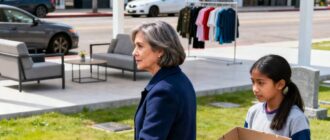
The woman looked at Lily — the dark curls, the careful brave eyes, the way she held the bread like it was proof of something — and searched for her voice.
Woman: “How long have you been out here? Tonight, I mean.”
Noah: “Since the afternoon. We were trying to find somewhere warm.”
Woman: “Where did you sleep last night?”
Noah: (glancing at Lily) “The underpass on Clement. There’s a spot that works.”
Woman: “How long has it been like this?”
Noah: “Since March. When the car got towed. Mom was going to come back and handle it, but she—”
Lily: (small voice) “She got sick.”
Woman: “Is she—”
Noah: “She’s at County. Three weeks now. They say she’s improving, but improving doesn’t happen fast.” (He studied his shoes.) “We didn’t have anywhere to wait it out.”
The woman pressed the bracelet flat against her palm.
Woman: “Why not a shelter?”
Noah: “They split kids up. Me and Lily had to stay together. That was the only rule I had.”
Woman: (barely above a whisper) “The only rule.”
Noah: “She’s four. You don’t walk away from someone who’s four.”
The little girl had started eating the bread in slow, deliberate bites, watching the woman over the top of the crust with eyes that took up too much of her face.
Lily: “Are you sad?”
Woman: “A little.”
Lily: “Because of the name on the bracelet?”
The woman looked down at the bracelet, then back up at the girl. She hadn’t expected that. Four years old and already reading people like weather.
Woman: “Yeah. Because of the name.”
Lily: “Was he your little boy?”
The question landed without cruelty, the way only children can manage — clean and direct and devastating. The woman felt her throat close around an answer that didn’t exist in any language she knew anymore.
Woman: “He was.”
Lily nodded, solemn, like she was filing the information somewhere important.
Lily: “My mom has a bracelet too. It has me and Noah on it. She never takes it off.”
Noah: “Lily—”
Lily: “She doesn’t. Even in the hospital. I saw it when we visited.”
The woman pressed the back of her hand against her mouth for a moment. Just a moment. Then she let it drop.
Woman: “What’s your mother’s name?”
Noah: “Renata. Renata Vasquez.”
Woman: “And you’re Noah.”
Noah: “Noah Vasquez. Yeah.”
She turned the bracelet over once in her fingers. Six years of muscle memory. She’d done it a thousand times standing at kitchen windows, in parking lots, at his grave on the hill above the bay where the wind always came in too cold for the flowers to last.
Woman: “I’m Claire.”
Neither of the children said anything. They waited. They were good at waiting — she could see that in the way they held themselves, the particular stillness of people who had learned that noise sometimes costs you.
Claire: “I have a house. Four blocks from here. It’s too big.”
Noah straightened almost imperceptibly. She caught it.
Noah: “We don’t take charity.”
Claire: “I’m not offering charity. I’m offering a couch and a bathroom and whatever’s in my refrigerator, which right now includes leftover soup and half a lemon cake that I made because baking at midnight is apparently how I handle things.”
Lily: “What kind of soup?”
Claire: “Tomato. Homemade.”
Lily looked at Noah. Noah looked at Claire. The street hummed around them — a car passing three blocks over, someone’s window unit rattling, the city’s indifferent machinery grinding on.
Noah: “One night.”
Claire: “One night.”
—
The kitchen was warm in a way that felt almost aggressive after the street. Lily sat at the table wrapped in an oversized cardigan Claire had found on the coat hook, her feet not quite reaching the floor, working through a bowl of soup with the focused attention of someone conducting serious business. Noah sat across from her with his hands wrapped around his own bowl, not eating yet, watching his sister eat first.
Claire stood at the counter and didn’t say anything about that. Some things you didn’t need to name.
She put the lemon cake on a plate and set it in the center of the table.
Noah: “You really made this at midnight?”
Claire: “Two in the morning, actually. I couldn’t sleep.”
Noah: “Why not?”
She considered lying. It would have been easy. Instead she sat down at the table with them and turned the bracelet once in her fingers.
Claire: “Today was the anniversary. Six years ago I lost my son. He was seven.”
Noah went very still.
Claire: “His name was Marcus. He had — he had a thing about bread too. He used to carry rolls from the bakery in his jacket pocket like currency. Like he was always prepared to negotiate.”
The memory arrived without warning, the way the real ones always did — not the careful photographs she’d built in her mind over the years but the actual boy, jacket lumpy with stolen rolls, grinning.
Lily had stopped eating. She was watching Claire with those enormous careful eyes.
Lily: “Did he live here? In this house?”
Claire: “Yes.”
Lily: “Is that why it’s too big?”
Claire felt something move through her chest. Not pain exactly. Something adjacent to pain that had been living in the same neighborhood for so long it had started to feel like furniture.
Claire: “Yes. That’s exactly why.”
Lily slid off her chair, walked around the table in her socks, and pressed her small warm body against Claire’s arm. No preamble. No announcement. Just the simple animal certainty that this was the right thing to do.
Claire sat very still and let herself be held by a four-year-old.
Noah was looking at the table. When he looked up, his eyes were wet and he was clearly furious at them for being wet.
Noah: “She does that. You can’t stop her.”
Claire: “I know.”
Noah: “She’s done it to strangers on the bus. It’s embarrassing.”
Claire: “It’s the opposite of embarrassing.”
He looked at her. He had his mother’s bracelet around his own wrist — she could see it now in the kitchen light, thin silver, names engraved on the inside. He’d been wearing it all along. She’d missed it in the dark.
Noah: “She’s going to be okay, right? My mom.”
The question was quiet and naked and enormous. He had probably been holding it for three weeks. Holding it away from Lily, away from the street, away from anyone who might give him an answer he couldn’t survive.
Claire: “I don’t know. I can’t promise you that.”
Noah: (after a pause) “Okay.”
Claire: “But I know County. I know people there. Tomorrow I can call and find out exactly what’s happening, exactly what she needs. Information is something I can get you.”
Noah stared at her.
Noah: “Why would you do that?”
Claire: “Because you’re sitting in my kitchen at two in the morning and you have been holding everything together for three weeks and you are sixteen years old.”
The fury in his eyes moved aside for something younger. He pressed the heel of his hand against one eye, then the other, fast.
Noah: “Seventeen.”
Claire: “Seventeen. My apologies.”
Lily had worked her way onto Claire’s lap at some point without either of them noticing. She was almost asleep, the soup finished, the cardigan pulled up to her chin. Her breath came slow and even against Claire’s collarbone.
The kitchen was quiet. Outside, the city went on doing what cities do — enormous and indifferent and humming with ten thousand lives pressing against each other in the dark.
Claire held the sleeping child and looked at the bracelet on her own wrist.
*Marcus.*
She had worn it like a wound for six years. Proof of what she’d lost. A private ceremony of grief she performed every morning when she put it on and every night when she laid it on the nightstand and felt the absence of his weight.
But sitting here — Lily’s warmth spreading through her chest, Noah watching her from across the table with eyes that were finally, cautiously, beginning to unknit — she turned the bracelet and felt something shift. Not less. Not lighter. Just — different.
Like it could be something else alongside the wound. Like it could be the reason she was sitting at this table at two in the morning instead of upstairs in the too-big house with all the lights off.
She had gone out for air.
She had read a name on a wall.
She had found two children on the sidewalk who needed soup and a couch and one person willing to know what was happening at County General.
Maybe Marcus had lumpy jacket pockets for exactly this reason. Maybe he’d been practicing negotiation all along.
She pressed her lips together against something she couldn’t name.
Noah: “I’ll pay you back. When things are — I’ll figure something out.”
Claire: “Noah.”
Noah: “I mean it. We don’t—”
Claire: “I know you mean it. Stop.”
He stopped. He looked at his soup. He finally, slowly, lifted the spoon and ate.
The clock on the wall moved toward three. Lily made a small sound in her sleep and settled deeper. Noah finished his soup and then, after a long moment of visible internal debate, cut himself a piece of the lemon cake.
He ate it like someone who had been pretending not to be hungry for a very long time.
—
By morning, Claire had made two phone calls.
The first was to a colleague at County General — a social worker named Deb whom she’d known for twelve years and who owed her nothing but helped anyway, because some people are simply built that way. Within forty minutes Claire had Renata Vasquez’s actual status, her doctor’s name, the specific program she was enrolled in, and the name of the caseworker handling the family’s file.
*Improving* turned out to mean real things. Specific things. A timeline.
The second call was harder. She stood at the kitchen window with the phone in her hand for a long time before she dialed. But she dialed.
It was the number for the housing assistance office where she sat on the board of directors. A board she had joined three years ago because grief needs somewhere to go and she had nowhere left to put it. She had the kind of leverage she almost never used, and she used it.
When she walked back into the living room, Noah was sitting on the floor next to the couch where Lily was still sleeping, his back against the cushions, his knees drawn up. He looked up when he heard her footsteps and she could see him preparing himself — the particular bracing she recognized from the way she’d walked into hospitals herself, years ago.
She sat in the armchair across from him.
Claire: “Your mother’s primary physician is Dr. Amara Osei. He says she’s been responding well to treatment for the past ten days. He expects her to be discharged in approximately three weeks, possibly less.”
Noah’s jaw moved. He said nothing.
Claire: “She’s been asking about you. Both of you. They have a note in her file.”
That was when he broke. Not loudly — nothing like that. Just a long exhale that seemed to come from somewhere below the ribs, and then his head went down, and his shoulders shook once, twice, and then stopped.
Lily stirred on the couch.
Lily: (foggy with sleep) “Noah?”
Noah: (rough, steady) “Still here. Go back to sleep.”
She went back to sleep.
He raised his head. His face was wet and he didn’t bother to hide it this time.
Noah: “And the other thing? The call you made after?”
Claire: “There’s a transitional housing unit eight blocks from this neighborhood. Family unit — you and Lily together, no separation. It comes with wraparound services, which means someone helping coordinate your mother’s discharge and the transition home.” She paused. “There’s a waitlist, normally. There isn’t one now.”
Noah stared at her.
Noah: “How did you—”
Claire: “I asked.”
He looked at her for a long time. The morning light was coming through the curtains now, thin and silver, and in it he looked exactly as young as he was — seventeen years old, terrifyingly capable, held together by a rule he’d made himself: *she’s four, you don’t walk away.*
Noah: “Why?”
She turned the bracelet once. Felt the engraving under her thumb.
Claire: “Because I went outside last night and I couldn’t sleep and apparently that’s what that was for.”
He didn’t ask her to explain. Maybe he understood. Maybe he was too tired to need an explanation. Maybe at seventeen, after three weeks on the street, you develop a very low threshold for the idea that some things simply land where they’re supposed to land.
Lily woke up properly an hour later and ate two pieces of lemon cake for breakfast, which Claire decided she had absolutely no objection to. She sat at the table and told Claire at considerable length about a bird she had seen at the underpass that she was certain was a parrot, even though Noah maintained it was a pigeon.
Claire: “I think you might both be right. Some pigeons have a lot of opinions.”
Lily: (delighted) “Like Noah.”
Noah: “I’m sitting right here.”
They stayed three more days. It took that long to get the transitional housing paperwork processed, and during that time Noah fixed the broken hinge on the back gate that Claire had been meaning to address for two years, and Lily reorganized the bookshelf in the living room by color, which Claire had to admit was a dramatic improvement.
On the last morning, standing at the front door with their bag, Noah held out his hand.
She shook it. His grip was firm and deliberate, the handshake of someone who had decided what kind of person he was going to be.
Noah: “I’ll come back and finish the fence on the side.”
Claire: “I know you will.”
Lily hugged her around the middle, fierce and certain, the way she did everything.
Then they went down the steps and up the block, Lily skipping slightly ahead, Noah’s hand loose at his side, and Claire stood on the front porch in the morning cold and watched them go until they turned the corner.
She looked down at the bracelet.
*Marcus.*
She thought about rolls in jacket pockets. About currency. About a seven-year-old boy who believed you should always be prepared to negotiate.
She went inside and left the porch light on.