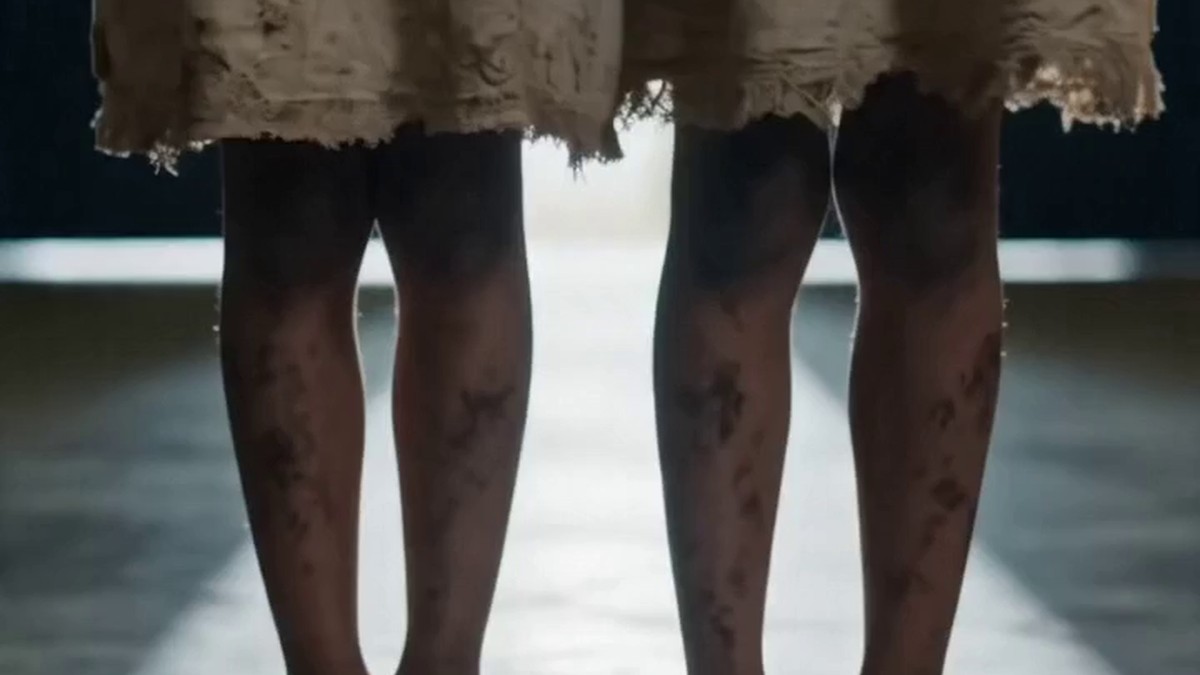
Then it broke open.
The bride stood at the altar in a sleek mermaid gown, a crown blazing at her temples under the chandelier light. She was pointing — arm rigid, finger aimed like a weapon toward the back of the hall — and her voice cut through the chamber with the kind of fury that silences entire rooms.
“Who let these filthy street rats into my wedding?”
Every head turned.
At the entrance stood two little girls. One of them — small, dark-haired, her face streaked with soot, her dress thin and worn at the edges — was crying. Not quietly. The kind of crying that comes up from somewhere deep, the kind a child’s body barely knows how to hold.
She looked past the flowers, past the guests, past all of it, and fixed her eyes on the man in the black tuxedo.
“Daddy,” she sobbed, “why did you leave us?”
The word *Daddy* hit the room like a dropped stone.
The groom crumbled. There was no other word for it. Whatever composure he’d built for himself — the pressed suit, the rehearsed smile, the careful life — it all gave way at once. He bent under the weight of it and wept, openly, helplessly, in front of everyone.
“Sofía—” he managed.
Just that. One name. And it said everything.
The bride’s expression didn’t shift so much as shatter. The contempt drained out of her face, replaced by something rawer — her eyes going wide, her mouth slightly open, the controlled world she had architected collapsing in real time around her.
“What did she just call you?” she whispered.
No one answered her.
Little Sofía and the other girl turned away from the altar. Barefoot, arms wound tight around each other, they walked back down the golden runner together — slow, unhurried — while the guests on either side watched in stunned silence, unable to look away.
At the front of the church, the groom remained.
Still standing. Still weeping. Caught between the wreckage of what he’d buried and the ruin of what he’d built.
The silence lasted exactly three seconds.
Then the groom moved.
He didn’t say a word to the bride. Didn’t look at the priest, or the guests, or the camera crew that was still — inexplicably, absurdly — recording all of it. He simply stepped down from the altar, one foot in front of the other, and followed his daughters down the golden runner.
“Marcos.” The bride’s voice came out stripped of everything. No fury left. Just a name, raw at the edges. “Marcos, don’t you dare.”
He didn’t stop.
—
Outside the church, the light was wrong for a wedding — too white, too flat, the kind of afternoon sun that leaves nowhere to hide. Sofía and the other girl had made it to the bottom of the stone steps before they heard the doors open behind them.
They froze.
Sofía turned first. She always turned first. Her sister — smaller, quieter, still clutching the torn hem of her dress — turned a half second later, and for a moment, all three of them just stood there. The man in the tuxedo. The two little girls. The whole world gone still around them.
“Papá.” The younger one said it like a question, like she wasn’t sure she’d earned the right to the word.
Marcos came down the steps and dropped to his knees on the pavement. Right there. On the stone, in his five-thousand-dollar suit. He gathered both of them in his arms and held them the way you hold something you thought you’d lost, and the sound that came out of him wasn’t crying so much as collapsing — years of something compressed, finally giving way.
“I’m sorry,” he said into Sofía’s hair. “I’m so sorry.”
Sofía didn’t hug him back right away.
That was the detail that broke everything open — the way her small arms stayed at her sides for a long moment, the way her chin trembled while she worked through something too big for her age. Then, slowly, she raised one hand and pressed it flat against his shoulder. Not holding. Just touching. Checking to see if he was real.
“Mamá is sick,” she said.
Marcos pulled back to look at her face. “What?”
“That’s why we came.” Her voice was steadier now, older than it had any right to be. “She told us not to. She said you had your own life now and we should leave you to it. But she’s been in the hospital for two weeks and I didn’t know what else to do.”
He stared at her.
A seven-year-old who had dragged her little sister across the city to a church she didn’t know, to find a man who had walked away — because there was nobody else. Because she was seven years old and she had run out of other options.
“Which hospital,” he said.
—
The bride appeared in the doorway before he could stand up.
She had the look of someone who had always been in control — of rooms, of outcomes, of the exact way things went — and who was now experiencing, for the first time, the sensation of a floor that wasn’t there. Her bouquet was gone. Someone must have taken it from her. Her hands were clasped at her waist, white-knuckled, holding herself together by structure alone.
“I need an explanation,” she said. “Right now. I need someone to explain to me what is happening.”
“Camila—”
“Do not *Camila* me.” She came down two steps. Stopped. Her eyes moved to the girls, and something flickered in them — not contempt this time, not the reflex disgust she’d shown inside. Something more complicated. Unsettled. “Who are they?”
Marcos stood up slowly. When he turned to face her, his eyes were red, his jaw set, his voice very quiet.
“My daughters,” he said.
The word landed between them like something dropped from a great height.
“You have—” Camila started, and then couldn’t finish it. She tried again. “You told me you had never—”
“I know what I told you.”
“You said you had no family. You said there was no one. For three years you said—” Her voice cracked on the last word and she stopped, pressing her lips together, forcing the fracture back down. “Three years, Marcos.”
He didn’t argue. There was nothing in him that wanted to argue.
“Their mother—” he began.
“Don’t.” She held up a hand. “Don’t tell me about their mother right now. I can’t.” She looked at the girls again. Sofía was watching her with a steadiness that was unsettling in someone so young, the kind of steadiness that comes from having seen too much and still surviving it. The younger one had her face buried against Marcos’s leg. “I called them street rats.”
“Yes,” Marcos said.
“I said that in front of everyone.” She wasn’t asking for absolution. She was just naming what she’d done, pressing her fingers against the shape of it. “She was crying and I called her a—” She stopped herself. Put a hand over her mouth. Breathed.
No one moved.
Then Camila walked down the remaining steps, slowly, and crouched in front of Sofía.
She stayed there a moment, at eye level, looking at this child who had done something most adults didn’t have the courage to do.
“What’s your name?”
“Sofía.”
“How old are you?”
“Seven. Valentina is five.”
Camila glanced at the younger girl, still pressed against Marcos’s leg. Then back.
“You walked here by yourself,” she said. “To find him.”
Sofía nodded.
Camila was quiet for a long moment. When she spoke again her voice had lost its architecture — no structure to it, no performance.
“That was very brave,” she said.
—
The guests filtered out eventually, in clusters, the way people do when the event they came for has become something else entirely — something private that spilled into public and then kept going, past the point where spectators were appropriate. The photographer stopped shooting. The string quartet packed up. The florist’s assistant began quietly removing centerpieces from tables no one would ever sit at.
Father Domínguez stood in the doorway for a while, watching the four of them on the steps — the groom, the bride, the two little girls — before deciding that whatever was happening out there was between them and God, and God didn’t need his help today.
—
Marcos got to the hospital by four o’clock.
He left the girls in the care of Camila, which was not a small thing — not for any of them. Camila sat in the car with Valentina asleep across her lap, and Sofía watching her from the passenger seat with that same unnerving steady gaze, and Camila looked back at her, and neither of them said much. They didn’t need to. They were both figuring out the same thing, from different angles.
Inside, Elena was in a room on the third floor. She was thinner than he remembered. The kind of thin that happens to people when they’ve been fighting something they didn’t tell anyone about.
She opened her eyes when he came in and for a long moment she just looked at him.
“They weren’t supposed to find you,” she said.
“I know.”
“I told them to stay—”
“Elena.” He pulled a chair to the edge of her bed and sat down. “Sofía dragged her little sister across the city to a church, barefoot, to ask me why I left.” He paused, letting that settle. “She’s seven.”
Elena looked at the ceiling.
“She’s like you,” she said. “Always was.”
He reached out and covered her hand with his. She didn’t pull away.
“Tell me what you need,” he said.
—
He wasn’t a good man — that was the thing none of the day’s emotion could paper over. He had left. He had built a new life on top of the old one and sealed it so well he’d almost convinced himself the foundation didn’t exist. He had not been there for first days of school or fevers or nightmares. He had sent money, occasionally, because money was easier than presence, and he had told himself that was enough, because it needed to be enough.
None of that disappeared.
But Sofía had come to find him anyway. Had crossed the city on bare feet, face streaked with soot, and stood in the back of a room full of strangers and said *Daddy* with all the force her small body could produce — not out of love, not yet, but out of need. Pure and uncomplicated. *We need you. We are here. You do not get to be invisible anymore.*
He thought about that on the drive back.
—
Camila was still in the car when he returned.
Valentina was asleep in the back. Sofía was asleep in the passenger seat, finally, one cheek pressed against the window, her hands loose in her lap.
Camila stood outside the car, leaning against the door, her wedding shoes in her hand. She had taken off the veil at some point. Without it she looked younger, somehow, and more tired.
He stopped a few feet away.
“She going to be okay?” Camila asked.
“I don’t know yet. It’s treatable. They caught it late.”
She nodded.
He looked at her — really looked, the way you sometimes can’t until after something has stripped away every buffer between you.
“I should have told you,” he said.
“Yes.”
“I didn’t know how.”
“I know.” She wasn’t forgiving him, not yet. She was just being accurate. “That doesn’t make it better.”
“No.”
The afternoon was cooling around them. Somewhere down the street a dog was barking. The wedding dress was getting dusty at the hem and neither of them cared.
“I don’t know what I’m supposed to do now,” she said.
“Neither do I.”
“That’s not very comforting.”
“No,” he agreed. “I guess it’s not.”
She looked through the car window at Sofía’s sleeping face. The soot had dried on her cheek. Someone would need to wash it off. Someone would need to make dinner, find blankets, figure out tomorrow. There were a thousand practical things pressing in around the edges of this impossible day.
“She walked across the city for you,” Camila said.
“Yeah.”
“She doesn’t even know you.”
“No.”
Camila was quiet for a moment. “She’s going to.”
It wasn’t a question. It wasn’t forgiveness, or absolution, or a promise that everything would be all right. It was something smaller and harder and more real than any of those things — a simple statement of what was now true, whether anyone had planned for it or not.
Marcos felt the weight of it settle into him, the way certain things do when they stop being feared and start being carried.
“Thank you,” he said.
Camila looked at him. Her expression was complicated in the way that real things always are — hurt and resolve and something not yet named braided together, no clean edges.
“Don’t thank me yet,” she said, and reached for the car door.
—
They drove back as the sun dropped behind the buildings — two adults, two sleeping children, the ruins of a wedding scattered somewhere behind them like petals on a golden runner.
Sofía stirred somewhere on the expressway. Blinked. Looked out the window at the city moving past.
Then she looked at her father in the driver’s seat, and he looked back at her in the mirror, and she didn’t smile exactly — but something in her face softened, the smallest degree, like a door that had been locked a long time and was not yet open but was no longer dead-bolted either.
He kept his eyes on the road.
She looked back out the window.
And that was enough, for now. Not everything. Not the whole story. But the first true page of it — the one that started not with vows or flowers or a room full of witnesses, but with a barefoot girl in a doorway who decided, despite everything, that it was worth it to walk in.





