King Aldric’s voice shook the rafters of Eldoria’s Great Hall.
At the center of the chamber sat the Forbidden Book — a slab of black metal etched with silver runes that crawled across its surface like living things.
Its first page held a single warning:
*Only the Dragon King may read these words.*
For three hundred years, scholars, archmages, prophets, and kings had tried.
Every last one of them had failed.
Six elder sages had just poured their combined magic into the thing. Its pages fluttered beneath cascading bursts of blue and gold light — and when the sparks died, the pages were still blank. Perfectly, mockingly blank.
“Useless!” the king thundered.
The reward could have bought castles. Armies. Entire provinces. And still, not a single soul in that hall took a step forward.
“Does no one in this kingdom have the spine to try?”
Silence swallowed the room whole.
Then, from somewhere near the towering bronze doors, a child’s voice cut through the quiet.
“I can read it.”
Every head turned at once.
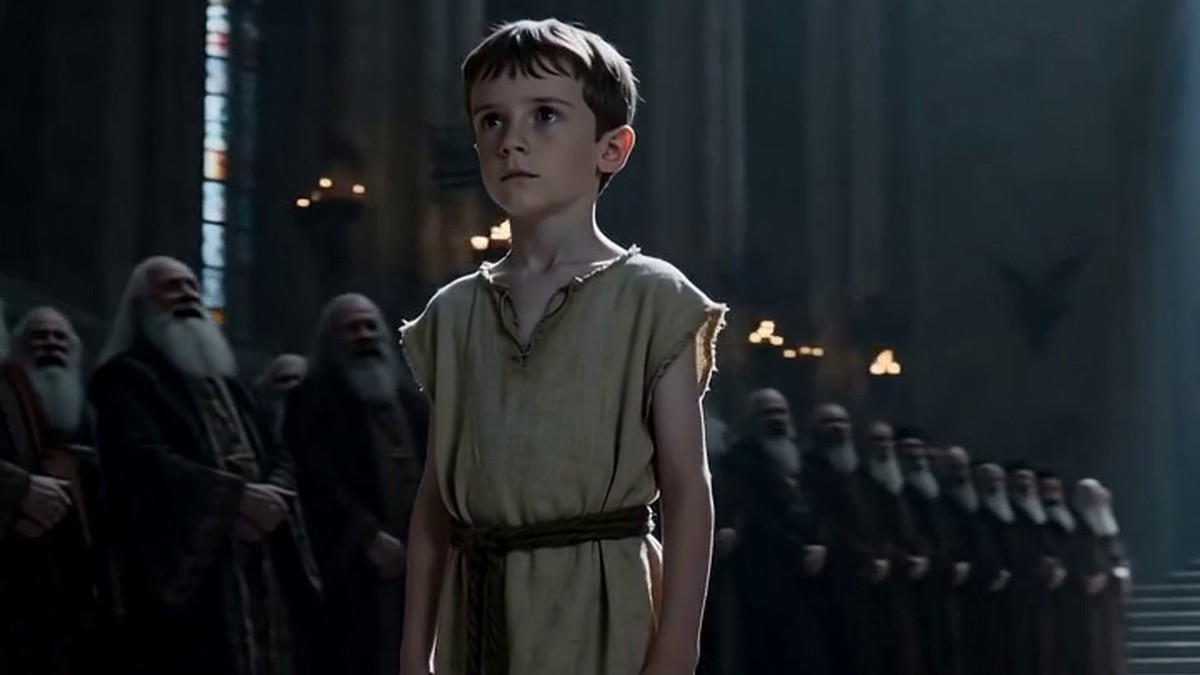
A barefoot boy — no older than twelve — stood in the doorway wearing a patched brown tunic, his ankles grey with road dust.
The nobles erupted in laughter.
The boy didn’t flinch. He kept his eyes fixed on the Forbidden Book, calm and unblinking.
“My name is Elias.”
The laughter hadn’t finished dying when Elias began walking toward the book.
No swagger. No performance. Just footsteps — quiet, deliberate, like a boy who had already decided something and saw no reason to revisit the decision.
A guard stepped into his path, one gauntleted hand dropping to the hilt of his sword.
“Back away, child. This isn’t a place for games.”
“I’m not playing,” Elias said.
The guard looked to the king. King Aldric studied the boy from his high seat — the patched tunic, the bare feet black with road dust, the calm that sat wrong on a twelve-year-old’s face. The calm of someone carrying something heavy, and carrying it so long they’d stopped noticing the weight.
The king raised two fingers. The guard stepped aside.
*Let the boy fail*, the gesture said. *Let everyone see.*
Elias moved through the parted crowd until he stood before the stone pedestal. Up close, the Forbidden Book was larger than it had looked from the doorway — a slab the size of a hearthstone, its black surface catching the hall’s torchlight and swallowing it, giving nothing back. The silver runes pulsed faintly, almost like breathing.
The boy reached out his hand.
“Don’t,” said a voice behind him.
It was the eldest of the six sages — a lean, weathered woman named Maren, her white robes still singed at the hem from the failed attempt. She had not laughed when Elias spoke. She hadn’t moved at all.
“The book burns those who reach without right,” she said, not unkindly. “We all felt it. Six of us, together, and it still burned.”
“I know,” Elias said.
“Then you know what you’re risking.”
“I know what I have to risk it for.”
He set his palm flat against the cover.
The room held its breath.
Nothing happened.
No surge of light. No thunder. No sizzle of scorched flesh.
The boy simply opened the book.
—
The silence that followed was a different kind of silence than before.
Before, it had been the silence of a crowd waiting to laugh. Now it was the silence of forty people trying to process something their minds refused to accept.
The pages — white, blank, mocking — began to fill.
Not with light. Not with magic. With ink, dark and deliberate, rising to the surface like words that had always been there, waiting for the one pair of eyes they had been written for. The text was bound to him — not by any spell cast that morning, but by something older than the kingdom itself; the same ancient compact that had let him bury the book three centuries ago and trust it to remember. Lines of script flowed across the pages in a tongue no scholar present could name, and Elias read without hesitation, his lips barely moving, his finger tracing each line as if following a path he’d walked before in dreams.
“What does it say?” the king demanded. His voice was different now. The thunder was gone. Something quieter had taken its place. “Boy. What does it say?”
Elias looked up.
His eyes had changed. Not in the way of sorcery — no glow, no unnatural colour. They had changed the way eyes change when someone has just been told the worst thing and the best thing at the exact same moment.
“It says Eldoria is dying,” he said. “There’s a sickness in the root of the land. Something old. Something that was buried a long time ago, before the kingdom had a name. It’s been growing for three centuries.”
The hall erupted. Nobles shouted over one another, chairs scraped stone, a woman near the back went pale and gripped her husband’s arm. Maren stood very still.
King Aldric rose from his throne.
He was a big man, broad in the chest, and when he stood, rooms tended to feel smaller. He descended the dais steps one at a time, his gaze locked on the boy.
“And the book says how to stop it?”
Elias looked back down at the page.
“Yes.”
“Then read it. All of it. Now.”
“I have been,” Elias said quietly. “I’ve been reading it for three hundred years.”
—
The silence that fell this time was total.
Maren moved first — crossing the floor to stand beside the boy, close enough to see the text that no one else could see. Her eyes moved over the pages and found only blank white. She looked at the boy’s face.
“Who are you?” she whispered.
Elias closed the book.
He turned to face the hall — all of them, the king on the steps, the sages, the lords and ladies clutching their jewelled cups, the guards with their hands on their swords — and he did not look like a twelve-year-old boy anymore. He looked like twelve years old was the shape he had chosen, the way water chooses the shape of its vessel.
“The book is a key,” he said. “And I am the lock it fits. Or the other way around — it’s been long enough that I have trouble remembering which came first.”
“Speak plainly,” King Aldric said. His voice was careful now, the way you speak around something you are no longer certain is smaller than you.
“I was the one who buried it,” Elias said. “The sickness. Three centuries ago. I was called the Dragon King then — not because I commanded dragons. Because I was the last thing that remembered being older than them.” He paused. “I buried it because I couldn’t destroy it. And I buried myself with it, to keep it from growing. But it grew anyway. And now the only way to end it is to go back down.”
“Go back down where?” Aldric asked.
“Under Eldoria. Under the bedrock. Into the dark where I left it.” He looked at the book in his hands. “The book holds the path. It holds the words I’ll need when I get there. It took three hundred years to remember enough of them to read it again.”
A lord near the king’s left shoulder — fat-faced, red with outrage — burst out laughing. It was not the easy laughter from before. It was the aggressive kind, the kind that picks fights.
“This is a beggar child in a rotten tunic,” the lord said. “He has some cantrip — some cheap hedge-witch trick that fills pages with ink. This is an embarrassment to the crown. Arrest him.”
Two guards started forward.
Maren stepped between them and the boy.
“Do not,” she said. Soft. Final. The guards stopped.
“You saw the pages,” she said, turning not to the guards but to the king. “We all saw them. Three centuries of scholars who could not open that book, and this child opened it with his palm. Whatever he is, he is not a trick.”
King Aldric studied Elias for a long time.
“If you go under,” he said finally, “can you come back?”
The boy’s expression answered before his words did. It was not a lie, what he said. But it was not a comfort either.
“I can try,” Elias said. “But the reason I came here — the reason I walked through your gates and into your hall and said those words — is not the gold.”
“No,” the king said. “I didn’t think it was.”
“The book says there’s a way to collapse it. All of it. The root, the sickness, the buried thing. But the collapse has to be sealed from the inside.” He looked down at the worn tunic, the dusty feet, the small hands holding the book. “Three hundred years to remember how to read. One more task to finish what I started.”
The fat lord sputtered. “You can’t possibly intend to take this child seriously—”
“Silence, Harwick.” The king did not look at him. He kept his eyes on Elias. “What do you need from me?”
—
They went at midnight.
The king, against every advisor’s protest, went himself. Maren went. Two guards — not because Elias needed protection, but because Aldric was stubborn about not sending others where he would not follow.
Elias led them through the lower city, into the old quarter where the streets stopped having names, and then further — to a place where the cobblestones gave way to bare earth and the earth gave way to a hatch of black iron set flush with the ground, so old that moss had grown over it in three separate generations and been cleared away and grown back again.
Elias pressed his hand to it.
It opened.
The air that rose from below was not stale. It was cold and old and clean the way deep caves are clean — untouched, unhurried. And beneath that, barely at the edge of sense, something else. A pulse. Slow and wrong, like a heartbeat running backwards.
“I can feel it from here,” Maren said.
“You’ll be able to feel it the whole way down,” Elias said. “That’s normal.”
It was not a reassuring sentence.
They descended for what felt like an hour. Stone steps, then carved rock, then something older — walls that had not been shaped by human hands, or hands of any kind. The passage breathed. Not metaphorically. The walls expanded and contracted, barely perceptibly, the way a sleeping chest rises and falls.
At the bottom, the passage opened into a chamber.
It was enormous. Large enough that their torches found no ceiling, no far wall. And at its centre — not a monster, not a demon, nothing the stories would have prepared them for — was a wound.
There was no other word for it. A tear in the stone floor roughly the length and width of a man, black at its edges and somewhere between dark red and dark green at its centre, pulsing with that slow, wrong rhythm. Around it, the rock was discoloured. Spreading. The damage was visible in concentric rings moving outward, like ripples from a stone dropped into still water, except frozen in mineral and moving again.
“It’s bigger than it was,” Elias said quietly.
“You knew it would be,” Maren said. It was not a question.
“I hoped I was wrong.” He knelt at the edge of the wound and opened the book. The text rose to meet him, ink surfacing in waves. “You should go back up.”
“Absolutely not,” said King Aldric.
“Your Majesty—”
“You said the seal has to be made from the inside.” Aldric crouched beside him, close enough that the light from the wound coloured his face. “What exactly does that mean?”
Elias was quiet for a moment. “It means the wound has to be closed around whoever seals it.”
The king absorbed this.
“And you knew this when you walked into my hall.”
“Yes.”
Aldric looked at the boy — the shape of the boy, the old weight behind young eyes — and said nothing for a long moment. Then: “Is there truly no other way?”
“I’ve had three hundred years to look,” Elias said. “If there were another way, I would have found it.”
The fat lord — Harwick — was not present. He was in the palace. He would not understand what happened next, and that was fine. Some things are not meant to be witnessed by men who only laugh.
Elias laid both palms on the pages of the open book and began to read aloud.
The language was not any tongue the king or Maren could name. It was not beautiful, exactly — it was something further back than beautiful, something that predated the concept. It was the sound of things being decided. The sound of a very old debt being paid.
The wound flickered.
It pulled back — not like something healing, but like something that had met something larger than itself and been reminded what it was. The red-green pulse stuttered. Sped up. Sped up again.
Maren grabbed Elias by the shoulder.
“There’s still time to—”
“There isn’t,” he said, without looking up. “Take the king back up the passage. Don’t stop. Don’t look back. The passage will seal when I’m done, but you’ll be on the other side of it.”
“Elias—”
“Please,” he said.
It was such a simple word. It was the word of a twelve-year-old boy, not a dragon king, not a centuries-old thing carrying an ancient error toward its reckoning. Just *please*.
Maren’s grip tightened. Then slowly, she let go.
She took the king’s arm. He resisted for one long moment, looking at the boy — the child with the road dust on his feet and the book in his hands and the weight that was finally, almost, set down.
“Well fought,” Aldric said. It was what Eldorian kings said to soldiers at the end. It was what the moment deserved.
Elias looked up one last time. He smiled — quick, genuine, completely twelve years old.
Then he looked back at the book and kept reading.
—
They were halfway up the passage when the stone shuddered.
Not a collapse — not falling rock or cracking walls. More like an exhale. The long, slow exhalation of something enormous finally releasing a breath it had been holding for three hundred years. The walls stopped breathing. They just became walls again — cold and still and ordinary.
The pulse beneath them was gone.
They emerged into the night air. The hatch of black iron lay inert. When Maren pressed her hand to it, it didn’t move. When she reached with her magic, she felt nothing below — no wound, no slow wrong heartbeat, no cold and patient sickness spreading through the dark.
Just bedrock. Just earth. Just the old, quiet foundations of Eldoria, resting at last.
King Aldric stood in the street in his midnight riding clothes with no crown and no court and looked at the sky. He stayed there for a long while.
“Did we do the right thing?” he asked. “Letting him.”
Maren considered this honestly, the way she’d been taught to consider hard questions.
“He already decided,” she said. “Before he walked through your gates. We were never making that choice for him — we were just present for his.”
The king nodded slowly.
He looked out over the darkened rooftops of Eldoria — the city that would wake in the morning, people stepping out of doors into ordinary sunlight, drawing water, beginning their ordinary days, not knowing what had shifted beneath them in the night. Not knowing what had been paid so they could continue having ordinary days.
“The reward,” he said.
“Sire?”
“One hundred million gold coins.” A long pause. “He never asked for it.”
“No,” Maren said. “He didn’t.”
The king looked at the iron hatch one last time. Then he turned and walked back toward the palace, and Maren walked with him, and the city was dark and quiet around them, and under their feet Eldoria’s roots ran deep and clean and still — healed from the inside out, sealed by the one who had known from the beginning that it was always going to cost exactly this much, and had come anyway.