She was twenty-two years old, but some mornings she felt closer to forty-five.
Every day at 5:30 a.m., she woke up not to an alarm but to the sound of the upstairs neighbor’s ancient pipes groaning through the ceiling. Her room was always slightly cold. Moisture crept into the corner by the window. On the kitchen table: overdue bills, a worn-out wallet, and two pieces of dry bread that had seen better days.
She worked two jobs. Mornings at a small café. Evenings at a grocery store two bus stops away. She was studying to become a nurse, but over the last few months she’d missed half her classes — not because she didn’t care, but because after her shifts, her legs simply refused to carry her anywhere else.
In the middle of all that — the debt, the cold, the exhaustion — there was one thing she never skipped.
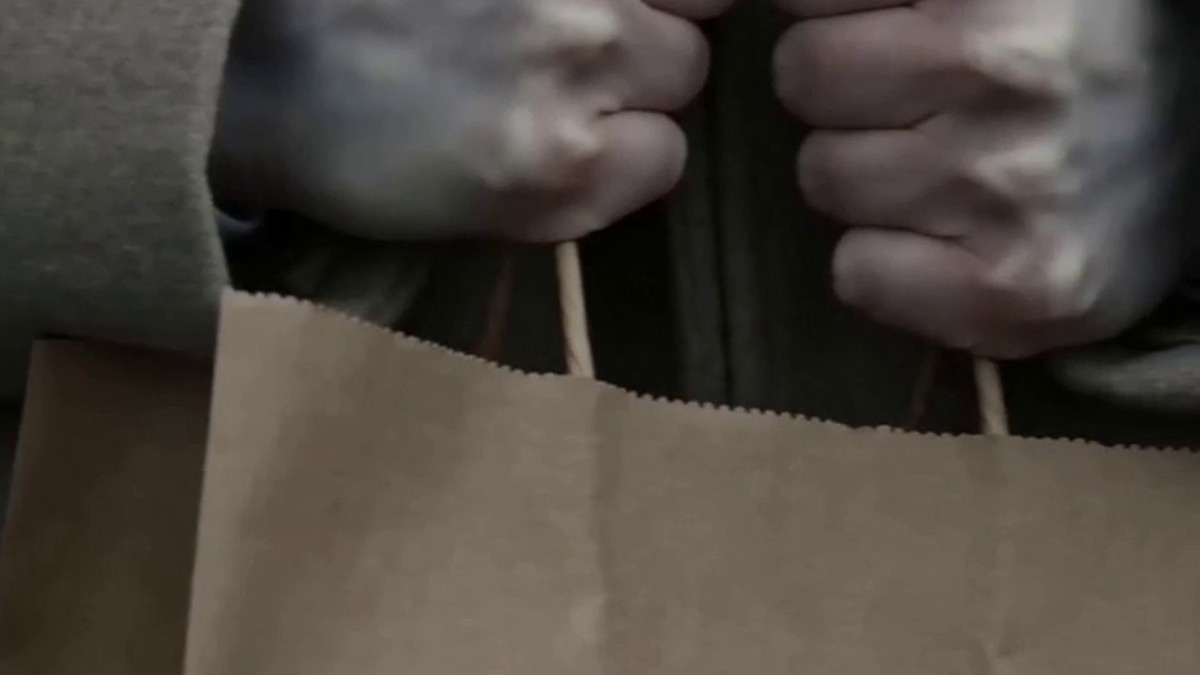
Every morning, she stopped at the same bus stop and set a small paper bag on the edge of the bench.
Inside: coffee. A piece of bread. Sometimes an apple. On the good days, a warm cheese roll.
She left it all for Mira.
Mira was an elderly woman with long silver hair, a weathered brown coat, and a small blue scarf she always tied the exact same way. She lived near that bus stop, beneath an old billboard, with a canvas bag resting beside her. Embroidered on that bag, in golden thread, was a single word:
*Hope.*
The first time Liana noticed her was a rainy morning. Everyone was rushing. Cars sent waves of dirty water crashing against the curb. A man walked by and kicked Mira’s bag without breaking stride — didn’t slow down, didn’t look back.
Mira said nothing. She simply reached down, pulled the bag to her chest, and looked at the ground.
Liana should have run for her bus. If she was late again, her manager would make the same tired remark about how easy it would be to find someone to replace her.
But something made her stop.
She walked over and said quietly, “Would you like some coffee?”
Mira raised her eyes. They were unusual eyes — worn, yes, but sharp. The kind of eyes that once belonged to someone who looked at people directly, not from below.
“Black, no sugar,” she said. “If you ever decide to ask again.”
Liana smiled.
The next morning, she bought two cups.
That was how it started.
Every day at 6:10, Liana would arrive, sit beside Mira for five minutes, listen to whatever she had to say, then run to catch her bus. Mira told strange stories. She talked about speaking in grand halls, signing documents with her own hand, shifting the lives of millions. She said that sometimes people lose everything not because they’re weak, but because one day they trust the wrong person.
Liana quietly assumed the old woman had simply built a more interesting past to make the present feel less empty. But she never interrupted. And Mira never asked for pity.
What she said instead stayed with Liana for a long time:
*”You’re not giving me food, Liana. You’re reminding me that I’m still a person.”*
More than once, Liana cried on the bus ride to work. The quiet kind — the kind where you keep your face turned toward the window.
Her own life wasn’t gentle with her. Rent was overdue. The electricity bill had arrived in a red envelope. Some weeks, so little money sat in her wallet that she had to choose — dinner for herself, or coffee for Mira the next morning.
More than once, she made up her mind to stop.
Once, she said it out loud, just to herself:
*”That’s it. After this week, I can’t keep doing this.”*
But the next morning, when she saw Mira on that bench with her hands pulled deep into her sleeves, Liana walked over and held out the paper bag anyway.
“There’s an apple today,” she said, trying to sound cheerful.
Mira looked at her for a long moment.
“Did you eat?”
Liana smiled too quickly. “Of course.”
Without a word, Mira broke the bread in two and pressed half of it into Liana’s hand.
“Don’t lie to someone who’s been hungry longer than you.”
They both laughed at that. It was a sad laugh — the kind that knows exactly what it’s laughing about — but it was real.
Then, one morning, Mira was gone.
The bench was empty.
Not just empty — bare. The canvas bag with the golden *Hope* was gone. The small hollow in the cardboard beneath the billboard, where Mira always tucked her feet against the cold — gone. Even the particular way the air smelled around that corner, like old wool and something faintly floral, soap or maybe memory — gone.
Liana stood there with the paper bag in her hand. Coffee going cold. Half an apple wrapped in wax paper. A cheese roll she’d bought with the last crumpled bills from her coat pocket.
She waited ten minutes past her bus.
Then twenty.
She went to work late. Her manager made the remark about replacements. She nodded. She didn’t really hear it.
—
Three days passed.
Then four.
She kept bringing the coffee anyway. She set it on the bench each morning and stood there for a minute, feeling ridiculous, feeling like she was leaving flowers for someone who would never come back. On the fifth morning, it rained so hard the paper bag dissolved before she even reached the bus stop. She stood under the billboard and watched the coffee soak into the pavement and thought — this is how things end. Quietly. In the rain. Without a proper goodbye.
That night, back in her cold room with the moisture creeping into the corner by the window, Liana sat at the kitchen table among the overdue bills and told herself it was over. Mira had moved on. People without fixed addresses moved on. That was the nature of things.
She almost convinced herself.
—
Tuesday arrived the way Tuesdays do — indifferently.
Liana was running late. She had dropped a coffee mug, mopped it up, burned her wrist on the edge of the kettle, and missed the first bus. She was walking fast with her coat half-buttoned when the black car appeared.
It came from around the corner of her street — unhurried, deliberate — and parked directly in front of her building. Not beside it. In front of it. The way cars park when they already know exactly where they’re going.
It was the kind of car that made the neighborhood feel suddenly smaller. Tinted windows. No plates she could read at a glance. A stillness about it that didn’t belong.
Three men got out.
Security. That word arrived in her mind before she consciously chose it. The way they moved — measured, checking angles — wasn’t police. It was something private. Something expensive.
And then a fourth door opened.
He was older. Late sixties, perhaps. Silver at the temples, a dark overcoat that cost more than Liana’s monthly rent. He moved carefully, not because he was frail, but because he was a man who had learned to take up space deliberately. He stood on her sidewalk and looked at her building the way people look at something they have been searching for for a very long time.
Then he looked at her.
“Liana Marsh?” he said.
Her full name. Not *Liana from the café.* Not *excuse me, miss.* Her full name, said with the precision of someone who had confirmed it in advance.
“Yes,” she said, because lying seemed beside the point.
“My name is Edmund Voss.” He said it like it should mean something. “I need to speak with you about a woman named Mira.”
—
The inside of her apartment had never felt so small.
Edmund Voss sat in the single chair that wasn’t covered in textbooks. His three security men waited outside in the hall, which did not make Liana feel particularly at ease. She stood with her back against the kitchen counter and gripped her elbows.
“Where is she?” Liana said. “Is she alright?”
“She’s alive.” He said it plainly. “That took some doing.”
He reached into his coat and set a photograph on the table between the bills and the worn-out wallet. Liana looked at it.
Mira — but not the Mira she knew. This woman wore a dark fitted jacket with a small pin at the lapel. Her silver hair was arranged. She was standing behind a podium, and behind the podium was a room full of people, and on the wall was a seal that Liana vaguely recognized from the news, the kind of news she didn’t follow closely because she was always too tired.
Her mouth went slightly dry.
“Her name isn’t Mira,” Edmund said. “It’s Miroslava Kaden. She was a senior director at an international humanitarian organization with operations in eleven countries. Twelve years ago, someone inside that organization fabricated a financial trail that led back to her. They were very careful. She lost everything — her position, her accounts, her name, in certain circles.” He paused. “And eventually, her willingness to be found.”
Liana looked at the photograph again. The sharp eyes behind the podium were the same eyes that had looked at her in the rain and said: *black, no sugar.*
“Why are you telling me this?”
“Because ten days ago, she was found.” Something crossed his face — not quite guilt, but close. “By the same people who removed her the first time. They had been looking for several years. They were afraid she still had documentation. Evidence of what they’d done.”
Liana’s hands were cold. “What happened to her?”
“She’s in a hospital two hours from here. She’s stable now.” He looked at her steadily. “When they found her at that bus stop, she had nothing on her. No identification. Nothing of value. Except —” He reached into his coat again and set something else on the table.
A small folded piece of paper.
Liana recognized her own handwriting. She’d written her phone number on it weeks ago, on a cold morning, and pressed it into Mira’s coat pocket and said: *In case you ever need anything. In case the nights get bad.* She’d felt silly about it afterward. Sentimental. Impractical.
“She had that,” Edmund said. “Nothing else. When she was able to speak — briefly, in the hospital, before we could establish her identity — she said your name.”
The kitchen was very quiet.
“She said: *Tell Liana she wasn’t wrong to trust me.*”
—
The hospital was two hours south on a highway that cut through flat grey country. One of the security men drove. Edmund sat in the front and didn’t make conversation, which Liana appreciated, because she was using the time to breathe.
She had not called in sick to either job before. She had not ridden in a car this quiet or this warm. She watched the landscape and thought about a woman who had held a coffee cup in both hands and said *you’re reminding me that I’m still a person*, and she thought about how you can sit beside someone every morning for months and understand almost nothing about them, and still — somehow — understand the thing that matters.
—
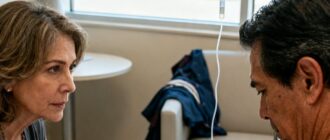
The hospital room was plain. A window with thin curtains. The smell of antiseptic over something more complicated underneath.
Mira was sitting up.
She looked diminished — that was the only word. The brown coat was gone, replaced by a hospital gown and a blanket. There was bruising Liana didn’t let herself look at too directly. But the silver hair was the same. And the eyes.
When Liana walked through the door, Mira looked at her with an expression Liana had never seen on her before.
Not guarded. Not composed. Not the careful dignity of someone protecting what little they had left.
Just — open. Undefended.
“You came,” Mira said.
Her voice was thinner. But her.
“Of course,” Liana said. She crossed the room and sat in the chair beside the bed and took the older woman’s hand, which was cold, the way hands get when they’ve been cold too long. “Of course I came.”
For a moment neither of them said anything.
Then Mira said: “I owe you an explanation.”
“You don’t,” Liana said. “You don’t owe me anything.”
“I do.” The sharp eyes were very direct. “I should have trusted you sooner. I was afraid. For a long time I was afraid that knowing the truth about me would put you in some kind of danger. And I was also —” A long pause. “I was also ashamed. That particular fear is harder to admit.”
“Mira.”
“Miroslava,” she said. Quietly correcting. Then: “But Mira is fine. You named me that the second morning, do you remember? You couldn’t pronounce the full name. You tried three times and then you looked at me and said *can I just call you Mira?* and I said yes because it was the first time in two years someone had asked me what I preferred.”
Liana felt something behind her eyes. She kept her face steady.
“I did eat, that morning,” she said finally. “For the record. I just didn’t eat much.”
Mira’s mouth curved. The same smile. Knowing. Sad and real.
“I know,” she said. “I always knew.”
—
They were in that room for almost an hour. Edmund came in partway through and sat quietly against the wall like a man who understood that some conversations aren’t for him. He had his own complicated history with Miroslava Kaden — twelve years of searching, he told Liana later, the kind of searching that starts as professional obligation and becomes something harder to name. He had been the one person inside the organization who had believed she was innocent. He had lost his own position for saying so. He had spent twelve years assembling his case from the outside — building it document by document, interview by interview, reconstructing the fabricated financial trail through sources he cultivated slowly and at considerable personal cost. The case he brought to the prosecutor’s office was thorough precisely because he’d had no shortcuts. No drives. No files. Just years of careful, unglamorous work.
What Miroslava herself provided, once she was well enough to speak at length, was the final layer: her memory. Specific, precise, intact. Names, dates, the exact wording of private conversations that corroborated the documents Edmund had gathered. She remembered everything — the particular kind of memory that belongs to someone who had looked at people directly for thirty years and never quite stopped.
Taken together, the two bodies of evidence locked into each other. Edmund had the architecture; Miroslava had the details that only someone present in the room could have known. Neither alone would have been enough. Together, they were very difficult to dismiss.
He had been three days too late to prevent what happened at the bus stop.
He would carry that. That was plain.
The people responsible — three of them, two still inside the organization, one recently departed and wealthy — were now facing that documented case, twelve years in the making, held up by both the paper trail and the memory of the woman they had underestimated.
—
Liana left the hospital as the sun was going sideways and orange across the flat grey fields.
On the drive back, she sat with her hands in her lap and watched the light change and thought about what Mira had said near the end, just before Liana had stood to leave.
*”You kept me here. I want you to understand that. Not figuratively. When the mornings felt like nothing — when there was no particular reason to be awake at six o’clock — there was always the small fact of a paper bag with coffee in it. That was enough. Sometimes enough is everything.”*
Liana had said: “I almost stopped. I want you to know that too. I almost stopped so many times.”
And Mira had nodded slowly, like this was not a confession but a simple and important fact.
*”But you didn’t.”*
—
The city came back into view as the highway bent north. Lights beginning in the dusk. Her neighborhood, small and cold and entirely ordinary.
Her apartment was the same when she got home. The moisture in the corner. The bills on the table. Two jobs in the morning. Classes she needed to get back to.
But something had shifted in the particular weight of the room.
She put the kettle on. She stood at the window and looked at the street below — the bus stop, the bench, the old billboard with its peeling edges. The bench was empty in the blue evening light.
Next Tuesday, Edmund had told her, there would be a preliminary hearing. He had asked her to make a statement. Just a character witness, he’d said. Just the truth of what she observed.
*I observed a woman,* she would say. *I observed that she was there, and then she wasn’t, and that the difference between those two things mattered.*
She thought that was enough. She thought she could say that plainly and without embarrassment.
—
In the weeks that followed, things changed in the small slow ways that things actually change — not dramatically, not all at once.
The hearing took place. Then another. The case moved through its careful legal architecture and Liana was not a central figure in it; she was a footnote, a witness, a girl who brought coffee. But she showed up each time she was asked. She wore the only decent jacket she owned and she said what she’d seen and she didn’t look away.
Miroslava Kaden was formally cleared eleven months later.
It had taken that long because cases built on twelve years of reconstructed evidence and the testimony of a woman the other side called unreliable did not move quickly. There were motions and countermotions, delays, a prolonged effort by the defense to discredit Edmund’s documents as selectively gathered. It was slow and grinding and nothing like the clean resolution Liana had half-imagined on the drive home from the hospital. But it held. Each piece confirmed the next, and eventually the weight of it became undeniable.
The day the clearance came through, Liana was finishing a morning shift at the café when her phone buzzed with a message from an unknown number. Three words.
*It’s done. — M.*
She read it twice standing at the counter with a dish towel in her hand. Then she set the towel down, walked to the back room, and let herself cry the way she hadn’t let herself cry in a long time — not the quiet kind on the bus, not the kind where you keep your face turned away. The real kind.
Her coworker knocked on the door after a minute.
“You okay?”
“Yes,” Liana said. And meant it completely.
—
They met again on a morning in early spring.
Not at the bus stop. At a small café — not the one where Liana worked, but one across the city, the kind with tall windows and real cups and coffee that cost more than it should. Edmund had suggested it, and Mira had agreed, and Liana had put on the decent jacket again and arrived exactly on time.
Mira was already there. Dark jacket. Silver hair arranged. No brown coat, but a blue scarf — the same one, tied the exact same way.
She stood when Liana came in.
They looked at each other across the café for a moment.
Then Liana walked over, and they sat down, and the coffee came, and outside the city moved past the tall windows in its ordinary ongoing way.
“Black, no sugar,” Liana said, when the cups arrived.
“You remembered,” Mira said.
“I always remembered.”
Mira wrapped both hands around the cup. Her eyes were the same — worn and sharp, the eyes of someone who had looked directly at a great many things and was still, improbably, looking.
“I’d like to pay your tuition,” she said. “The nursing program. I’ve made inquiries. There’s a remainder of two years.”
Liana opened her mouth.
“Before you refuse,” Mira said, “I’ll tell you what you told me. It isn’t charity. It’s reminding someone that they’re still a person.”
She said it quietly, without drama, the way true things are said.
Liana closed her mouth.
Looked at her coffee.
Looked at the window.
Outside, the morning was doing what mornings do — arriving, irreversible, full of ordinary difficulty and the occasional, improbable fact of kindness returned.
“Okay,” she said.
One word.
It was enough.