The girl hadn’t moved from the doorway. Both arms pulled the milk carton against her chest like she was holding something irreplaceable — because she was.
She looked like she hadn’t slept in days. Hair tangled, skin drained of color, eyes swollen from crying that had long since stopped being useful. Next to her, a small stroller carried a baby in a red onesie, tucked under a blanket that wasn’t nearly enough for the weather outside.
The store clerk kept his tone even. Not heartless, but firm.
“I can’t let you walk out without paying. I’ll have to make a call.”
The girl looked down at the baby. Just for a second. Then back up.
“I’m not trying to steal anything.” Her voice fractured at the edges. “He hasn’t eaten today.”
Those five words landed hard.
Nobody spoke.
Then the door chimed.
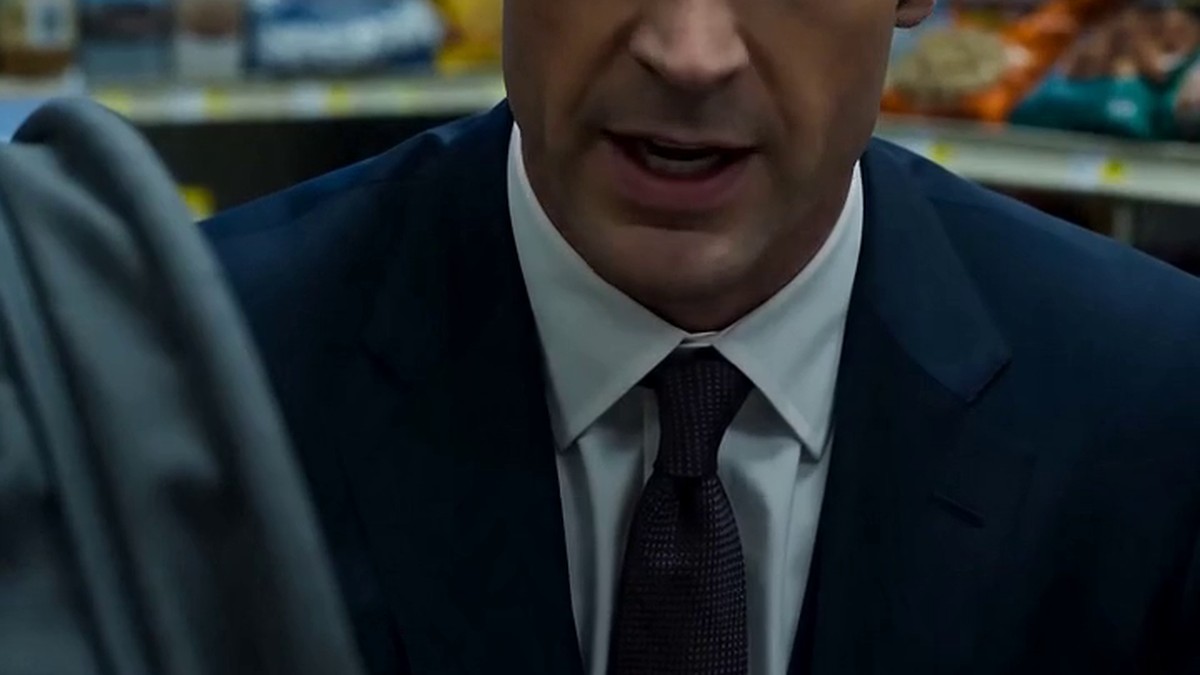
A man in a dark navy suit stepped in from the street, stopped when he caught sight of her, and moved toward her slowly — the way you approach someone who might bolt if you breathe wrong. He lowered himself to her eye level, keeping his hands where she could see them.
“What’s your name?”
She tightened her grip on the carton.
“Anna.”
Something shifted in his expression. Fast, then gone, then back again.
He took in her trembling hands. The baby sleeping in the stroller. The exhaustion carved into her face.
“Anna.” He said it quietly, like he was testing the weight of it. “What if I could help you with more than just milk?”
She stared at him. Uncertain. Like kindness was a thing she’d stopped trusting somewhere along the way.
Then she swallowed, and reached into the small pocket at the back of the stroller.
“My mom told me…” Her breath hitched. “She said if I ever had nobody left, I should find the man in the blue suit. And show him this.”
She held out a photograph. Old and soft at the corners, the way photos get when someone has carried them too long.
He took it from her fingers.
His hand went still. Then it started to shake.
The picture showed a younger version of him, standing next to a woman who was laughing — one hand resting gently on her stomach, eyes bright, like the world hadn’t happened to her yet.
He couldn’t look away from it.
The photograph trembled between his fingers. The store had gone completely quiet — no hum of the refrigerator, no distant traffic through the glass, nothing. Just the sound of his own breath coming slower, the way breathing does when a man is fighting to stay upright.
“Where did you get this?” His voice came out wrong. Too small for a man his size.
Anna hadn’t loosened her grip on the milk. “My mom kept it in her Bible,” she said. “Between Psalms and Proverbs. She said that’s where you keep the things you’re afraid to lose.”
He looked at her — really looked at her — for the first time since he’d walked through the door.
The shape of her jaw. The particular stillness of her eyes when she was scared. The way she tilted her chin up just slightly, defensive, the way a person does when they’ve been disappointed enough times that they brace for it automatically.
He had seen that posture before. In a mirror. A long time ago.
“What was her name?” he asked. “Your mother.”
“Elena.” Anna’s throat moved. “She died eleven months ago. Pneumonia. She’d been sick a long time, but she kept — ” The sentence broke. She steadied herself and tried again. “She kept waiting until she felt better before she called anyone. She never felt better.”
The man in the dark navy suit pressed the photograph flat against his chest. His eyes closed for three full seconds.
When they opened, something had rearranged itself inside him. Something permanent.
“Your mother and I—” He stopped. Started over. “I was twenty-three. She was twenty-one. We were — ” He searched for the word that would carry the weight without collapsing under it. “We were everything to each other. And then I was stupid and young and I thought I was choosing my future, and what I was really doing was burning it down.”
Anna’s eyes searched his face. Not softening yet. Not hardening either. Just — searching.
“She never told you,” he said. Not a question.
“She told me your name,” Anna said. “She told me you were a good man who made a terrible choice and that those two things could both be true at the same time.” A breath. “She said I’d know you by the suit. She said you always wore navy blue when you wanted the world to take you seriously.”
He made a sound that wasn’t quite a laugh. Grief wearing a laugh’s clothes.
The baby stirred in the stroller then — a small, soft sound, barely a murmur, but the girl’s attention snapped to him instantly, the way new mothers do when their whole nervous system has been rewired around someone else’s breath. She rocked the stroller once, and the baby settled.
The man watched this. Watched her hands on the handle. Watched the exhaustion in the line of her shoulders and the way she held herself together anyway, molecule by molecule, because she didn’t have the option of falling apart.
He had done this, he thought. Not by being cruel. By being absent. By being a letter that was never written, a call that was never made, a door that was never knocked on. The cruelest thing about absence is that it keeps happening. Every day. Long after you’ve stopped thinking about it.
“How long have you been on your own?” he asked.
“Seven months.” She was still watching the baby. “I tried to keep the apartment. I had a job at a hotel, but the baby came early and the insurance — ” She shook her head. “You don’t need to hear all of it.”
“I do,” he said. “I need to hear all of it.”
She looked at him sharply. Like he’d said something in a language she wasn’t fluent in.
—
The clerk had moved back without anyone noticing, giving them the space that the moment required, the way decent people do when they understand they are standing at the edge of someone else’s private country.
The man set the photograph down on the counter very carefully. Like it was the most fragile thing he’d ever held — because it was. He reached past Anna and picked up the milk carton from where she was still clutching it.
He placed it on the counter beside the photograph.
“Ring it up,” he said to the clerk. “And — ” He looked out the window at the street, then back at Anna. “Is there anything else you need? Right now. Not eventually. Right now.”
“I — ” She stopped. Closed her mouth. Tried again. “Formula. He needs — the milk is just for me, he needs formula, but it’s — ” She swallowed the price down, the way people swallow things that embarrass them. “It’s okay.”
“It’s not okay,” he said, and his voice had gone very quiet and very certain, the way voices go when someone has just decided something. “It’s going to be okay. That’s different.”
He walked to the baby aisle himself. He didn’t know which formula. He had never bought formula in his life. He stood in front of the shelf for a moment and then turned back to Anna.
“Which one?”
She blinked. Then she came and stood beside him and pointed.
He took two. Then he went back and he picked up two more. He carried all of it to the counter and he didn’t look at what it cost before he paid, which is the specific language of a man trying to communicate something that words aren’t big enough for.
—
They stood outside on the sidewalk afterward. The January air pushed against them. The baby was awake now, blinking at the pale winter light with the absolute serenity of someone who has no idea how hard the world is working to be survived.
“I don’t want your money,” Anna said. “I need you to know that. I wasn’t — my mom didn’t tell me to find you for money.”
“I know,” he said.
“I found you because she said — ” Her voice cracked, not dramatically, but at the roots, the quiet structural kind of cracking that happens after months of holding. “She said you would want to know. That even if you never — that you would want to know she existed. That *he* existed.”
She looked down at the baby.
Then she looked up.
“She named him after you,” she said. “I didn’t know if I should say that. But she did.”
He looked at the baby for a long time. The baby looked back at him with the unfocused, generous attention that babies give the world before the world teaches them to be selective.
The man crouched down to the stroller.
He didn’t touch the baby. He didn’t reach out. He just looked at him, close, the way you look at something you are trying to memorize in case it disappears. The small fist curled against the blanket. The flicker of an almost-smile that meant nothing and everything.
When he stood back up, there were tears running down his face and he wasn’t doing anything about them. That was the part that would stay with Anna longest afterward — not that he cried, but that he didn’t hide it. He just let it happen. On a sidewalk in January. In his navy suit that he wore when he wanted the world to take him seriously.
“I have a lot to make right,” he said.
“I know,” Anna said.
“I don’t expect forgiveness. I don’t expect — ” He exhaled. “I’m not asking for anything. I want you to understand that. I’m not asking for anything at all.”
Anna looked at him for a long moment.
“My mom forgave you,” she said finally. “She told me that too. She said she spent a long time being angry and then one day she just — let it go. Not for you.” A half-breath pause. “For herself.”
He nodded. He kept nodding, slowly, like something was settling inside him that had been loose for years.
“Could I — ” He stopped. “Would you be willing to get coffee? Somewhere warm. And just — let me listen. You don’t have to want anything from me. I just want to listen.”
Anna looked at her son. Then at the man who was, she understood now with full certainty, her father. Not in the way that mattered most, not in the way that counted through all the years her mother had been sick and the nights she’d sat in hospital waiting rooms and the seven months she’d been surviving on nothing but stubbornness and love. But real, nonetheless. A fact. A complication. A door that had, impossibly, opened.
“Coffee,” she said. “Okay.”
She gripped the stroller handle and turned it toward the café at the corner. He walked beside her — not ahead, not behind, but beside — and the baby rode between them, serene and warm, already too young to understand what he had caused simply by existing.
The winter light came flat and pale off the sidewalk.
Inside the carton in the bag on the back of the stroller, the milk stayed cold.
And the photograph was in Anna’s pocket again, back where it had lived for all those years — between what she was afraid to lose and everything she was still, somehow, carrying forward.