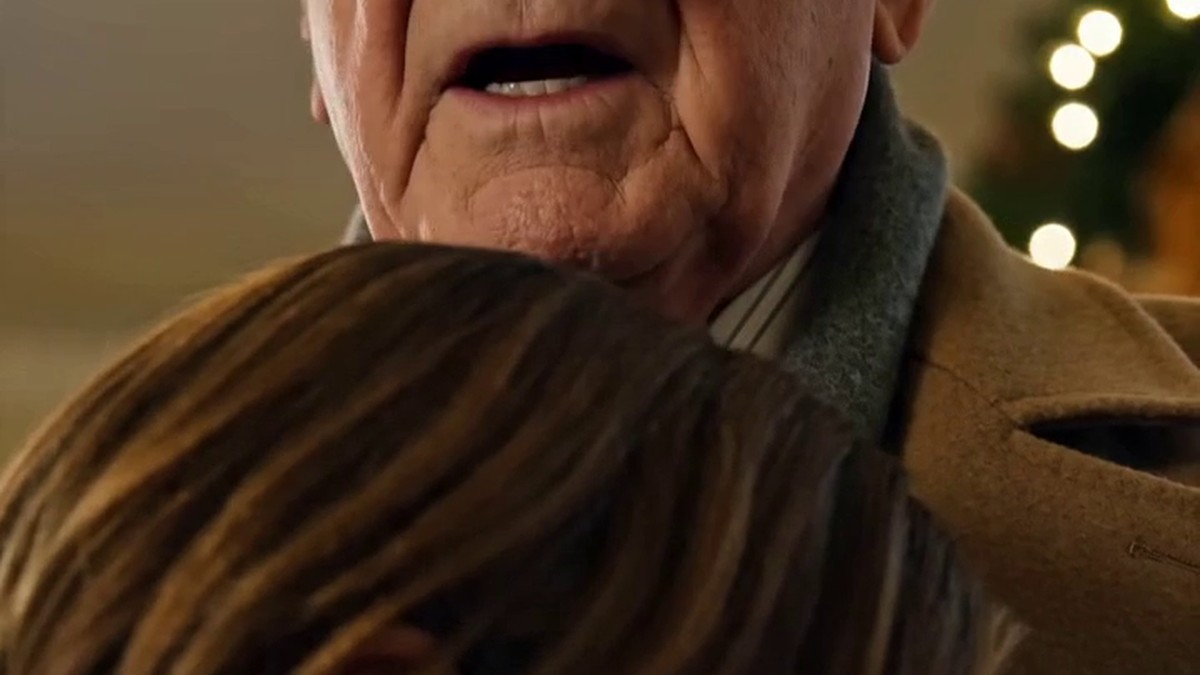
Then her grandfather said one name — and the manager’s face went the color of a man who’d just seen something he’d buried come walking back through the door.
He didn’t move for several seconds.
He just stared at the small star-shaped keychain hanging from the old man’s coat pocket. The blood drained from his face so completely that even the nearby shoppers stopped pretending not to watch.
A minute ago, the store had been bright and warm and perfect. Soft music drifted between shelves of dolls and bears and wooden trains, past holiday displays that glittered like promises.
Now the air felt thick.
Lily pressed herself against her grandfather’s side, both hands wrapped around his sleeve. She was seven — too young to understand the old family lies, but old enough to recognize the look adults gave her when they’d already decided she’d done something wrong.
Marsha, the employee who’d humiliated her in front of everyone, flicked her gaze between the manager and the old man.
Her sharpness faltered.
“What is that?” she said. “Why are you looking at it like that?”
The manager didn’t answer.
His eyes stayed on the keychain.
It was small and scratched and dull from years of living in a coat pocket. To anyone else, it would have looked like junk. Worthless. The kind of thing you find at the bottom of a drawer and throw away without thinking.
To him, it was clearly something else entirely.
Arthur Whitman closed his fingers around it.
He hadn’t come here to fight.
He hadn’t come here to drag his daughter’s name back through the mud.
He’d only brought Lily because she wanted to see the blue music-box doll — the one her mother used to sing about, back when there had still been a mother to sing.
That was all.
One look.
One song.
One tiny piece of Clara that Lily had never been allowed to hold.
But Marsha had blocked the aisle with a smile like a locked door.
“Don’t touch that display case,” she’d said, her voice clipped and final. “Those dolls are expensive.”
Arthur had kept his voice low.
“She only wanted to look.”
Marsha’s eyes had moved slowly — over his worn coat, over Lily’s scuffed shoes, over the few folded bills he held in his hand.
“This isn’t a place for begging.”
The words hit Lily first.
Her face crumpled. She stepped back, cheeks burning, fingers scrambling for her grandfather’s sleeve like it was the only solid thing left in the room.
Arthur felt something old rise up inside him.
Not just anger.
Something deeper. The particular ache of watching someone humiliate your family in public and expecting you to swallow it quietly, to shrink, to disappear.
Before he could speak, the manager arrived.
Young. Polished. The kind of effortlessly assured that made people step aside for him without knowing why.
Then he saw the keychain.
His shoulders locked. His mouth fell open slightly. Whatever authority he’d walked in wearing fell away from his face — as though the past had reached out and grabbed him by the throat.
When he finally spoke, his voice came out careful. Almost afraid.
“Sir… may I ask your name?”
Arthur looked down at Lily.
She was watching him with wet eyes, waiting to see if he would shrink too.
He set one steady hand on her shoulder.
Then he looked back at the manager and said the name this store had been pretending not to remember for twenty-two years.
“Arthur Whitman.”
The manager’s lips parted.
Marsha went still.
And suddenly every person in that gleaming toy store seemed to understand — all at once, like a current moving through them — that the shabby old man they’d dismissed minutes ago might be connected to something buried beneath the polished floors they were standing on.
—
The manager’s name was Derek Holt.
He was thirty-four years old, had held this position for six months, and had been coached on exactly one crisis scenario during his orientation: a shoplifter, caught on camera, denying everything at the door.
Nobody had coached him on this.
But he had read the staff handbook. All of it — the earnest, thorough reading of a man who wanted to do the job correctly. And on the third page of the supplier acknowledgements section, buried between outdated wholesaler contacts and a discontinued stationery line, there had been a single internal note flagged in red: *Whitman licensing matter — unresolved. If name arises in any customer context, escalate to regional immediately. Do not engage independently.*
He had thought it was a billing dispute. Some dry contractual remnant.
He understood now that it was not.
And the keychain — he had seen that keychain before. Not this one, not in a pocket, but in a photograph pinned to the corkboard in the regional manager’s office, clipped beside a copy of the original 1982 contract: a prototype promotional piece, star-shaped, produced as a launch gift for the holiday line. The same line whose boxes still filled the window. The same stars. The same moons.
He had assumed the photograph was history.
It had just walked through his door.
“Mr. Whitman.” He said the name slowly, like a man testing ice. “Would you — could I ask you to come to my office?”
“No.”
The word was quiet. Absolute. A door swinging shut on a hinge that had never been oiled.
“Whatever needs saying,” Arthur told him, “gets said here. In front of my granddaughter.”
Lily looked up at him. Her cheeks were still flushed, but something had shifted in her expression — the humiliation cooling, replaced by something watchful and alert. She was learning, in real time, what her grandfather looked like when he decided not to disappear.
Derek’s eyes cut to Marsha.
Marsha, who had not moved, who was standing with her hands clasped in front of her like a woman waiting for a verdict that kept refusing to come.
“Why don’t you go check on the back display,” Derek said to her.
She didn’t argue.
She walked away without looking at Lily, without looking at Arthur, her footsteps precise and deliberate on the polished floor. The sound of them faded into the soft piped-in music, and then she was gone — through a door marked EMPLOYEES ONLY, and out of sight.
But not gone. Arthur knew that. People like Marsha were never gone. They just relocated their certainty to a place you couldn’t see it.
He turned back to Derek.
“My daughter’s name was Clara Whitman,” he said. “Twenty-two years ago she signed a contract with this store. A licensing deal. Her drawings — the star-and-moon series — became your holiday line. The one that’s still on the boxes in your window.”
Derek opened his mouth.
Arthur raised one hand.
“I’m not finished.”
A woman near the teddy bear display had stopped pretending to shop. A father with a stroller had drifted two steps closer. The store felt suspended — that particular stillness that falls when people sense they are witnessing something true.
“The contract had a royalty clause,” Arthur continued. “Clara was twenty years old and she didn’t have a lawyer. The clause was buried on page eleven. She signed it because she loved what she made and she trusted the people across the table from her.” He paused. “She died four years later. She never saw a cent beyond the initial fee. And I was told — very politely, by people in rooms like your office — that the matter was settled and I should not return.”
Lily had gone very still.
She knew her mother had drawn pictures. She knew her mother had loved stars. She had a single photograph taped inside her nightstand drawer — Clara at nineteen, laughing, a sketchbook open on her lap, stars and moons scattered across the page in pencil like a private sky.
She had not known about the store.
She had not known about any of this.
She looked up at the window display. At the boxes stacked in cheerful pyramids — midnight blue, printed with tiny silver stars and crescent moons, a small girl reaching up toward them with one hand.
She had seen that image her whole life.
She had never known it had a face behind it.
“Grandpa,” she whispered.
He squeezed her shoulder once. Firm and warm.
“I know, Lily-bird.”
Derek Holt stood very still in the centre of his own store. The colour had not come back to his face. If anything, he looked worse — the particular look of a man who has just understood that a problem he inherited is not smaller than he thought. It is much, much larger.
“Mr. Whitman,” he said carefully. “I want to be clear — I was not here when—”
“I know you weren’t.” Arthur’s voice was not cruel. That was the thing about it. There was no performance in him, no rage dressed up as righteousness. He was simply a man standing in a toy store with his dead daughter’s granddaughter, holding a keychain she had pressed into his hand the last Christmas she was well enough to give gifts. “I’m not here to punish you for what you didn’t do.”
“Then what—”
“I want Lily to see the music box.”
Derek blinked.
“That’s it?” he said.
“That’s where we start.”
Something shifted behind Derek’s eyes. A calculation — quick, private, the arithmetic of a man weighing what this moment could still become against what it had already been allowed to be. He could call regional. He could ask them to leave. He could invoke the flag in the handbook and pass this whole thing up the chain and be technically correct in doing so.
He looked at Lily.
She was watching him the way children watch adults when they are deciding, quietly and permanently, what kind of people exist in the world.
“Alright,” he said. “Come with me.”
—
The display case was at the back of the store, behind a low arch threaded with fairy lights.
Derek unlocked it himself. His hands were not entirely steady.
The blue music-box doll sat on the centre shelf — porcelain face, silk dress the colour of a winter midnight, a small brass key in her back. Painted across the base in fine silver lines: stars and moons. The same stars. The same moons.
Clara’s.
Lily leaned in close, her breath fogging the glass for just a moment before she caught herself and leaned back.
“Can I hold her?”
Derek looked at Arthur.
Arthur nodded once.
Derek lifted the doll carefully and set it in Lily’s hands.
She held it like something alive. Like it might feel the warmth and remember.
She turned the brass key.
The music started — a small, bright, climbing melody, the kind that sounds like something being opened rather than something being played. Three notes up, two notes down, one sustained note that hung in the air like a question.
Lily went very still.
“Mama used to sing this,” she said.
Not a question. A fact she had been keeping, not knowing where to put it.
“She wrote it,” Arthur said. “She sketched the doll and hummed the tune in the same afternoon. She was eighteen. She thought she was just playing.”
Lily looked at the base of the doll. At the stars. At the moons. At the small painted girl reaching up.
“Is that her?” she asked. “The little girl on the box?”
Arthur looked at the figure for a long moment.
“She always said it was nobody,” he said quietly. “But she had your mother’s hands.”
Lily’s chin moved. She pressed her lips together — a gesture Arthur recognised with a pain that didn’t dull, would never dull — because it was exactly what Clara had done, that same controlled effort, when she was trying not to cry in front of someone she loved.
He put his arm around her.
She leaned into his side and held the doll and let the music run out.
—
Marsha came back.
She appeared from the EMPLOYEES ONLY door with her coat on and her bag over her shoulder, clearly having decided that her shift was over now, emotionally if not officially. She angled toward the front exit with the practised invisibility of someone who has made a calculation.
She almost made it.
“Ma’am.”
Arthur’s voice stopped her four feet from the door.
She turned slowly. Her expression had rearranged itself into something neutral, professional. Closed.
“I want my granddaughter to hear this,” he said.
Marsha’s jaw tightened. She looked at Derek.
Derek looked at the floor.
She looked back at Arthur.
“The things you said to her,” Arthur said. He did not raise his voice. He did not move from where he stood. “Not a place for begging. You said that to a seven-year-old child whose mother drew every star on every box in this store. You said it because of our shoes.” He let that land. “I need you to understand what you did. Not for me. For her.”
Marsha said nothing.
“She’s going to remember today for the rest of her life,” Arthur said. “The question is what she remembers.”
A long silence.
Lily was watching Marsha with the music-box doll held against her chest, both arms wrapped around it, the way children hold things they have just decided are theirs.
Something moved in Marsha’s face.
It was not a large movement. It was the small interior collapse of someone whose certainty has just met something it could not dismiss — not the manager’s discomfort, not the threat of a lawsuit, but a child’s face. Just a child’s face, clear and watching and already learning what the world costs.
She crossed the floor.
She crouched down in front of Lily — a practised motion, knees together, spine straight, the way people crouch when they are not used to being at a child’s level.
“I was unkind to you,” she said. Her voice came out stiff, but she did not look away. “It wasn’t right. I’m sorry.”
Lily considered this.
The way only children consider things — not deciding whether to accept it, but whether it was real.
“Okay,” Lily said finally.
Not forgiveness, exactly. Not yet. But the door left open.
Marsha stood. She didn’t look at Arthur. She walked to the exit, pushed through the glass door, and was gone into the grey afternoon outside.
—
Derek Holt called regional that same evening.
The conversation was not comfortable. The regional director’s voice went very flat very quickly — the particular flatness of a man confronted with a problem he had been assured was dormant. He told Derek the matter had been resolved years ago. Derek said he understood that, but suggested respectfully that Arthur Whitman did not appear to share that understanding, and that the name had been spoken in a store full of witnesses, and that perhaps someone with more authority than a six-month manager should decide how to proceed.
There was a long pause.
Then the regional director said he would make some calls.
He made more than some.
Arthur Whitman was not a litigious man. He had not come into that store with a lawyer or a grievance letter or anything except his granddaughter and the forty dollars in his pocket that he had been willing to spend on one blue doll.
But he had come with a name.
And sometimes a name is enough to remind a corporation that the thing they buried had a face, had a family, and left behind someone who carries a star-shaped keychain in a worn coat pocket not because it is valuable — but because it was hers.
The settlement was not a headline.
It was not large, by the standards of large things.
But it was enough to mean that Lily Whitman would go to college someday without that particular weight on her.
And it was enough for one other thing.
Three weeks after the papers were signed, a box arrived at Arthur’s door. A holiday box, midnight blue, printed with silver stars and crescent moons. He turned it over in his hands before he opened it, the way you handle something you have been waiting a long time to touch.
Along the underside, in small clean letters: *Original designs by Clara Whitman.*
He read it twice.
Then he set the box on the kitchen table and did not move for a while. He just sat with it, in the quiet of a Tuesday morning, the winter light coming through the window, his hands flat on either side of the box like he was steadying something that might otherwise drift.
Lily found him there when she came down for breakfast.
She read the words. She touched them with one finger, tracing each letter slowly, as though she needed to be certain they were real and not something that would vanish if she pressed too hard.
“They put her name on it,” she said.
“They did.”
She looked up at him. Her eyes were bright, and her chin did the thing — the controlled, careful thing — and she looked away quickly and busied herself pouring cereal.
But she left the box on the table.
It stayed there all through breakfast, and all through the morning, and as far as Arthur could tell, it was still there when he looked in from the hallway that night, catching the last of the lamp’s light, the silver stars quiet against the blue.
—
They had left the store as the streetlights came on, three weeks earlier.
Lily had carried the music-box doll in a blue bag printed with stars. Arthur had paid for it — the full price, exact change, no gesture made of it.
On the sidewalk, she slid her hand into his.
“Grandpa.”
“Mm.”
“Did she know? Mama? That they used her stars?”
He walked for a moment before answering.
“She knew,” he said. “She thought it was enough — that people would see them and feel what she felt when she drew them. She wasn’t wrong about that part.”
Lily thought about this.
She looked at the store window as they passed it — the pyramid of midnight-blue boxes, the silver stars, the small reaching girl.
“She’s still in there,” Lily said.
It wasn’t a sad thing, the way she said it.
It was the way you talk about someone who has simply gone ahead of you — who is waiting somewhere, patient and bright, in a place that still holds the shape of them.
Arthur’s hand tightened around hers.
“Yes,” he said. “She is.”
They walked on into the evening, the two of them, the old man and the little girl, the keychain catching the last of the light in his pocket — a small star, scratched and dull and irreplaceable — swinging gently with every step.