But the first lie in her marriage wasn’t about money. It was about him.
Caleb looked at Grace like he hadn’t quite heard her, and the disbelief on his face made something ache deep inside her chest.
“Do you actually mean that?”
Grace turned toward him.
“I grew up in a house you could get lost in. It never once made me happy. After my mother died, my grandfather drove me out to his little cabin in western North Carolina. One bedroom. A wood-burning stove. A porch swing that groaned in the wind. I loved it, because nobody there treated me like a piece of forgotten furniture.”
The tension in Caleb’s face gave way.
“I’m sorry.”
“That’s not your fault.”
“No,” he said quietly. “But I’m sorry anyway.”
Before she could find the words to answer, knuckles landed sharp against the door.
“Please,” Caleb muttered, “not right now.”
A woman’s voice pushed through from the hallway.
“Caleb Carter! You open this door before I embarrass you in front of your wife!”
Grace glanced at him.
“Your mother?”
“Yeah. She swore she’d dress like a normal person.”
Eleanor swept into the room wearing a coat that was anything but understated.
“There she is. Welcome home, sweetheart. I’m Eleanor. This serious boy is mine, though certain days I deny the connection entirely.”
The older man beside her smiled warmly.
“William Carter. We’re real glad you’re here.”
Caleb pressed two fingers to his forehead.
“Mom. The coat.”
“It’s faux,” Eleanor said. “Extremely affordable. Painfully modest.”
William cleared his throat. Grace caught a glimpse of his watch — simple in design, but expensive in the way that only quiet money could pull off — before he tucked his wrist away. Caleb noticed too. The look he cut toward his father could have scored glass.
Something passed between them. Careful. Buried.
Grace felt it land without being able to name it yet.
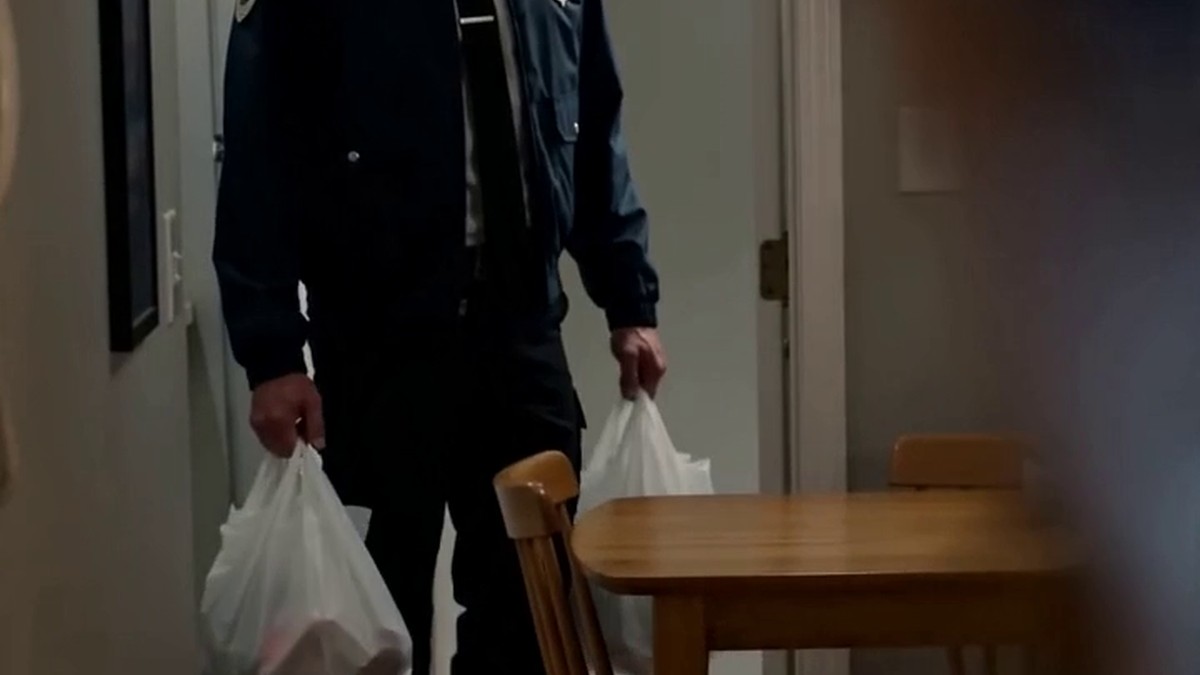
Over the first week, the marriage surprised her. Caleb rose early, brewed coffee, and left for work in a uniform that read CARTER SECURITY across the chest. He came home carrying groceries and actually listened when she talked.
Eleanor brought soup. William fixed a warped cabinet door with a screwdriver that cost more than the life they were all pretending to live.
Together, they offered Grace something genuinely dangerous.
Kindness with no strings attached.
And that kindness made her want to believe.
The trouble arrived ten days after the wedding, when Celeste called. Grace was folding towels when her sister’s name lit up the screen. She almost let it go to voicemail. Old habits, though, have a way of winning.
“Grace, darling,” Celeste said, stretching the word until it curdled. “Grant and I are going to a private investment dinner at the Rosemont Grand tomorrow evening. You should come.”
“Why?”
“Because you’re my sister.”
“Since when?”
Celeste laughed, light and sharp at once.
“Don’t be bitter. The Ashford family is hosting. Grant’s working an angle toward partnership with them. It might do you some good to watch what real ambition looks like.”
Grace’s fingers tightened around the towel. The Ashford name carried weight — their hotels lined the coastline, and their hidden heir had become the kind of rumor people passed around at dinner tables. People said the family had kept a second son out of sight for years, acknowledged privately, useful occasionally, embarrassing by implication — a man who existed in the margins of the official family ledger while Elliot Ashford held the public title and the public face. People called that second son proud. People called him damaged. People said his family had kept him at arm’s length until they could find a way to fold him back in without it costing them anything.
“I don’t think that world is mine anymore,” Grace said.
“Oh, please. Are you already embarrassed by your new little life? Come out. Show everyone how happy you are — unless your husband can’t tear himself away from the gate.”
Grace stared at the stack of towels until their white edges blurred together.
She went.
Not for Celeste. Not even to prove anything. She went because something in the Ashford name snagged in her memory like a loose thread she couldn’t leave alone, and Grace had never in her life been able to walk away from a pulled thread.
She told Caleb that evening while he was rinsing dishes. She kept her voice even, factual, the way she always did when she was bracing for something.
He dried his hands slowly.
“The Rosemont Grand.”
“Yes.”
“Private investment dinner.”
“That’s what she said.”
He set the dish towel on the counter and looked at her — not through her, the way her father used to, not past her, the way Grant always did. Directly at her.
“You don’t have to explain yourself to me,” he said. “You want to go, we go.”
“We?”
“You think I’m sending you into a room full of Celeste’s people alone?”
Grace almost smiled. Almost.
—
The Rosemont Grand hadn’t changed. It never did. Twelve stories of pale limestone, a lobby that smelled of hothouse flowers and inherited confidence, chandeliers that threw off light the way old money threw off warmth — generously, impersonally, to no one in particular.
Grace walked in on Caleb’s arm wearing a navy dress she’d bought herself three years ago, before the debts, before the quiet collapse of everything she’d thought her life was. It still fit. That felt like a small, private victory.
Celeste was already there, positioned near the entrance the way a person positions themselves when they want to be seen arriving. She wore champagne silk. Grant stood beside her looking like he’d been assembled from a catalog of acceptable masculinity.
“Grace.” Celeste kissed the air beside her cheek. Her eyes dropped to Caleb’s uniform-free frame — he’d worn a simple charcoal suit, well-cut, nothing flashy — and something flickered in her expression. Assessment. Dismissal. Then a slow, deliberate reset into charm. “And this must be the husband.”
“Caleb,” he said, extending his hand. His grip, Grace knew, was firm.
Grant shook it with the practiced ease of a man who’d shaken a thousand hands and remembered none of them.
“Security work, is that right?” Grant said.
“That’s right.”
“Steady field. Essential, really.” He said it the way you’d call a fire extinguisher essential — correct, obvious, and something you never actually thought about.
Caleb smiled pleasantly. Said nothing.
Grace loved him a little for that.
—
The dining room held forty people arranged across round tables that gleamed with crystal and white linen. A string quartet worked quietly in one corner. The Ashford family’s people moved through the room like weather systems — you felt them before you saw them.
Grace found their table. Sat. Accepted a glass of water she didn’t drink.
She was watching the far end of the room when Caleb leaned in close.
“Third table from the left,” he said quietly. “Don’t look immediately.”
She waited five seconds. Then looked.
The man was perhaps forty, dark-haired, with the kind of composed stillness that didn’t come from ease — it came from practice. He wore his suit the way her grandfather used to wear his: without thinking about it, which meant he’d been wearing suits his whole life. He was speaking to an older woman in pearls, but his eyes moved across the room at intervals with the methodical patience of someone who was always, underneath every conversation, doing a different calculation entirely.
“That’s him?” she asked.
“That’s Elliot Ashford,” Caleb said.
Something about the way he said it — no surprise in it, no introduction in it, like a name he’d said before, privately, in another context — made her go still.
She turned to look at him.
“Caleb.”
“Grace.”
“How do you know what he looks like?”
The pause was only a half-second. But she’d grown up in rooms full of people who knew how to pause before answering, and she recognized the weight of it.
“I’ve seen his photograph,” he said. “In the news. Ashford Hotels.”
It was a perfectly reasonable answer. It sat in her chest like a stone.
—
Grant made his move during the third course. Grace watched him cross the room toward Elliot Ashford with the bright-eyed momentum of a man who believed his own pitch. Celeste tracked him from their table, her fingers moving in small adjustments on the stem of her wine glass.
Elliot Ashford listened. Nodded once. Said something brief. Grant’s smile didn’t falter, but Grace had watched enough deals fall apart in real time to recognize the exact moment a door closed in a man’s face while he was still talking.
Grant came back to the table six minutes later with his jaw set.
“He’s not what I expected,” he said.
“Meaning he said no,” Celeste said.
“Meaning he’s harder to read than his reputation suggests.”
Grace looked toward the far table. Elliot Ashford was watching them. Not staring — watching, with that same methodical patience, and when his eyes landed on her, they stopped moving.
Then they moved to Caleb.
And something happened in Elliot Ashford’s face that Grace could not have described precisely but understood instinctively: recognition. Complicated recognition. The kind that carried history.
Caleb was looking at his water glass.
Celeste noticed none of it. She was already recalibrating, leaning toward Grant and speaking in the low, rapid tones of someone revising a strategy in real time. By the time the dessert plates were cleared, she had moved on entirely — the Ashford angle relinquished, a new target already forming somewhere behind her eyes. Grace watched her sister collect her wrap from the back of her chair and touch Grant’s arm with the brisk efficiency of a woman who had never once confused sentiment for momentum.
They said their goodbyes at the lobby door. Celeste kissed the air beside Grace’s cheek again and said they should have lunch, which they both understood to mean they would not. Grant shook Caleb’s hand a second time with the same impersonal ease as the first — and Grace understood, watching him go, that she had finally and completely set that world down. It felt less like loss than like putting a heavy coat away at the end of a long winter.
—
She waited until they were in the car. The city moved past the windows in amber and neon, and she counted two full blocks before she spoke.
“He knew you.”
“Grace —”
“Don’t.” She kept her voice even. “Don’t manage me.”
Caleb was quiet for a long moment. His hands stayed steady on the wheel. Outside, a light turned red, and the car slowed and stopped, and the whole world seemed to hold its breath with it.
“My name,” he said finally, “is Caleb Ashford Carter.”
The red light held.
“Elliot is my brother,” he said. “Half-brother. My mother is Eleanor Carter. My father is William — William Carter publicly, William Ashford when it matters to the family ledger.” He exhaled through his nose. “I grew up on the outside edge of that family. Acknowledged privately. Useful occasionally. Embarrassing by implication. Elliot was the public heir — groomed for it, visible, the version of the family they showed the world. I was the version they kept in a different column of the ledger.”
“The watch,” Grace said. She remembered it — the quiet, expensive watch that William had tucked away when he caught Caleb’s look.
“Dad still moves between worlds like he’s commuting. Like both families are just stops on the same line.” The light turned green. “He wanted me at that dinner tonight. He’s been pushing for months for me to come back into the fold. Some kind of public reconciliation. A gesture.”
“And the security job.”
“Is real,” Caleb said. “I needed something that was mine. Not his. Not theirs. Something nobody could fold into the family narrative.” He glanced at her. “I should have told you before.”
“Yes,” Grace said. “You should have.”
“I know.”
She looked out the window. A woman walked a dog past a closed bookstore. A boy on a bicycle cut through the crosswalk. Ordinary, irreducible life moving through the city at half past ten at night.
“I grew up performing happiness for people who owned everything and felt nothing,” Grace said quietly. “I married you because you felt real. Because your apartment was small and your coffee was bad and you looked at me like I was a person.” She turned back to him. “If that was also a performance —”
“It wasn’t.” His voice cracked slightly on the second word. Just slightly. “Grace. None of that was performance.”
She studied his face in the passing light. The jaw she’d memorized by now. The eyes that looked at her directly.
“The inheritance,” she said. “The family money. Is it coming for us?”
“It’s already here,” he said. “My father put the apartment in a family trust two years ago. I found out six months ago when the management company sent the wrong letter. That’s what we weren’t —” He stopped. “That’s the thing I didn’t know how to tell you.”
—
Three nights later, William Carter came to dinner.
He brought a bottle of wine that cost more than a month’s groceries, and he set it on the counter with the ease of a man who had never once thought about what things cost, which was, Grace had come to understand, its own particular kind of violence.
Eleanor was not there. Eleanor, Grace suspected, had never been told.
William sat at the kitchen table and talked about opportunity, about legacy, about the Ashford name being broader than one branch, about Elliot coming around to the idea of public acknowledgment. He used words like *reconciliation* and *family* the way politicians used them — full of warmth, empty of specific obligation.
Caleb listened. His hands were flat on the table.
“You put this apartment in the trust,” Caleb said, when his father reached a pause.
“As a gesture —”
“Without telling me.”
“To protect you —”
“From what?” Caleb’s voice didn’t rise. That was the thing about him, Grace thought. He didn’t need volume. “What exactly were you protecting me from, Dad?”
William’s composure held, but something underneath it shifted — the slight recalibration of a man who had not expected to be asked a precise question and needed a moment to produce a precise answer.
Grace set her hands in her lap and waited.
“I wanted to make sure you had something solid,” William said. “Regardless of choices you made.”
“Choices like marrying Grace.”
A pause. The wrong kind.
“Choices like keeping your distance from the family,” William said carefully. “I respect that you wanted independence, Caleb. But independence has limits when the people around you don’t share your —” He seemed to search for the word. “Resources.”
“Say what you mean,” Grace said.
Both men looked at her. She met William’s eyes steadily.
“You mean you wanted to make sure the apartment stayed in the family’s control in case Caleb made a choice you couldn’t manage,” she said. “In case he married someone you hadn’t vetted. In case your quiet, useful, outside-the-ledger son suddenly had a wife with her own claim.”
The silence that followed was long and specific.
“I mean that families are complicated,” William said finally.
“Yes,” Grace said. “I grew up in one. I know exactly how families use that word.”
William looked at his son.
Caleb looked back at him — steadily, without anger, which Grace realized was worse. Anger could be managed, explained away, folded into a story about difficult personalities and emotional overreaction. This was something else. This was a man who had made a clean accounting of what he was owed, found the balance, and accepted the number.
“I’m not coming back to the Ashford table,” Caleb said. “Not as a project. Not as a reconciliation gesture. Not to make Elliot comfortable or the board comfortable or you comfortable.” He exhaled once. “I’ll have a lawyer look at the trust. We’ll settle that quietly. But that’s the last piece of your architecture in my life, Dad. I mean that.”
William picked up the wine bottle and looked at it for a moment as though it might suggest a different ending to the evening.
Then he set it down and stood.
“I hope you know,” he said, “that I did love you. I do.”
“I know,” Caleb said. “That’s what makes it complicated.”
—
William left. The wine stayed on the counter.
Grace stood at the kitchen sink, looking at the dark window that gave back her own reflection. She heard Caleb cross the room. Felt him stop just behind her.
“Are you angry?” he asked.
“At you?”
“At any of it.”
She thought about it honestly, the way she’d learned to think about things in this small apartment with its bad coffee and its groaning pipes.
“I’m angry that everyone in both our lives thought they could arrange us,” she said. “Like furniture.”
He was quiet a beat.
“Yeah,” he said. “Me too.”
She turned around. They were close — the kitchen was not large — and she looked at him in the plain overhead light that forgave nothing and hid nothing.
“The cabin,” she said. “Your grandmother had one too?”
He blinked. Surprised by the pivot.
“My mother’s mother. Yeah. Tennessee. Basically fell apart.”
“Did you love it?”
Something shifted in his face. Something genuine and unguarded and rare.
“Loved it,” he said. “No one there cared who my father was.”
Grace nodded slowly.
“Okay,” she said.
“Okay?”
“That’s a real thing we have in common.” She reached past him, picked up the wine bottle, and put it in the cabinet above the refrigerator — out of sight, neither used nor wasted. “We’ll figure the rest out as we go.”
He looked at her for a long moment.
“Grace.”
“Caleb.”
“I’m sorry I wasn’t honest sooner.”
“You will be, from here,” she said. It was not a threat. It was not quite forgiveness either. It was something more durable than both — a decision, made clearly, in a small kitchen, in the kind of ordinary light that doesn’t lie.
He nodded once.
She turned back to the window. Her reflection looked steadier than she felt, and she took that as a good sign — she’d always been a little ahead of herself when it mattered.
Outside, the city went on doing what cities do: indifferent, relentless, full of people negotiating the distance between who they came from and who they were choosing, night after ordinary night, to become.