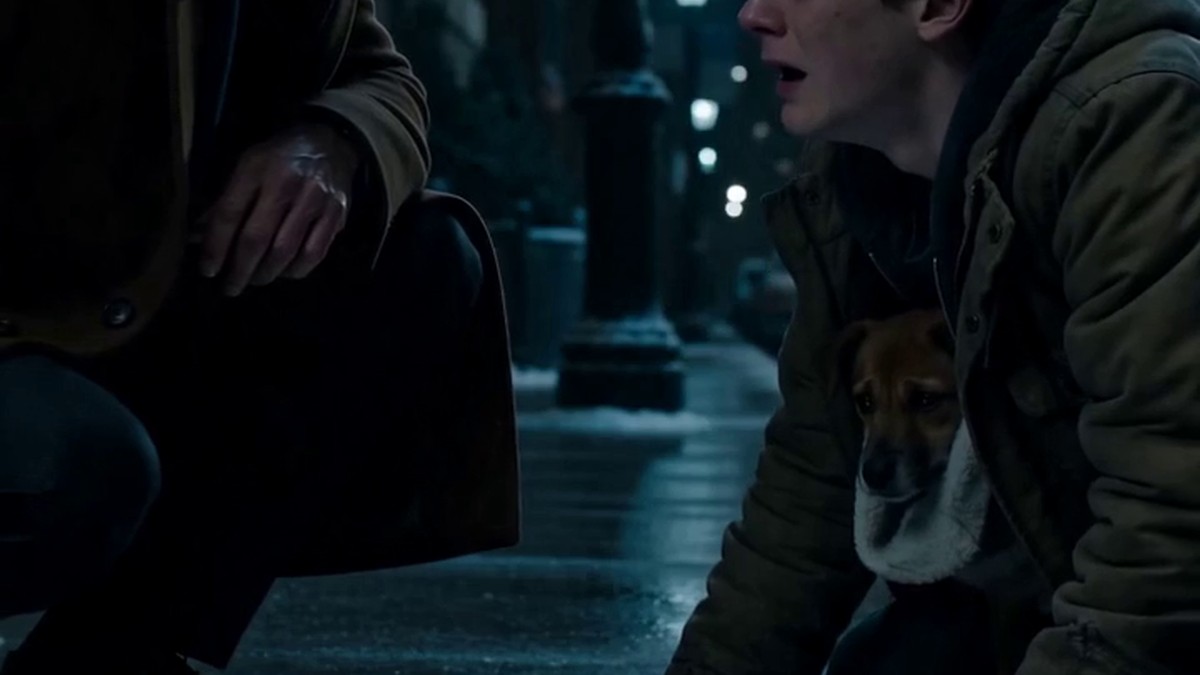
He clawed his way across the ice on all fours, the puppy trembling against his chest, and pressed his face to the grate. Down in the shallow pool of water at the drain’s bottom, a silver ring caught the streetlight and threw it back at him — a cold, indifferent glint, as though it hadn’t just destroyed everything.
“Please,” Max whispered again. To no one. To the ring. To whatever corner of the universe might still bother with someone like him.
He forced his fingers through the iron slats. Not wide enough. He couldn’t touch it.
He looked around in a panic — for a stick, a wire, anything thin enough — and came up empty. He pressed his forehead against the frozen metal of the drain cover and just breathed.
The ring had been his mother’s. The morning they took her to the hospital for the last time, she had folded his fingers around it. *Keep this safe*, she’d told him. *It belongs to someone important. One day you’ll understand who.*
Nine months, he had kept it safe. Through the shelter system. Through three evictions. Through everything the world had thrown at him.
“Hey.”
Max looked up.
The Range Rover sat idling half a block ahead, driver’s door hanging open. The man was walking back — but not the way he’d walked before. Gone was the easy, loose stride, the warmth of someone who’d just been laughing. Something had locked up inside him. He moved the way people move when their body is still going but their mind has fallen behind, scrambling to catch up.
His eyes hadn’t left the drain.
He crouched beside Max without a word. Without asking. He brought his face close to the grate and stared down at the ring resting in the shallow water below.
Then his breathing changed.
Max watched the color drain from the man’s face — pink to ash to something closer to old paper left too long in the sun.
“Sir?” Max said.
The man didn’t answer right away. His hand moved to his coat — the reflex of someone accustomed to solving every problem through someone else — and then stopped dead. Because there was no one to call for this. No assistant to dispatch. No system to route it through. Just him, and a storm drain, and a ring that had no business existing.
“That ring,” he said. The warmth that had been in his voice moments ago was completely gone now, scraped clean. “Where did you get it?”
“It was my mom’s,” Max said carefully. “She gave it to me before she passed.”
“What was your mother’s name?”
The question landed like a stone dropped in still water.
Max felt the puppy shift against his chest, a tiny warmth against the cold spreading through him. He looked at the man — really looked at him — and something in that pale, stripped face made him answer.
“Claire,” he said. “Claire Hartwell.”
The man sat back on his heels as though Max had pushed him. The word *Hartwell* seemed to knock something loose inside him — Max could see it happen, watch it travel through his jaw and down into his shoulders, undoing years of careful posture in a single second.
“Claire,” the man repeated. Not a question. Just the name, turned over in his mouth like something he’d been holding under his tongue for a long time.
The wind cut down the empty street. Somewhere above them a stoplight swung on its cable, throwing red across the pavement, then dark, then red again.
“You knew her,” Max said. It wasn’t a question either.
The man pressed the heel of his hand against his mouth. His eyes stayed on the drain. On the ring catching that cold, indifferent light.
“My name is Daniel Hargrove,” he said finally. “I knew your mother before you were born. Before either of us understood what we were doing or what it would cost.” He paused. “That ring was my mother’s. I gave it to Claire twenty-two years ago.”
Max went very still.
Twenty-two years ago, he was two years old. He knew his math.
“Why?” he asked, though the word came out smaller than he meant it to.
Daniel looked at him then — fully, without the buffer of pleasantries or the cushion of charitable distance. Just man to boy, which was maybe also something more than that, and the weight of it pressed down on both of them equally.
“Because she was the most important person in my life,” Daniel said. “And I was a coward, and I didn’t fight for her the way I should have. And by the time I understood what I’d thrown away—” He stopped. Started again. “She was already gone. From my world, I mean. Not from the earth. Not yet.”
He reached into the inside pocket of his coat and withdrew a slim leather wallet. Max watched him pull out a card — not a business card, something older, edges softened from years of handling. A photograph. He held it out.
Max took it.
Two people, young, squinting into summer light. A woman with dark hair laughing at something off-camera. A man with his arm around her, younger and looser and lit up from somewhere inside, the way Max had never once seen a grown man look in real life.
The woman was his mother. Unmistakably. The line of her jaw, the way she tilted her head — Max had that same tilt, people had always told him so.
The man was Daniel Hargrove. Before whatever had locked up inside him had done so.
Max handed the photograph back. His fingers were shaking, but he didn’t think it was the cold anymore.
“She never told me about you,” he said.
“I know.” Daniel tucked the photograph away with the precision of someone handling something irreplaceable. “That was probably the kindest thing she could have done for you.”
“Or the least fair.”
Daniel looked at him sharply. Then something moved across his face — surprise, and underneath the surprise, something that looked uncomfortably like recognition.
“Yes,” he said quietly. “Or the least fair.”
—
They sat like that for another moment, two people and a trembling puppy on a frozen sidewalk at two in the morning, the city indifferent around them.
Then Daniel stood. He walked to his car, opened the boot, and came back with a telescoping ice scraper — the kind with the long handle. He fed the handle through the grate at an angle, worked it carefully, and on the third try nudged the ring against the drain wall and up the slope until Max could reach through and close his fingers around it.
Cold metal. Slight weight. The whole story of his life in a circle of silver.
Max held it a moment, then looked up at Daniel. “Why did she tell me it belonged to someone important? That one day I’d understand who?”
Daniel was quiet for a long time. Long enough that Max stopped expecting an answer.
“Because she was smarter than me,” Daniel said at last. “She always was. She knew I’d come back around to it eventually. She just wasn’t counting on—” His voice caught. He cleared it. “She wasn’t counting on running out of time before I did.”
The stoplight swung through its cycle again. Red. Dark. Red.
“She was sick for two years,” Max said. “I was in the shelter system for nine months before tonight.”
He didn’t say it as an accusation. He didn’t have enough left in him for accusation. He said it the way you state coordinates — here is where I am, here is what the ground looks like, so that whoever comes after you doesn’t make the same miscalculation.
Daniel received it that way. He didn’t flinch from it, didn’t soften it, didn’t route it through a system.
“I know,” he said. “I didn’t know about you until six weeks ago. I hired someone to find her when I heard she was ill — a mutual friend told me, too late. And they found her obituary instead. And then they found her records.” He paused. “And then they found you.”
The night seemed to contract around that sentence.
“You’ve been looking for me,” Max said.
“For six weeks. Yes.”
“I’ve been on this street for three.”
Something crossed Daniel’s face that Max didn’t have a word for yet — though he suspected he would, eventually. The specific pain of proximity. How close you can be to the thing you’re searching for while still being absolutely, catastrophically separated from it.
“I know that too,” Daniel said. “Now.”
—
The puppy made a small sound and nuzzled against Max’s collarbone. Max put his palm flat against its back, feeling the miniature heartbeat.
“What happens now?” he asked.
Daniel crouched down to his level again — not talking down to him, but meeting him where he was, on the cold ground.
“That’s up to you,” he said. “I’m not going to tell you what this means or what you should feel about it. I don’t have that right.” He held Max’s gaze. “What I’m going to tell you is that it’s almost three in the morning, it’s nineteen degrees, and that dog needs food and warmth, and so do you. And I have a house with a guest room and a kitchen and nothing in it at this hour except a housekeeper who will be deeply relieved to have something useful to do.” He paused. “You don’t have to decide anything tonight. You don’t have to decide anything ever, if you don’t want to. Tonight you just have to decide about the cold.”
Max looked down at the ring in his palm. *Keep this safe. It belongs to someone important. One day you’ll understand who.*
He had kept it safe. Through the shelter system. Through three evictions. Through tonight, through the ice, through the drain.
His mother had known. Not that it would be easy. Not that it would be clean or fair or on any reasonable timeline. But she had known it would arrive — the moment where the ring found its way back to the story it came from, and maybe pulled Max into that story along with it.
*You always knew*, he thought. *Didn’t you. You stubborn, brilliant woman.*
He closed his fingers around the ring.
“The dog’s name is still undecided,” Max said. “I haven’t had him long enough.”
Daniel nodded, as if this were a perfectly reasonable thing to establish before anything else.
“We can work on that,” he said.
Max stood up. His knees ached from the cold pavement. The city stretched around him, vast and lightless and indifferent as ever — but there was, for the first time in nine months, a door. Not a solution. Not a happy ending handed to him like charity. Just a door, standing open, on a night cold enough to make you honest.
He looked at Daniel Hargrove — at the man in that photograph, decades older and locked up tight with everything he hadn’t said or done or fought for — and he thought that maybe the bravery his mother had always talked about wasn’t the absence of fear. Maybe it was just the willingness to walk through the door anyway, even when you didn’t know yet what it made you.
He tucked the ring into his chest pocket, next to the puppy’s heartbeat.
“Okay,” he said. “Just tonight.”
Daniel nodded. “Just tonight.”
They walked toward the car. The stoplight made its cycle one more time — red, dark, red — and then they were past it, and the street was quiet behind them, and the drain sat empty in the ice, giving back nothing now but the dark.