Ethan said it the way he always said things to me — flat, distracted, like he was reminding someone to take out the trash. It was his wedding day, and still, somehow, being an inconvenience to him felt like my primary function.
He stood in front of a floor-length antique mirror inside a stunning vineyard estate in Napa Valley, adjusting his designer tuxedo with the focused precision of a man who believed appearances were a form of currency.
He barely looked at me.
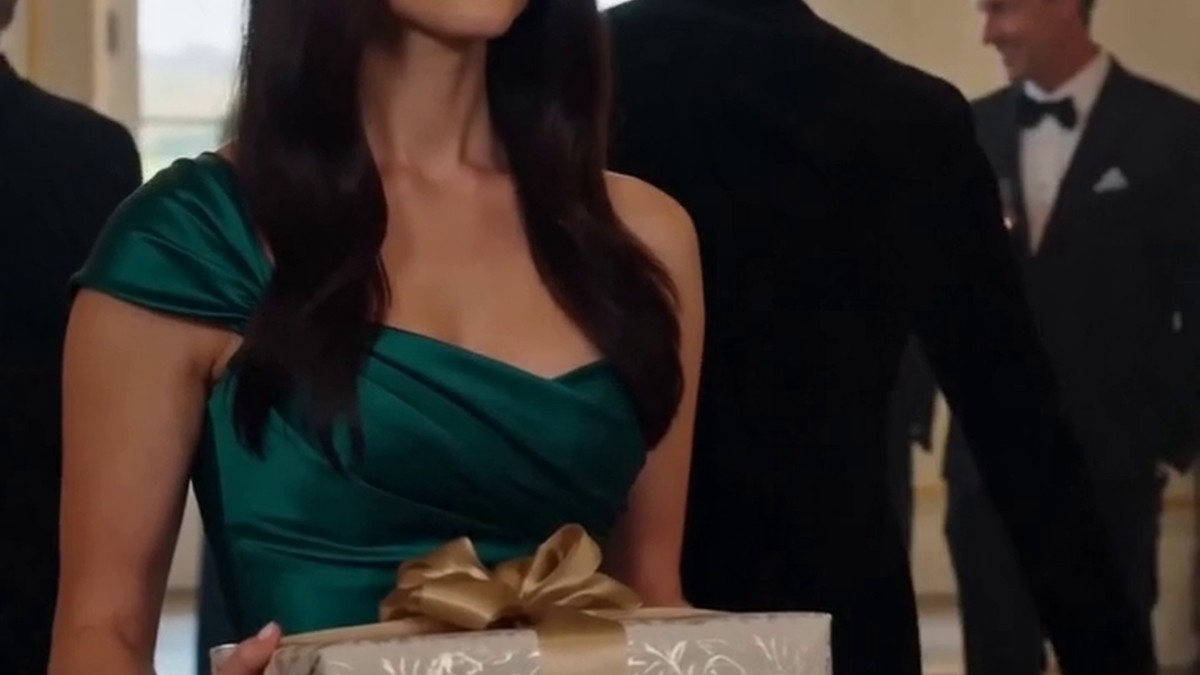
I was twenty-nine. I was wearing the emerald dress he had specifically told me to buy. I was holding an Italian espresso machine — imported, exquisite, and worth nearly two months of careful saving — wrapped and ready to hand over as a wedding gift.
The ballroom around us was the kind of place you’d see in a spread for a luxury travel magazine. Crystal chandeliers poured light down onto white rose centerpieces. White-gloved servers drifted between guests carrying silver trays. A string quartet breathed soft music into every corner of the room.
This was Ethan’s natural habitat.
He had always lived by the gospel of appearances — every introduction a transaction, every handshake a rung on the ladder. Success, to Ethan, was what other people could see.
He crossed the room toward me with that familiar look on his face. The one that said my existence was an aesthetic problem he hadn’t fully solved.
“Why are you standing there?” he asked. Loud enough that a few nearby guests turned their heads.
“I’m here for your wedding,” I said.
He exhaled like I’d said something deeply unreasonable.
“You’re blocking the entrance, Claire.”
I just looked at him.
“The entrance.”
He glanced at his watch.
“The executive team from Summit Technologies arrives in minutes. So do the investors. I can’t have distractions showing up in every frame of every photo.”
His eyes moved over me — the dress, the hair — both of which I had chosen based on the very specific instructions he’d emailed me three weeks earlier.
“Ethan. I’m your sister.”
“Which is exactly why I went ahead and found you a better seat.”
He produced a seating chart, unfolded it with practiced efficiency, and tapped a spot near the far wall — tucked beside the service doors, just outside the kitchen.
A little balloon illustration marked the place card.
The children’s table.
“That’s… where the kids are sitting.”
“My Aunt Dorothy will be there too,” he said, already moving on mentally. “She’s hard of hearing. You’ll have someone to talk to.”
“You want me eating dinner with toddlers.”
His pleasantness evaporated.
“You don’t fit with the executive crowd. Those people are here to network and do business.”
He gave a small, conclusive shrug.
“That’s not your world. Have dinner, stay in the background, and please — don’t make tonight about you.”
I held the frustration down like something I’d swallowed wrong.
“I work just as hard as anyone in this room.”
He laughed. Not meanly, almost worse — dismissively, like I’d made a small and forgivable error in logic.
“Posting articles on the internet isn’t really a career.”
Then something shifted behind his eyes and he lowered his voice.
“And do not — under any circumstances — go introducing yourself to Daniel Carter.”
He tilted his head toward the guest list in his hand.
“A man like that doesn’t need to be bothered by random people making small talk.”
He didn’t wait for me to respond. He pivoted on his heel and moved toward a cluster of arriving guests, his smile already resetting into the warm, polished version he reserved for people who mattered to him.
What Ethan didn’t know was that Daniel Carter wasn’t just a name I recognized.
Daniel Carter was my first major interview.
Eighteen months ago, when his venture fund was still a rumor circulating in Silicon Valley, before the *Forbes* cover and the Senate testimony and the documentary that Netflix had greenlit last spring, he had agreed to sit down with me for three hours in a coffee shop in San Francisco.
He’d found my newsletter through a mutual contact. Said he’d read everything I’d published for the past two years. Said — and I had saved this email, I still had it — *you write about business the way people actually experience it. That’s rare.*
That interview became the most-read piece I’d ever published. Two million readers in the first week. Syndicated in eleven countries. The piece that made Daniel Carter a household name outside of finance circles, and the piece that quietly turned my little newsletter into something with a staff of four, a podcast with sponsors, and a distribution list that crossed six figures.
Ethan didn’t read my work.
That had never been a secret.
—
I stood at the edge of the ballroom and watched the entrance the way you watch something you already know the ending of.
The espresso machine sat heavy in my arms. I thought about setting it down. I thought about walking out to the parking lot, getting in my rental car, and driving back to San Francisco without eating a single passed appetizer.
Then the doors opened.
Daniel Carter walked in with the quiet authority of someone who had never needed to announce himself. Tall. Gray at the temples. A suit that fit the way suits only fit when someone has stopped caring about whether they impress you. He scanned the room with the quick, practiced eye of a man who had been in a thousand rooms and learned to read all of them.
His gaze landed on me.
And he smiled — not the polite neutral smile of recognition, but the real kind, the kind that rearranges someone’s face.
He crossed the room directly toward me. Not toward the bar. Not toward the cluster of executives near the fountain where Ethan was already holding court.
Toward me.
“Claire Harmon,” he said.
His hand came out and I shook it, and something settled in my chest. The particular quiet of being seen by someone who means it.
“Mr. Carter.”
“Daniel.” He glanced at the wrapped box. “Please tell me that’s not a wedding gift.”
“Espresso machine.”
“Good choice.” He tilted his head slightly. “Are you covering the wedding, or — ”
“He’s my brother.”
Daniel’s expression shifted just enough. A recalibration.
“Ethan Harmon is your brother.”
“Unfortunately.”
He made a small sound that wasn’t quite a laugh. “He didn’t mention that.”
“No,” I said. “He wouldn’t have.”
—
I don’t know who spotted us first.
But I know exactly when Ethan saw us, because I saw his face change from twenty feet away. He was mid-sentence — one hand on the shoulder of a man I vaguely recognized from the Summit Technologies press releases Ethan had emailed the family as a form of Christmas letter — and then his eyes found the corner of the room where Daniel Carter and I were standing, and the sentence just stopped.
He excused himself.
He crossed the room with the particular velocity of a man who is trying not to appear to be moving quickly.
“Daniel.” His smile arrived three steps early. “I’m so glad you — ”
“Your sister and I were just catching up,” Daniel said.
The word *sister* landed in the air between them like something physical.
Ethan looked at me. Then at Daniel. Then back at me, and in that look was every assumption he had ever made about me, rearranging themselves at speed.
“You — ” he started. “You two know each other?”
“Claire interviewed me for *The Architecture of Money* series,” Daniel said. “Eighteen months ago.” He said it the way people say things they assume everyone already knows. “Honestly, that piece changed the trajectory of how my fund communicated publicly. We’ve been in touch since.” He paused. “She didn’t tell you?”
The silence stretched.
Ethan’s jaw was doing something complicated.
I looked at my brother — really looked at him, maybe for the first time all day — and I understood that this moment was not going to fix anything between us. He would not apologize in the car on the way home. He would not call next week with a changed heart. He would fold this evening into some private narrative where my success was either an accident or a threat, and he would go on being exactly who he had always been.
That was fine.
That was, at last, completely fine.
“I don’t usually bring it up,” I said. “Posting articles on the internet and all.”
Daniel looked at me sidelong. There was something warm in it.
Ethan opened his mouth, closed it, and then performed a small miracle of social recovery — the handsome smile, the easy redirect, the hand extended toward Daniel as though the last thirty seconds had simply not occurred.
“Well,” he said, “let me introduce you to the Summit team — ”
“In a minute.” Daniel’s tone was pleasant. Absolute. “I want to hear about Claire’s podcast expansion. She mentioned she’s adding a second show.”
Ethan stood very still.
Around us the string quartet moved into something new. A server appeared at my elbow with a tray of champagne and I took a glass, because it seemed right, because this was after all a wedding, and the chandeliers were beautiful, and I had saved for two months to bring a gift for a brother who had seated me at the children’s table and told me I wasn’t worth speaking to.
I took a sip.
“The second show launches in September,” I said to Daniel. “Long-form profiles. First episode is already locked.”
“I know,” he said. “I’m the first guest.”
—
I did not eat dinner at the children’s table.
I sat with Daniel Carter’s team, at a round table near the center of the room, and for three hours I talked about work with people who had read my work, and laughed at things that were actually funny, and let the espresso machine sit gift-wrapped against the wall where a staffer had promised to keep it safe.
Across the room, at the head table, I could see Ethan in profile. He had the controlled expression of a man executing a performance, which was, I supposed, exactly what this had always been to him.
His new wife looked lovely. She laughed at something the man beside her said, and it was a real laugh — bright, unguarded — and I hoped, genuinely, that she knew something about him that I didn’t. I hoped that for her.
At one point during the speeches, Ethan looked out over the room and found me, the way you find something you’ve lost and then wish you hadn’t.
I raised my glass.
He looked away.
—
In the parking lot after midnight, the Napa air was cool and smelled like eucalyptus and dry grass, and I sat on the hood of my rental car and called my best friend Mara back in San Francisco.
“How bad was it?” she asked.
I thought about the seating chart. The balloon illustration. *That’s not your world.*
“About what we expected,” I said.
“And Carter was there?”
“He was there.”
She made a sound like she was winding up to say something satisfying.
“Mara.”
“I’m just saying — ”
“Don’t.”
“I’m just saying *karma* is a — ”
“Good night, Mara.”
She laughed and we hung up, and I sat there in the dark for a while, under a sky that was enormous and indifferent and full of stars.
The thing about growing up dismissed is that it carves a channel in you — a low, narrow place where other people’s opinions of your worth tend to collect and pool. You spend years learning to drain it. Years realizing the water was never clean to begin with.
Tonight had not fixed my brother. Nothing would fix my brother.
But something in me had clicked closed like a door latching softly in a house where all the windows are finally shut.
I was not a distraction.
I was not background.
I was not the girl with the balloon on her place card, eating dinner near the service entrance while the important people talked.
I was Claire Harmon, and I had two million readers, and a second show launching in September, and a long drive back to the city in front of me.
I slid off the hood.
I left the espresso machine at coat check with a card that said *congratulations* — because whatever I was, I was not petty, and I meant it, at least a little — and I drove back through the dark hills toward home.
The radio played something old and good.
I turned it up.