But every afternoon, right when the autumn light turned flat and cold against the asphalt, their fourteen-year-old Golden Retriever would haul himself across the empty gravel driveway on hips that had no business carrying him anywhere.
He wasn’t just waiting. He was performing a ritual someone had built into him — and he was terrified of failing it.
I’d lived next door to Richard and Elaine Vance for six years. The kind of neighbors who treated their front lawn like a private golf course and rotated leased SUVs every two years to make sure the street knew exactly how well they were doing. When they sold the house that fall, they cleared out fast. They left a water-warped leather couch at the curb, three trash bags, and their dog.
His name was Cooper.
I remember the morning they went. Richard was forcing the trunk shut on a car packed too full, dressed in a pressed gray suit, moving with the clipped irritation of a man already late for his next life. Cooper was tied to the back porch railing with a short length of cheap yellow nylon rope.
Richard leaned over the fence without quite looking at me. “He’s too old for the new place, Elias. Ruins every floor he walks on. Animal control’s coming first thing tomorrow. Put some water out if you feel like it, but leave the rope alone — he’ll wander off.”
I didn’t say anything. I watched their taillights disappear at the end of the block, then walked over with my pocketknife and cut the rope. Cooper came home with me.
I’m sixty-two. Retired lineman. My house runs quiet — the loudest thing most days is the grandfather clock ticking in the hallway. I figured an arthritic old dog who wanted nothing more than to sleep beside a baseboard heater would be reasonable company.
For a while, he was exactly that. He ate carefully, moved slowly, and slept like a man paying off a long debt of exhaustion. He was gentle and grateful and worn all the way through.
But he wasn’t at peace.
Every day at 4:45 PM, something inside him shifted. The sleepy dog disappeared. He’d lift his head sharply, ears pressed flat, then drag himself off the floor — back legs trembling with the effort — and make his way to my front door. The sound he made was low and continuous, a tight vibrating whine that didn’t sound like a dog who needed the yard. It sounded like something closer to dread.
The first time, I figured he needed outside. I opened the door.
Cooper didn’t go to the grass. He walked directly across the property line, pushing through the damp fallen leaves, and took up a position at the very end of the Vance driveway, right beside the brick mailbox post.
Then he waited.
He sat rigid, facing the two-lane road. Every car that came around the bend made his whole body go electric — he’d lean forward, those clouded brown eyes chasing the headlights down the street. Every car that didn’t slow down broke something in him a little. He’d let out a soft, wrecked sound, and actual tears would track down through the gray fur of his muzzle.
He held that post for a full hour. Every single day. If I tried to move him, he’d plant all four feet and go still as concrete, and it was the only time he ever growled — not with anger, but with a desperation so complete it felt almost sacred. He could not leave. He had to be there.
I watched this for two months. October hardened into a mean, bitter November. The wind off that road was enough to make my own knees ache, and still Cooper never missed a shift.
I told myself he was just a heartbroken old dog grieving people who hadn’t deserved him.
Then yesterday happened.
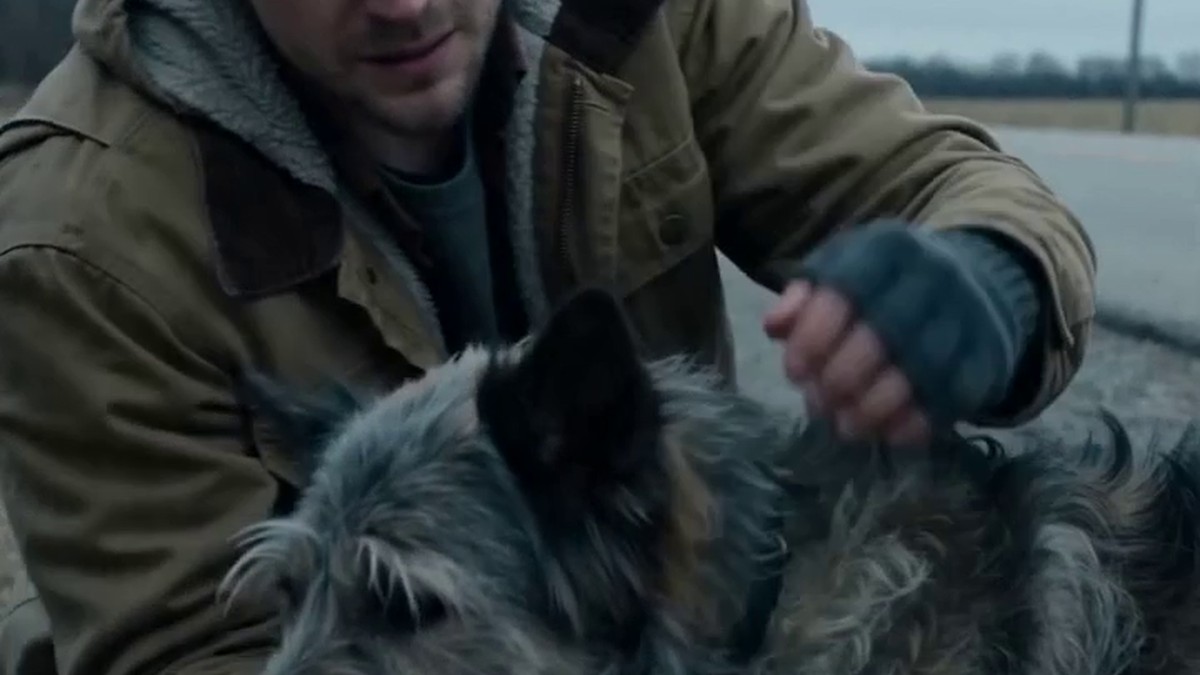
Tuesday. The temperature had fallen to freezing by mid-afternoon. At 4:45 Cooper was at the door. I pulled on my heavy canvas coat, tucked a wool blanket under my arm, and walked out with him. When he took his place by the mailbox post, I lowered myself onto the cold gravel beside him and spread the blanket over his shaking back.
He didn’t look at me. His eyes were already down the road, fixed on the bend.
“They’re not coming, buddy,” I said quietly, working my fingers through the thick, matted fur behind his ears. “Richard and Elaine are gone.”
At 5:02, a heavy diesel engine came around the corner.
Not a sleek SUV. The county transit bus — the battered yellow-and-white shuttle that ran through the working-class towns just outside our suburb.
Cooper didn’t just tense. He stood up completely. His tail began to move in a slow, desperate arc, knocking rhythmically against my leg. He put one paw on the asphalt, eyes fixed on the folding doors as the bus eased through the curve.
It didn’t stop. It rolled past in a wash of exhaust and diesel heat.
Cooper went back down into the gravel, nose pressed between his paws, and made a sound that had no business coming out of a dog. It landed somewhere in my chest and stayed there.
I reached down to lift him, sliding my fingers under his thick leather collar. My knuckles caught on something hard — metallic, deliberate, buried deep in the dense fur at the back of his neck. Not his tags. Something wrapped tight in black electrical tape, secured against the inner lining of the collar.
I pulled my gloves off. The tape was old, the adhesive barely holding. I worked it back with stiff, cold fingers.
Underneath was a heavy tarnished silver carabiner. Clipped to it was a laminated plastic card.
I scraped the frost and grime off the surface.
It was a student ID. Public high school, local district. The face in the photo was David Vance — Richard and Elaine’s sixteen-year-old son.
According to Elaine, David had been shipped off to a prestigious out-of-state boarding academy a full month before the house sold. They’d mentioned the tuition to everyone within earshot. Strict no-contact policy for the first semester, they said. He was states away, thriving, out of reach.
I stood there in the freezing driveway, staring at the ID, and felt the bottom drop out of my stomach.
The expiration date had been scratched out. Not worn away — scratched out deliberately, with something sharp, a key or a blade. And carved into the plastic in its place, pressed in deep with real force, were two numbers.
Route 44.
The exact route number of the 5 PM county transit bus that had just rolled past without stopping.
I couldn’t make sense of why David Vance’s public school ID had a specific bus route gouged into it by hand. The rest is in the pinned comment.
The gravel pressed into my knees as I crouched there, turning the card over in my fingers. The back was blank except for a strip of school-issue barcode, already half-peeled. But beneath it — and I almost missed it, my eyes being what they are past sixty — someone had pressed a line of ballpoint ink into the plastic. Tiny, compressed letters, the handwriting of a person trying to take up as little space in the world as possible.
*He knows which stop. Don’t let them get him first.*
I read it three times. The wind off the road drove a sheet of dead leaves across the driveway and I barely felt it.
Cooper was watching me. He’d turned his head away from the empty road for the first time in two months, and those fogged brown eyes were on my face with an attention that made my scalp prickle. He wasn’t grieving anymore. He was waiting for me to catch up.
“Okay,” I said. Out loud, to a fourteen-year-old dog on a frozen driveway. “Okay.”
—
I went inside and pulled up the county transit authority website on my laptop. Route 44 ran east-to-west through four townships, terminating at the regional intermodal station downtown. Twelve stops. The last bus of the evening departed the eastern terminus at 5:48 and hit our road — the Sycamore Road stop, half a mile up from the Vance driveway — at 6:11.
I had forty minutes.
I thought about calling someone. I sat with that thought for about ninety seconds. Calling who, exactly? The police, to say a neighbor’s kid might be on a bus? Richard Vance, whose number I’d never had and hadn’t wanted? I picked up my phone and put it back down. The message on that card hadn’t said *call someone*. It had said *don’t let them get him first.* The operative word being *them.*
I didn’t know who *them* was. But I’d watched Richard Vance tie his dog to a back porch railing on moving day and tell me to leave the rope alone. I had a working theory about the kind of decisions Richard Vance made about people who were inconvenient to him.
I loaded Cooper into the truck.
He climbed in without any help, which surprised me — those hips had been failing for weeks. He settled in the passenger seat and faced forward, and in the flat amber glow of the dome light he looked less like a dying dog than like an old soldier who’d finally gotten his orders confirmed.
I drove.
—
The Sycamore Road stop was a metal bench bolted to a concrete pad under a single overhead light. I parked on the gravel shoulder forty feet back, engine idling, heater running, and waited.
At 6:04 a car came down from the northern end of the road and slowed. A dark-colored sedan — newer, expensive, the kind that didn’t belong in this part of the county at this hour. It pulled to the curb twenty feet ahead of the bus stop and sat there, engine on, exhaust rising in a quiet plume.
I didn’t move.
Cooper’s ears came up.
At 6:09 the sedan’s passenger window came down four inches. A man’s arm appeared, resting in the gap. No phone. No cigarette. Just resting there, watching.
At 6:11, the bus headlights swung around the long curve from the east.
I got out of the truck. I didn’t think about it. I was moving before I’d decided to move, the way you move when a line comes down and there’s no time to negotiate with your own body. I walked to the bus stop and stood in the full light of the overhead lamp, hands visible, nothing in them. When the bus hissed to a stop I was standing right at the folding doors.
They opened.
Two people came off. First, a heavyset woman in a hospital scrubs jacket who walked straight past me toward a car down the block. Second — hesitating on the second step, one hand tight on the rail, a backpack so full it had changed the shape of his shoulders — a sixteen-year-old boy with his father’s jaw and his mother’s eyes, both of which went very wide when they found my face.
He didn’t know me. I’d been the neighbor for six years and I was a retired lineman in a canvas coat at a bus stop at night, and he didn’t know me at all.
“My name is Elias Pruitt,” I said. “I live next door to your old house. I have your dog.”
Something broke open behind his eyes. Not relief — not yet. He was still on that step, body braced, and I could see him calculating.
“Cooper’s in my truck,” I said. “Right there.” I pointed. I kept my voice the way you keep a hand steady when someone’s hurt and scared. “He figured out your route about two months ago. He’s been waiting for you every afternoon since.”
The boy’s face crumpled for exactly one second. Then he pulled it back together and said, in a voice that cracked once through the middle, “There’s a car up there. I think it’s my dad’s assistant.”
“I know,” I said. “Don’t look at it. Walk to my truck.”
He came off the step.
I heard the sedan’s door open.
—
“David.” The voice came from behind us — clipped, precisely modulated, the voice of a man who was used to having sentences end conversations. I turned around. He was mid-forties, the kind of trim that comes from a gym membership rather than work, wearing a coat that cost more than my truck payment. He had the specific expression of someone exercising patience they resent needing. “Your father called ahead. The car’s right there. Let’s not make this complicated.”
“He’s not going with you,” I said.
The man looked at me for the first time. The look lasted about a second and a half — the brief calculation of what category I fell into and whether I mattered. He landed on *no.*
“Sir, this is a family matter. I’d encourage you to step back.”
“He’s a minor who left without consent,” I said. “So is this a family matter, or do you want to have the conversation where I explain to the deputy who’ll be here in about four minutes why a man I’ve never seen before followed a sixteen-year-old off a transit bus and tried to force him into a private vehicle?”
The man’s jaw set. “You haven’t called anyone.”
“Check the top of my recent calls,” I said. “I dialed when I parked.”
I hadn’t. But his eyes moved — just slightly — to my coat pocket, and that slight movement told me I had about thirty more seconds of leverage before he concluded I was bluffing.
David was beside me, rigid, not breathing.
And then Cooper made a sound.
It came from the truck — that low, continuous vibrating note I’d heard every afternoon for two months, the one that sounded like something close to dread, except right now, with the passenger window cracked and the boy standing ten feet away, it had shifted into something else entirely. It was the same frequency but it wasn’t grief anymore. It was an outpouring. It was a fourteen-year-old dog burning through whatever was left of his reserves to say *here, here, I am here, you came, I knew you would come.*
David broke. He made a sharp, helpless sound — one syllable, swallowed immediately — and his whole body swung toward the truck like a compass needle dropping to north.
The man in the coat took one step forward.
I moved between them. Not dramatically. Just solidly, the way a lineman plants his feet before a trunk line falls, because the calculation is simple: something has to stand between the thing that’s falling and the thing it will destroy.
“Walk away,” I said. I was looking at him directly and there was nothing in my voice except certainty. “I’ve got forty years of being the man who shows up when someone calls. So do you want to find out what those deputies look like when they arrive and find this situation, or do you want to get back in that car?”
Three seconds. Five.
He straightened his collar. “Richard Vance will hear about this tonight.”
“I imagine he will,” I said.
He walked back to the sedan. The door closed with the precise, expensive sound of a well-sealed machine. The headlights came on. And then it pulled a slow U-turn and disappeared around the curve, heading west, and the road was just a road again — quiet blacktop and cold air and the hum of the bus pulling away behind us.
—
I turned around.
David was at the passenger door of my truck, both arms around Cooper’s neck, face buried in the dog’s ruff, and Cooper was pressed into him so completely it was hard to tell where one ended and the other began. The dog’s tail moved in that slow, rhythmic arc — the same desperate beat I’d watched every afternoon for eight weeks — but it wasn’t desperate anymore. It was tidal. It was the motion of something returning to the shore it was always meant to reach.
David was crying without any sound, which is the hardest kind.
I stood back and let them have it.
After a while I walked around to the driver’s side and got in and ran the heater up. I didn’t say anything. Some moments have their own grammar, and the right response is not to clutter them.
Eventually David climbed in, Cooper arranged heavily across both their laps — the dog had no idea he was too big for this and wouldn’t have cared if he did — and we sat there for a long moment in the orange glow of the dashboard.
“He hid the card before they took him away,” David said, finally. His voice was steady now, or almost. “I sewed the carabiner into the lining myself. I trained him on the route number over — I don’t know. Months. Before any of it happened.” He exhaled. “I didn’t know if he’d remember. I didn’t know if anyone would find it.”
“He remembered,” I said.
David pressed his face briefly into the top of Cooper’s head. “Yeah.”
I put the truck in drive.
—
He slept on my couch that night. Not the water-warped leather one his parents had left at the curb — my couch, the good one, with a wool blanket and a pillow from the spare room. Cooper slept beside him on the floor, one paw resting against the boy’s ankle, and I don’t think either of them moved until morning.
I called a friend who knew a lawyer before the sun came up. There are people who know how to put themselves between a kid and the decisions adults make for convenience, the same way there are people who know how to stand between a falling line and everything below it. You just have to know which calls to make.
Richard Vance did hear about that night. I was told he was very unhappy about it.
Good.
The weeks after were complicated, and hard, and not mine to recount in full — they belonged to David. What I can tell you is that he didn’t go back to the boarding academy. He didn’t go back to the new house, either. There were relatives — an aunt in the same county — who turned out to be exactly the kind of people you call when the people who should show up don’t.
He came by on a Sunday in early December, his aunt’s car at the curb, both of them red-cheeked from the cold. He had colour in his face. He looked like a person who had slept.
He knelt down in my hallway and held Cooper for a long time.
When he stood up, he said, “I want to take him with me. If that’s okay. If you’d let me.”
I looked at Cooper. The dog was leaning his full weight against David’s leg, eyes half-closed, tail moving with that slow, enormous steadiness — as if he had all the time in the world, as if he had never been in any doubt about how this was going to end.
“That’s where he belongs,” I said.
David nodded. He didn’t trust his voice right then, so he just nodded.
They walked out together into the December light — the boy and the old dog — and Cooper’s gait was different than I’d ever seen it. The trembling was still there, the hips were still bad, the grey was still deep in his muzzle. But he walked without hesitation, without looking back toward the empty Vance driveway, without that low vibrating note of dread.
He wasn’t waiting anymore.
He was done.





