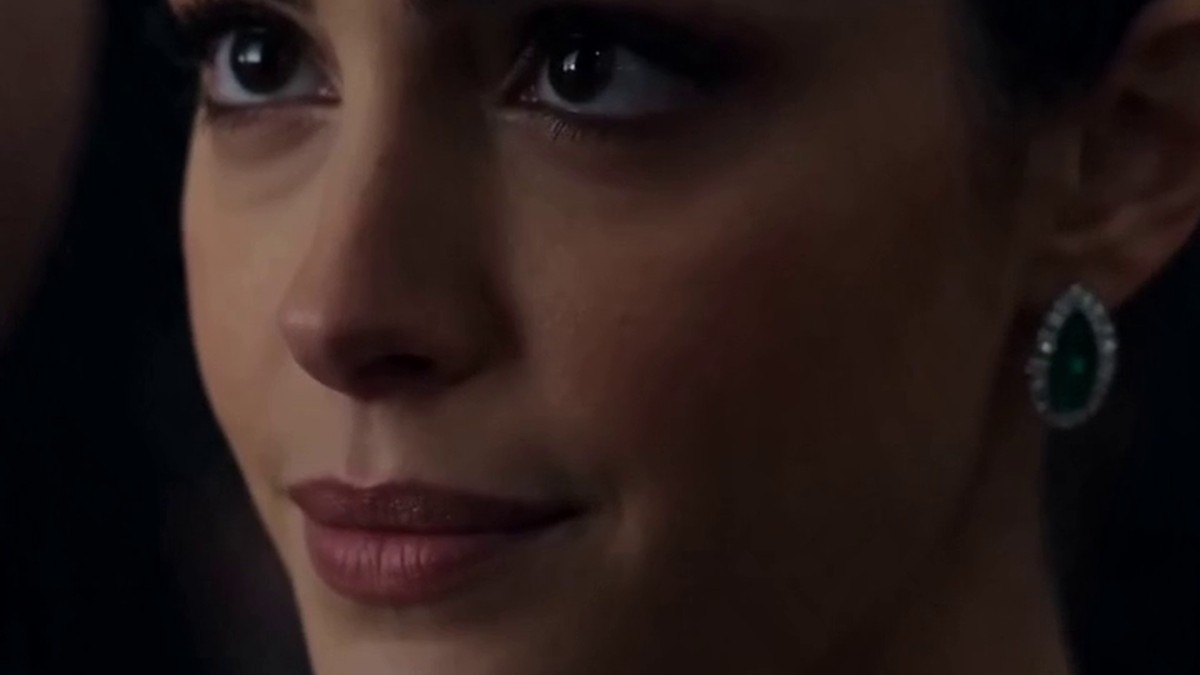
He had no idea I was already holding an envelope that made everything he owned look small.
—
Forty-three floors above Michigan Avenue, the Hail Crown penthouse ballroom glittered like something assembled from cut crystal and winter light. Beyond the floor-to-ceiling glass, snow dissolved over the city, turning Chicago the color of old silver. Every person Brennan needed to impress had made the trip — investors, city officials, hotel magnates, charity board members, journalists whose cameras hovered like blades waiting to drop. The room hummed with the particular electricity of people performing power for one another.
I stood near the back in an emerald dress. Brennan had once told me it made my eyes look like the Savannah River after a hard rain.
That night he didn’t look at me like a wife.
He looked at me like a complication that had learned to stand still and stay quiet.
At the center of everything, Selene Duvall pressed one manicured hand against his sleeve while photographers jockeyed for position.
“Mr. Hail — one more with Miss Duvall!”
She laughed and reached up to straighten his tie. In front of everyone. No one flinched. No one had the grace to look away.
A woman beside me murmured, “Isn’t that his wife?”
The answer floated back, soft and precise as a scalpel.
“Technically.”
*Technically.*
Eleven years of marriage compressed into a word people use when they mean the paperwork hasn’t caught up yet.
I kept my face smooth. I had learned that skill over years of donor dinners where Brennan accepted applause for ideas I had sketched out past midnight. Through interviews where he thanked his “team” in that generous, magnanimous voice and never once said my name. Through the slow, patient choreography of watching Selene move closer to him in public — inches first, then steps, then full, unashamed possession.
But that morning, in a quiet office on Lake Shore Drive, I had learned something Selene hadn’t.
Six weeks.
The ultrasound printout was still inside the cream envelope tucked against my palm.
I had sat in my car afterward and stared at it. For one weak, foolish minute, I let myself wonder whether this was the thing that could reach him — whether the man I had married still existed somewhere beneath everything the money had built over him.
Then I watched him lift a champagne flute with his mistress beneath the chandelier we had chosen together.
And something went very still inside me. Cold. Clear. Certain.
A child does not rescue a marriage.
A child only inherits one.
—
By ten-thirty the formal ceremony was finished. Brennan had announced his coastal expansion to sustained applause. The guests were comfortable now, loosened by old money and open bars, and Selene was still fastened to his side like a medal he’d awarded himself. When I finally crossed the room toward them, a few heads turned — not out of concern, but out of that particular hunger people feel when they sense something is about to break.
Brennan saw me coming. His expression didn’t shift by much.
Selene’s hand didn’t move at all.
I stopped in front of them. For one full second, the only sounds were glass against glass and the low murmur of the string quartet.
Then Brennan spoke in the smooth, bored register he used when he wanted to wound me without disturbing the line of his jacket.
“Don’t do this tonight, Kalista.”
Selene offered me a smile of such studied sympathy it made my stomach clench.
“You should step outside,” she said. “Get some air. You look pale.”
I looked at her hand on his arm.
Then I looked at him.
“Are you humiliating me publicly,” I asked, keeping my voice level, “or have you simply decided to stop hiding it?”
He exhaled once through his nose — the sound of a man annoyed that honesty had been let into the room without his permission.
“Lower your voice,” he said.
I hadn’t raised it.
A reporter two feet away stared very intently at his phone screen.
Brennan leaned in. His smile held steady for the cameras, curated and perfect.
“If you’re going to make a scene,” he murmured, “at least have the dignity to do it somewhere that doesn’t cost me anything.”
*People who matter.*
Selene’s fingers pressed tighter against his sleeve.
Then Brennan looked me over — a slow, dismissive scan from heel to face — and delivered the sentence that cut the marriage cleanly open.
“If you walk out,” he said, “don’t touch a single dollar with my name on it.”
There it was.
The room didn’t gasp. Rooms built on power almost never do. They go quieter instead, a collective stillness, like something contracting around a wound.
A board member found something worth studying in his drink. One of Brennan’s vice presidents turned his body a quarter rotation away. An older woman near the auction display pressed her lips into a line and said nothing.
Witnesses become cowards when the man doing the damage is also the man signing the checks.
I did not cry.
I didn’t slap her.
I didn’t beg him to remember Savannah, or spring rain, or the bare-walled apartment where we ate takeout cross-legged on the floor and mapped out a future that didn’t yet understand what ambition would eventually cost us both.
I simply nodded once.
“All right,” I said.
That two-word answer unsettled him far more than any scene would have.
His eyes sharpened.
“Kalista —”
But I was already walking away.
—
The private elevator carried me up past the ballroom and deposited me into silence. The penthouse was warm and still and immaculate — the kind of emptiness you feel inside a room that has been designed to impress and never actually lived in.
I walked to the bedroom and opened the closet.
There was enough hanging in that room to fund a small life in most parts of the country.
I touched none of it.
No diamonds. No couture. No watches. None of the gifts that had always been chosen to resemble devotion and function like ownership.
From the top shelf I pulled a single leather travel bag.
Two pairs of jeans.
Three sweaters.
Boots.
My old sketchbooks — the ones from before.
A folder containing my passport, my birth certificate, and the professional licenses Brennan had quietly assumed I would never have cause to use again.
The ultrasound envelope.
That was everything.
In the living room, his bourbon sat half-finished on the side table, ice dissolving into pale amber. I slid my wedding ring from my finger and set it beside the glass.
My hand stayed there a moment.
I thought about the young man who used to walk barefoot with me along River Street and talk about building places where strangers felt genuinely welcome, genuinely safe.
Then I thought about the man forty-three floors below me, telling me not to touch his money while another woman wore his attention like a crown she’d already fitted to her head.
I straightened.
At the security panel by the entry, I entered one code — a private sequence only I still remembered, from the months before his team had converted this apartment into something resembling a fortress.
Not to lock him out.
Just to erase my own digital footprint from the system.
Then I opened the banking app on my phone, navigated to the household account he monitored with the diligence of a man who understood that money is a kind of language, and transferred nothing.
Not one cent.
A marriage can collapse in a single gesture.
Mine ended in the deliberate absence of one.
—
When the elevator returned, I expected Brennan.
It was Marta — the longest-serving house manager in any of his properties, a woman who had worked in these buildings since before I had a ring on my finger. She took in my bag, then the ring beside the glass, and understood the entire situation without needing it explained.
Her eyes moved briefly to the envelope in my hand.
She said only one thing.
“Do you need a car, Mrs. Hail?”
*Mrs. Hail.*
Perhaps for the last time.
“No,” I said. “I need ten quiet minutes.”
She nodded and drew the elevator doors closed again.
I wrote Brennan a note on the back of one of his event cards, in my own handwriting, calm and precise.
*I took nothing that was yours.*
*Keep the name until the lawyers sort it out.*
*The child won’t.*
My pen stopped after that last line.
Then I pressed down hard until it tore through the card.
*Not yet.*
He had earned absence long before he earned the truth.
I left the card on the table with only the first two lines showing.
—
The service corridor was quieter than the ballroom below but not empty. Two waiters passed without breaking stride. A security guard glanced at my bag, then at my face, and looked deliberately away.
Everyone understood.
No one was going to help.
So I helped myself.
Outside, the Chicago wind arrived like something with an edge. Snow caught in my hair and dissolved against my face. I pulled my coat tight, lifted my bag, and walked away from the tower Brennan had constructed as a monument to himself.
I didn’t look back once.
—
Two hours later, reviewing the security footage, what Brennan saw was not a woman in flight.
It was a woman leaving with such composure that it took him several long seconds to fully absorb that she was gone for good.
The gala had emptied out. Selene had gone. The cameras and the board members and the reporters had all dispersed. Brennan came upstairs expecting the kind of argument he had already rehearsed winning.
He found his bourbon. My ring. The note.
He said my name once.
Then louder.
Then he crossed to the closet.
Still full.
He checked the safe.
Untouched.
He pulled up the accounts.
Untouched.
He went to the security cameras, and on the monitor, under a sweep of cold white light, he watched me step into the Chicago snow carrying one small bag and nothing that could be used to prove I had ever belonged to him at all.
Then his phone rang.
Not my number.
A number he hadn’t encountered in years.
Savannah.
He picked up with my name already forming in his mouth.
The voice on the other end was unhurried and precise.
“Mr. Hail — before you begin looking for your wife, there’s a document you’re going to want to see first.”
# The Call from Savannah
The voice belonged to Marcus Webb.
Brennan’s grip went white around the phone.
Marcus Webb had been two years ahead of him at Emory — thin, meticulous, the kind of man who wore patience the way other men wore expensive watches. He had also been Kalista’s first employer out of graduate school, her mentor in commercial architecture, and the only person who had ever looked at Brennan across a dinner table with something other than deference.
Brennan had not heard that voice in six years.
“What document,” he said. Not a question. A door shutting.
“A structural assessment,” Marcus said. “Filed with the city of Chicago nineteen months ago. Signed by a licensed engineer and countersigned by the architect of record for the Meridian Tower project.”
The floor didn’t shift. But Brennan felt something beneath his feet change quality — the way you feel a pier move under you on open water before you see the wave.
“Kalista,” he said flatly.
“She flagged load-bearing compromises in the northeast tower foundation during the original review. You know this. She submitted the report through proper channels.” A pause measured and precise as a scalpel. “You had it buried.”
—
Forty-three floors below, the ballroom crew was still dismantling the evening — folding linen, stacking chairs, coiling the microphone cables from the stage where Brennan had announced his coastal expansion to sustained applause three hours ago.
The coastal expansion that required Meridian Tower’s financing to close.
The coastal expansion whose primary investor, a seventy-two-year-old man named Gerald Ashby who had built his fortune on the principle that a man’s word was the architecture of everything else, had been seated in the front row when Brennan took that stage.
Brennan had known about the report for nineteen months.
Kalista had filed it. His legal team had located it, assessed the political risk, and made it disappear from the public record with the particular efficiency that sufficient money can purchase from people who understand that their continued employment depends on their discretion.
He had never once considered that she would keep a copy.
—
I was sitting in a booth at the back of a diner on Wabash when Marcus called me.
The coffee was the color of motor oil and tasted approximately as good. I held the mug in both hands anyway, grateful for the heat, and watched the snow coming down past the window in long, diagonal lines.
“He picked up,” Marcus said.
“I know he would.”
“He sounded like a man who just realized the floor is thinner than the blueprints suggested.”
A woman two booths over was reading to a small child from a picture book, her finger tracing each line. I watched them for a moment.
“The report,” I said. “Is it secure?”
“Three copies. Your attorney has one, I have one, and the original is filed with a journalist at the Tribune who is already very interested in the structural integrity of high-occupancy buildings in this city.” Marcus paused. “Kalista. You understand this is not a small thing you’re holding.”
“I know what I’m holding.”
“He’s going to come at you.”
“He’s going to try.”
Outside, a cab moved slow through the snow. I pulled the ultrasound envelope from my coat pocket and set it flat on the table in front of me. Looked at it for a long moment. The pale grey image. The curved shape that was barely yet a shape at all, more like a suggestion — the universe in the earliest possible draft of something.
“Marcus,” I said. “How long do you think he needs before he gets in a car?”
“He’s already in one,” Marcus said. “I may have implied you were at my firm’s office.”
“Which gives me forty minutes.”
“Approximately.”
I left cash on the table — enough to cover the coffee and then some — and stood and lifted my bag.
“Thank you,” I said.
“Don’t thank me yet,” he said. “Thank me when this is over.”
—
The architectural firm of Webb, Cordero and Associates occupied the ninth floor of a building on South Michigan, a clean, serious space of exposed concrete and careful light. Marcus had built it from three employees and one borrowed conference room into something that had outlasted two recessions and Brennan’s very deliberate attempt, four years ago, to cut them out of every project he touched.
Brennan had underestimated how many clients Marcus had made feel genuinely welcomed, genuinely respected, over the years.
He had not understood that reputation, built carefully and honestly, is a more durable foundation than money.
The lobby was empty at that hour except for the overnight security guard, who knew my face and said nothing when I walked past. I took the elevator to nine, let myself in with the code Marcus had texted me, and stood in the dark of the conference room for a moment before I turned a single lamp on.
The city burned orange and silver through the window.
I opened my old sketchbook on the table.
Then I waited.
—
Brennan arrived in twenty-eight minutes.
Faster than forty. He must have pushed the driver.
I heard him in the lobby — heard the particular low, controlled urgency of a man accustomed to having doors open before he reaches them. Heard him convince the security guard with one sentence and his name. Heard the elevator. Heard his footsteps in the corridor, which was quiet enough at midnight to carry sound cleanly.
The conference room door opened.
He was still in his tuxedo. No coat. He had come out into a Chicago snowstorm without a coat, which told me everything about the state of his composure.
He stopped when he saw me.
I had turned to face the door. I was standing, not sitting — I had decided, consciously, that I would be standing when he walked in.
For a long moment neither of us spoke.
He was still Brennan. That was the hard thing. He was still the face I had known for fifteen years, since before the money had put its full weight on him. The jaw I had pressed my forehead against on the worst nights. The hands I had held while we planned everything we intended to build together.
He was still that man, underneath.
He had simply chosen, repeatedly, not to be.
“Where is it,” he said.
“Hello, Brennan.”
His jaw worked. “Don’t. Where is the report?”
“Which copy?”
Something moved across his face — a quick, uncontrolled thing that he pulled back almost immediately. But I saw it. I had spent eleven years learning to read the weather of that face.
“This is not what you think it is,” he said.
“You buried a structural safety report on a building where people live.” I kept my voice very level. “Tell me what I think that is, and then correct me.”
“There were remediation measures taken. The issue was addressed.”
“There were three memos between your legal team and the city inspector’s office suggesting that a public filing might create unnecessary alarm.” I had read those memos fourteen times in the past six weeks. I had memorized them the way you memorize something you intend to use. “The load-bearing assessment was never corrected. The building was occupied anyway. Four hundred and twelve units, Brennan.”
“I am telling you — ”
“Gerald Ashby’s investment closes in eleven days.” I watched his face. “I know that because I still have access to the household calendar you forgot to revoke. And I know that the moment the Tribune runs a story about the foundation of the flagship property in that deal, eleven days becomes zero.”
He crossed the room in three steps — not threatening, not quite, but close enough that I felt the change in air between us.
“Kalista.” His voice dropped. Something shifted in it — something I recognized from years ago, from the register he used when he was not performing but actually asking. “Whatever you think I’ve done to you. Whatever this is. Don’t do this to the company. There are two thousand people employed across these properties.”
“I know that.”
“Then you know what this does to them.”
“I know what hiding a safety report does to four hundred and twelve families.”
He looked at me for a long moment.
Snow pressed against the window in silence.
“What do you want,” he said finally.
And there it was — the sentence that ended the performance. No more curated smile. No more ballroom register. Just a man in a snow-damp tuxedo asking what it was going to cost him, because everything, to Brennan, ultimately reduced to cost.
I had spent six weeks thinking about what I wanted.
I had thought about it in the car outside the ultrasound clinic. In the quiet hotel room where I had stayed the past three nights while I arranged everything. In the diner on Wabash over bad coffee while the snow came down.
And I had understood, slowly, that what I wanted was not revenge. Revenge would have been leaking the report to the Tribune the night I found the memos and watching everything collapse in real time. Revenge would have felt clean for approximately forty-eight hours and then left me standing in the wreckage of two thousand people’s livelihoods and one structural problem that still wouldn’t be fixed.
What I wanted was what I had always wanted.
For the building to be fixed.
For people to be safe inside something built honestly.
“Here,” I said.
I slid a document across the conference table.
He looked at it without touching it.
“That’s a remediation agreement,” I said. “Your engineers and a city-appointed independent firm conduct a full structural review of the northeast tower, jointly. The findings go into the public record. If remediation is required, it happens before the coastal deal closes, not after. Gerald Ashby’s attorneys review the findings before he signs anything.” I paused. “The Tribune holds publication for sixty days pending the agreement.”
Brennan stared at the document.
“The divorce proceeds on equitable terms,” I said. “Not on the terms you announced tonight in front of cameras.”
His chin came up.
“And,” I said, and here my voice did something I had not entirely planned — it changed quality, went quieter, went somewhere under the professional register into something else. “And you will know, in about seven months, that there is a child. That child will have what they need. Not from guilt and not as a transaction. Because that is simply what a decent person does.”
The room went completely still.
Brennan looked at me for a long time.
I watched him absorb it — the math of it, first, because that was always how he processed things, the calculation of cost and risk. But then something happened behind his eyes that I had not seen in years. Something that was not calculation at all. Something older and less defended.
His mouth opened. Closed.
“Kalista,” he said. Very quietly. “I didn’t know.”
“No,” I said. “You didn’t. Because you stopped asking.”
Another long silence.
Outside, Chicago kept its own counsel under the snow.
Then Brennan picked up the document.
He read it the way he read every contract — carefully, without expression, with total attention. I had always respected that about him. Whatever he had become, he was not careless. He did not skim things that mattered.
When he reached the bottom, he set it down.
“I’ll need my attorneys,” he said.
“Marcus’s office can accommodate that tomorrow morning. Eight o’clock.”
He looked up at me. “You planned this carefully.”
“I had six weeks.”
Something crossed his face that I could not quite name. Not quite remorse. Not quite respect. Something in the territory between them, in the complicated geography of a person recognizing that they misjudged someone they should have known completely.
“The note,” he said. “You wrote that the child won’t keep the name.”
I had not expected him to reference it.
“That line was for me,” I said. “Not for you.”
He nodded slowly. He looked at the document again. At the table. At the window where the snow was finally easing, the storm thinning itself out over the city.
“All right,” he said.
Two words.
The same two words I had given him in the ballroom.
The symmetry was not lost on either of us.
—
I did not feel triumphant walking out of that building.
I don’t think triumph was ever the right word for what I was trying to do in that conference room. Triumph suggests a defeated enemy, a flag planted, a victory that belongs entirely to you. What I felt was something more exhausted and more honest than that.
I felt like a person who had survived a long winter and was now, at last, genuinely certain that spring was directional — that it was coming toward her rather than away.
The snow had almost stopped. The city was quiet the way cities are at two in the morning, not empty but held — like something breathing slowly in sleep.
I walked south on Michigan Avenue with my one bag and my sketchbook tucked under my arm. The lights of the buildings reflected gold and white on the wet pavement. A night bus moved past, slow and solitary.
I pressed my free hand against my coat, flat against the place where a new and terrifying and necessary future was already deciding who it intended to be.
I thought about river cities. I thought about Savannah — the low light, the Spanish moss, the particular quality of warmth in a place built at the edge of water. I thought about an old design professor who had once told me that the truest purpose of any structure was not to impress but to hold: to create a space where people could be safe, and rest, and become.
I had spent eleven years inside a building that had been constructed to impress.
I was going to build something different now.
For the first time in longer than I could easily remember, the future felt like mine.
I kept walking.
The city held itself around me, enormous and indifferent and blazing with light, and I moved through it like something finally, fully free — carrying nothing borrowed, nothing taken, nothing that could be used to prove I had ever belonged to anyone but myself.