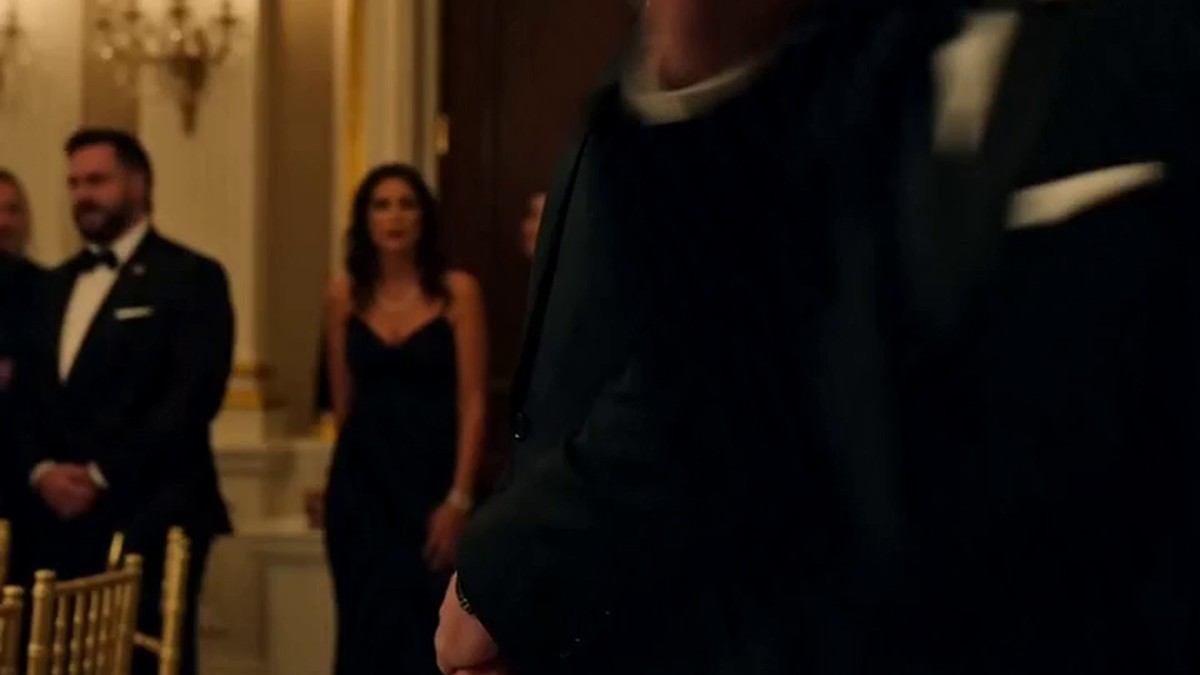
The water hit like an open hand across the face.
One second I was standing beside the courtyard fountain in a black-tie dress, trying my best to disappear into the background of Lauren’s flawless celebration. The next, my heels lost their grip on the wet stone, my arms sliced through empty air, and I went under — right in front of two hundred people who had nowhere better to look.
For half a breath, the whole world went quiet.
Then came the laughter.
Not the uncomfortable kind. Not the startled, guilty kind people try to swallow.
This was open. Effortless. Like I had been arranged there specifically for their pleasure.
When I broke the surface, water flooded down my face and into my mouth. My silk dress sealed itself against my skin. Mascara burned at the corners of my eyes. Somewhere near the champagne tower, a woman breathed, *”Oh my God,”* but she didn’t move an inch.
Nobody did.
The phones were already up.
The photographer kept shooting.
And standing above me — holding the microphone like a scepter, like the room and every soul in it belonged to him — was my father, Richard Whitaker.
“Come on, Claire,” he said, smiling down at me. “Don’t be so dramatic.”
The courtyard erupted all over again.
But the laughter wasn’t what fractured something deep inside me.
It was my mother.
She was laughing behind her champagne glass. Softly. Tastefully. As though watching her daughter drag herself out of freezing water was simply another charming footnote to a perfect evening.
Lauren stood beside her new husband in her custom lace gown, luminous beneath the warm terrace lights.
She didn’t look horrified.
She looked *satisfied.*
That was the moment I understood.
This hadn’t been an accident. It hadn’t been a joke that slipped past its boundaries.
It was a production.
And I had been cast, one final time, in my lifelong role — the Whitaker family embarrassment.
I climbed out slowly. Water cascaded from my sleeves and spread across the marble. The guests fell quiet, holding their breath, waiting for the tears. Waiting for me to scream. Waiting for me to hand them the scene they seemed to believe I owed them.
I found my father’s eyes and held them.
“Remember this moment.”
His smile fractured.
Just for a breath.
Then it reassembled itself, because Richard Whitaker had spent thirty-two years operating under the conviction that consequences were reserved for lesser people.
I turned and walked away.
Behind me, the band picked back up.
That hurt worse than the fall.
—
I locked myself inside a restroom stall and watched cold water drip from my hair onto the marble floor.
At sixteen, my birthday dinner had transformed — mid-toast — into a celebration of Lauren’s Yale acceptance.
At twenty-one, my graduation dinner was quietly canceled because Lauren had a recital.
At twenty-eight, the news of my promotion dissolved without a ripple beneath Lauren’s engagement announcement.
Every time I managed to become something, my family engineered a way to make me smaller.
And still, I had shown up tonight.
Because some stubborn, foolish corner of me kept believing that someday they would look in my direction and actually see a daughter.
My phone buzzed in my wet palm.
Ethan.
I answered, but nothing came out.
“Claire?” he said.
One word. That was all it took.
“What happened?”
I tried to breathe the way my career demanded — steady, measured, unshakable.
Then I whispered, “My father pushed me into a fountain.”
The silence that followed wasn’t empty.
It was *loaded.*
“Are you hurt?”
“No.”
“Where are you?”
“Bathroom.”
His voice dropped half a register. “I’m ten minutes out.”
“Ethan, don’t —”
“I’m already moving.”
The line went dead.
—
I changed into the spare black dress I kept in my car — a habit born from years of unpredictable federal work. I scrubbed the ruined makeup from beneath my eyes and stood very still in front of the mirror.
The woman staring back was exhausted.
Not broken.
That distinction mattered more than I could say.
—
By the time I returned to the ballroom, the wedding had stitched itself back together. Champagne made its rounds. Music smoothed over the air. Guests moved through the room with the practiced ease of people who had already decided not to remember what they’d filmed.
My mother stood among her old-money circle, her voice pitched just loud enough to carry.
“Claire has always been so sensitive.”
Lauren materialized beside me, extending a champagne flute like a peace offering she didn’t mean.
“Are you okay?” she asked, in the tone of someone whose attention was already somewhere else.
“I was pushed into a fountain.”
She exhaled slowly. “Dad was joking.”
“You thought that was funny?”
Her lips drew tight. “Why do you always have to make everything so difficult?”
There it was.
Not *Are you hurt?*
Not *I’m sorry.*
Just the family catechism, the one they’d been reciting at me my entire life: *Why are you reacting?*
I looked at my sister — the golden child my parents had consecrated from birth.
“When have you ever once been happy for me?”
Her face went to stone.
No answer.
Because there wasn’t one.
—
My phone lit up.
*Ethan: On the ground. Security already positioned inside.*
Security?
Before I could respond, three men in dark suits came through the ballroom doors.
Not hotel staff.
Not private security.
Their eyes moved with too much precision. One pressed a finger to his earpiece. Another swept the exits with a single practiced glance.
Across the room, my father stopped laughing.
For the first time in my life, I watched Richard Whitaker go pale.
Then the front doors swung open all the way.
A black Maybach idled at the curb.
Ethan stepped out in a dark suit.
Beside him walked the federal task force director I reported to — a sealed investigative folder tucked under one arm.
My mother’s champagne glass slipped from her fingers and exploded against the marble.
The director crossed the room in a straight line toward my father, broke the seal on the folder, and said, in a voice built for courtrooms and consequences:
“Richard Whitaker. We need to talk about what you buried before your daughter’s wedding.”
The room didn’t shatter.
It *curdled.*
Two hundred guests froze mid-motion — glasses half-raised, mouths mid-sentence, phones suddenly forgotten in pockets. The band trailed into silence one instrument at a time, like lights going out in a building floor by floor.
Richard Whitaker stood at the center of the ballroom with the same expression he’d worn above the fountain twenty minutes earlier. But the architecture was wrong now. The smile had caved in. What remained was something more primitive — a man who had spent a lifetime building walls suddenly realizing his daughter had blueprints.
“This isn’t the place,” he said.
The director didn’t slow down. “We tried your office three times this week.”
“My attorney —”
“Your attorney is already aware.” She set the folder on the nearest table — a small, deliberate motion, the way you place a detonator. “We can do this here, or we can do this outside. But we’re doing it tonight.”
Lauren’s new husband touched her elbow. She shrugged him off, her eyes locked on our father, and I watched her register something she’d spent her whole life refusing to see — that the man she’d been consecrated to had always been the most dangerous person in the room.
Ethan crossed to me in three strides. He didn’t touch me. He stood close enough that his presence became its own kind of sentence.
“You okay?” he said, low.
“Explain the folder.”
His jaw worked for a moment. “How long have you been handling the Hartwell securities case?”
“Fourteen months.”
“Your father’s holding company appears in the offshore transfer records. Three shell accounts, two of them opened the same week the initial complaint was filed.” He paused. “We think someone tipped him. Which means someone in proximity to the investigation.”
The cold that moved through me had nothing to do with the fountain.
“You think he knew I was on the case.”
“We think he’s known for eleven months.”
I turned and looked at my father across the length of the ballroom.
The timeline landed like something physical.
Eleven months ago, he’d called me out of nowhere — a rarity — and taken me to dinner at the kind of restaurant where the privacy was baked into the price. He’d asked about my work with the particular incuriosity of a man performing disinterest. I’d told him nothing beyond generalities. I’d been careful.
But I’d been there.
And he’d seen enough of my face to know that I was close to something.
Every olive branch since then. Every manufactured occasion. Lauren’s engagement party in March. The pre-wedding dinner last month. Tonight.
*We need to talk about what you buried before your daughter’s wedding.*
Not Lauren’s wedding.
Mine.
—
“Richard.”
My own voice surprised me. It came out even. No tremor. The voice I used when I needed a room to understand that the conversation was no longer optional.
My father turned from the director.
The guests between us stepped back without being asked.
I walked toward him, and the space cleared as though the room had decided, finally, to get out of the way.
“The Cayman account,” I said. “The one you opened February fourteenth of last year. Do you want to tell me what you moved through it, or would you like the director to read it aloud?”
His chin lifted. Some old reflex — the patriarchal architecture, the performance of a man unaccustomed to being questioned by anything he’d produced.
“You don’t understand what you’re looking at.”
“I’ve spent fourteen months learning exactly what I’m looking at.”
“You don’t know the full picture.”
“Then paint it.” I stopped four feet from him. “Because right now the picture I have is a man who knew his daughter was working the case that could put him in federal court, and spent eleven months engineering opportunities to be in the same room with her. To watch her. To keep her off-balance.” I held his gaze. “Was the fountain tonight operational, Dad? Or were you just angry that it wasn’t working fast enough?”
The room pulled in a single breath.
My mother made a sound — small, compressed, the sound of a woman whose entire social architecture was coming apart at the seams in front of the people she’d spent forty years cultivating.
My father’s composure fractured in stages. First the eyes — a flicker of something unguarded, something almost afraid. Then the hands, which moved slightly at his sides as if reaching for a microphone that wasn’t there. Then the mouth, which opened and found nothing prepared.
For the first time in my adult life, Richard Whitaker had nothing to perform.
“I am your father,” he said.
The words landed with no weight at all.
“You shoved me into a fountain in front of two hundred people.” I didn’t raise my voice. “You used your daughter’s wedding as cover to be near a federal witness. You spent eleven months destabilizing me on purpose.” I let the silence sit for exactly one beat. “So you’ll forgive me if that particular argument has stopped working.”
Lauren stepped forward from somewhere to my left.
“Claire.” Her voice carried the familiar warning note — *don’t, not here, you’re making a scene.* The family catechism, right on schedule.
I looked at her.
Not with anger. Not anymore.
With the specific grief of someone who had finally accepted the diagnosis.
“I’m not making a scene, Lauren. I’m ending one.” I turned back to the director. “He’s all yours.”
—
They walked him out through the side entrance.
Not in cuffs — that would come later, in a less cinematic setting, with less of old money watching. But surrounded. Escorted. Diminished.
My mother stood very still beside the collapsed champagne display, her social smile still arranged on her face by sheer muscular memory, because it was the only expression she had left that didn’t require her to feel anything.
Lauren’s new husband was speaking quietly in her ear. She wasn’t listening. She was watching our father disappear through the side door with the look of someone watching a foundation crack — not surprised, exactly, but not prepared for how loud it was.
Ethan appeared at my shoulder.
“The task force will want a formal debrief Monday morning. I can push it to afternoon if you need the time.”
“Morning is fine.”
He was quiet for a moment.
“You knew some of it,” he said. Not an accusation. A careful observation.
“I suspected the proximity wasn’t coincidental.” I exhaled slowly. “I didn’t know the account.”
“Why didn’t you flag it?”
I turned that question over honestly, the way it deserved.
“Because some part of me still needed to believe the version of him that showed up to dinner.” I looked at the side door, now closed. “That part is done now.”
Ethan nodded once.
That was the thing about him — he never asked you to be more resolved than you actually were. He just waited while you got there.
—
I found Lauren near the terrace doors, alone for the first time all evening, her bouquet abandoned on an empty chair beside her.
She didn’t look luminous anymore. She looked like a woman who had just watched the architecture of her entire childhood get walked out under federal escort.
I almost walked past her.
I almost let it be.
But the stubborn, foolish corner of me — the one that had dragged itself out of a fountain with its dignity intact — that corner apparently still had something to say.
“I’m not your enemy,” I told her.
She turned. Her eyes were dry, which somehow made it worse.
“I know that,” she said, in a voice that meant she was only just arriving at it.
“Whatever happens next with Dad —” I stopped. Tried again. “You don’t have to choose a side. But you do have to decide what kind of person you’re going to be about it.”
She was quiet for a long time.
“You never needed us the way I did,” she said finally.
“I needed you constantly. You just never looked.”
That landed. I could see it — a small fissure, moving across the stone.
I didn’t wait for her to fill it. Some gaps take years to cross, and tonight had already asked enough of both of us.
I picked up my bag and walked out through the terrace doors.
—
The night air was cool and clean after the sealed warmth of the ballroom.
The Maybach was still at the curb — doors open now, task force agents moving with quiet efficiency, the ordinary bureaucracy of consequence.
I stood on the bottom step and breathed.
My dress was dry. My mascara was clean. The woman who had gone under that fountain an hour ago had dragged herself out, changed, and walked back into the room. And when the room finally gave her something worth responding to, she’d responded.
That felt like enough.
More than enough.
Ethan came through the doors behind me and stood a few feet back, hands in his pockets, looking out at the same ordinary night.
“How are you doing,” he said. Not a question, exactly. More like a door he was leaving open.
I thought about it honestly.
“I feel like I’ve been carrying something very heavy for a very long time,” I said, “and I just put it down.”
“Good place to put it.”
“A federal task force is a reasonable substitute for a therapist.”
He almost smiled.
Almost.
“We’ll see how you feel Monday morning.”
“Monday morning I’ll be professional and contained.”
“I know.”
“Tonight I’m just —” I searched for the word. “Done. I’m done.”
The last task force vehicle pulled away from the curb.
The music inside had started again — of course it had, because weddings were engineered to outlast almost anything — but it sounded very far away now, through glass and brick and all the distance I was finally, deliberately, building.
I had been cast as the Whitaker family embarrassment for thirty-two years.
I had played the role with more grace and more endurance than it ever deserved.
Tonight I had stepped off the stage.
And the funny thing — the thing I hadn’t expected, standing on the bottom step of my sister’s wedding venue in a borrowed-calm dress with wet-hair memories and a federal investigation closing behind me like a chapter — the funny thing was how much like freedom it felt.
Not the loud, cinematic kind.
Just the quiet kind.
The kind that sits in your chest like a door you thought was locked, opened at last onto a night full of ordinary air.
That was enough.
That was more than enough.
I walked to my car.