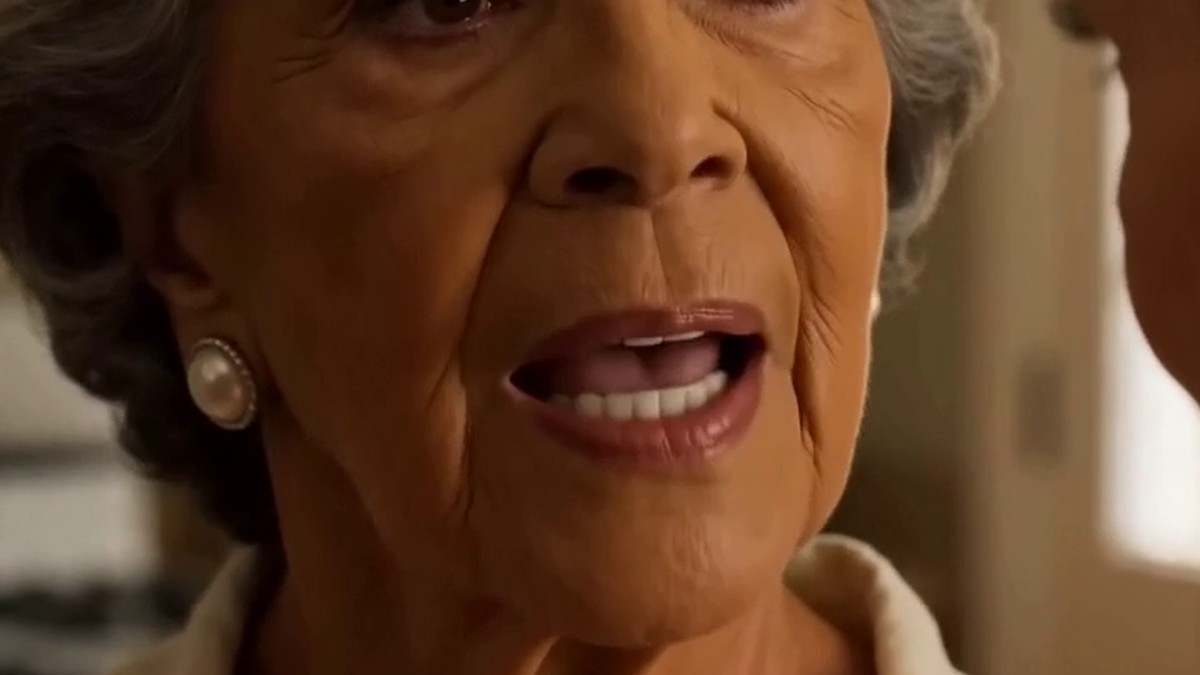
“Mom,” she said, still smiling, “you’re eighty-three years old and you’re still alone. Nobody wants you at this point.”
I sat very still.
I said nothing.
Three weeks later, I married the billionaire widower I had met on that cruise. And when Linda saw the wedding photographs, every assumption she had ever made about me rearranged itself in front of her eyes.
—
My name is Louisa, and I’ve lived on Oleander Street in Savannah, Georgia, for fifty-one years.
Gerald and I built our life in that house the slow, deliberate way people used to — painting walls on weekends, planting a magnolia in the front yard that grew taller than either of us expected, raising two children in rooms that held every sound a family makes. When Gerald died seven years ago, quietly, in his sleep, the way a decent man deserves to leave this world, the house became mine alone. In time, I made my peace with that.
I want to be clear about something: I was not a lonely woman.
I had my garden. My Wednesday book club. My neighbor Pauline, who arrived every October with pimento cheese and homemade preserves like clockwork. I had Admiral, my cat, who slept on Gerald’s pillow and maintained a dignified pretense of indifference while shadowing me from room to room. I had my health — remarkable health, my doctors always noted, for a woman my age. My mind was sharp. My hands were steady. I drove myself to the grocery store. I balanced my own checkbook. I filed my own taxes without assistance and without complaint.
What I had less of, in those years after Gerald, was the warmth of family. And that absence had a shape. It had a name.
Linda.
My daughter was fifty-eight years old, and she had always lived in the most private corner of my heart as someone genuinely difficult to love. Not impossible — never impossible — but difficult in the particular way of a person who inherited their father’s stubbornness without his tenderness, and their mother’s practicality without her patience. She had married Craig Holloway twenty-six years ago, a man whose smile arrived too quickly and whose attention departed just as fast. Their daughter Ashley, thirty-two years old, had grown up watching her parents perform affection when it served a purpose, and she had learned to do the same.
The visits had shortened over the years. The phone calls had thinned after that. I told myself this was ordinary. Children build their own lives. Grandchildren have careers and obligations and distances between them that aren’t always measured in miles. I was not a woman who tallied grievances.
But I noticed things.
I noticed that Craig had raised the question of my will twice in a single year, both times with the careful casualness of someone who had rehearsed the question. I noticed that Ashley had begun referring to my home as “the Oleander property,” the way someone speaks of a thing they are already sorting through in their imagination. I noticed that Linda had stopped asking about my garden, my book club, my cat — and had started asking, with growing frequency, whether I had looked into assisted living arrangements.
I was eighty-three years old. I drove my own car. I had just finished reading *Middlemarch* for the third time.
I held my tongue. I come from a generation that doesn’t broadcast its wounds. You observe. You consider. You wait.
—
The cruise had been Pauline’s idea, or rather Pauline’s gift — a two-week Mediterranean sailing out of Barcelona that she’d won through some promotional contest, surrendered at the last moment when her hip gave out on her. She pressed the tickets into my hands and told me that if I didn’t use them, she would carry the guilt of it for the rest of her life. I almost refused anyway.
Then I thought of Gerald. He had always wanted to see the Greek islands.
So I packed my blue suitcase and went.
That was where I met Walter.
But I will come back to Walter.
—
I returned on a Tuesday, tanned and carrying a different kind of quiet than the one I’d left with. The good kind — the kind that settles into you when you’ve watched the Aegean go silver at sunrise and understood, somewhere beneath the words, that the world is far older and far larger than whatever is troubling you. I had barely set my suitcase down when I heard the knock.
Linda. Craig behind her. Ashley behind him.
No phone call ahead. No warning.
Linda moved through my house the way she had begun to move through it in recent years — with a certain deliberate attention, the eyes of a person conducting a quiet inventory. She picked up the ceramic vase Gerald and I had carried home from Lisbon decades ago and turned it over to read the mark on the bottom. She noted that the kitchen could use updating. She asked whether I’d spoken with a financial adviser recently.
And then she looked at me across my own kitchen table.
Craig leaned in the doorway. Ashley stood at the counter, her eyes on her phone.
It started as a small sound — almost involuntary, the way a laugh sometimes is.
Then it opened up.
“Mom,” Linda said, still smiling, “you’re eighty-three and you’re still alone. You know that, right? Nobody wants you at this point. You went on a cruise by yourself.” She shook her head slowly. “It’s kind of sad.”
Craig made a soft sound of agreement in the doorway. The corner of Ashley’s mouth shifted, though she never looked up.
I sat without moving.
I looked at my daughter’s face — the face I had watched enter this world, had kissed through fevers and heartbreaks and the unremarkable Tuesday afternoons that make up most of a life — and I nodded once.
Slowly.
I said nothing at all.
But I remembered every word. Every sound. The precise shape of the smile on her face.
And somewhere deep inside me, in a place Linda had never once thought to look, something that had been lying still for a very long time opened its eyes and began to wake.
Three weeks later, I stood in a civil registrar’s office in Savannah wearing a cream-colored dress I had bought on the last afternoon in Santorini, and I married Walter Ashford.
There were four witnesses. Pauline, who wept openly and without apology. Walter’s attorney, a careful young man named Marcus who wore the same expression throughout that a surgeon wears in the operating room. A courthouse clerk named Deirdre who had performed what she estimated to be three thousand ceremonies and teared up anyway. And Admiral, present only in spirit, though I had told Walter about him at length on the third night of the cruise, and Walter had listened the way you listen when a detail matters to you.
It was not a grand ceremony.
It was, however, real.
—
I should tell you about Walter now, because I suspect you have already begun to construct him in your imagination, and I suspect what you’ve constructed is wrong.
Walter Ashford was seventy-nine years old, with the kind of face that had been architectural rather than handsome in youth and had only improved with age — planes and angles and a particular set to the jaw that suggested he had decided something, long ago, and had never uncided it. He had made his money in industrial shipping, the quiet, unglamorous kind of wealth that doesn’t photograph well and doesn’t try to. His wife, Margaret, had died four years ago from pancreatic cancer. He had a son in London and a daughter in Seattle, and they called him faithfully every Sunday, and he called them when he needed nothing and simply wanted to hear their voices. He had told me this on the second morning, over coffee on the ship’s aft deck, while the coast of Corsica emerged from the haze off to the east.
He was not lonely either. I understood that about him immediately, the way you recognize a quality in another person because you know it in yourself. He was complete. Self-contained. He had a greenhouse full of orchids, a library he was genuinely still working through, a dog named Franklin who apparently ran the household with benevolent authority.
What he was, and what I was, were simply people who had loved well once and had not closed that capacity off when the person they’d loved departed.
We talked for seven days before anything shifted. Then on the eighth evening, standing at the rail while the sun went down over the water, he said something unremarkable — a small observation about the color of the light — and reached over and touched my hand where it rested on the railing, just once, briefly, and then didn’t move his hand away. And I didn’t move mine.
He asked if he could write to me. Old-fashioned word, write. I told him I would prefer it to the alternative.
He sent the first letter before the ship had even docked.
—
We wrote for two weeks. Real letters, on paper, in envelopes. His handwriting was precise and slightly left-tilted. He wrote about orchids and Yeats and a particular October morning in County Clare he’d never quite gotten out of his system. I wrote about Gerald. About the magnolia tree. About the Tuesday I had sat in my own kitchen while my daughter smiled at me.
I had not planned to write about that. But the page was there, and the words came, and I let them.
He called me three days after that letter arrived. He said, “I’d like to come to Savannah.” He said it the way you state a fact that was decided quietly, some time ago, when you weren’t paying attention.
I said, “When?”
He arrived on a Friday. He met Pauline, who interrogated him with the focused enthusiasm of someone who has been waiting to do exactly this for some years. He walked with me through my garden in the long afternoon light and asked about every plant by name and actually listened to the answers. He sat in Gerald’s chair without knowing it was Gerald’s chair, and when I told him later, he stood up, and then looked at me to see if he should have, and I told him to sit back down. He sat back down.
He met Admiral, who subjected him to forty-five minutes of deliberate indifference before climbing, without ceremony, into his lap.
“Cats know,” Pauline said from across the room.
I said, “Pauline.”
She said, “I’m just saying.”
On the third day he walked me to a bench in Forsyth Park and told me that he had not expected this. That he had gone on the cruise because his son had worried about him, that he had expected nothing more than a change of scenery, that he was not a man given to fast decisions or romantic impracticality. And then he said that he was also not a man given to ignoring the plain evidence before him, and the plain evidence before him was that he had not felt like himself — his best self, the version he most recognized — since Margaret, and he felt exactly like himself when he was talking to me.
He asked me to marry him on that bench.
I sat for a long moment. Long enough that a small child on a bicycle wobbled past us twice.
Then I said yes.
I said yes because he was kind without being soft. Because he had listened to me talk about Gerald without once making me feel that grief was a competition. Because he found Admiral’s arrogance genuinely charming rather than merely tolerable. Because he wrote letters, and wrote them well. Because when I had told him about Linda — about the kitchen, the smile, the words *nobody wants you* — he had gone very quiet and very still, and then said, simply, “She’s wrong,” with the calm certainty of a man correcting a factual error.
Because I was eighty-three years old and my mind was sharp and my hands were steady and I knew, as well as I had ever known anything, that this was true.
—
The wedding photographs arrived by messenger — Marcus’s doing, efficient as always — on a Saturday morning, six days after the ceremony. I had arranged it this way deliberately. I sent a set to Linda without a note.
I knew she would call. I waited.
She called that afternoon.
I let it ring twice, then answered.
There was a silence on her end that I had never heard from her before. Linda was not a woman given to silence. She filled rooms with herself, always had. This silence had texture to it — the texture of a person standing in a hallway with an envelope in their hand, looking at something that has just reordered the room around them.
“Mom.” Her voice was different. Not softer, exactly. More careful. The way a voice gets when the script has been pulled away. “Who is — what is — ”
“His name is Walter,” I said. “Walter Ashford. We were married last Tuesday at the Chatham County courthouse. Pauline was a witness.”
Another silence.
“You got married.”
“I did.”
“You were — you only just got back from the cruise three weeks ago.”
“Twenty-two days,” I said. “Yes.”
I heard her breathing. I heard, in the background, Craig’s voice saying something, and Linda’s hand must have moved to cover the receiver, because his words blurred into unintelligible murmuring, and then cleared again.
“Mom,” she said. “We should — we should talk. We should come over. We should — we need to talk about this.”
“You’re welcome to come on Sunday,” I said. “Walter will be here. He’s looking forward to meeting you.”
That was not precisely true, but it was not precisely false either. Walter had said, the evening before, with the calm of a man who has navigated corporate negotiations across four decades, that he was entirely prepared to meet my daughter and had every confidence in the outcome.
I had asked him why he was so confident.
He had smiled — a slow, contained smile, the kind that doesn’t perform itself — and said, “Because I’m going to be very polite, and very interested in her, and she is not going to know what to do with that.”
I had laughed then. Actually laughed, the full kind, from somewhere real.
He was right.
—
Sunday came in the long, golden way Savannah Sundays do in October, the light coming sideways through the live oaks and making everything look like a painting of itself. I had made coffee and set out the good china — not for performance, but because this was my house and my marriage and I would use my good china when I chose to.
Walter stood at the kitchen counter reading the newspaper with the same ease he brought to most things. Franklin was not present — he had remained in Walter’s home outside Charleston, under the care of a housekeeper until we had sorted out the logistics of combining two households. But Admiral was present, seated on the counter in that particular imperial way of his, observing the kitchen as though he had convened it.
Linda arrived first. Then Craig, then Ashley. The same order as that other Tuesday, three weeks and an entire rearrangement ago.
The difference was the quality of their entry. Last time they had moved through my house with the casual proprietorial ease of people who believed they knew what it contained. Today they moved carefully, the way you move in a space that has been changed in your absence and you’re still locating the new dimensions.
Walter looked up from his newspaper, folded it with unhurried precision, and stood.
He was taller than I think any of them expected. He shook Craig’s hand with the practiced ease of a man who has shaken ten thousand hands and given each one its due attention. He smiled at Ashley with the warm, undemanding smile of a person who wants nothing from you. He turned to Linda last.
“Linda,” he said. “I’ve looked forward to this. Your mother speaks about you a great deal.”
It was true. I had spoken about her. Not in the way she would assume — not glowingly, not with the performed pride of a mother auditioning her child for approval. But honestly. As myself. Walter knew who my daughter was. He knew what she had said in my kitchen. He knew the shape of that wound, because I had described it in a letter, in ink, on paper, and he had read it and understood it and said she was wrong.
Linda looked at him. For a moment her face did something unguarded — something young. A flicker of recalibration so rapid it was almost invisible.
“She speaks about you too,” Linda said. “Or — she will, I imagine. We didn’t — I didn’t know about you. Until the photographs.”
“I know,” Walter said, simply, without judgment. “Sit down. I’ll pour the coffee.”
He poured the coffee. He did it the way he did most domestic things — competently, without fuss, as though he had poured coffee in this kitchen a hundred times. Craig watched him with the expression of a man who has prepared for a certain type of encounter and found himself in a different one. Ashley set her phone on the table and left it there, which I had never seen her do in my kitchen before.
We sat.
For a while we talked in the careful, circling way of people testing the ground. Walter asked Craig about his work with the practiced curiosity of a man who could converse across any professional divide and genuinely wanted to. He asked Ashley about her life in Atlanta. He was — exactly as he had predicted — very polite, and very interested, and Linda did not know what to do with it.
Then Linda set down her coffee cup.
She looked at me. Not at Walter. At me.
“Mom,” she said. “I need to — about what I said, when you got back — ”
“You don’t have to,” I said.
“I think I do.” A pause. She straightened slightly, the stubbornness engaging, but this time behind something else. Something that looked, unexpectedly, like work. Like effort. “What I said was unkind. It was — I was looking at you and I was seeing something I’d already decided, and I said it out loud, and it was unkind.”
I looked at my daughter’s face. Fifty-eight years old. Gerald’s jaw. My eyes. The particular crease between her brows that she’d had since she was nine years old and working through a problem that mattered to her.
She was not apologizing the way she’d rehearsed it in the car, I could tell. She was apologizing the way you do when the script fails you and you’re left with the actual thing.
“Thank you,” I said. Just that.
Not *it’s all right.* Not *I understand.* Those would have been gifts she hadn’t earned yet. But *thank you* — that I could give her. That cost me nothing and was simply true.
Craig said something smoothing and unnecessary. Walter talked him gently into a different direction. Ashley picked up her phone, then put it back down, then said, to no one in particular, “This is a really nice house, actually. I always thought the light in here was nice.”
I looked at my granddaughter. Thirty-two years old. Learning a thing late, maybe. But learning it.
“Your grandfather picked these windows,” I said. “He drove three hours to get the right size.”
She looked at the windows. Really looked.
“That’s a Gerald thing to do,” she said. Quietly. Like she meant it.
And in my kitchen, in October light, with the magnolia taller than anyone expected outside the window and Admiral watching the proceedings from the counter with the ancient dignity of a cat who has seen everything and found it basically acceptable — something shifted. Not fixed. Not simple. But shifted.
The long, unmoving thing that families can become when they stop looking at each other clearly — it moved. Just slightly. Just enough.
—
Pauline came over that evening, after the others had gone. She sat across from me and Walter at my kitchen table with her tea, and she looked at the two of us with the frank, affectionate assessment of a woman who has known me for thirty years and is not given to sentimentality except when sentimentality is precisely correct.
“Well,” she said.
“Well,” I agreed.
“Gerald would have liked him,” she said.
Walter looked at me. I looked at him. It was the look of two people who have had a private conversation about a thing and are now seeing that conversation confirmed by someone else, from the outside.
“I think he would have,” I said.
Pauline drank her tea. Walter refilled her cup without being asked. Outside, the street was going dark in the particular way of a Savannah October, the live oaks holding the last of the light in their upper branches while everything below went to shadow.
I was eighty-three years old.
My mind was sharp. My hands were steady. The magnolia Gerald planted was taller than either of us had expected, visible from the kitchen window, still holding its shape against the darkening sky.
And somewhere on that ship, watching the Aegean go silver at sunrise, I had understood — not for the first time, but more deeply than before — that the world is far larger and far older than whatever is troubling you.
That life, when you let it, still moves forward.
That nobody gets to tell you when you’re done.