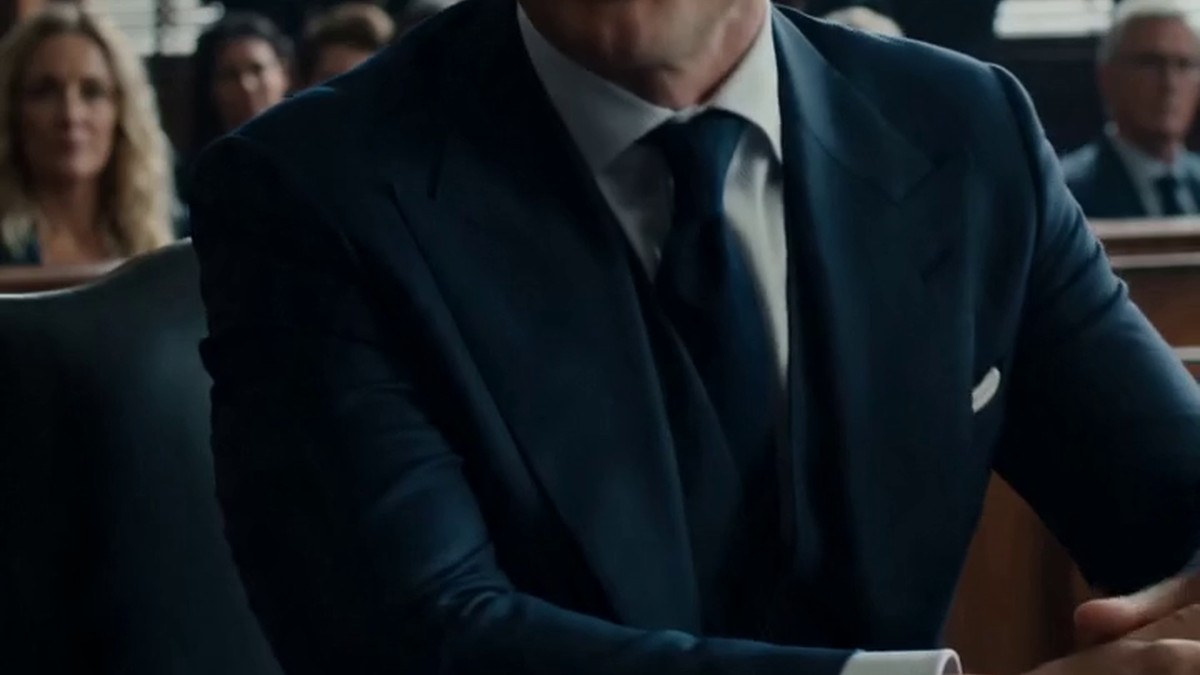
Charcoal suit. Perfect shoulders. Silver cufflinks catching the light. His left hand draped across the polished table like he was mildly inconvenienced by having to be here at all.
I was eight months along. His child moving inside me. I wore a simple navy maternity dress that Miriam had picked because she said it projected calm, and calm was armor. My ankles were thick beneath the table, my back had been grinding since the cab ride over, and our daughter shifted restlessly inside me as though she could already taste the chill in that room. I kept one hand below the table’s edge, palm flat against my stomach, and I made my face do what Richard had once complimented at fundraisers and punished behind closed doors. He believed he had carved that stillness into me. He believed every measured breath I drew was evidence that I understood my position.
“You’re walking out with nothing,” he said, pitching it loud enough for the press row in back while pretending it was only for me.
Behind him, Vanessa Vale dropped her gaze and let out a small, private laugh. She was twenty-seven, blond, luminous in winter-white silk — dressed not for a legal proceeding but for a photograph someone was going to want later. At her ears hung my grandmother’s sapphire earrings. Deep blue stones. Old gold setting. The last thing my grandmother ever placed in my hands before she left this world. Richard had lifted them from my dressing room during the week I was gone from Sterling House, and his assistant had relayed his explanation: I must have misplaced them somewhere.
He wanted me to shatter when I saw them on her. He wanted my hands to shake, my voice to splinter, my fury to surface right there in front of the judge so his team could lift it up and call it instability.
I gave him nothing at all.
Beside me at the petitioner’s table, Miriam Vance pressed two fingers against my wrist beneath the edge of the table. She didn’t look at me. Her eyes stayed forward, her spine straight, silver hair knotted low at the nape of her neck, dark suit with the severity of something you’d wear to a military tribunal. But her fingers said what her voice didn’t need to.
Hold.
So I held.
Richard had spent six years confusing silence with submission. Every polished smile at investor dinners, every softened voice, every gracious public concession — he had tallied it all as proof that I was easy to steer. He liked me best beside him at those long tables, my hand on his arm, laughing at the right moments while men with private planes praised what he had built at Sterling Capital. He liked me remembering which senator’s wife couldn’t stand lilies, which donor was gluten-free, which board member needed to be seated across the room from which former lover. He liked me useful, quiet, grateful, and polished.
His family called me lucky.
His friends called me refined.
Richard called me easy to manage.
That was before the hotel receipts. Before the late messages. Before the necklace billed to a company account and shipped to a hotel suite where a photographer caught Vanessa stepping into an elevator with Richard’s hand low on her back. Before I understood that none of this was impulsive — not a lapse, not a weakness, not one of those quiet marital failures that wealthy families press behind the curtain of good manners. It was a construction project. While I was going through fertility treatments. While I was losing our first pregnancy alone on a bathroom floor with Richard presenting at a conference in Aspen. While I was smiling beside him at a children’s hospital gala. He was already moving money, rerouting assets, and sliding Vanessa into the shape of a life he intended to begin the moment I became a problem to solve.
When I finally placed it all in front of him, he didn’t argue. He reached over and closed my laptop — two fingers, slow — and said, “Caroline, you’re too emotional right now to think clearly about what’s good for you.”
I left Sterling House in the middle of a hard rain with one bag. By then, his lawyers had already begun building someone I barely recognized. In their letters, I was volatile. In their filings, I was grasping. In their whispers to shared friends, I was an overwhelmed pregnant woman clinging to a marriage that had quietly ended long before Richard “found something real.” His mother, Evelyn Sterling, called me from a blocked number and told me that women in families like theirs endured in silence if they had any class left. I stood in the guest room of Miriam’s townhouse, one hand on my belly, listening to Evelyn’s voice move through the phone like a blade folded inside silk. “Think about the child,” she said. “Think about the life Richard can still offer if you don’t humiliate all of us.”
But I had already thought about the child.
That was exactly why I stopped crying.
And started working.
I copied emails. Saved messages. Photographed invoices. Ran transfer histories through shell account names that looked like nothing until they looked like everything. Richard had decided I had no instinct for finance because I never cut him off when he explained deals over dinner. He had forgotten who I was before I became Mrs. Sterling. A master’s degree in archival accounting. Three years helping museums trace forged donation trails and falsified acquisition records. I understood how men with wealth concealed things. I understood how documents lied with perfect grammar. I understood that a man like Richard left evidence intact because he believed evidence could always be managed.
Three weeks before the hearing, in a locked archive beneath the Sterling family office, I found the document he had stopped remembering existed.
The original prenuptial agreement.
Not the cleaned-up version his attorneys had been waving like a flag. Not the scanned file sitting in Sterling Capital’s legal database. The original — signed twelve days before our wedding, bearing my signature, his signature, his father’s signature as witness, and a clause buried so deep inside the language of that agreement that even Richard appeared to have lost track of it entirely.
Article Twelve.
The Infidelity Forfeiture Clause.
Now his lead attorney, Gregory Mallon, was on his feet, assuring the court that the prenuptial agreement was unassailable. He spoke with a kind of practiced gentleness, as though dismantling a pregnant woman’s future were a simple administrative task. Under the agreement’s terms, I had signed away all claims — marital assets, corporate shares, residences, family trusts, investment returns, appreciation, future growth tied to Sterling Capital. One hundred thousand dollars. The personal effects I had brought to the marriage.
Vanessa leaned toward the woman beside her. “That’s generous,” she murmured.
Then she laughed.
The sound passed through me without finding purchase. My throat closed — not from fear but from accumulation. From memory. From six years of words swallowed whole. From the particular weight of watching my grandmother’s earrings catch the courtroom light against someone else’s skin. I let the silence run. I let Richard settle deeper into his certainty.
Then Miriam stood up.
“Your Honor,” she said, and her voice had the quality of something that had been engineered to carry, “before this court moves to enforce the prenuptial agreement, we ask leave to address a condition embedded in Article Twelve.”
Richard’s smile broke.
Only for a second.
But I was watching for it.
Gregory Mallon paused mid-breath. It was the only signal his body permitted before the professional mask snapped back into place. He lowered himself into his chair with the controlled unhurry of a man reminding himself that he was being paid too much to show surprise.
Richard didn’t sit down.
He leaned toward Mallon’s ear, and whatever passed between them lasted less than four seconds. Then Richard straightened, reset his jaw, and resumed the smile.
Judge Elaine Whitmore peered over her reading glasses at Miriam. She was sixty-two, silver-haired, and possessed of a particular stillness that told you she had seen this theater before and had long since stopped being amused by the set design.
“Counsel,” she said.
Miriam nodded once — not deferentially, but with the precision of a woman who had done her waiting and was done waiting now.
She produced a document. Crisp pages inside a clear folder, handled with the careful neutrality of someone carrying something that did not need embellishment. She passed copies to Mallon’s table, to the clerk, and set the original in front of the judge with both hands.
“Your Honor, the agreement Mr. Mallon has presented is a scanned reproduction of the prenuptial contract executed twelve days prior to my client’s marriage. His firm has relied on that reproduction throughout these proceedings. We have no argument with the terms of the agreement as copied.” She paused just long enough. “We take issue with what was omitted from the copy.”
Mallon was on his feet. “Your Honor, the document submitted by the petitioner’s team has been verified by —”
“Sit down, Gregory,” Judge Whitmore said, without heat.
He sat.
Miriam continued. “Article Twelve of the original prenuptial contract, which my client recovered from the Sterling family office archives three weeks ago, contains a provision absent from all reproductions in Sterling Capital’s legal database. The clause is titled ‘Conditions of Enforcement.’ It reads, in relevant part” — she opened her own folder and did not need to search for the page — “‘The financial limitations set forth in this agreement shall be rendered null and void in the event that the non-petitioning party engages in documented marital infidelity prior to any formal dissolution proceeding. In such event, the petitioning party shall be entitled to seek full equitable distribution under applicable state law, irrespective of any other terms herein.'”
The courtroom did not erupt. Courts do not erupt. What happened was smaller and more total than eruption. It was the sound of a room discovering it had been holding its breath.
Richard Sterling did not move. He had the particular stillness of a man whose body understood the news before his mind had finished refusing it. His left hand, the one that had been draped across the table like a mild inconvenience, curled inward once. Then lay flat again.
Vanessa’s chin came up. She looked at the back of Richard’s head the way a person looks at a door they assumed was locked.
“The clause,” Miriam said, “was signed. By both parties. By the witness.” She let that land before she added the last piece. “The witness being Edward Sterling, Richard’s father, who is prepared to testify before this court that he recalls the inclusion of this language and its purpose.”
Mallon was writing furiously. His junior attorney was already on her phone, angled low beneath the table. The press row in back had become very still and very alert in the way of people whose notebooks have suddenly become relevant.
“Your Honor,” Mallon said, and his practiced gentleness had been replaced by something tighter and more honest, “this alleged clause requires immediate forensic verification. The integrity of the document —”
“Has already been established,” Miriam said pleasantly. “We anticipated that concern. You’ll find in tab three a report from Dr. Constance Harwell at the University archival forensics laboratory. The original document has been dated, the ink analyzed, the signature impressions verified. It is authentic. It predates the marriage. And it has never been altered.” She closed her folder. “The reproduction in Sterling Capital’s database, however, was scanned from a version that did not include pages eleven through fourteen.”
The judge looked at Mallon over her glasses. “How does page twelve end on the copy you submitted, Mr. Mallon?”
A pause. Then, very quietly: “With a section break, Your Honor.”
“And in the original?”
Miriam answered before he could. “With the full text of Article Twelve.”
I had been watching Richard’s face. It was the same face I had watched across dinner tables and in boardrooms and in the dark of Sterling House at two in the morning when he came home and believed I was asleep. It was a face that had never fully learned to absorb bad news because bad news had always been something that happened to other people — people with fewer resources, fewer allies, fewer names worth protecting.
Now he turned and looked at me.
Not with anger. That came later, I imagined, in a car on the way to a different building where men in other expensive suits would begin the work of determining how this had happened. What crossed his face in that unguarded second was something I had almost forgotten he was capable of. Something raw. Something that recognized me, finally, as the person I had always been. Not a position. Not a variable. Not a problem to manage or a room to clear before the next arrangement began.
I looked back at him and I felt the old pull — that terrible muscle memory of wanting to offer him something, a door, an out, the way I had always reflexively reached for his comfort in the moments when he’d let the mask drop enough to need it. Six years had built that into me like a reflex. And I felt it now, the ghost of it. The shape of the woman I had been in that house.
But our daughter moved inside me.
One slow, deliberate shift. Elbow or heel, I never knew which, pressing outward against my palm where my hand still rested below the table’s edge.
I breathed in.
I let the old reflex pass through me like weather.
And I sat still.
—
Mallon requested a continuance. Judge Whitmore denied it without ceremony and told him he could file for a forensic challenge through proper channels, which would take months he didn’t appear to have, and that in the meantime the court would proceed on the basis of the original document’s verified authenticity. She said it in the measured, unhurried tone of a woman who had already read everything Miriam filed and had already formed her opinion and was now giving everyone in the room the courtesy of watching her arrive at it in sequence.
Richard’s team consulted in low voices with their jackets turned inward. Mallon kept his expression professional. His junior attorney had stopped looking up.
Vanessa Vale left before the session was recessed.
I didn’t watch her go. I heard the soft percussion of heels against marble, and I kept my eyes on the carved seal above the judge’s bench, and I breathed the way Miriam had coached me to breathe months ago in her office with the afternoon light coming through the tall windows and a legal pad between us covered in my handwriting. *He will expect you to break*, she had said, not looking up from the pad. *He has built an entire case around it. So we don’t break.* She had underlined something. *We outlast.*
We outlasted.
—
In the corridor during recess, Miriam steered me away from the press and into the alcove near the north stairwell. She pressed a bottle of water into my hand and watched me drink it. Her expression was not celebratory. She was already moving to the next calculation.
“He’ll settle,” she said. “Before it goes further. His father will want it contained.”
“Edward signed the clause.”
“Edward signed the clause because Edward is eighty years old and has spent forty of them believing Richard would be the kind of man who didn’t need it invoked.” She folded her hands. “Now he knows otherwise. That matters to him more than the money does.”
I pressed the water bottle against the side of my neck and felt the cold run down into my shoulder. The baby had settled. The grinding in my back had not. Somewhere behind us, voices moved through the marble corridor in clusters, and I could hear Richard’s name passing between mouths with the new cadence that attached itself to names when the story around them had changed.
“He’ll want a gag clause,” I said.
“He’ll ask for one.”
“And?”
Miriam looked at me. “And you will remember that you don’t need his money to be comfortable, and you don’t need his silence clause to be safe. What you decide about that is yours.” She picked up her bag. “But I’d recommend he not get to buy his way out of a public record.”
—
The settlement came eleven days later, in a room without windows on the fourteenth floor of Miriam’s firm. Richard arrived with Mallon and one other attorney whose name I never learned. He wore a charcoal suit again. Different from the one at the hearing. His eyes, when they met mine across the conference table, had the careful neutrality of a man who had been coached very specifically not to let anything show.
He was not coached enough.
I could see it under the surface. Not guilt — I was not naive enough to reach for guilt by then. But a reordering. The particular discomfort of a man who had organized his life around the premise that he was better than his circumstances and had now been required to confront a circumstance that had outpaced him.
He didn’t speak to me directly. Everything passed through attorneys.
I didn’t need him to speak to me. I had spent six years waiting for him to speak to me honestly and it had never come. I had spent the last eight months learning to stop wanting it.
What came out of that room: a third of the Sterling Capital shares he had held in my name and then moved before I could document them, returned. The house in Connecticut that his mother had transferred into a family holding company six months into our marriage, contested and reclaimed. Custodial terms for our daughter written by Miriam with the specificity of someone who trusted nothing verbal. Child support calculated on the actual scope of Sterling Capital’s portfolio, not the compressed figures his team had initially submitted. My grandmother’s earrings, returned to me by courier the following morning in a padded envelope with no note.
I held them for a long time before I put them anywhere.
—
She was born on a Tuesday in late November, during a sleet storm that iced the hospital parking structure and made the nurses joke about the weather having opinions. Seven pounds, four ounces. Dark hair, already a surprising amount of it. Gray eyes that I was told might change but haven’t, not yet.
Miriam was in the waiting room. My sister flew in from Portland and arrived twenty minutes after, still in her coat, and cried before I did. My mother video-called from her garden and talked too loudly into the phone and I didn’t mind at all.
Richard came to the hospital. He stood in the doorway of the room in a dark coat with sleet still visible on his shoulders. He looked at her for a long time. Something moved across his face that I had never seen there before, something undefended and bewildered and real, and I wondered if it would change him. I wondered if it would make him the kind of father she deserved.
I did not wonder long. That was not my work anymore.
“Her name is Nora,” I told him.
He nodded. He looked at her again. Then he looked at me with something that wasn’t quite an apology and wasn’t quite a question — something that occupied the uncertain country between the two, where men like Richard Sterling sometimes arrived too late to say the thing that mattered.
“Caroline,” he started.
“You can see her,” I said. “The schedule is in the agreement. The attorneys have everything you need.”
He stood in the doorway another moment. Then he left.
I looked down at Nora. She had her fist pressed against her own cheek, eyes closed, entirely unconcerned with the circumstances of anything beyond the radius of her own warmth. Her chest rose and fell with the total commitment of someone for whom breathing was still a new and serious endeavor.
Outside, the sleet moved sideways past the window in long pale curtains. The city sounds came in muted and indistinct beneath it. The room smelled of antiseptic and the gas-station flowers my sister had thrust into a plastic vase on the windowsill and which were, improbably, exactly right.
I was thirty-four years old.
I had a daughter named Nora with gray eyes and too much dark hair and a fist pressed to her cheek like she was already thinking something over.
I had walked out of a courtroom with everything.
Not what Richard meant when he said everything — not the cars or the shares or the Connecticut house or the invitations to the right tables. Something older than that. Something that had been mine before I ever learned to stand still beside him at those long dinners while men praised what he had built and I smiled and remembered whose wife preferred lilies removed from the centerpieces.
I had walked out with myself.
Nora made a small sound. Not a cry — something earlier than a cry. A breath that became a syllable. An announcement.
I pulled her closer.
“I know,” I said. “I know. I’ve got you.”
And for the first time in a very long time, those words were only the truth.