She almost didn’t stop.
Manhattan moved the way it always did — relentless, indifferent, yellow cabs cutting through cold afternoon light like the world had somewhere better to be.
But her son had planted his feet on the sidewalk.
Still.
He was staring at a street pole near the curb.
A boy sat against it — homeless, barefoot, heels on raw concrete. His knees were scraped dark. A hoodie sagged off his narrow shoulders like it had given up trying to fit.
He raised his eyes.
And something inside the woman locked up completely.
Because that face.
God, that *face.*
Not a passing resemblance.
Not the kind you blink away and forget.
The same eyes. The same jaw. The same curve of the mouth.
Her son moved first — one cautious step forward, voice caught somewhere between confusion and fear.
“He looks like me.”
The homeless boy rose slowly from the ground.
He didn’t reach out a hand. Didn’t speak.
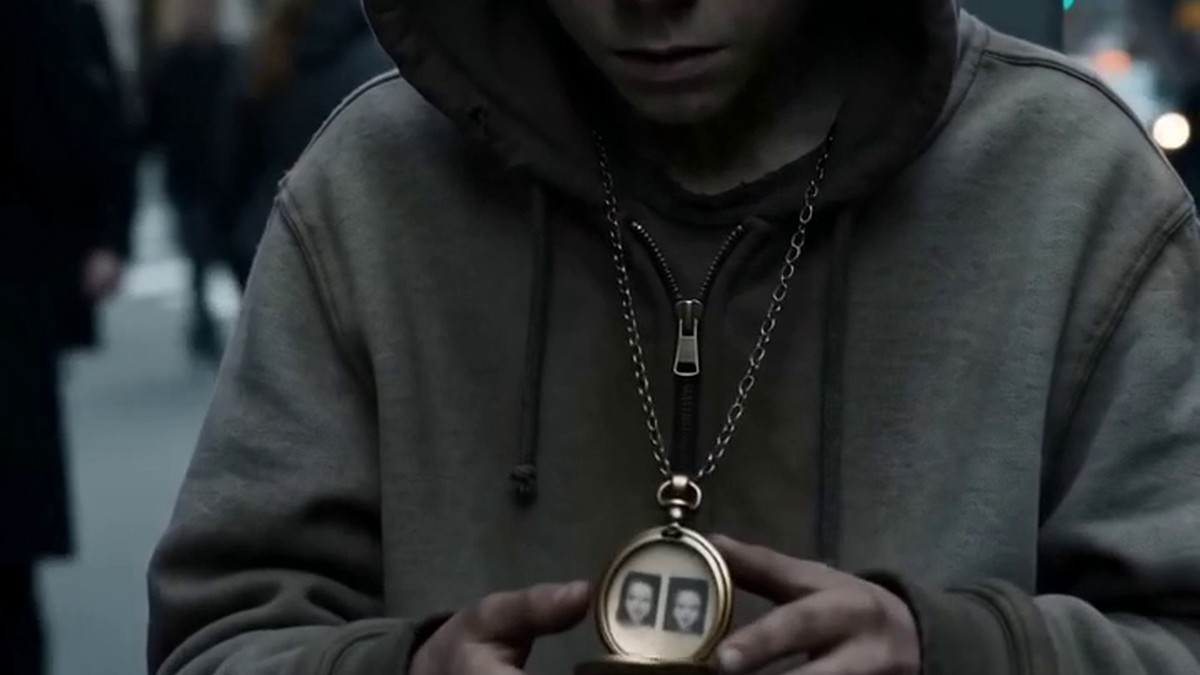
He just lifted his fingers to the locket hanging at his chest — tarnished, worn thin at the edges — and opened it with the careful deliberateness of someone who had been rehearsing this moment for years.
Her grip tightened on her son’s shoulder.
The boy held the locket open.
Two small photographs inside.
And below them, pressed into the metal in letters nearly rubbed smooth:
*”To our twin sons.”*
Her son’s hands started to shake.
His voice came out barely above nothing.
“Mom… what does this mean?”
Her sunglasses slid down the bridge of her nose.
Her mouth opened. Closed.
The tears came before she had any say in the matter.
“That’s not possible…”
The homeless boy watched her. Eyes tired. Eyes careful. Eyes that had learned long ago not to expect much from the world.
Then he said it.
One word.
Quiet as a door opening after years of being sealed shut.
*”Mother?”*
The sound hit her like something physical.
Not the word itself — but the voice. Low and careful, like he’d been holding it in reserve for years, saving it for exactly this moment, terrified it would be the wrong one.
*Mother.*
Margaret Holloway hadn’t heard that word in eighteen years.
Not from *him.*
Her knees wanted to go. She felt them — that liquid, dissolving feeling that starts in the joints and moves upward until your whole body forgets it has a frame. She locked them. Forced them to hold.
“What’s your name?” she asked.
Her voice didn’t sound like hers.
The boy — the *man*, almost, he had to be sixteen at least — kept his eyes on her face. Reading her the way people read faces when they’ve never been sure what was coming next.
“Daniel,” he said. “At least that’s what they called me at the first shelter. Before I stopped going.”
Behind her, she heard her son make a sound she’d never heard him make before. Something between a gasp and a word that hadn’t found its shape yet.
Because her son’s name was Daniel, too.
—
She sat them both on the steps of a bodega that had closed for the afternoon, the metal security grate halfway down like a half-lowered eyelid. The cold was getting serious — that particular Manhattan cold that comes off the Hudson and makes you feel like the city has decided to become honest about itself.
She gave the homeless boy — her son, she kept saying it inside her head like something she was rehearsing, *her son, her son* — her coat. He resisted. She didn’t give him a choice.
“You need to tell me everything,” she said. “Everything you know.”
He looked at the locket in his palm.
“I’ve had this since I can remember,” he said. “The woman who had me in the beginning — she wasn’t good. I don’t say that to hurt anything. She just wasn’t.” He paused. “She died when I was six. After that it was placements. Different houses. I ran from the last one four years ago.”
“Four years.” Her voice fractured on it. “You’ve been out here for *four years?*”
“Not always here. Different cities.” He looked at the sidewalk. “I came to New York six months ago. I’d seen a photograph — in a newspaper, left on a bench at a shelter in Philadelphia. A city council piece. A man named Reeves standing next to a woman at some fundraiser. And the woman.” He stopped. He turned the locket over in his fingers once, twice. “She had my face. Or I had hers. I didn’t know what that meant. I just started moving toward it.”
Her other son — the one she had raised, the one who had her last name and a warm bed and a school he sometimes complained about — was sitting very still beside her. His face had gone somewhere inward. Processing. She could see him doing it.
“Mom,” he said quietly. “Tell me what happened.”
—
She had been twenty-two.
She had been alone in a way that twenty-two can manufacture when you have no family left and the man you trusted turned out to be someone else entirely by the time you were showing.
Twins. She’d been told twins at the first ultrasound, then there’d been complications, then fear, and then the man she’d trusted — *Reeves*, the name still sat in her chest like a stone — had made arrangements she hadn’t understood until it was too late.
She had woken up from an emergency delivery with one son in her arms.
She had been told the other hadn’t survived.
“I believed them,” she said. The words tasted like ash. “For eighteen years I believed them.”
She looked at the boy across from her — the boy wrapped in her coat, the tarnished locket pressed between his fingers.
“Reeves,” she said, and her voice had changed. Gone flat. Gone cold. “Did anyone ever mention that name to you?”
The boy’s expression shifted.
Just slightly.
The way a door shifts when there’s wind behind it.
“There was a man,” he said slowly. “At the last house. He came twice. He said he was a social worker but he wasn’t dressed like one. He asked me questions about whether I knew who I was, whether I had any papers, any photographs.” His jaw tightened. “He tried to take the locket.”
Margaret’s hand balled into a fist against her knee.
Because Victor Reeves hadn’t died. Hadn’t disappeared. Hadn’t faded into the category of men you put behind you and never think about again.
He’d run for city council three years ago on a family values platform. He had an office on the forty-second floor of a building on Park Avenue. He had a wife, a foundation, a reputation that had been built with careful deliberate hands over the course of nearly two decades.
And he had, apparently, been watching.
—
She called her lawyer from the bodega steps.
She called him twice because he didn’t pick up the first time and she needed him to understand from the sound of her voice that this was not a *call me when you get a chance* situation.
When he answered the second time, she talked for four minutes without stopping. She heard him go quiet in the specific way lawyers go quiet when they are calculating very quickly and the numbers are serious.
“Don’t go home yet,” he said.
“Why not?”
“Because if Reeves has been tracking the boy, he’s been tracking you too. If he sees you together—”
“He’ll know I know.”
“Yes.”
She looked at the two boys sitting on either side of her. Same eyes. Same jaw. Same curve of the mouth. The distance between them on the step was about eight inches and eighteen years.
“What do I do?”
“Come to my office. Now. All three of you.”
—
They walked.
It was only twelve blocks but it felt like something more than distance. The city moved around them the way cities move — unaware, indifferent, caught up in its own enormous business. But inside the small radius of the three of them, something seismic was happening. A tectonic shift that had been building for eighteen years was finally completing its motion.
The boy who had been Daniel on the streets kept glancing at the other Daniel beside him.
At one point, halfway through a crosswalk, Daniel — her Daniel, her raised-Daniel — reached out and grabbed the other boy’s elbow to stop him from walking into a cab that came through late on the yellow.
Neither of them said anything about it.
But neither of them moved apart again after that.
—
The lawyer’s name was Philip Chen and he had a face built for delivering difficult information calmly. He poured water for all three of them without being asked and sat across the desk and listened to the whole story without interrupting once.
When she finished, he opened a file.
An actual physical file, which surprised her, because Philip was famously paperless.
“I’ve had this for two years,” he said. “I need you to understand why I couldn’t act on it until now.” He set his hands flat on the folder. “I had the documents. I had the financial trail. What I didn’t have was the boy himself — a living person who could be placed at the origin point, who carried physical proof. Without him, any move I made would have been dismissed as circumstantial. Reeves would have buried it and we’d have lost our one chance.” He paused. “Now we have everything.”
Inside: a series of documents. A private investigator’s report. Hospital records from 2007. A series of financial transfers traced to a private medical services company that had dissolved in 2009 — one year after its sole director, a Dr. Arthur Mead, had died of a stroke.
And a sworn statement from a woman named Gloria Reeves.
Victor’s first wife.
The one before the foundation and the platform and the Park Avenue office.
The one who had left him in 2010 and moved to Arizona and, apparently, on her way out the door, had decided to tell someone what she knew.
“She knew about the baby,” Philip said quietly. “She didn’t know what happened to it. But she knew Victor had paid someone to handle a situation. She said he used the word ‘handle.’ She said he told her it was necessary for his future.”
Margaret’s hands were in her lap. Very still. The way hands get when the body has decided that stillness is the only option left.
“His future,” she repeated.
“A second illegitimate child by a woman he’d abandoned would have complicated the image he was building.” Philip looked at her over his glasses. “So he handled it.”
—
The meeting happened three days later.
It happened in Philip’s conference room because that was the terrain he’d chosen, and because Philip had made three calls to three different people who made Victor Reeves understand that declining would create a larger problem than attending.
Victor walked in at two in the afternoon.
He was exactly what he’d become — silver at the temples, suit that cost more than most people’s monthly rent, the particular confidence of a man who had not been genuinely surprised in a long time.
He stopped when he saw who was in the room.
The two boys sat on one side of the conference table. Same posture. Same guarded stillness. They hadn’t planned it — it had just happened.
Victor’s face moved through three expressions in rapid succession and then settled on something practiced and unreadable.
“Margaret,” he said.
“Sit down, Victor.”
He looked at the boys.
He looked at the locket on the table between them, which she’d placed there deliberately, open, the two photographs facing up.
He sat down.
Philip laid the documents on the table one at a time, unhurried, like a man who had been waiting for exactly this. The hospital records. The financial transfers. Gloria’s statement. Two additional statements they’d gathered in seventy-two hours from a former nurse and a woman who had worked intake at the first shelter, who remembered a man fitting Victor’s description asking questions about a boy’s origins.
With each paper, something happened to Victor Reeves’s face.
Not guilt — she hadn’t expected guilt. Men like Victor had long ago rerouted the circuitry that produced guilt into something more manageable.
But fear. That, she could see. Genuine and specific and tied directly to the calculation of what this could cost him.
He looked up from the documents.
“What do you want?” he said.
The second Daniel — the one from the street, still in borrowed clothes, shoulders squared like he was bracing for something — leaned forward slightly.
“I want to know,” he said, “if you’ve ever thought about me once.”
The room went quiet in a way rooms rarely go quiet.
Victor opened his mouth.
Closed it.
The practiced answer had not arrived.
“Because I thought about you,” the boy said. “Not you specifically — I didn’t know you existed until three days ago. But whoever had decided I wasn’t worth keeping. I thought about that person every cold night for four years.” He held Victor’s gaze without flinching. “I just wanted you to know that I existed. That I was cold. That I made it anyway.”
Victor said nothing.
There was nothing adequate to say and, for once in his constructed life, he seemed to understand it.
—
The legal proceedings took eight months.
The outcome was not prison — the statute of limitations had done its work on the criminal side — but Philip had anticipated that from the beginning. The civil exposure was real, and more to the point, the documents were now a matter of public record. Gloria’s statement. The hospital records. The financial transfers to Dr. Mead’s dissolved company. A journalist at the *Times* who had been quietly watching Reeves’s council run received a package the same morning Victor’s attorney filed the first response. Within a week, two more former associates had given statements on background. The story ran on a Thursday. By Friday, three of the foundation’s largest donors had withdrawn.
Victor resigned from his council run in February.
By April, the Park Avenue office was vacant.
Margaret didn’t feel triumph when she heard. She felt something quieter and less satisfying — the particular exhaustion of a wrong that has been partially righted, which is different from a wrong that has been undone, because some wrongs cannot be undone.
Eighteen years could not be given back.
—
But here is what could happen.
Here is what *did* happen, on a Tuesday evening in March, when the cold had finally started to consider leaving:
A kitchen table in an apartment on the Upper West Side. Two boys doing homework across from each other — one for the first time in years, the other pretending not to be watching his brother figure out which notebook was which. A woman standing at the stove who kept looking over her shoulder for no reason she could have explained rationally.
Just to confirm.
Just to make sure they were still there.
The second Daniel — she had kept calling him that in her mind, but he’d asked to go by his middle name, which had been assigned at the shelter and which was, improbably, *James* — looked up from his worksheet and caught her watching.
He didn’t smile right away.
He was still learning how. Still calibrating the difference between a look that meant something was wrong and a look that meant someone was simply glad you were there.
But he got there.
And when he did, it reached all the way up.
Same eyes as his brother.
Same jaw.
Same curve of the mouth.
She turned back to the stove before he could see her cry.
She cried anyway.
The kind that comes not from grief, but from the staggering, almost unbearable weight of something lost being returned — imperfect, late, altered by everything it had survived — and still, somehow, *there.*
Still there.