Long enough to watch the wallpaper surrender its color.
Long enough to know every groan the pipes made when winter arrived.
Long enough for the building to become the last place on earth that still held the memory of who she used to be.
Now strangers were hauling her life out onto the sidewalk in the middle of a downpour.
A sewing machine sealed in plastic.
Two cardboard boxes stuffed with fabric remnants.
A lamp with a chipped base.
One worn brown suitcase containing everything she hadn’t yet been forced to sell.
Maria stood beside it all in a drenched cardigan and a faded floral dress, her silver hair pressed beneath a knitted scarf.
Both of her trembling hands cradled a handmade baby blanket stitched in pale blue thread.
That blanket was the one thing she wouldn’t surrender to anyone.
Across the sidewalk, sheltered beneath a wide black umbrella, Grant Holloway glanced at his watch.
He didn’t look villainous at first glance.
Just impatient.
He was tall, immaculate, insulated from the rain inside an expensive wool coat and pristine gloves — the polished public face of the luxury development that would swallow Maria’s building whole.
Six months from now, the crumbling apartments would be rubble.
What would rise in their place: glass balconies, private elevators, rooftop gardens, and units priced far beyond anything Maria could have afforded even in her prime, when her hands were still steady enough to sew from dawn until midnight.
Sophie, his pregnant fiancée, stood beside him with one hand resting gently against her cream maternity coat.
She watched the tenants being pushed toward the curb and couldn’t disguise her discomfort.
“Grant,” she said softly, “maybe they need a little more time.”
He barely turned toward her.
“They had time.”
He moved toward the entrance, where Maria hadn’t budged an inch.
Rain traced the lines of her face the way tears might, if she’d had anything left to cry.
Grant pointed toward the street.
“Six months. It’s done. Go.”
Maria looked at him.
Not at the coat.
Not at the gleaming car idling behind him.
Not at the watch he raised with such casual authority.
She looked at his face.
Dark hair.
A sharp jawline.
The small crease that formed between his brows whenever frustration took hold.
A crease she had once kissed before it belonged to a man who now looked at her like a line item on a demolition schedule.
Sophie caught Maria’s expression.
It wasn’t rage.
It was something heavier.
Maria’s gaze drifted slowly to Sophie’s rounded belly.
Then she extended the blanket forward.
Her hands shook so violently the pale stitching trembled in the rain.
Sophie hesitated, then accepted it.
The blanket was old, worn supple from decades of careful folding, with a tiny embroidered cradle in one corner — small and slightly crooked, the way only something handmade can be.
Maria’s voice barely rose above the sound of the rain.
“I made that the night I gave birth to you.”
Grant went completely still.
For the first time, he looked at her the way you look at a person rather than a problem.
Sophie glanced between the blanket and Grant’s face, searching for something to explain what she’d just heard.
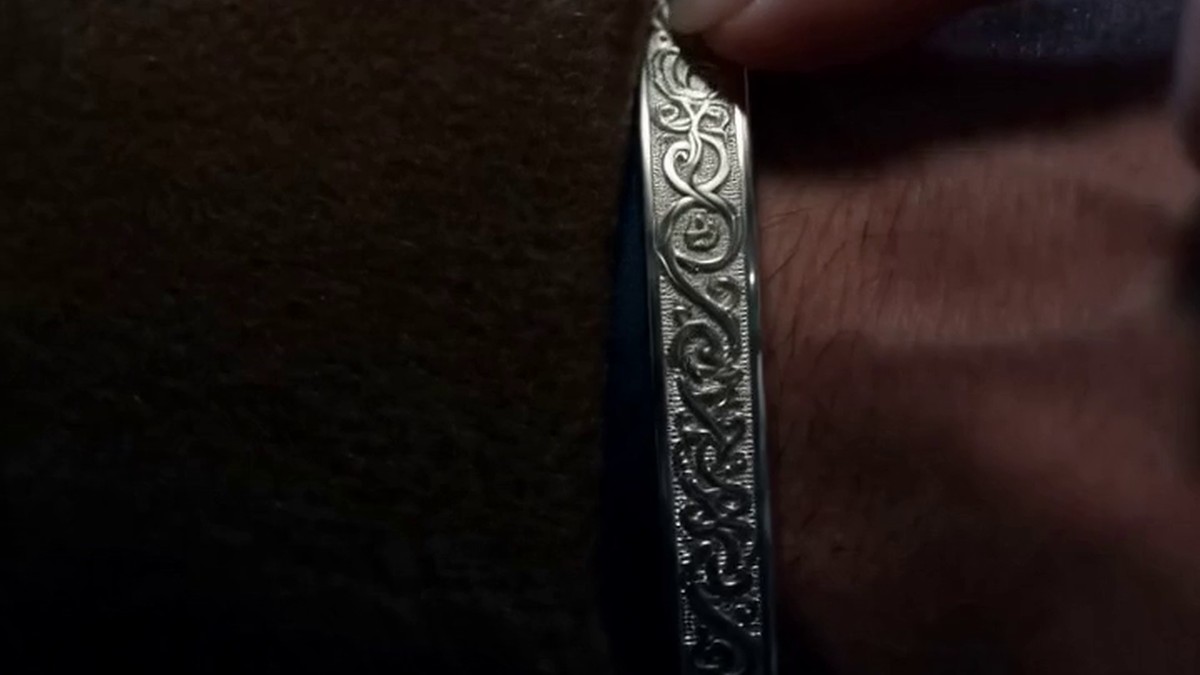
Then her eyes landed on the small silver keepsake bracelet around his wrist — the one he had worn since he was a child, the one his father told him was the only thing that remained of the mother he had never known.
On the inside of the clasp was a tiny embroidered symbol.
The same cradle.
The same lopsided curve of blue thread.
The same imperfection only a single pair of hands could have made twice.
Sophie’s breath stopped in her chest.
“Grant…”
He dragged his eyes from the blanket and fixed them on Maria.
Fear arrived before anything else.
Then anger surged forward to bury it.
“My mother died the night I was born.”
Maria held his gaze without flinching.
Rain pooled in the deep creases around her eyes.
“That’s what your father paid me to tell people.”
The world contracted around the three of them.
The movers went still mid-step.
A woman sheltering beneath the awning slowly lowered her hand from her mouth.
Sophie pulled the blanket against her chest, suddenly unwilling to let it go.
Grant’s face had lost all color.
“My father?”
Maria raised one shaking hand toward him — reaching, but not quite daring to close the distance.
Behind Grant, the rear door of the black car swung open with force.
A polished shoe met the wet pavement.
Harrison Holloway emerged into the rain.
White hair.
A dark tailored overcoat.
The practiced bearing of a man who had spent decades trusting that money could quietly dissolve anything inconvenient.
Until he saw her standing there.
For one unguarded moment, pure panic broke across his face.
Grant turned to look at him, the blue-stitched blanket still in his hands.
Harrison’s eyes moved to the cloth.
Then to the battered suitcase sitting at the curb.
When he spoke, his voice came out hollow.
“Maria…”
Grant’s grip on the blanket tightened.
“You know her?”
Maria stepped forward, reaching toward the son she hadn’t touched since the night she’d brought him into the world.
And Grant stood between them — looking from the rain-soaked woman in the faded dress to the father whose sudden silence had become the loudest answer he’d ever received.
The rain fell harder.
No one moved.
Not the movers with their dolly wheels frozen against the wet concrete. Not the woman under the awning. Not Sophie, who stood clutching the blanket with both arms now, the way you hold something you suddenly understand is irreplaceable.
Harrison Holloway took one step forward.
Just one.
Then he stopped, as if the distance between himself and Maria was not ten feet of rain-slicked sidewalk but something much older, much harder to cross.
“Get back in the car, Grant.” His voice had found its composure again. Just barely. “This isn’t what it looks like.”
Grant didn’t move.
“What does it look like?”
Harrison’s jaw tightened. He cut his gaze to Maria — a look that carried decades of practiced warning inside it. *Don’t.*
Maria had spent thirty-eight years folding that look into the back of a drawer and living around it. She was done folding.
“His name,” she said, “was James before you changed it. James Michael.” She spoke to Grant now, not his father. “You had a birthmark on your left shoulder. A small one. The nurses called it a thumbprint.”
Grant’s hand moved — involuntarily, instinctively — toward his left shoulder.
Sophie made a small, broken sound.
Harrison stepped forward again, faster this time, and his voice dropped into something hard and corporate, a voice built for boardrooms and ultimatums. “Maria, we had an agreement.”
“You had an agreement.” She didn’t raise her voice. She’d long since run out of the energy required for rage. What came out instead was something quieter and more devastating — the flat, clear truth of a woman who had been swallowed alive and learned to breathe underwater. “I had a signature on a page I could barely read because I hadn’t slept in four days. I had a number in a bank account that disappeared within a year. And I had a building that let me stay close to the only place I ever knew him.”
She looked up at the crumbling facade of Apartment 3B.
The chipped window sill on the third floor. The water stain beneath it shaped vaguely like a hand.
“That’s why I never left,” she said. “Even when the rent climbed. Even when the radiator died and the ceiling buckled and my fingers got too stiff to take on the work I used to.” She exhaled slowly. “I stayed because this was the last place in the world where I still felt like his mother.”
Grant’s face had gone somewhere beyond pale.
He was doing the thing people do when the architecture of their entire life is shifting beneath them and they’re still standing inside it — trying to find one wall that hasn’t moved.
He turned to Harrison.
“Tell me she’s wrong.”
Harrison straightened. Looked at his watch — the same reflexive gesture Grant had made not twenty minutes ago, the borrowed habit of a man who had raised himself in his father’s image without knowing it.
“She was very young. She was struggling. She came to me because she had nothing, and I made sure she had something. That was a kindness.”
“That was a purchase,” Maria said.
The word landed like something thrown.
Harrison’s composure cracked along the edge. Just barely. “You signed—”
“I was twenty-two years old,” she said. “I had just given birth alone in a hospital with no family in the waiting room and a man in a suit telling me my child would have everything I couldn’t give him.” Her voice wavered for the first time. She pressed it flat. “And he did. I could see that. I drove past his school once. I wasn’t going to stop. I just wanted to see him walk to the door.”
Grant looked at her. “How old was I?”
“Seven.” A ghost of something crossed her face. “You were chasing a paper boat down the gutter after a storm. You were so focused on it that you walked straight into a signpost.”
His hand went unconsciously to the small scar bisecting his left eyebrow.
Sophie pressed the blanket harder against her chest. Her other hand had found her belly again.
“Grant,” she said. Not asking anything. Just saying his name. Anchoring him.
He looked at her. Then at the blanket. Then at the woman standing in the rain in a waterlogged cardigan that had once been burgundy and was now the color of old brick.
He took a step toward Maria.
Harrison moved to intercept — one hand extended, the practiced gesture of a man who had always been able to redirect. “Grant. There are legal structures in place. There’s a process—”
“Stop.” Grant’s voice came out low. Controlled in the way that means the control is costing something. “Stop talking about process.”
He took another step.
He was close to her now. Close enough to see that her eyes were gray-green — the same gray-green he’d seen every morning in the mirror for forty-one years and quietly assumed he’d inherited from some unnamed, conveniently deceased maternal grandmother his father had described in vague and forgettable terms.
He looked at her hands.
They were still trembling. They’d probably been trembling for years. Decades of needlework will do that eventually, the repetitive motion wearing the fine bones down to something fragile and luminous, the way river water shapes stone.
Those hands had made the blanket his wife was holding.
Those hands had made the symbol on the bracelet he’d worn since childhood — the one his father said was “a keepsake from your mother,” which was technically, in the most hollow sense of the word, true.
He reached up and unclasped the bracelet.
Turned it over.
The tiny embroidered cradle on the inside of the clasp. Blue thread. That lopsided curve that couldn’t have been replicated by machine, or by any hands other than the ones that had made it the first time.
He held it out toward Maria.
She looked at it for a long moment. Her chin moved. She pressed her lips together hard.
Then she took it.
Her fingers closed around it and she held it against her sternum, and for a moment she closed her eyes, and the rain came down on all of them equally — on her faded dress, on Harrison’s tailored overcoat, on Sophie’s cream maternity coat, on the blue blanket, on the sewing machine sealed in plastic at the curb — and none of it stopped.
Harrison Holloway was silent.
It was a specific kind of silence. The silence of a man watching something he’d spent four decades managing come fully and finally unmanageable. He was still standing with his posture correct, his coat unblemished, his expression arranged into something composed — but around the eyes there was the look of a man staring at the edge of a very long drop he had been carefully steering other people toward for years, now discovering it had been curving back toward him the whole time.
“I’ll call Bernard,” he said finally. Bernard was his attorney. Bernard had been solving problems like this for thirty years.
“No,” Grant said.
Simple. Flat. The syllable of a man who has just redrawn his own interior map.
“Grant—”
“I said no.” He turned to face his father fully, and something had changed in the way he held himself. Something had settled, or perhaps the more accurate word was *arrived* — some quality that had been waiting its whole life for the right confrontation to crystallize it. “You bought a woman’s child. You erased her. And then you sent me here today — to evict her — and you sat in that car and watched.”
Harrison opened his mouth.
“Did you know it was her building?” Grant asked. “When the acquisition came across your desk. Did you know?”
A pause that was one breath too long.
“I recognized the address,” Harrison said. Quietly.
The movers had retreated to their truck. The woman under the awning had gone inside. It was just the four of them now, and the rain, and the sewing machine in its plastic shroud, and the suitcase containing everything Maria hadn’t been forced to sell.
Grant turned back to Maria.
“You’re not going anywhere,” he said.
She blinked. “The sale—”
“Is mine to restructure.” He said it without fanfare. Not magnanimously — he wasn’t performing grace, wasn’t positioning himself as a savior. He said it the way you say something that is simply and plainly true. “I’ll have someone call you tomorrow. We’ll find a solution for the building. For the tenants.” He paused. “That’s going to take some time to work out properly. But it’ll get worked out.”
Maria studied his face for a long moment.
That crease between his brows.
It had arrived the same way on her own face when she was young and uncertain, though she hadn’t seen her young face in so long she had nearly forgotten.
“I’m not asking you for anything,” she said carefully. “I want you to know that. I’m not — I’m not here with my hand out. I never wanted money. I never wanted to disrupt your life.”
“I know.”
“I just wanted—” She stopped.
“I know,” he said again. Softer.
Sophie had come to stand beside him. She held the blanket between them like something shared — because it was. She looked at Maria with the particular clarity of a woman who is about to bring a life into the world and has just discovered, in the span of twenty minutes, something essential about the weight of that.
“I’d like to know you,” Sophie said. “If you’d let us.”
Maria looked at her. At the rounded belly beneath the cream coat. At the blanket pressed against it.
“I’ve been waiting thirty-eight years,” Maria said, “to have someone to give that blanket to.”
She looked at Grant one more time — just for a moment — the way you look at something you memorized from a distance for decades and are only now allowed to see up close. Then she looked away, because it was almost too much, and she had never been a woman who allowed herself too much at once.
Behind them, Harrison Holloway walked back to his car.
He didn’t speak again.
He folded himself into the back seat, and the door closed, and the idling engine carried him away from the sidewalk, away from the building, away from the rain and everything it had uncovered.
No Bernard could fix this one.
Some things, once seen, cannot be made invisible again.
—
Maria made coffee in Apartment 3B that afternoon.
The sewing machine was back by the window. The fabric remnants were back in their boxes, and the boxes were back where they belonged, beside the sewing table with its worn groove in the wood where her elbow rested during the long nights.
Sophie sat across from her in the kitchen’s one good chair, the blue blanket folded in her lap.
Grant stood in the doorway, because the apartment was small and he hadn’t yet figured out how to take up space inside it without feeling like he was imposing on something he hadn’t earned.
Maria set three cups on the table.
She noticed him hovering.
“Sit down,” she said. “You’re letting in a draft.”
He sat.
She poured.
Outside, the rain had slowed to something barely there — a suggestion, a murmur, the sound of something easing.
Maria wrapped both hands around her cup.
The trembling was still there. It was always there. But her hands were warm, and the coffee was strong, and on the other side of the table sat the boy she had watched walk into a signpost chasing a paper boat through a puddle thirty-four years ago.
He was watching her the way he probably didn’t know he was watching her — openly, quietly, trying to find the features he recognized.
She let him look.
There was time now.
For the first time in thirty-eight years, she was not counting down to something being taken away.
There was simply time.