He looked all wrong against the wet city sidewalk — a miniature black tuxedo, shoes buffed to a shine, a bowtie knocked sideways, and eyes flooded with tears that swept across every face passing him by.
Cars rushed too close.
People walked on.
Maya was the only one who stopped.
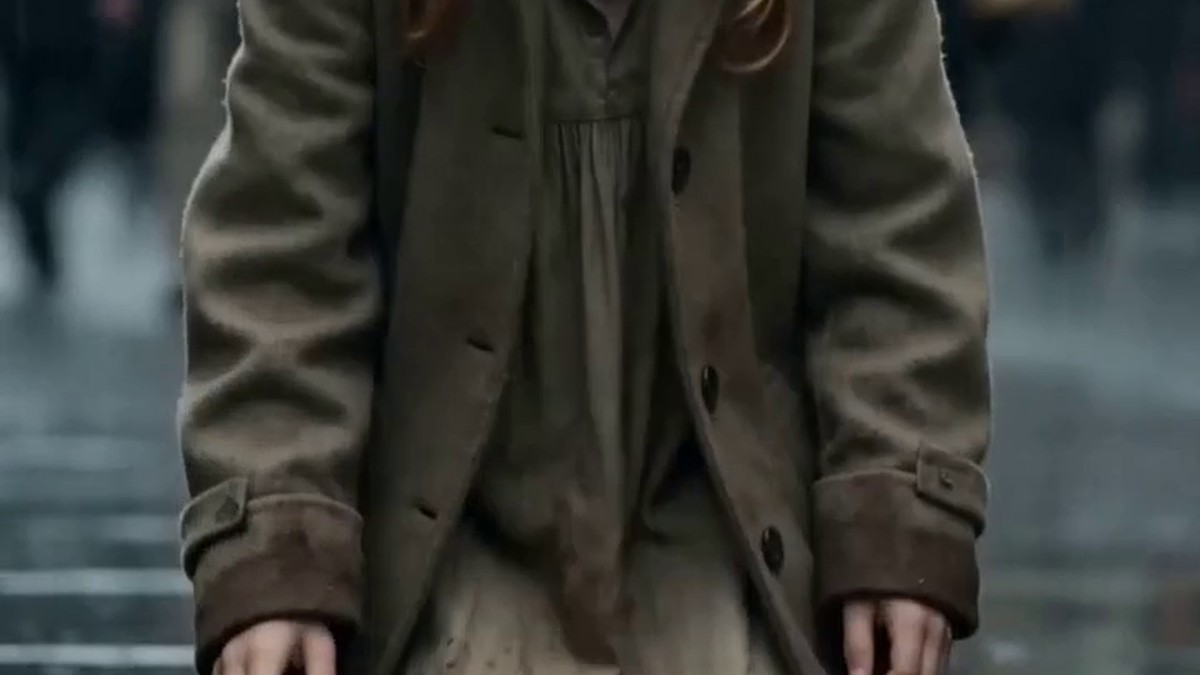
She was twelve, slight inside an oversized coat, mud cracked along her sleeves, two loose braids hanging against her cheeks. In one hand she gripped a bouquet of red roses she’d spent all morning trying to sell.
She lowered herself carefully in front of him.
“Are you lost?”
The little boy hiccupped between sobs.
“Mom…”
Maya glanced at the traffic. Then at his shaking hands.
“It’s okay,” she said softly. “I’ll help you find her.”
He reached for her without a second thought.
Maya wrapped her cold fingers around his warm little ones and moved through the crowd with him, stopping strangers, asking quietly if anyone had seen a woman looking for a child.
The boy cried the entire way.
So Maya gave him one of her roses.
“Hold onto this,” she said, pulling up a smile that cost her something. “It helps when you’re scared.”
He pressed it to his chest with both hands.
Two blocks later, a woman in a cream lace dress came running at them in heels — face wild, expensive handbag swinging at her side like a pendulum.
The boy’s whole face broke open.
“Mommy!”
Maya exhaled with relief.
“I found him near the road,” she said. “He was crying, so I—”
The woman snatched her son and knocked Maya’s hand away.
“Get away from my child!”
The force sent Maya stumbling backward.
Her bouquet dropped into a dirty puddle.
Red roses fanned across the wet pavement. One disappeared under the woman’s heel.
Maya stood completely still.
Those flowers were everything she had.
She’d promised herself she would sell enough to buy soup for her sick grandmother before dark.
The boy started crying again.
“No, Mommy! She helped me!”
His mother pulled him in against her dress, watching Maya the way people watch something they consider a threat — measuring her torn coat, her muddy sleeves, deciding what kind of girl she was.
“You expect me to believe you were helping him?” Her voice had an edge like a blade. “A girl like you sees a well-dressed child alone and figures she can shake down his family.”
Maya’s chin shook.
“I didn’t ask for anything.”
“Then go.”
Maya knelt slowly in the rainwater and began collecting the ruined roses.
One by one.
Petals clung to her dirty palms like something unwilling to let go.
The little boy thrashed in his mother’s hold.
“She gave me her flower! She held my hand!”
Maya picked up the last broken stem and lifted her eyes, tears catching the gray light.
“I brought him back to you,” she said, barely above a whisper. “You’re the one who broke the flowers.”
Something in those words made the woman go quiet.
As Maya reached for a rose near her foot, the collar of her old coat fell open.
A small silver pendant slipped free.
A tiny heart — split clean down the center.
The woman’s eyes locked onto it.
Her grip on her son went loose.
“No,” she breathed.
Maya tucked the pendant back inside her coat quickly.
The woman took one unsteady step toward her.
“Where did you get that necklace?”
Maya pulled back on instinct.
“My mother left it for me. Before she died.”
The color left the woman’s face entirely.
Her fingers moved to her own throat, pressing beneath the lace until she found the matching half-heart resting there.
The little boy looked between them both.
“Mommy?”
The woman’s lips had started trembling.
“What was your mother’s name?”
Maya swallowed hard.
“Anna.”
A sob broke out of the woman before she could stop it.
Because Anna was the younger sister she had been told died twelve years ago — along with the infant daughter no one had ever let her see. She stared at this girl kneeling over crushed roses in a dirty puddle and felt something inside her chest split open.
“Anna’s baby,” she whispered, “was named Maya.”
The girl went still as stone.
The woman sank to her knees in the water beside her, lace dress and all.
And before Maya could pull away, she said it — her voice breaking on every syllable:
“You’re my sister’s little girl.”
The words sat between them like something fragile and explosive at the same time.
Maya didn’t move.
The rain had started again — fine and cold, barely more than mist — and it settled on her braids and her eyelashes and the ruined roses still clutched in her fists. The woman was on her knees in the puddle now, lace dress soaking through, mascara tracking gray lines down her cheeks, and she didn’t seem to notice any of it. She just kept staring at Maya the way you stare at something you’ve dreamed about so many times you’re terrified to blink.
The little boy had gone completely quiet.
Even the traffic seemed to pull back.
“That’s not possible,” Maya said finally. Her voice came out smaller than she wanted it to.
“Your mother.” The woman’s throat worked hard. “Anna Voss. She had a scar on her left hand, here—” she pressed two fingers below her own knuckle— “from a broken jar when she was seven. She used to hum when she was nervous. She couldn’t stand the smell of cigarette smoke. She collected—”
“Postcards,” Maya whispered.
The woman closed her eyes.
“Postcards,” she confirmed. “From places she’d never been.”
Maya’s hand went to her coat pocket on reflex — the worn edge of a postcard lived there, had lived there for three years, a picture of the Amalfi Coast her mother had kept tucked under her pillow. She’d taken it the morning of the funeral because she couldn’t bear to leave it behind.
Her fingers found its familiar corner now and held on.
“She never told me she had a sister,” Maya said. Not accusing. Just the bare fact of it, laid down like a stone.
Something moved across the woman’s face — grief and guilt arriving together the way they always do, inseparable.
“She didn’t know I was looking.” Her voice fractured. “They told me she was gone. They told me the baby didn’t survive. Our aunt — she handled everything after our parents died, and she — she kept us apart because—” She stopped. Pressed her hand flat against her sternum. Started again. “It doesn’t matter why. It was wrong. All of it was wrong, and I have spent twelve years—”
She broke off completely.
The little boy slid out of her hold and stood between them, his rose still pressed to his chest, watching his mother cry with the grave bewilderment of small children who have never seen their parents undone before.
“Mommy’s crying,” he reported, to no one in particular.
Despite everything — despite the cold water soaking through her knees and the crushed roses and the ache lodged somewhere behind her ribs — Maya almost laughed. The sound that came out of her was short and wet and surprised, half grief and half something else entirely.
The woman looked up at her.
And in the looking, something between them shifted.
Maya studied her face the way she’d sometimes studied photographs of her mother — searching the architecture of it, the line of the jaw, the particular way the eyes sat. She found it. Not identical, but rhyming. The same deep-set dark eyes. The same small hollow at the base of the throat.
Her own throat tightened so hard it hurt.
“My grandmother is sick,” Maya said. The words came out sideways from what she meant to say, but she needed solid ground, needed something real and immediate to stand on. “That’s why I was selling the flowers. She needed soup, and I was — I was going to get enough before dark.”
She looked down at the roses.
Wrecked. Every one of them.
“I’m sorry.” The woman’s voice was raw. “For the flowers. For what I said to you. For—” She gestured helplessly at the puddle, at Maya’s coat, at all of it, and what she seemed to mean was: *for all twelve years I didn’t know you were out here.* “I’m so sorry.”
Maya sat with that for a moment.
Her grandmother had told her once that apologies were like rain — they couldn’t undo the drought, but they were still worth something. You still turned your face up to them.
She turned her face up now.
“Okay,” she said.
Not *it’s fine.* Not *don’t worry about it.* Just: okay. A door cracked open rather than flung wide. The only honest thing she had.
The woman nodded, understanding the difference.
She reached out slowly — the way you reach toward something wild, giving it every chance to bolt — and touched the back of Maya’s hand. Just her fingertips. Just barely.
Maya looked down at the contact.
Did not pull away.
The woman exhaled like she’d been holding that breath for twelve years.
“Tell me where your grandmother lives,” she said. “Please. Let me take you both somewhere warm.”
—
The car was too clean.
Maya sat in the back seat with the little boy — his name was Theo, she’d learned, he was four, and he had apparently forgiven his mother entirely and was now deeply preoccupied with whether Maya’s rose was magic — and she kept her hands folded in her lap and watched the city move past the window and tried to locate herself inside what was happening.
The woman’s name was Clara.
Clara Voss-Hartley, and she had a husband and a son and an apartment on the ninth floor and a half-heart pendant she’d worn every day for twelve years because it was the only piece of her sister she had left.
Maya had the other half.
She pressed her palm flat against the pendant through her coat and felt its small shape against her sternum and thought about her mother humming in the kitchen of their two-room apartment, humming while she was scared, humming when the lights were off and Maya was small and the dark felt large. She’d hummed all the time and Maya had never known it meant something other than comfort. That it meant fear finding its way out in the only quiet way it could.
*She didn’t know I was looking.*
Maya stared out the window.
Outside her grandmother’s building, Clara stopped the car and turned around. Her eyes were still swollen. She’d fixed her mascara in the rearview mirror with the focused precision of someone who needed one small thing they could control, and now she looked at Maya with her hands folded over the back of the seat and said:
“I don’t want to overwhelm you. We can go as slowly as you need.”
Maya considered her.
“You knocked me into a puddle,” she said.
Clara winced. “I know.”
“And you called me—”
“I know.” Her voice collapsed on itself. “I was terrified. Theo had been missing for six minutes and I—” She stopped. “There’s no excuse. I saw what I expected to see instead of what was there. I’m ashamed of it.”
Maya thought about the way the woman’s eyes had traveled over her torn coat. The calculation in them. The verdict.
She knew that look. She’d worn it like weather her whole life — the specific weight of being seen as a problem before you’d said a single word.
“People do that a lot,” she said quietly.
“I know they do.” Clara held her gaze. “I won’t. Not again. Not to you.”
The sincerity of it was uncomfortable in the way that only true things can be — too direct, no place to deflect it.
Theo leaned over and patted Maya’s arm. “The rose is definitely magic,” he announced with complete confidence.
Maya looked down at the battered flower he was still holding.
Somehow, through all of it, he’d kept it intact.
She felt something loosen in her chest — some long-held brace, some old girding against the world — and it didn’t disappear but it shifted, just fractionally, the way a door shifts when someone on the other side finally, carefully, begins to push.
—
Her grandmother was asleep in the chair by the window when Maya came in.
She woke at the sound of the door and blinked at her granddaughter, then at the tall woman standing behind her, then at the small boy inspecting the shelf of postcards on the wall with enormous scientific interest.
“Maya,” she said. “You sold them all?”
“No.” Maya set the ruined roses on the table. She sat down on the footstool in front of her grandmother’s chair and took both her old hands in hers. “Babusya. I need to tell you something.”
Her grandmother looked at her face for a long moment. Then she looked at Clara.
Something passed through her eyes — recognition, or its ghost. Her grip on Maya’s hands tightened.
“Anna’s eyes,” she murmured, barely audible. “She has Anna’s eyes.”
Clara’s breath caught.
She stood in the doorway of that small, warm room — with its postcards on the wall and its worn curtains and its smell of old wood and chamomile — and she pressed one hand over her mouth and tried, visibly, not to fall apart.
“I’m Clara,” she managed. “Anna’s sister. I—” Her voice gave out. She tried again. “I didn’t know. I swear I didn’t know they were alive. I’ve been looking — for years, I’ve been trying to find—”
Maya’s grandmother was quiet for a long moment.
Then she said, in her careful accented English: “Sit down, child.”
And Clara, who had an apartment on the ninth floor and an expensive lace dress now soaked through with puddle water, sat down on the worn floor of that small room like she’d been given a gift.
—
They stayed three hours.
Clara sent her husband a single text — *Going to be late, I’ll explain everything* — and then she put her phone in her bag and didn’t look at it again.
Theo fell asleep on the couch with Maya’s grandmother’s old quilt pulled up to his chin.
Maya made tea.
Clara talked about Anna — things she remembered, things she’d held onto: the postcards, the humming, a particular laugh. And Maya’s grandmother talked back, and sometimes Maya talked too, and sometimes they all just sat with it, with the strangeness and the grief and the impossible arithmetic of twelve lost years being slowly, imperfectly counted.
At some point Clara ordered soup from the restaurant on the corner and they ate it together at the small table.
At some point Maya’s grandmother took Clara’s hand and held it for a long time without speaking.
At some point Maya caught herself watching them — her grandmother’s white head bent toward this woman in her ruined dress — and thought: *my mother would have known her.* Would have hummed beside her. Would have sent her postcards from places neither of them had been.
The grief of it was real.
It was also not the only thing in the room.
—
When Clara finally stood to leave, she looked at Maya for a long moment.
“I don’t want to ask too much too fast,” she said. “But I need you to know—” She stopped. Collected herself. “You’re not alone. Whatever you need. Whatever happens next. You’re not alone anymore.”
Maya looked at her.
She thought about the rose she’d given Theo on that cold sidewalk — the one that cost her something, that she’d handed over anyway because he was scared and she knew what scared felt like from the inside.
She thought about her mother humming in the dark.
She reached into her coat and drew out the half-heart pendant, held it flat in her palm.
Clara’s hand went to her own throat. She drew out the matching piece and held it the same way — two halves facing each other across the small space between them.
Maya studied the clean fracture line where they would meet.
“Okay,” she said again. A door. Cracked open.
And this time, she held it there — didn’t let it close.
Clara closed her fingers around her half and exhaled slow and long, and her eyes were full, and she nodded once like a woman receiving a verdict she had not dared hope for.
Theo slept on the couch.
Her grandmother watched them both.
The city pressed on outside the window, indifferent as ever, rushing and cold and full of people who would walk past a crying child in a tuxedo and never stop.
Maya had stopped.
It had cost her a bouquet of roses and a puddle and the world cracking open underneath her feet.
She was still here on the other side of it.
Still standing.
Her mother’s daughter.
Her aunt’s niece.
Her grandmother’s girl.
*Hers.*