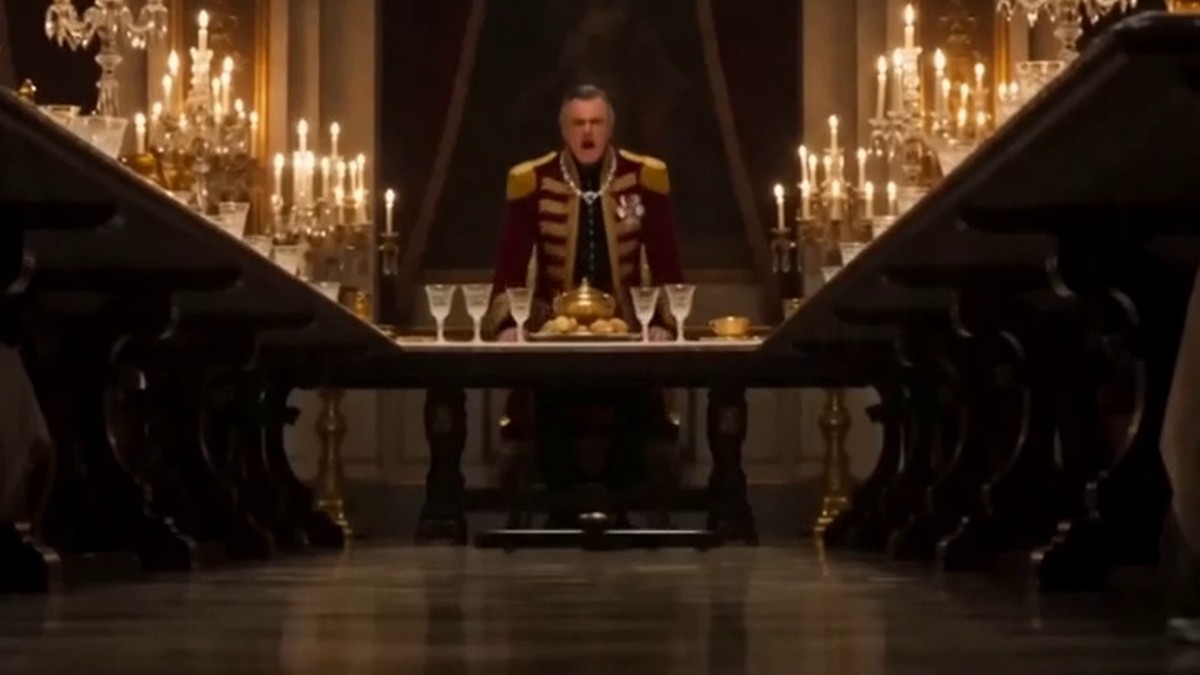
Princess Adrielle occupied the head table like a throne of her own, diamonds catching the candlelight, her arms sheathed in long white silk gloves.
Beside her, a young maidservant poured the wine. Her hands wouldn’t stop shaking.
Then —
a single drop.
It landed on the princess’s sleeve.
Adrielle was on her feet before the girl could blink.
The slap cracked through the room like a gunshot.
Gasps rippled wall to wall. The maid staggered backward, one hand pressed to her burning cheek, while every nobleman at that table suddenly found something fascinating to study on his plate. No one moved. No one spoke.
Princess Adrielle let out a thin, contemptuous laugh.
— Servants would do well to remember what they are.
And then —
a chair screamed across the marble floor.
The king had risen.
His face was stone. His eyes were fire.
Not aimed at the trembling girl.
Aimed at his daughter.
Because there, resting against the maidservant’s collarbone —
was the royal sapphire necklace. The one stolen the night the queen was murdered. Fifteen years gone. Fifteen years missing.
The king crossed the room slowly, each step deliberate, his hands trembling at his sides.
— Where did you get that?
The girl swallowed hard, her voice barely a thread of sound.
— My mother gave it to me. Before she died.
The silence that followed didn’t just fill the room.
It crushed it.
Because the queen’s long-lost daughter —
had just been struck across the face by the princess who stole her crown.
The king stopped three feet from the girl.
His breath came in shallow pulls, like a man surfacing from deep water. His eyes moved from the necklace — that impossible, familiar sapphire catching the candlelight like a trapped star — to her face. Her jaw. The reddening handprint still blooming on her cheek.
His hand rose slowly. Not to touch the necklace.
To touch her face.
— Your eyes, he whispered. — God help me. Your mother’s eyes.
Adrielle’s voice cut between them like a blade.
— Father. She’s a servant girl who stole —
— *Silence.*
The word landed like a hammer. Every violin in the hall went mute. Every nobleman at the table seemed to shrink two inches into his chair.
The king didn’t turn around.
— I said silence, Adrielle. Do not test me. Not tonight. Not with *this.*
—
The maid — whose name was Seren, though no one in this palace had ever thought to ask — stood with her spine pressed against the wall and her heart hammering so loud she was half-convinced the room could hear it.
She had not meant for any of this.
She had carried the necklace for six years, ever since her mother pressed it into her hands on a winter night with blood on her lips and urgency in her ruined voice. *Keep it hidden. Keep it close. One day you’ll know what to do with it.*
She hadn’t known. She’d had no idea. She’d taken the servant position at the palace because she was seventeen and starving, not because she had some grand design.
The necklace had simply been her mother’s last gift.
And now a king was staring at her like she was a ghost he’d spent fifteen years trying to forget.
— Your name, the king said. His voice had dropped to something intimate and devastating.
— Seren, Your Majesty.
— Seren. He repeated it carefully, like a man handling something fragile. — And your mother. What was her name?
Seren felt her throat tighten.
— Mira, sir. She was a healer in the valley of Aldenmere. She never spoke much of her past. Only that she’d served the palace once, a long time ago. Only that she’d left to protect someone.
The king closed his eyes.
When he opened them, they were wet.
— She was protecting you, he said. — She was my queen’s most trusted lady-in-waiting. The night of the murder, she fled with the infant. With *you.* We believed you both dead. We were told — he stopped. Swallowed. His hands had curled into fists at his sides. — We were *told.*
He turned then.
Finally turned.
And looked at Adrielle.
—
Adrielle had not moved from her place at the head table. She stood with her chin elevated and her shoulders back, the picture of composure, her white silk gloves folded together at her waist. Her diamonds caught the candlelight. Her expression betrayed nothing.
That was the most damning thing about her, Seren realized. Not the cruelty. Not the slap. The *nothing*. The practiced, polished nothing on her face when a dead girl walked back into the room.
— You knew, the king said.
Not a question.
Adrielle’s chin lifted a fraction higher.
— I knew *possibilities,* Father. Rumours. Street talk from people with too much imagination and too little sense.
— You knew she was alive.
— I knew nothing of the —
— *Adrielle.*
His voice broke on the second syllable. Broke and hardened into something new, something old and cold and beyond grief.
— The man you paid to give me that report. Fifteen years ago. He confessed on his deathbed two winters past. I have kept the letter. I have kept it and I have asked myself every day since then what I was afraid of. He moved toward her now, slowly, the way he’d crossed the room toward Seren — except this time there was no tenderness in his steps. Only weight. — I told myself it was grief making me paranoid. That you were my daughter. That you wouldn’t.
He stopped in front of her.
— But you would.
The first thing to move in Adrielle’s face was her eyes. Just a flicker — a rapid recalculation, the kind Seren had watched her do a hundred times when a noble lord said something inconvenient, when a budget didn’t balance the way she needed it to, when a servant didn’t perform to expectation.
She was deciding how much to admit. How much to hold.
— I was eight years old, she said finally. Her voice was cool and carefully paced, each word placed like a chess piece. — I was eight, and I was frightened, and someone told me that if the queen had a daughter, I would no longer be the heir. Children hear things. Children misunderstand.
— Children don’t hire men to lie to kings, Seren said.
Every head in the room turned toward her.
She hadn’t planned to speak. The words simply came, quiet and steady, from a place in her chest she hadn’t known was there.
— Children don’t keep lying about it for fifteen years, she continued. — Children grow up.
Adrielle looked at her.
For a long moment, just looked at her. And in the space behind those cool, calculating eyes, something moved. Something old and buried and just barely visible, like a shape seen through ice.
Then it was gone.
— You have no standing here, Adrielle said. — You have no title, no proof beyond a piece of stolen jewellery, no —
— The proof is in the vault, the king said.
Adrielle went still.
— The queen’s personal effects. Her journals. A letter she wrote the night before she died, sealed and held for the daughter she believed was taken from her. He reached into his coat — a gesture so calm it was devastating — and produced a small iron key, worn smooth at the edges. — I have carried this for fifteen years. Waiting to know whether to burn the letter or deliver it. He looked at Seren. — I believe I know the answer now.
—
What followed was not quick, and it was not clean.
There were royal advisors summoned, and council members who arrived in their nightclothes with sleep-creased faces and wild eyes. There were two physicians brought in to take measurements and comparisons — the queen had been meticulous in her personal records, and the resemblance, once examined in proper light, in proper company, became something that even the most sceptical man in the room couldn’t entirely argue away.
There was the letter.
Seren read it alone, in a small antechamber off the main hall, while a guard stood outside the door and the sounds of the palace reorganising itself filtered through the walls. The queen’s handwriting was careful and slanted and increasingly urgent as the pages turned.
*If you are reading this, my darling, then Mira kept her promise and you are alive. If you are alive, then I have failed to be there to see it, and I am sorry. I am so deeply, endlessly sorry. Know that every choice I made, I made to give you a world worth surviving into. Know that your father is a good man who will be blinded by grief for a while, but who will find his way back to himself. Know that you were wanted. Know that you were loved before you were ever born. Know that the sapphire was your grandmother’s, and her mother’s before that, and it belongs to you absolutely, and no one — no one — has the right to take it.*
*Be brave. Be kind. Be everything they tried to stop you from becoming.*
*— Your mother, the queen*
Seren sat with the letter in her hands for a long time.
The candle on the table burned down half an inch.
Then she folded it carefully, tucked it against her chest where the necklace rested, and stood up.
—
Adrielle was arrested before midnight.
Not loudly. Not dramatically. Two members of the king’s personal guard came for her in the east corridor, where she was found standing at a window with a glass of wine in her hand, staring out at the dark gardens below.
She didn’t struggle.
She didn’t plead.
She looked at Seren — who was standing in the corridor, who had asked to be there, who wasn’t sure why except that she felt she needed to be — and for a moment, just one moment, her expression cracked along a hairline fracture, something human leaking through.
— I would have been a good queen, Adrielle said. Quietly. With what sounded, improbably, like genuine belief.
Seren looked at her. At the handprint her own cheek had received. At the composed, diamond-bright creature who had spent fifteen years holding a dead girl’s crown.
— Maybe, Seren said. — But not like this.
The guards moved her along.
The corridor went quiet.
—
The king found Seren on the south balcony an hour before dawn, standing in the cold with her arms wrapped around herself and her eyes on the horizon, where the black was beginning to soften toward grey.
He stood beside her without speaking for a moment. Two strangers sharing the same blood and fifteen missing years, looking at the same lightening sky.
— I don’t know how to do this, Seren said finally. — I don’t know how to be what you need me to be. I’m a healer’s daughter from Aldenmere. I know how to set bones and stretch a coin and survive a cold winter. I don’t know anything about courts.
— Neither did your mother, the king said. — When she first came here. He paused. — She learned. She was terrified, and she learned, and she became the finest person I have ever known.
Seren was quiet.
— I’m not her.
— No. He turned to look at her, and his face was open in a way she suspected it hadn’t been in fifteen years. — You’re you. And you’re here. And that is — he stopped. Steadied himself. — That is more than I dared to hope for, in a very long time.
The sun broke the horizon.
It came in slow and golden and without ceremony, the way mornings do — indifferent to the night they’re ending, indifferent to everything that happened in the dark. It simply arrived.
Seren felt the warmth of it on her face.
On the cheek that still ached, faintly, from a blow dealt by a woman who had spent fifteen years afraid of exactly this: the truth walking through a door in white gloves and a stolen necklace, wearing her mother’s eyes.
She reached up and touched the sapphire at her collarbone.
*You were wanted. You were loved before you were ever born.*
She took a slow breath.
Then she turned away from the horizon and faced the palace — its vaulted ceilings and its marble floors and its entire terrifying, intricate weight — and she walked back inside.