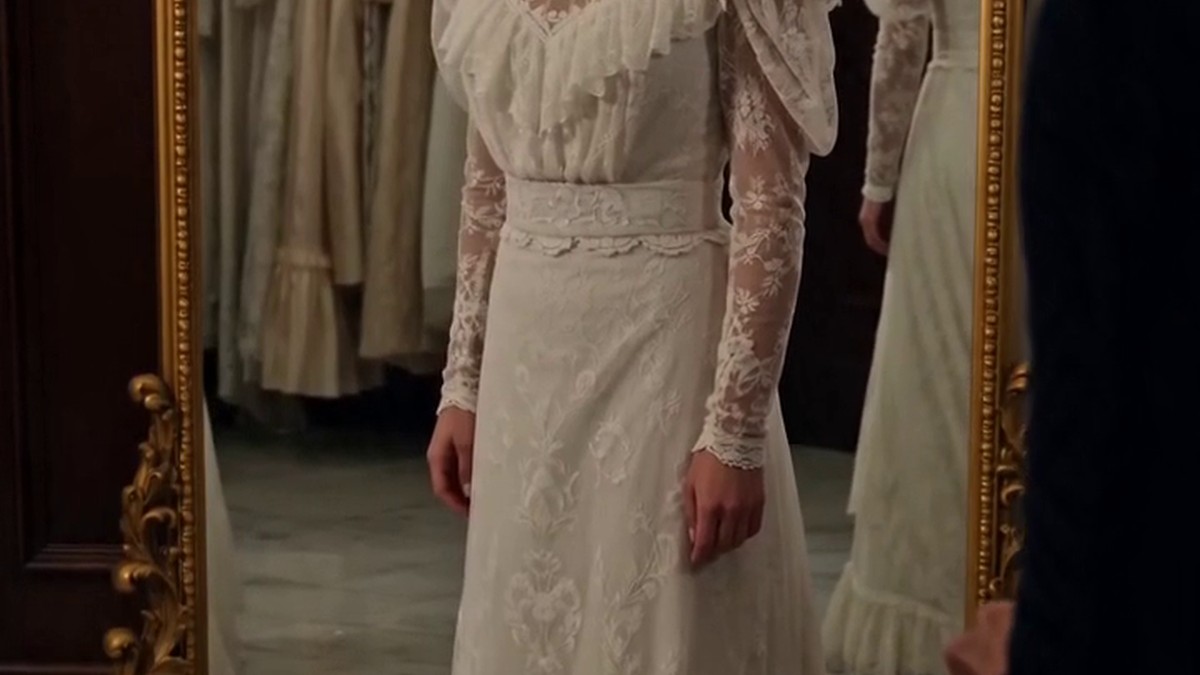
The bridal boutique looked like it had been built from light.
Mirrors stretched floor to ceiling, white curtains fell like liquid silk, and wedding gowns hung in perfect silence — expensive, untouchable, waiting. A marble table held champagne flutes, white blooms, and a leather-bound book where clients signed their fitting appointments as though entering a dream.
For Sofia, though, this place felt nothing like a dream.
It felt like a trap.
She was twenty years old, with chestnut hair falling in loose waves past her shoulders and eyes carrying a shame she’d spent years learning to hide. She stood in front of the mirror wearing a white bridal gown — old, graceful, with lace sleeves and a soft skirt that seemed to have been holding its breath for years, waiting for exactly this moment.
It wasn’t the most modern dress in the shop.
But the second Sofia slipped it on, something strange happened.
It fit her perfectly.
The boutique attendant — a young woman in a sharp black suit — had smiled nervously at first.
“It looks like it was made for you,” she said.
Sofia touched the lace with the tips of her fingers.
For one brief second, she almost smiled back.
Then the door swung open.
An elegant woman walked in as though she owned the place. Mid-forties, blonde hair set flawlessly, black dress, pearl necklace, and a gaze sharp enough to cut glass. Two women trailed behind her, draped in expensive bags and an air of practiced superiority.
The woman stopped cold when she saw Sofia.
The woman’s name was Vivienne Ashford.
Sofia knew that without being told. She’d memorized the face from photographs — old ones, creased at the corners, hidden inside a shoebox under her childhood bed. The woman had been younger in those photos. Softer, maybe. Or maybe Sofia had just been too young to see the edges.
“What are you doing in here?” Vivienne’s voice was low, controlled. The kind of voice that had never once needed to raise itself to be obeyed.
“I have a fitting,” Sofia said.
“In *that* dress?”
The two women behind Vivienne exchanged a glance — small, quick, devastating. The kind of look that said *we expected this* and *how embarrassing* all at once.
The attendant stepped forward. “Mrs. Ashford, your appointment isn’t until—”
“I know when my appointment is.” Vivienne moved through the boutique like water displacing everything in its path. She came to stand three feet from Sofia and studied her the way a jeweler studies something that might be counterfeit.
“Take it off,” she said.
Sofia’s jaw tightened. “Excuse me?”
“That dress isn’t for you. It belongs to a client. Someone who actually *matters* here.” She turned to the attendant with a dismissive wave. “Get it off her and put it back where it belongs.”
The attendant looked stricken, caught between the money and the moment.
Sofia didn’t move.
She should have. She knew she should have. Twenty years of being in rooms where she was the wrong kind of person, the unwanted variable, the inconvenient presence — twenty years had built very specific reflexes. Shrink. Apologize. Disappear.
But something about this dress made her stay.
She pressed her fingertips against the lace at her wrist. And that’s when she felt it.
Not the fabric.
Something *beneath* the fabric.
She turned her arm slowly, tilting it toward the light from the tall windows. There, hidden where the inner lining met the cuff — stitched in thread so fine it was nearly invisible — were letters.
No. Not letters.
A name.
*Mara.*
Sofia stopped breathing.
“Did you hear me?” Vivienne said.
Sofia looked up. “Who made this dress?”
The attendant blinked. “I — it came in as a consignment, years ago. Anonymous surrender — that’s all the record shows. No name, no estate. Whoever brought it in didn’t want to be traced.”
“How long ago?”
“The paperwork just says — twenty years, maybe more. It’s been in storage most of that time. We almost never pulled it out.”
The boutique went very quiet. Outside, a car passed on the street. Inside, one of the champagne flutes caught the light and threw it across the ceiling like a small, cold star.
Vivienne’s expression had changed.
Just slightly. Just enough.
Her mouth stayed composed. Her chin stayed lifted. But something in her eyes — some careful arrangement she’d spent decades building — shifted.
“That’s enough,” she said. “I’m telling you to take the dress off.”
“My mother’s name was Mara,” Sofia said.
The words came out steadier than she felt. Her hands were trembling against the lace, but her voice held.
“I was told she died before I could know her. I was told she left nothing behind. No photographs, no letters, nothing.” She looked down at the cuff, at the tiny stitched name, at the thread so old it had turned from white to the faintest gold. “I was told that by the woman who raised me.”
She looked up.
“My stepmother. The woman my father married after he left my mother. The woman who looked a lot like you.”
The two women behind Vivienne went very still.
Vivienne herself didn’t move for a long moment. Then she set her handbag down on the marble table with a precise, deliberate click — as though setting a clock, as though buying herself exactly three more seconds of control.
“You have no idea what you’re talking about,” she said.
“Vivienne Ashford.” Sofia’s voice didn’t waver. “My father’s second wife. The woman he chose over my mother. You told him she ran off. You told him she wanted nothing to do with the baby. You raised me in her place, and you told me, when I was old enough to ask, that my birth mother was unstable. Troubled. That I was better off not knowing.”
“She *was*—”
“Her name was Mara.” Sofia pulled the cuff gently back, revealing more embroidery. Not just a name. Initials. A date. A small, unsteady cross stitched beside them — the kind a person makes when they’re praying and sewing at the same time. “She made this dress herself, didn’t she? She was a seamstress. That was the part you left out. She was *talented*. And when you forced her out, she had to surrender even this — the last thing she’d made with her own hands.”
One of the women behind Vivienne touched her arm. “Viv—”
“Don’t.” Vivienne shook her off.
For the first time, something cracked open in her voice. Not guilt. Not quite. Something older and harder than guilt — the thing that lives underneath it when guilt has never been allowed to breathe.
“She left,” Vivienne said. “She made her choices. Your father chose me, and she—”
“She didn’t leave.” Sofia had known this the way you know things before you can prove them — in the body, in the place below the chest that goes cold when it hears a lie told too many times. “She was pushed out. Slowly. Systematically. Until she had nothing left to hold onto.” She looked at the dress around her — the soft skirt, the lace that had waited this long to be worn. “But she made this. She made it for someone. She left something behind after all.”
The attendant had backed toward the curtained hallway, her hand pressed over her mouth.
The room held its breath.
Vivienne’s composure didn’t shatter. That wasn’t how women like Vivienne broke — not in pieces, not dramatically. It was more like watching stone develop a fracture. The kind you can’t see until the light hits it exactly right.
“What do you want?” she asked finally.
“I want to know where she is.”
Silence.
“She’s alive,” Sofia said. It wasn’t a question. She’d spent years telling herself it was a question. But standing in this dress, with this name against her skin, she knew. “She’s alive and you know where she is.”
The seconds stretched.
Then one of the women behind Vivienne — the quieter one, dark-haired, who had said nothing the entire time — took a small step forward.
“There’s a town,” she said quietly. “About four hours north. She moved there — I don’t know — fifteen years ago, maybe more. She has a little shop. She does alterations.” A pause. “Custom work.”
Vivienne turned to look at her. The betrayal in that look was almost architectural.
The dark-haired woman met it without flinching. “Enough,” she said softly. “Vivienne. *Enough.*”
—
Sofia drove north that same afternoon.
She still had the dress on when she got behind the wheel of her car — she’d refused to take it off, paid for it herself with the last of the money in her account, and driven out of the city with the white skirt spread across the passenger seat like a passenger of its own.
The town was small. Green in a way cities forget to be. A main street with a hardware store, a bakery, a pharmacy, and at the very end — a narrow shop with a wooden sign that read *Alterations & Custom Work* in hand-painted letters.
The lights were on inside.
Sofia sat in the parked car for a long time.
She thought about everything she’d built her anger around for twenty years — every unanswered question, every night she’d pressed her face into a pillow so no one would hear her cry, every time she’d looked in a mirror and seen a stranger. She thought about the shoebox. The photographs.
Then she got out of the car.
A bell above the door rang when she pushed it open.
The shop smelled like fabric and cedar and something older, something she didn’t have a word for but recognized in the way you recognize a melody you haven’t heard since before you could speak.
A woman came through from the back, wiping her hands on a cloth.
She was in her mid-forties. Dark hair, mostly — with gray threading through it now, silver at the temples. Her eyes were chestnut brown.
The exact same shade as Sofia’s.
She stopped.
She looked at the dress first — really *looked* at it, the way you look at something you made with your own hands a long time ago. Her face did something quiet and enormous.
Then she looked at Sofia’s face.
Her hand came up slowly to cover her mouth.
“I found it,” Sofia said. Her voice broke on the last word, just slightly, the way glass breaks before it falls. “I found the dress.”
The woman — Mara — crossed the shop in three steps.
She didn’t say anything. There weren’t words built for this. There was only her hands cupping Sofia’s face, and Sofia’s hands gripping her wrists, and the two of them standing in a circle of lamp-lit silence while the dress that had waited twenty years finally understood what it had been waiting for.
Outside, the evening came in slow and golden.
Inside, two women held on to each other in a little shop that smelled like cedar and thread — and the distance between them, all twenty years of it, began, slowly, to close.