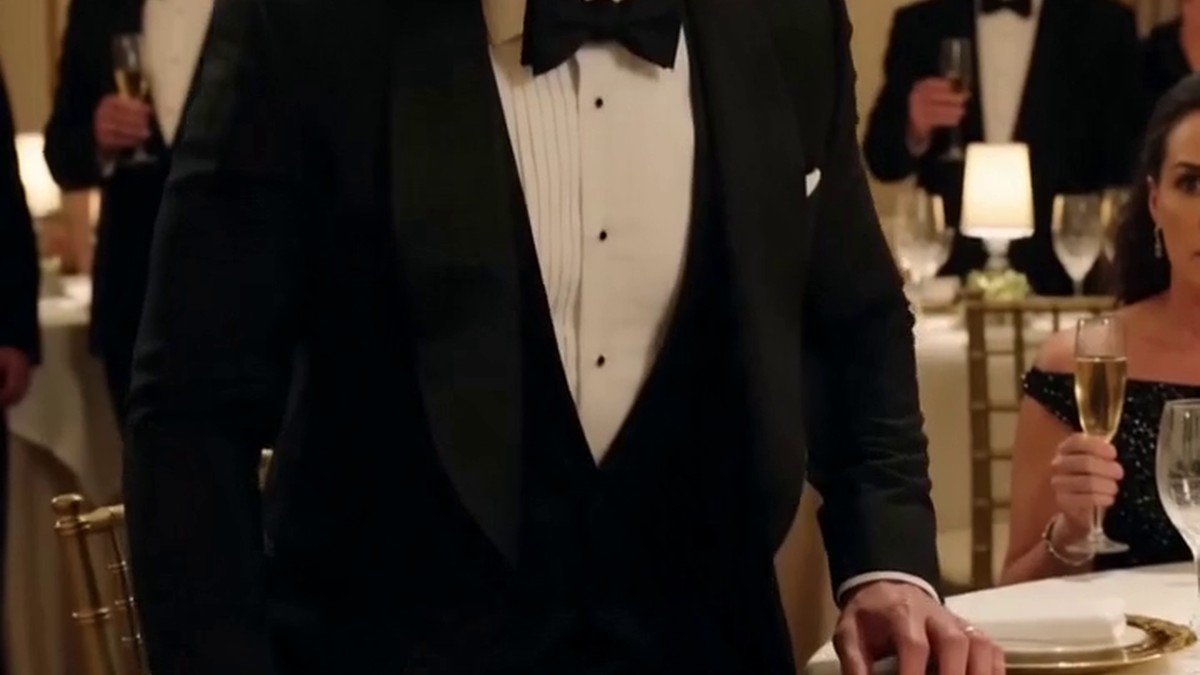
Genevieve Langston’s voice cut through everything.
“How dare you touch my son.”
The young waitress stepped back immediately, her tray still trembling in her hands.
“Ma’am, he nearly fell. I was only trying to catch him—”
The slap landed before she could finish the sentence.
The sound cracked across the marble ballroom like a gunshot. A tray full of champagne flutes hit the floor a half-second later, glass exploding in every direction. Hundreds of guests froze where they stood.
Genevieve leaned in, her voice low and sharp as a blade.
“Don’t you ever put your filthy hands on my child again.”
The waitress pressed her palm to her cheek. She kept her eyes down. Her jaw was tight, fighting something back — pride, tears, rage — maybe all three at once.
“I was trying to protect him,” she said quietly.
At the VIP table, Victor Langston rose from his chair. Slowly. The way a man moves when his legs have forgotten what they’re supposed to do. He wasn’t looking at his wife. He was staring at the waitress — at her face — with an expression that didn’t belong at a gala. It belonged somewhere darker. Somewhere buried.
Then a small voice cut through the silence.
“NO!”
Ethan broke free from his nanny’s grip and ran. He sprinted across the entire length of the ballroom, arms pumping, shoes squeaking against the polished floor — and crashed into the waitress, wrapping both arms around her waist and holding on like she was the only solid thing left in the world.
He was sobbing.
“Mama.”
The room stopped breathing.
Genevieve went white.
Victor didn’t move. Not a single muscle. But something behind his eyes collapsed entirely.
Ethan pressed his face against the waitress and held tighter, his small shoulders shaking.
“Mama… please. Please don’t leave me again.”
He wasn’t confused.
He wasn’t mistaken.
He simply knew something the rest of the room was only now beginning to understand.
The waitress — the woman — didn’t move.
She stood perfectly still with the boy’s arms locked around her waist, one hand hovering just above his back, trembling, as if she didn’t trust herself to touch him. As if touching him would make it real. As if real was something she wasn’t sure she could survive.
Her name was Claire. Claire Duvall. And three years ago, she had been someone else entirely.
—
The silence in the ballroom had gone from shocked to surgical.
No one spoke. No one reached for their glass. Three hundred people in black tie and diamonds stood exactly where they’d been standing, and the only sound in the marble room was a seven-year-old boy crying into the apron of a woman who was supposed to be invisible.
Genevieve Langston found her voice first.
“Ethan.” It came out clipped, controlled — the voice she used in board meetings. “Come here.”
Ethan pressed closer.
“Ethan.” Sharper now.
He shook his head without lifting his face.
Genevieve’s eyes cut to the waitress — to Claire — and what lived in them wasn’t fury anymore. It was fear. The very particular fear of someone watching something crumble that they had spent years building.
“I don’t know what he said,” Genevieve began, pivoting toward the nearest guests with a practiced smile, “children at this age develop such vivid—”
“He said ‘mama.'”
Victor’s voice.
Low. Quiet. The kind of quiet that fills a room more completely than shouting.
He was still standing at the VIP table. Still hadn’t moved. But his eyes had traveled from the boy to the woman, and something in his face had changed — the careful architecture of it, the curated calm — it was just gone. Like a wall that had been holding back water for a very long time.
For three years he had not let himself look. Not at the drawings Ethan brought home from school — faces he didn’t examine too closely. Not at the photographs that surfaced sometimes in old email threads, which he had closed without opening. He had told himself it was stability he was protecting. He understood now that it was only comfort. His own.
“Victor—” Genevieve began.
“I know her face,” he said. He wasn’t speaking to his wife. He was speaking to himself, the way a man speaks when he’s confirming something he already knew and spent years refusing to look at. “I’ve always known her face.”
—
Claire finally moved.
Her hand — the one that had been hovering — came down and rested on Ethan’s back. Between his shoulder blades. She could feel him breathing. Fast, ragged, then slowly starting to even out, like a small machine recalibrating toward something steady.
She had told herself she wouldn’t do this.
She had told herself that seeing him once — just once, from across a room, to know that he was healthy and whole — would be enough. She had taken this job under a different name, worn her hair differently, kept her head down. She had been so careful. Three years of careful.
She looked up.
Victor was walking toward her.
He moved the way he had in the beginning — before the money got serious, before the Beaumont circle closed around him like a fist — with his shoulders forward and his jaw set and his eyes absolutely fixed on where he was going. She had loved that about him once. That certainty.
She hadn’t counted on the certainty being aimed at her.
“Claire.” He stopped five feet away. Close enough that she could see the gray at his temples that hadn’t been there before. “How long have you been in this city?”
“Victor, this is not the time—” Genevieve’s voice had gone somewhere between silk and warning.
“How long?” he asked again. Still looking at Claire.
“Eight months,” Claire said.
His jaw tightened. “Eight months.”
“I wasn’t — I wasn’t trying to make contact. I just needed to see—” Her voice broke on the last word. She pressed her lips together and tried again. “I needed to see that he was okay.”
Ethan made a sound against her waist. Not words. Just sound.
“He’s been asking for you,” Victor said. It came out rough, like it cost him something. “Every night for the first year. Every night.”
The room was still watching. Claire was aware of it — the collective held breath of three hundred strangers, the discreet tilt of champagne flutes forgotten in hands, the phones that were definitely, quietly, recording. None of it mattered. There was only the weight of the boy against her and the look on Victor Langston’s face.
“You told me she was dead.”
It wasn’t a question. He was speaking to Genevieve. He turned, finally, and faced his wife.
Genevieve Langston did not flinch. She was not a woman who flinched. She had weathered worse than this — hostile acquisitions, a public affair that hadn’t been hers, a miscarriage she’d announced as a scheduling conflict. She lifted her chin and met her husband’s eyes.
“I protected this family,” she said evenly.
“You told my son his mother was dead.”
“His *birth* mother abandoned him—”
“She’s standing right here.” His voice cracked on the last word — the first crack she had ever put in it, Claire thought. The first fracture that had made it all the way through. “She’s been in this city for eight months working *catering* to see him from across a room. That is not abandonment.”
“She signed—”
“Tell me what you did.” He took one step closer. “Not what papers she signed. What did you *do*?”
The guests closest to the VIP table took a subtle collective step backward, the instinct of people who recognize a conversation that has stopped performing for them.
Genevieve’s composure held. It held the way ice holds — right up until it doesn’t.
“I had her benefits revoked,” she said finally. “After the agreement. The legal aid, the housing assistance, the job placement. I had it reversed.” A pause. “She had nothing to come back to. I assumed she’d understand the message.”
“That was the architecture,” Claire said quietly. Not to the room. To Victor. “That’s what I couldn’t prove. Every door I tried — legal resources, housing, three different organizations — the funding had been pulled, the offices had relocated, the intake process had changed. I spent a long time telling myself it was coincidence.”
Genevieve turned toward her with something sharper than composure. “You signed a legal agreement of your own free will. Whatever followed was consequence, not cruelty. You had options you chose not to pursue.”
“I was twenty-four,” Claire said. “I had no attorney and no income, and the account I was given was frozen within a month. What options, exactly?”
“Resourceful people find a way.”
“I did find a way.” Claire’s voice was steady. “I’m standing in it.”
The silence that followed had a different quality — not the shocked suspension of the ballroom’s first moments, but something more deliberate. Genevieve seemed to weigh it. Then something in her face closed, like a final ledger being shut.
“Whatever Marcus advises,” she said, to no one in particular — and stopped.
Claire closed her eyes for just a moment.
There it was.
She had known it — had known something like it, some deliberate hand behind the cascade of closed doors and rescinded offers — but hearing it said aloud, in a ballroom, in a diamond necklace, with three hundred witnesses, was a different thing entirely. It had a different weight.
“Mama.” Ethan’s voice again, small and close. He’d tilted his head up. He was looking at her. His eyes were wet and his cheeks were flushed and he was looking at her the way children look at things they’ve dreamed about and are not fully certain are real. “Are you really here?”
“Yeah, baby.” She stopped trying to hold back whatever was in her chest. “I’m really here.”
He hid his face again.
—
The hotel manager had materialized somewhere near the edges of the room — a small, anxious man in a too-tight jacket who was moving his mouth without producing useful sound. A photographer from the society column was having the genuine ethical crisis of their career. The nanny who had brought Ethan to the gala had found a pillar to stand very close to and was studying it intently.
Victor turned back to Claire.
“I’m going to need you to tell me everything,” he said. “All of it. From the beginning.”
“Victor.” Genevieve’s voice carried its final warning note.
He looked at his wife for a long moment. There was no anger in it — which was somehow worse. Anger was navigable. This was something else. This was a man performing a very quiet inventory.
“I’ll need you to call Marcus tonight,” he said. Marcus was their attorney. He said it like a calendar item.
Genevieve went very still.
“Victor—”
“I’m not doing this here.” He looked around the ballroom — at the guests, the cameras, the frozen catering staff, the shattered champagne flutes that no one had cleaned up yet, crystals catching the candlelight like something out of a different event entirely. “We’re not doing any of it here.”
Then he did something no one in the room anticipated.
He crossed the remaining distance to where Claire stood, reached down, and put a hand on his son’s shoulder. Not pulling him away. Just — resting it there. On the boy’s back, beside Claire’s hand.
“It’s okay,” he said quietly, to Ethan. “It’s okay, buddy.”
Ethan didn’t let go of Claire. But some of the rigidity in his small shoulders eased.
—
They left through a side corridor — Victor, Claire, and Ethan, the boy’s hand locked around Claire’s wrist like something he intended to keep. A hotel aide, wordless and professional, materialized to guide them. Genevieve did not follow immediately. She stood for a moment at the edge of the ballroom, very straight, very still, while three hundred people pretended not to be watching her.
Then she followed.
Because she was not, in the end, the kind of woman who stayed behind.
—
The room they were given was a small conference space off the lobby — neutral colors, a long table, a pitcher of water nobody touched. It felt like the anteroom to a verdict, which was, in some sense, what it was.
Ethan had exhausted himself. He sat in a chair next to Claire, her arm around him, his head dropping toward her shoulder with the slow inevitability of a child running out of adrenaline. His eyes kept jerking back open. He was fighting sleep with everything he had, as if letting go now meant risking losing something.
“It’s okay,” Claire told him softly. “I’m not going anywhere.”
She looked at Victor when she said it. A statement to both of them.
Victor sat across the table. Genevieve stood by the door — never quite sitting, never quite leaving. Her composure had returned. It was formidable, that composure. Claire had spent a long time resenting it from a distance and now found she was close enough to see the seams.
“The agreement was presented as standard,” Claire said. “I was twenty-four. I had no attorney. I had no income.” She kept her voice level — not for Genevieve’s benefit, but for Ethan’s. He was nearly asleep. She wanted the last thing he heard before he drifted off to be her voice, steady, not breaking. “They told me it was the best thing for him. That I couldn’t give him what he needed. That I should sign and start fresh and he’d have every advantage.” She paused. “They didn’t tell me ‘starting fresh’ meant starting with nothing.”
“She was compensated,” Genevieve said from the door.
“The account was frozen within a month.” Claire looked at her directly. “I think you know that.”
Genevieve held her gaze. Did not confirm. Did not deny.
“I looked for legal resources,” Claire continued, to Victor. “Three different organizations. All of them — the funding had been pulled, the offices had relocated, the intake process had changed. It took me a long time to understand that it wasn’t coincidence.”
Victor’s hand was flat on the conference table. He was staring at it like it was a document.
“I’m not here to take him,” Claire said, and her voice finally wavered — just once, just at the edges. “I know what his life is. I know what I can’t give him. I came back because I needed to know he was — I needed to see—” She stopped. Started again. “I just needed to see his face.”
The boy in her arms had finally stopped fighting. His breathing had gone soft and even. He was asleep, cheek against her arm, one hand still loosely gripping her sleeve.
Victor looked at his son. Something moved across his face — complicated and private and not for the room.
“I want a full legal review,” he said. “The original agreement, everything after. All of it.” He said this to the table, to the water pitcher, to no one specifically. Then, finally, to Genevieve: “I want to know what I signed.”
Genevieve said nothing.
“And I want Claire to have access.” He looked up. “Whatever that looks like, legally and otherwise. Regular access.”
“Victor—”
“Genevieve.” Just the name. Just her name, the way you say it when you’ve run out of other words to put before it.
She looked at her husband — really looked at him — and for just a moment the composure wasn’t performing. It was just a woman looking at the place where something used to be and realizing she’d been the one to remove it.
She left the room.
Not dramatically. Not slamming the door. She simply turned and walked out, heels deliberate on the floor, and the door swung shut behind her with a soft, final click.
—
The room was quiet after that.
Victor looked at Claire. At his son asleep against her arm. The candle-lit gala was still happening somewhere on the other side of the building — muffled music, the distant constellation of other people’s evenings.
“He’s been drawing pictures of you,” Victor said. “He didn’t know that’s what they were. He’d never say it. But—” He cleared his throat. “I knew. I think I always knew. I just—” He stopped. Looked at the table. “I told myself the drawings were something else. Something a boy makes up.”
Claire pressed her lips together. She didn’t trust what would come out.
“I’m sorry,” Victor said. Not for any one thing. For the whole weight of it — for what had been managed without his knowing, for what had been allowed to slide, for all the moments he hadn’t looked hard enough at the life that had been arranged around him.
It wasn’t absolution. It wasn’t supposed to be.
Claire looked down at Ethan’s sleeping face — the particular softness of it, the way children become entirely themselves when they stop performing wakefulness, the small mouth slightly open, the long lashes against his cheek.
“He’s good,” she said quietly. “He’s really good.”
“Yeah.” Victor’s voice came out rough. “He is.”
Outside, the city moved through its ordinary midnight business, indifferent and ongoing. Inside the small conference room, something that had been broken for three years was not yet fixed — was nowhere near fixed, would take lawyers and time and very hard conversations and probably years beyond that — but it had been found. Pulled up from where it had been buried.
And the boy slept on, one hand still holding on, in the particular trusting way of children who have finally, after a very long time, decided that solid ground is where they are.