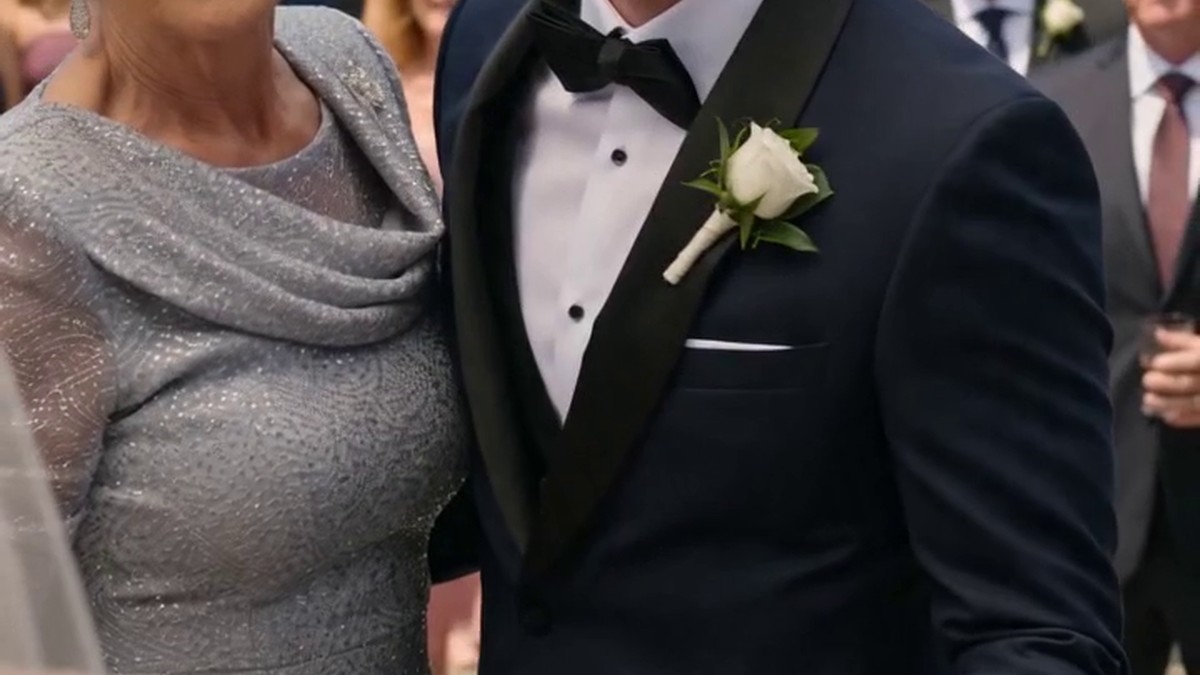
After the wedding ceremony, the groom was supposed to carry his bride in his arms from the church steps down to the car — a symbol of the life they were stepping into together. Everyone knew about it. His relatives had talked about it for months, and I had played that moment in my mind more times than I could count.
For me, it wasn’t just a tradition.
It was a promise.
So when the ceremony ended and we walked out into the light, I stood beside Daniel in my white dress, hands trembling with something that felt like joy. Guests pressed in around us, phones raised, cameras clicking. His mother, Evelyn, had positioned herself near the front row, already dabbing at her eyes.
I smiled at my husband.
I waited for him to turn toward me.
He didn’t.
Instead, Daniel stepped right past me, bent down, and swept his mother into his arms.
For one full second, I couldn’t process what I was seeing.
A nervous laugh rippled through the crowd. Evelyn threw her arms around his neck like a queen accepting her tribute. Daniel beamed with pride while photographers captured the moment that was supposed to be mine.
I stood alone on the church steps.
The bouquet felt like dead weight in my hands.
Then Daniel glanced over at me and shrugged.
“That’s my mother,” he said — loud, clearly, for everyone to hear. “She will always matter more to me than anyone else.”
The entire courtyard went silent.
And in that moment, something inside me broke clean in two.
Not the crack that comes from grief.
The kind that comes from clarity.
—
I didn’t cry.
I think that surprised everyone — maybe even me. I just stood there on those steps with the sun in my eyes and the bouquet hanging at my side, and I looked at my husband of eleven minutes like I was seeing him for the first time.
Which, I realized, I was.
Evelyn was laughing now, still draped across Daniel’s arms, performing delight for the crowd. She caught my eye over his shoulder. Something flickered in her expression — not guilt. Not even satisfaction, exactly. Just awareness. The quiet, practiced awareness of a woman who had just won something she’d been maneuvering toward for years.
She knew exactly what she’d done.
And so had he.
—
The reception was at a vineyard twenty minutes outside the city. Rolling hills, string lights, a hundred and forty people who had watched me stand alone on those steps and were now doing the polite, desperate work of pretending they hadn’t.
I rode in the car with Daniel.
He talked the whole way.
He talked about how the moment had been spontaneous, how his mother had looked so emotional, how it had felt right in the instant — “you understand, don’t you, Sarah? You know how she is about these things.” He talked with his hands, glancing at me at red lights, smiling the careful smile of a man who knows he’s done something wrong but is betting heavily on charm.
I listened.
I said nothing.
And when we pulled into the vineyard and he reached over to squeeze my hand, I let him — because I was still deciding. Still holding the thing that had broken inside me like something fragile you don’t yet know whether to mend or discard.
—
The first hour was performances.
Toasts and laughter and the slow ceremonial business of a wedding reception. I danced with my father, who held me close and whispered *you okay, sweetheart?* into my hair. I said yes. I wasn’t, but the yes was easier than opening that door in public, where everything would spill out onto the floor and ruin the string lights.
Evelyn held court at the family table. She was radiant, I’ll give her that. Dressed in a pale champagne that could, in certain lighting, be mistaken for ivory. She had done that on purpose too — I understood that now, looking back through a lens that had suddenly, permanently sharpened.
She summoned me somewhere around the second course.
Not asked. Summoned. A small gesture, fingers curling inward, the way you call a dog.
I crossed the room and sat down across from her.
“You’re not eating,” she said.
“I’m fine.”
“You seem upset.” Her voice was warm with false concern, textured like velvet over something harder. “I hope you’re not still thinking about the steps. It was just a little fun.”
“It was a tradition,” I said. “That was supposed to be for me and Daniel.”
She smiled. The kind of smile that doesn’t move the eyes.
“Sarah.” She set down her fork. “You’re going to be in this family for a long time. And there are some things you’ll need to understand about how we work.” A pause, perfectly timed. “Daniel and I are very close. We’ve always been close. The women who do best in this family are the ones who accept that early.”
The women who do best.
I turned that sentence over in my mind like a stone, looking at what lived underneath it.
“What happened to the ones who didn’t accept it early?” I asked.
Something crossed her face. Just for a second. Then the smile came back, wider.
“They were very unhappy,” she said pleasantly.
—
I found Daniel at the bar.
He was laughing with his cousins, jacket off, tie loosened, fully settled into the version of himself that belonged to his family — easy, magnetic, at home in a way I had always found charming. Until today. Until I understood that this version of him left no room for anyone else.
“I need five minutes,” I said.
He read something in my face and peeled away from the group.
We found a narrow corridor behind the catering kitchen, the kind of functional space that exists at every wedding and no one ever photographs — bare walls, a stack of folding chairs, a fire exit with a green glow. The music thumped faintly through the wall.
I looked at my husband.
“Tell me it meant nothing,” I said. “Tell me it was a mistake and you didn’t think and you’re sorry. Give me something real, Daniel, because right now I am standing in my wedding dress in a hallway trying to decide what the rest of my life looks like.”
He opened his mouth.
Closed it.
Opened it again.
“It wasn’t — I mean, I didn’t mean for it to be —” He stopped. Ran a hand through his hair. And then, because he was fundamentally an honest man who had simply never examined himself, he said: “She looked like she needed it.”
“And I didn’t?”
Silence.
“I’m your wife,” I said. “I have been standing next to you all day waiting to feel like your wife. And what you did on those steps — in front of everyone, with the cameras — and what you *said*—”
“I got carried away—”
“You said she would always matter more than anyone else.” My voice didn’t shake. I was surprised by that. “That’s not getting carried away, Daniel. That’s a policy statement.”
He flinched.
Good.
“Is it true?” I asked.
The green light of the fire exit hummed between us. Somewhere beyond the wall, someone clinked a glass and the crowd cheered.
“She’s my mother,” he said finally. Like that was an answer.
“And I’m your wife.” I let the words sit there. “Those aren’t supposed to be competing categories.”
—
I don’t know what I expected.
Some part of me had been hoping — foolishly, desperately — for the scene where the hero understands. Where the light breaks through and he sees it, really sees it, and says the thing that starts to repair what broke. I had seen enough movies to know what that moment looked like.
But Daniel just looked tired and cornered, and he said: “Can we please talk about this tomorrow? It’s our wedding day.”
And something in me went very, very quiet.
—
I walked back into the reception alone.
I picked up a glass of champagne from a passing tray. I stood at the edge of the dance floor and I watched Evelyn hold court — watched the way the family orbited her, watched the way Daniel drifted back to her side within minutes, watched the way she placed a proprietary hand on his arm and he leaned into it without thinking, the way you lean into something so familiar it has become structural.
I watched all of it with the clarity of a woman who has just been handed, free of charge, the complete truth of her situation.
My maid of honor, Priya, appeared at my elbow. She had been watching me watch the room.
“Say the word,” she said quietly.
“Not yet.”
“Sarah—”
“I said not yet.” I took a sip of the champagne. It was very good champagne. The kind you pick out with hope. “I need to think.”
What I was thinking was this: I had a choice. And unlike the choices I’d been making for the past two years — always softening, always accommodating, always telling myself that his relationship with his mother was something I could learn to navigate — this one was simple.
I could stay. I could become one of the women who do best. I could fold myself into the shape this family required and call it compromise.
Or I could understand that what I’d seen today was not a mistake.
It was a preview.
—
At nine-fifteen, I walked across the room to where Evelyn sat.
She looked up with that smile already in place, ready, like she’d been expecting me.
“I want you to know,” I said, keeping my voice even and low, “that I saw exactly what you did today. And I want you to know that I understand it.”
Her smile didn’t waver.
“I also want you to know,” I said, “that you may have won today. But I am not one of the women who does best by accepting. I am the other kind.”
Something finally moved in those careful eyes.
“And before you say anything,” I continued, “I’m not doing this for your benefit. I’m doing it because you deserve to know exactly where we stand.”
I turned and walked away without waiting for her response.
—
Daniel found me on the terrace at ten o’clock.
The valley below was dark, the vineyards just shapes against the hillside, and the air had gone cool in that specific way that California evenings do — like the world exhaling.
He stood beside me.
For a long time neither of us spoke.
“I love you,” he said at last.
“I know.” And I did. That was the terrible part. “But I don’t think love is the problem.”
“Then what is?”
I thought about how to say it. About all the gentle, careful ways I could package what I had spent the last six hours arriving at. And then I thought about the church steps, and the shrug, and *she will always matter more than anyone else*, spoken clearly and proudly into a crowd of people who would remember it.
“The problem,” I said, “is that you have never once, in the two years I’ve known you, chosen me.”
He didn’t answer. But he didn’t argue either, and that was the most honest thing he’d said all day.
“I’m not leaving tonight,” I said. “This is still our wedding. I’m not going to burn it down. But I need you to understand something.” I turned to look at him — really look at him, in the dark, without the dress and the cameras and the family watching. Just two people at the edge of something. “What happens next is a choice you’re going to have to make. Not for me. For yourself. Because I already know what I need. I’ve known it since the church steps.”
“And what’s that?”
“A husband,” I said. “Just a husband. Not a man with a throne room he shares with someone else.”
The music inside shifted to something slower.
Daniel looked at me for a long time. I could see him wrestling with it — the version of himself that was my husband and the version that was Evelyn’s son, and the long, difficult work of figuring out whether those two things could exist in the same life.
Then he turned toward the terrace doors.
Through the glass, Evelyn was still at the family table — champagne raised, laughing, the whole room tilted in her direction the way it always had been and, I understood now, always would be. His entire history was in there. Everything familiar and load-bearing and known.
He stood with his back to me and looked at it.
Ten seconds. Maybe fifteen.
Then he turned around.
He reached out and took my hand — not the smooth, reflexive grip from the car ride over, not the practiced gesture of a man managing damage. This was slower. Uncertain. The way you reach for something when you’re not yet sure you’ve earned it, but you’re reaching anyway.
I looked down at his hand holding mine. I didn’t close my fingers around his. Not yet. But I didn’t pull away either.
“Okay,” he said quietly. Just that one word, aimed at the dark valley below us like a thing he was trying out for the first time.
It wasn’t enough. We both knew it wasn’t enough. But it was, for the first time all day, a gesture that faced the right direction.
I didn’t know what the days ahead would require of him. Whether he had it in him to do what choosing me would actually cost.
But I felt the ground solid beneath my feet.
Because whatever he decided, I already knew what I would do.
I would not fold.
I would not become the other women.
And I would not spend my life standing alone on church steps, holding dead-weight flowers, waiting for a man to turn toward me.
I had stood there once.
That was enough.