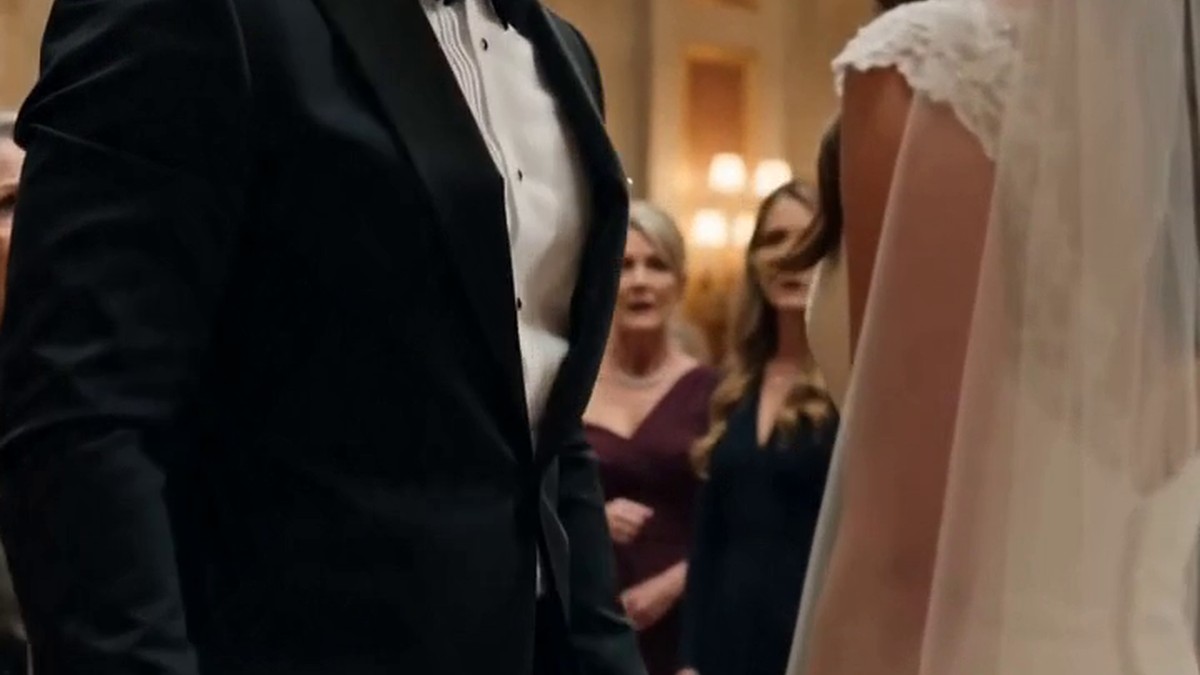
The bride’s open hand connected with the old woman’s cheek so hard that the bucket of white roses flew from her grasp. Petals scattered across the ballroom floor like broken confetti as the guests stood frozen, not a single voice rising above the silence.
The woman was dressed in a faded gray uniform and a worn cap. To the bride, she was nobody — a careless worker who had wandered too close to an expensive lace gown.
“Get her out of here!” the bride snapped.
Security hadn’t taken a single step when the grand doors burst open.
The groom sprinted across the ballroom, dropped to his knees, and pulled the trembling woman into his arms.
“Mom… are you hurt?”
The color drained from the bride’s face.
The woman she had just struck was not a hired cleaning lady. She was the groom’s mother — the woman who had worked quietly for years, in the shadows, to put her son through school. She had come in through the service entrance because the bride’s family had refused to put her name on the guest list.
The groom rose slowly. He turned to face his fiancée, and his eyes were stone.
“That is my mother,” he said, his voice flat and final. “The wedding is over.”
The bride collapsed into tears.
But then the old woman reached down, lifted one of the fallen roses from the floor, and from between its petals revealed a hidden ring…
—
*Facebook won’t let us share the rest here, but you can find it in the comments below. If you don’t see the link, switch from “Most Relevant Comments” to “All Comments.” 👇👇👇*
The old woman’s fingers — rough, chapped at the knuckles, the fingers of someone who had never stopped working — closed gently around the stem.
She turned the rose over.
A ring slipped free from between the petals and landed in her palm. Gold. Simple. A woman’s band, worn thin on one side from decades of use.
Her own ring.
The room held its breath.
“Viktor.” Her voice was barely above a whisper. “Where did you find this?”
The groom didn’t answer right away. He was still watching his fiancée — watching Natasha with those flat, cold eyes that none of the guests had ever seen on him before. Then he looked at his mother’s open hand, and something shifted in his face. Something old and private and deeply his.
“I’ve had it for three years,” he said quietly. “You sold it when I was finishing my last year at university. You thought I didn’t know.”
She closed her fist around it.
“The tuition—”
“I know what it was for.” He stepped toward her and wrapped both hands around hers. “I had it bought back. I was going to give it to you today. Here. In front of everyone.” He paused. “That was the plan.”
The word *was* landed like a stone in still water.
Every person in that ballroom felt the ripple.
—
Natasha’s mother materialised from the crowd first — a woman built like a courthouse, draped in ivory silk, her composure surgical.
“Viktor.” Her voice was low and practised and very, very steady. “This has clearly been an emotional morning. Let’s not make any permanent decisions based on—”
“Mrs. Sorokina.” Viktor didn’t raise his voice. He didn’t have to. “Your daughter’s name is on the invitations. My mother’s was not. You told me the list was full.”
A beat.
“The venue had a capacity—”
“The venue seats three hundred and forty people.” He looked around the room slowly, deliberately. “I counted two hundred and twelve chairs.”
Natasha’s mother stopped speaking.
Natasha herself had gone very still near the altar. The tears were real — Viktor knew they were real, he’d seen her cry before, he knew the difference — but they were also doing what tears often do when everything is falling apart around a person who has never once expected to be held accountable. They were buying time.
“Viktor.” Natasha’s voice came out soft and broken and carefully aimed. “I didn’t know she was your mother. I swear to you, I didn’t—”
“You told me she couldn’t come,” he said. “You said she would be uncomfortable. That the setting wasn’t right for her.” He looked at his mother’s uniform, her worn cap, the bucket of roses she’d been hired to carry because it was the only way she could get through the door. “You arranged that. Didn’t you.”
It wasn’t a question.
Natasha’s jaw tightened almost imperceptibly. If you weren’t watching for it, you’d miss it. Viktor had spent two years watching her face.
He didn’t miss it.
“She could have dressed differently,” Natasha said, and the softness in her voice cracked just slightly at the edge. “I just thought — for the photos, for the guests — I didn’t want her to feel out of place—”
“She felt out of place because you put her to work.”
The room went so quiet that someone near the back could be heard setting down a champagne glass.
—
Viktor’s best man — a broad, quiet man named Dima who had known Viktor since they were seven years old and had never once inserted himself into anything that wasn’t his business — walked across the ballroom floor, picked up the overturned bucket, and set it upright near the wall.
He didn’t say a word.
He just did it. And somehow that small, wordless act was the most damning thing that happened in that room.
Natasha looked at Dima. Then at the guests. Then at her mother, who had finally gone still.
Something moved behind her eyes — not guilt, exactly. More like the moment a person realises the math no longer works in their favour.
“Viktor.” Her voice changed registers entirely. Softer now, but with a wire running through it. “Everything I did — the planning, the list, all of it — I did it for *us*. For the life we were building. You know who you’re supposed to be. You know what people expect. I was protecting that.”
“Protecting it from what?”
“From—” She stopped. Restarted. “People judge. I know you hate that. But they do. And I was just trying to—”
“From her.” He said it gently, which was worse than if he’d shouted it. “You were protecting our life from my mother.”
Natasha didn’t answer.
Which was, itself, an answer.
—
Viktor’s mother had been standing quietly through all of it, the ring still pressed inside her fist. She was a small woman. She had always been a small woman in rooms built for other people, and she had learned long ago how to be still inside that smallness without disappearing entirely.
Now she looked at her son.
“Viktor,” she said. “You don’t have to—”
“Mom.” He turned and looked at her with an expression so unguarded that several of the guests looked away. “Stop. You don’t have to do that either.”
She pressed her lips together.
He crossed to her and took her hand and opened her fingers and looked at the ring resting in her palm.
“Will you put it on?” he asked. “I want to see it where it belongs.”
Her eyes went bright and wet. She slid the ring onto her finger — the thin side, the worn side, the side that showed where it had lived for thirty years — and held her hand against her chest.
Then Viktor straightened, looked once more at Natasha, and said very simply: “I’m sorry. Not for this. For not seeing it sooner.”
He offered his arm to his mother.
She took it.
And together they walked out of the ballroom, through the grand doors that had burst open not twenty minutes ago, back into the ordinary world — the one she had always lived in, the one he was finally, fully, choosing.
—
The guests filed out in ones and twos, quietly, the way people leave a church after a funeral when they didn’t know the deceased well but understood they had witnessed something true.
The catering staff ate the food. Dima made sure of it — he found the head chef and told him nothing should go to waste, and the staff ate at the long tables in their uniforms, and someone put music on low, and it was almost, in its way, a celebration.
Natasha and her mother left through a side door. Nobody stopped them. Nobody needed to.
—
Three weeks later, Viktor brought his mother to a small restaurant near the apartment where he’d grown up. Nothing fancy. White paper on the tables, bread in a basket, a window that looked out onto the street.
They sat across from each other and ordered the same thing they always ordered, and for a while they just ate.
“The ring fits the same,” she said at some point, looking at her hand.
“I know,” he said.
“You always notice everything.” She shook her head slowly, the way mothers do when they are proud of something and don’t quite know how to hold it. “Even when you were small. You always noticed.”
Viktor looked at her across the white paper tablecloth — at her face, which was lined now in ways it hadn’t been when he was a boy, at her hands, which had never once stopped moving on his behalf — and he thought about all the mornings she had left before he woke up, all the years she had carried things without naming them, all the rooms she had stood in quietly, holding the weight of someone else’s occasion.
“Thank you,” he said. “For coming today. I know it wasn’t—”
“I came because you asked me.”
“I know.”
“That’s enough,” she said simply. “That’s always been enough.”
Outside, the city moved through its ordinary afternoon — cars and pigeons and someone selling flowers on the corner — and inside, a woman wore her ring again, and her son watched her face in the window light, and nothing needed to be said about any of it.
Some things are repaired quietly.
Some debts are paid not in grand gestures but in presence — in showing up, in choosing, in refusing to walk through the wrong door.
He had walked through the right one.
That was the whole story. That was all of it.