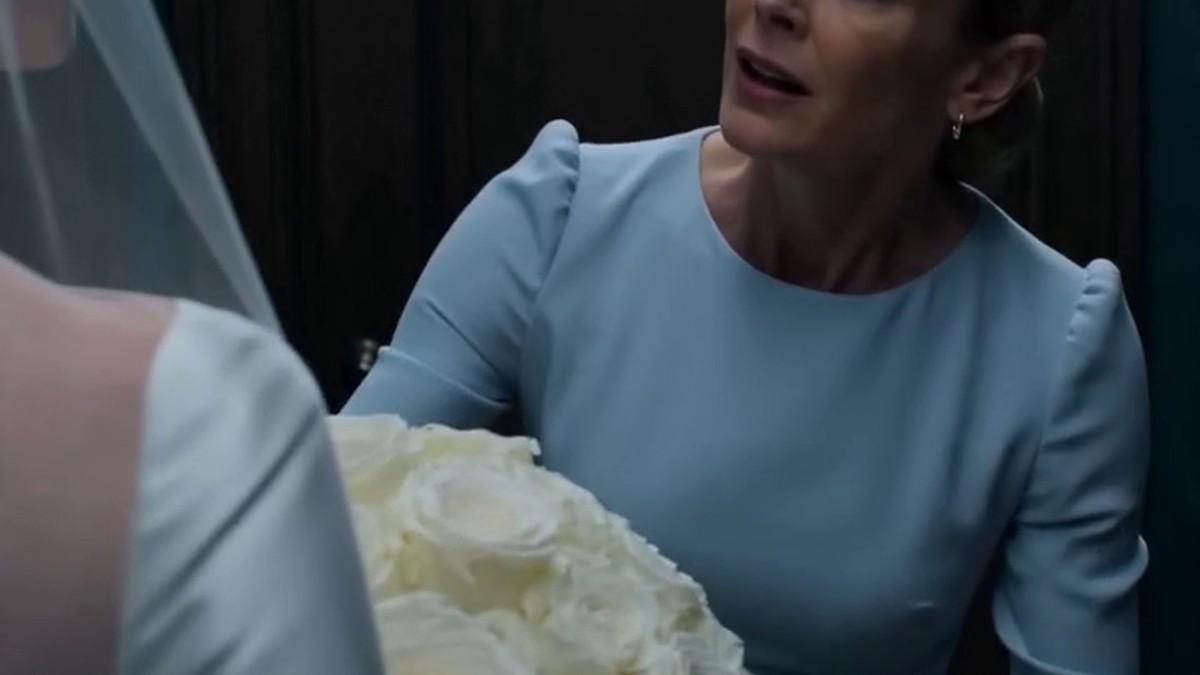
Four months along. One hand resting over the soft swell beneath my wedding gown, the other strangling a bouquet of white roses until the petals began to give. Hidden inside that bouquet was a small blue teddy bear. Nobody knew it was there — not the two hundred guests sitting in the pews, not my mother, not Grant, who was currently standing on the other side of that door with Natalie.
The bear was supposed to be the moment.
After the first dance, after the champagne went around and the toasts got teary, I was going to press a little button sewn into its side and let the whole room hear my baby’s heartbeat for the very first time. I could already picture it — women pressing napkins to their faces, Grant’s mother covering her mouth with both hands, Grant himself looking at me the way you look at something you cannot believe you get to keep.
Then I heard him say, “The baby only matters until she signs.”
The sitting room door hadn’t caught all the way. A sliver of light lay across the marble like a blade. Inside, my sister Natalie laughed — low and satisfied, a sound with no business being anywhere near a wedding.
“Keep your voice down,” Grant said.
“Relax.” Natalie’s voice was smooth, unbothered. “In ten minutes she’ll be walking toward you like you hung the moon.”
I didn’t throw open the door. I didn’t make a sound. I didn’t let go of the bouquet.
My fingers found the seam of the blue bear and pressed the record button. The click barely existed. Outside the chapel, the string quartet played something meant to make people feel safe.
To me, it sounded like the first word of a verdict.
Grant’s voice sharpened. “Once the ceremony’s done, everything falls into place. Claire will sign over management power when we get back from the honeymoon. She’s pregnant, she’s soft right now — talk about the baby’s future and she’ll go wherever I steer her.”
Claire.
My own name sounded like a tool in his mouth.
I pressed my shoulder against the cold wall. The antique mirror across from me showed the bride everyone was waiting on. Smooth veil. Pearl earrings. Lipstick the color of cream. A silk dress engineered to conceal shaking knees and soften the small curve of a stomach the world wasn’t supposed to notice yet.
But my eyes.
My eyes looked nothing like a bride’s.
Natalie sighed. “And if she starts pushing back?”
“She won’t,” Grant said. “She’s in love with me. That’s more reliable than keeping her ignorant.”
My baby moved right then. The faintest flutter beneath my palm — barely a whisper, barely a knock, but it was there, from the inside, unmistakable. I don’t know whether babies sense what their mothers are feeling. But standing in that hallway, I made a decision: my son was not going to be born inside a deception someone else had dressed up with white flowers and string music.
Natalie dropped her voice. “Your mother’s ready?”
“Diane knows her role,” Grant said. “She’ll tell Claire that signing is a show of trust. Family solidarity. She has a gift for dressing guilt up as love — and your mother is very good at making Claire swallow things.”
That landed harder than anything else.
They had mapped out my company. My inheritance. My shares. My father’s trusts. My unborn child. But they had also studied my mother — her particular way of asking me to absorb pain so no one around her had to feel it, her lifelong talent for making other people’s shame into my burden to carry.
Grant kept going. “First the general power of attorney. Then the voting rights package. Then I leverage the Lakeview property as collateral on the expansion. Once she’s attached to that debt, walking away becomes impossible.”
The hallway smelled like candle wax and lilies and money. It felt less like the entrance to a wedding and more like a room where someone had draped a clean white sheet over something that wasn’t breathing anymore.
“What about the baby?” Natalie asked.
Grant let the silence sit just long enough for my heart to understand what was coming.
“The baby is useful leverage for now,” he said. “After she delivers, if she gets difficult, the right attorney can do quite a lot with an emotionally unstable new mother.”
My hand pressed flat against my stomach.
Not out of fear.
Out of something colder than that.
I thought it through fast and clearly: if I walked in right now, there was no winning. Grant would lower his voice and look wounded. Natalie would cry. My mother would ask me to breathe. Somebody would mention pregnancy hormones. Somebody else would call it a misunderstanding. There would be no line I could draw that they couldn’t blur, no proof I could hold up that couldn’t be reframed, no ending that didn’t somehow become my fault for starting a scene.
So I kept recording.
“Three years, Grant.” Natalie’s voice had an edge to it now. “Three years while she walked around thinking I had her back. I’m done waiting.”
Three years.
Three years of Christmas dinners. Birthday candles. Hospital chairs after our father died. Natalie sitting across from me while I admitted Grant felt unreachable, her hand reaching for mine, her voice saying, *Good men get tired sometimes, Claire. Give him space.*
Three years meant my sister hadn’t stumbled into this.
She had planned it.
Grant sounded clipped. “The ceremony is the door, not the destination.”
“The destination is control,” Natalie said. “Whitmore Foods is the showcase. But the real value is in her signatures. Her voting rights. The trusts Daddy locked up before he died.”
My father had been dead eighteen months.
They were still picking his pockets.
And that was the thing that organized everything. Not rage. Not tears. Something cleaner. Geometry.
Evidence first. Exposure second. Then whatever came after that.
Inside the chapel, the wedding coordinator announced the bride would enter shortly. Applause. The clink of glassware somewhere near the back. The quartet eased into something softer, the particular kind of music that tells people they are safe to feel things.
Natalie laughed one last time, almost admiring the whole construction. “Pregnant bride, polished groom, a family that would rather choke than survive a scandal. It’s almost too clean.”
“Go fix your face,” Grant said. “We can’t have anything go sideways before she puts pen to paper.”
I saved the file before the door swung open.
Then I did something the version of me from three hours ago would have said was impossible.
I opened my phone and sent three texts.
To Paul Wexler, the attorney who had served my father for twenty years: *Front pew, left side. Bring the gray folder. No questions.*
To Jenna Hayes, my best friend and the one person I trusted anywhere near the sound system: *Stay at the audio table. No one touches my phone but you.*
To Robert Whitmore, my uncle and the interim chairman of Whitmore Foods: *If Grant approaches the microphone, you stop him.*
I slid the phone back into the bouquet, straightened my veil, and smoothed away a tear that had never actually fallen.
The door opened.
Natalie stepped out first. That pale blue bridesmaid dress looked guileless in the hallway. Her face had rearranged itself into something resembling worry.
“There you are,” she said, tilting her head. “Everyone’s been looking everywhere for you. Have you been crying?”
“Allergies,” I said.
Natalie blinked. The word didn’t fit anywhere in the script she was running, and for half a second her face showed it — a small, bright crack in the performance.
Then she recovered. She always recovered.
“Oh, sweetheart.” She stepped forward with her arms open and I let her hold me, felt her hands smooth down my veil, felt the warm pressure of her cheek against mine. She smelled like the perfume I’d given her for Christmas. I’d driven forty minutes to find it because she’d mentioned once, offhand, that it reminded her of Mom. I’d thought that was a beautiful thing.
Now I catalogued it like evidence.
“You look stunning,” she whispered near my ear. “He’s going to lose his mind when he sees you.”
“I know,” I said.
Grant appeared in the doorway. He’d fixed his tie. His expression was the one I recognized from every difficult conversation we’d ever had — open, soft, the face of a man who was already deciding how your reaction made him feel.
“There she is,” he said.
He crossed to me and took my free hand and looked at me the way people look at something they intend to keep. Not the way I had imagined — not the stunned, grateful kind of keeping. The inventory kind.
“You ready?” he asked.
“More than you know,” I said.
—
The doors opened.
Two hundred people stood.
The string quartet found the opening bars and the sound rose up into the vaulted ceiling and I watched it all the way Grant had taught me to watch profit-and-loss statements — not with feeling, but with attention. The flower arrangements. The candlelight. The faces turning one by one like pale flowers toward a sun.
My mother stood at the end of the front row with her handkerchief already pressed to her mouth. Beside her, Diane Whitfield — Grant’s mother — wore a champagne sheath and a smile I now understood was also a blueprint.
Paul Wexler was in the front pew, left side. Gray folder on his knee, expression arranged into something professionally blank. He was sixty-three years old and had written my father’s will and sat with me in the hospital parking garage the night my father died while I couldn’t figure out how to make myself go back inside. He hadn’t asked questions. He had just stayed. When I was eight years old, my father had called him the most reliable man in any room. I had not understood what that meant until right now.
Jenna was at the audio table near the side wall, dark hair pulled back, her hand resting on the board with a stillness that told me she’d read the text twice. She didn’t look at me. She was good at not looking at things she was about to do.
Uncle Robert stood near the end of his row, shoulders back, watching the front of the room. He’d run Whitmore Foods for six months after my father died and handed it back to me the day the lawyers said it was mine. He had never once suggested I might need help holding it.
I walked toward Grant.
One step, two steps, the way you walk toward something that no longer scares you precisely because you have already survived the worst version of it in a hallway outside.
He watched me come. And because I was still smiling — the exact smile he expected, soft and overwhelmed — he believed every step.
The pastor began.
I said the words I was supposed to say. I said them clearly, evenly, the way my father had taught me to speak in boardrooms: loud enough to be heard, quiet enough to sound certain.
Grant said his.
His voice was warm. His eyes were warm. He was the most convincing liar I had ever loved, and I had loved him completely, and somewhere beneath all the cold geometry I had built in the last eleven minutes was a woman who was going to need a very long time in a room by herself after this. But that woman would have to wait.
“If anyone present knows of any reason these two should not be wed,” the pastor said, and paused, and the silence was the kind that usually exists only to be filled with nothing—
I turned to face the room.
“I do,” I said.
—
It landed like a stone into still water.
Two hundred people didn’t make a sound. Not one. The kind of silence that has weight, that you feel in the back of your molars.
Grant’s hand tightened around mine. A reflex. Then he loosened it — adjusting, reframing, already deciding what story would explain this.
“Claire.” His voice was gentle, a little amused, the voice he used when I was being emotional. “Sweetheart—”
“I need to play something for you,” I said, and looked at Jenna.
She was already moving.
The bouquet in my hands hummed once, barely audible, and then the chapel’s sound system opened up and my baby’s heartbeat filled the room.
It was not what I had planned it for.
*Ba-dum. Ba-dum. Ba-dum.* Fast and impossible and relentlessly real, a small engine made of nothing but the intention to keep going.
I had pressed the wrong button in the dark of the hallway. Or maybe the right one. I couldn’t have said anymore which was which.
My mother made a sound behind her handkerchief.
Then Jenna switched feeds, and the recording played.
—
Grant’s voice came through the speakers first.
*The baby only matters until she signs.*
I watched his face do four things in two seconds. Denial. Calculation. Fury. Control. In that order. He was very fast. I had once found that quality impressive.
Natalie, three steps to my left in her pale blue dress, went the color of old chalk.
*Claire will sign over management power when we get back from the honeymoon. She’s pregnant, she’s soft right now — talk about the baby’s future and she’ll go wherever I steer her.*
Someone in the back pews said something low and sharp. I heard my aunt begin to cry.
*The baby is useful leverage for now. After she delivers, if she gets difficult, the right attorney can do quite a lot with an emotionally unstable new mother.*
Diane Whitfield rose from her seat. Champagne sheath, rigid posture, a face that had spent decades wearing the expression of a woman who expected her choices to remain private. She took exactly one step toward the aisle.
Robert was already there.
He didn’t touch her. He simply stood in the space she intended to cross and looked at her with the particular patience of a man who had read the gray folder cover to cover.
She stopped.
The recording ran out. The heartbeat cut off.
What was left was two hundred people breathing.
Grant let go of my hand. The absence of it was so precise it almost had a shape.
“I can explain what you heard,” he said. His voice was low now, intimate, meant only for me, which was an interesting choice given the sound system. “You were tired. You misunderstood the context. We need to step outside—”
“Paul.” My voice didn’t shake.
Paul Wexler rose from the front pew.
He opened the gray folder and walked to the microphone stand beside the altar the way he walked into depositions — like the room had been expecting him. He set the folder on the lectern and looked out at the congregation over his reading glasses.
“For those I haven’t met,” he said, “I’m Paul Wexler, counsel for the Whitmore Family Trust. In the folder you’re looking at are three documents prepared in the last forty-eight hours at the direction of Grant Whitfield: a general power of attorney, a voting rights transfer agreement, and a collateral assignment of the Lakeview property.” He paused. “All bearing a signature line for Claire Anne Whitmore. None bearing a date, because they were prepared to be signed after today’s ceremony.” Another pause. “All three are fraudulent instruments under state law, and I have already been in contact with the District Attorney’s office this morning.”
The word *morning* sat in the air.
I looked at Grant.
“You called this morning,” I said. “When I was getting my hair done. You said it was the caterer.”
Something moved across his face. Not guilt — Grant didn’t do guilt. Something more like the expression of a chess player watching a board reconfigure into a shape he hadn’t seen coming.
“You’re making a mistake,” he said quietly.
“I’ve already made them,” I said. “I made them for three years. I’m done with yours.”
—
Natalie stepped forward.
I had been waiting for this. She was the one variable I couldn’t fully predict, because I had known her face since before I could walk and I still didn’t know what lived behind it.
“Claire.” Her voice broke on my name in a way that almost worked. “Listen to me. He manipulated me too. I was — he convinced me it was the only way—”
“Don’t,” I said.
“I swear to you, I didn’t want—”
“Three years,” I said. “Three years you held my hand. You sat with me after Dad died. You told me to give him space. You told me he loved me.”
Her eyes filled. She was genuinely crying, or performing crying with such precision that the distinction had ceased to matter.
“I’m still your sister,” she said.
“I know,” I said. “I know exactly what you are.”
She flinched.
I turned away from her, and that was the hardest thing I did all day.
—
The chapel cleared in stages. Some people moved toward me. Some moved toward the exits. Grant’s college friends gathered near the back in a silent cluster, looking at one another with the expression of people trying to calculate whether they’d known.
Diane Whitfield sat back down in her pew. She didn’t speak. She sat with her handbag on her lap and her spine very straight, and she looked at the altar with an expression I recognized because it was the one my own face made when it was deciding something. She would retain counsel by nightfall. She would issue a statement by morning. She would call it a misunderstanding and find language smooth enough to slip through the space between what she’d done and what could be proven.
I let her have that calculation. It was the only thing I could still give her.
My mother reached me near the front of the room. She was small and she was shaking and she didn’t say anything for a long moment, just took my face in both her hands and looked at me the way she used to when I was a child with a fever — frightened, searching, all the pretense gone.
“How long did you know?” she whispered.
“Eleven minutes,” I said.
She pressed her forehead to mine. She was crying. I could feel the warmth of it.
“I’m sorry,” she said. “About Natalie. About all of it. Whatever I did to make you think you had to—”
“Not today,” I said softly. “That conversation is real and we’ll have it. Just not today.”
She nodded. She kept holding my face. I let her.
—
Grant left through the side door.
Paul Wexler went with him, not because Grant wanted company, but because the legal conversation that needed to happen couldn’t wait for a more convenient location. I watched them go through the tall chapel window, Paul’s gray folder under his arm, Grant’s broad shoulders tight with the effort of maintaining posture. They would talk in a parking lot. Grant would threaten. Paul had been threatened by men like Grant for forty years and found it about as frightening as weather.
Uncle Robert appeared beside me.
“Board meeting Monday,” he said. “Your seat is yours. It was always yours.”
“I know,” I said. “Dad made sure of that.”
“He did.” Robert looked down at the bouquet still in my hands. “He also spent a great deal of energy making sure Grant never knew exactly what was in those trusts.” He paused. “I never said anything because it wasn’t my place.”
“It wouldn’t have helped,” I said. “I wouldn’t have believed you.”
He accepted that without argument, which was the most respectful thing anyone could have offered me.
—
By the time the chapel was mostly empty, Jenna had found me a chair and a glass of water and a piece of bread from someone’s abandoned reception plate, the last of which she pressed into my hand with the particular authority she reserved for moments when she was right and knew it.
“Eat,” she said.
“I’m not hungry.”
“Eat anyway.” She sat beside me. “How are you doing?”
“I don’t know yet,” I said honestly. “I think I will be, eventually.”
She looked at the altar — white flowers, candles burning down, a ceremony that would live in this building’s memory for a long time. “You were remarkable,” she said. “Genuinely. The sound timing alone—”
“I was terrified,” I said.
“I know. That’s what makes it remarkable.”
I looked down at the bouquet in my lap. The blue bear’s button was still warm from my thumb. I pressed it again, just once, and listened.
*Ba-dum. Ba-dum. Ba-dum.*
The room was nearly empty now. No applause, no flash of cameras, no Grant looking up at me like something he couldn’t believe he got to keep. Just the sound of a small, fast heartbeat and the chapel light going amber as the afternoon shifted outside the windows.
It was not the moment I had planned.
It was the only moment I would have kept.
—
I drove myself home.
Not to the house Grant and I had been sharing for eight months — my lawyer would handle the choreography of that, the awkward geography of shared things split back into single lives. I drove to the house I’d grown up in, the one my father’s estate still held, where my old bedroom had a window seat that faced a garden my father had planted the year I was born.
I sat in that window seat with my shoes off and my veil gone and the bouquet set on the bed behind me. I sat with both hands over my stomach and watched the last of the daylight move across the garden.
My father had been meticulous about that garden. Roses along the back fence. A Japanese maple near the gate. Gravel paths edged so cleanly they looked drawn. He’d said once that a garden was a letter to people who hadn’t been born yet. You planted things you wouldn’t see finished. You had to trust the direction of the growing.
*Ba-dum. Ba-dum. Ba-dum.*
My son, in four months, give or take, was going to come into a world where his mother owned her own company and her own name and a garden with an unfinished maple tree that leaned a little south because of the afternoon light.
He wasn’t going to be born inside a deception.
I had made that decision in a hallway, in a dress engineered to conceal the shape of him, with a bouquet full of white roses and a small blue bear and the only plan I’d had time to make. And it had held. Not cleanly, not without cost — I could already feel the places where the cost was going to show up later, in quiet rooms, in the hours between two and four in the morning. Grief didn’t care that you were right. Grief was going to come for the three years of Christmas dinners regardless.
But I was my father’s daughter, and my father had believed that the direction of the growing mattered more than the speed.
I pressed my hand flat against the curve of my stomach.
“Hey,” I said softly, to the only person in the room with me.
The garden held its last light a little longer.
Outside, the maple rustled toward the south, the way it always had, patient and slightly crooked and full of the particular tenacity of things that were already here before you arrived, and planning to outlast a great deal of what came next.