Then a woman in plain clothes stepped through the door.
That was all it took.
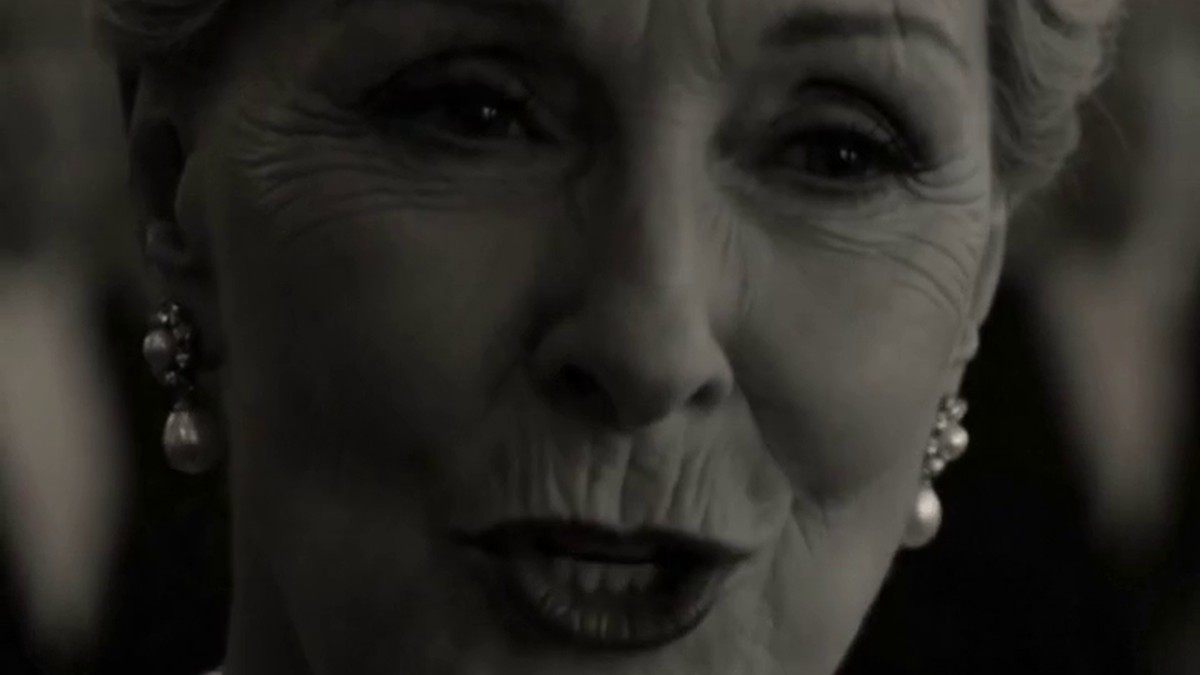
An older woman in pearls and a tailored gown turned from her circle of guests, looked the newcomer up and down, and let her voice carry.
“This isn’t the kind of place for someone like you.” She smiled without warmth. “Leave now, before you embarrass yourself any further.”
The woman in simple clothes said nothing. Just lowered her eyes.
Then a girl stepped forward.
Thirteen, maybe — slight enough that no one had noticed her until that moment. She planted herself directly in front of the woman — arms spread wide, chin up.
“Don’t talk to her like that.” Her voice didn’t shake. “She hasn’t done anything to you.”
The older woman let out a short, contemptuous laugh.
“And who exactly are you to speak to me that way, child?”
The girl looked straight at her.
“Someone who knows you’re not better than her.”
The room went quiet. The kind of quiet that has weight.
The older woman took a step closer, her expression sharpening.
“Your parents clearly forgot to teach you how to address your elders.”
A man emerged from the crowd before she could say another word. His voice was low and steady — the kind that doesn’t need volume to command attention.
“You always do this.” He looked at the older woman without flinching. “You humiliate people because you’re convinced no one remembers who you really are.”
She arranged her face into something resembling amusement.
“I haven’t the faintest idea what you mean.”
The girl reached into the pocket of her coat.
“Everyone thinks nobody remembers,” she said quietly. “But I do.”
The older woman’s smile faltered.
“What did you just say?”
The girl held up a photograph. Old and slightly worn at the edges. In it, the woman in simple clothes had her arms wrapped around a small child — both of them standing in front of an orphanage, both of them smiling like the world was enough.
“Seven years ago, I lived there.” The girl’s voice was steady, unhurried. “Nobody came to visit us much. But she did. Every single Sunday. She brought food and toys. She sat with us and read to us until we fell asleep.”
The color drained from the older woman’s face.
The girl wasn’t finished.
“You came too.” A pause. “But not to help. You came to laugh at us. You told us we’d never amount to anything.”
Silence swallowed the room whole.
Then something began to happen.
A man near the back of the hall straightened up. His voice broke slightly when he spoke.
“I grew up in that orphanage too.” He looked at the woman in simple clothes. “She paid for my entire education.”
A hand went up across the room.
“She’s the reason I got my first scholarship.”
Another voice, closer.
“I’m a doctor today because of her.”
One by one, people rose to their feet. Then dozens. The room filling with standing figures, each one carrying a piece of the same story — a story that had been quietly unfolding for years, unseen, unannounced, unrewarded.
The older woman stared at the floor. There was nothing left to say and no way to say it.
The girl reached up and took the woman’s hand. She looked at her and smiled — simple, certain, without a trace of cruelty.
“You always said doing good didn’t need applause.” She squeezed her hand. “But tonight, everyone deserves to know who you really are.”
The ballroom erupted.
Because money can dress a person in the appearance of greatness. It can buy the room, the pearls, the polish.
But only the lives you quietly change leave something behind that can never be taken back.
The applause didn’t stop.
It rolled through the ballroom in waves — not the polished, obligatory kind that fills a room when politeness requires it, but something rawer. Something that had been waiting years to finally happen.
The older woman didn’t move.
She stood exactly where the girl had left her, one hand still clutching the stem of her champagne flute. The crystal was sweating. Her knuckles had gone white.
Around her, the room had transformed. These were her people — her donors, her board members, her social circle, the ones who had stood beside her at a hundred events exactly like this one. They were all on their feet.
For someone else.
She had never felt so completely alone in a crowd.
The man who had emerged from the crowd earlier — still standing nearby — watched her. He didn’t move to comfort her. He didn’t need to. He just watched, the way you watch something inevitable complete itself.
“Margaret.”
Her name. Spoken quietly.
She turned.
The woman in simple clothes was looking directly at her. Not with triumph. Not with contempt. With something far more disarming than either.
With recognition.
“I remember you from back then too,” she said. Her voice was soft enough that only those closest could hear it over the applause. “You drove past in a black car the first time I ever visited the orphanage. You were on your way somewhere important.”
Margaret’s champagne flute clinked against a table as she set it down. Her hand shook slightly.
“You had everything,” the woman continued. “You always have. And I think — I think that’s always been the hardest part for you.”
The girl still held her hand. She looked up at the woman — her protector, her Sunday visitor, her quiet certainty in an uncertain world — and didn’t say a word. She just held on.
Margaret’s composure, that careful architecture she had been building and maintaining for decades, cracked along a fault line she hadn’t known was there.
It wasn’t dramatic. There was no collapse, no scene.
Just one tear.
One she didn’t bother to hide.
She looked at the girl. Then at the woman. Then at the dozens of people still standing — doctors, scholars, strangers who had once been children with nowhere to go and nothing promised to them.
“I did say those things.” Her voice came out wrong — too thin, stripped of its usual authority. “To those children. I said them.”
Nobody answered.
“I believed that the world sorted people,” she said. “That where you began was where you belonged.” She pressed her lips together. “I was wrong.”
It wasn’t an absolution. It wasn’t even close.
But it was true. And in a room built on performances, on curated impressions and careful half-truths, something true had an almost physical weight.
The woman in simple clothes looked at her for a long moment.
Then she nodded — once, quietly — and turned back to the girl.
“Come on,” she said. “There are people I want you to meet.”
And just like that, the evening continued.
The man who had spoken — whose name was Daniel, whose tuition had been paid in anonymous monthly installments for four years — walked with them. He shook hands with the doctor who had stood first. He embraced a woman near the bar who had also grown up in that building, whom he hadn’t seen in eleven years, who burst into laughter the moment she recognized his face.
The girl moved through it all with that particular ease young people have when they’ve done something enormous and haven’t yet decided it’s remarkable.
She just moved through it.
Margaret remained near the table for a while. Then, quietly, without ceremony, she set her empty glass down and walked toward the exit.
At the door, she paused.
She looked back at the room — at the light, at the standing figures, at the girl in her plain coat holding the hand of the woman she had chosen as her world.
Nobody was watching her leave.
That, too, felt like something earned.
—
Later, when the gala wound down and the chandeliers dimmed and the last champagne flute was returned to a silver tray, the woman and the girl sat on the front steps of the venue.
The city moved past them, indifferent and alive.
The girl leaned against the woman’s shoulder.
“Were you scared?” she asked. “When she said that to you at the door?”
A pause.
“Yes,” the woman said. “A little.”
“You didn’t show it.”
“Neither did you.”
The girl thought about that. She turned the photograph over in her hands — the one of the two of them, years ago, standing in front of the orphanage. The edges were soft now from so much handling.
“I’ve kept this a long time,” she said.
“I know.” The woman put her arm around her. “You showed it to me once. When you were very small.”
“I wanted you to know I wouldn’t forget.”
The city lights reflected off the wet pavement below the steps. Somewhere nearby, a car horn sounded and then faded. The night smelled of rain that hadn’t quite arrived yet.
“Why didn’t you tell me?” the woman asked. “Tonight. Any of it. Why didn’t you warn me?”
The girl shrugged — total, unbothered, entirely certain, the way of someone who has done something enormous and hasn’t yet decided it was remarkable.
“Because you would have said not to.”
The woman laughed. Quietly, from somewhere deep.
“Yes,” she said. “I would have.”
The girl tucked the photograph back into her coat pocket. Patted it once, like a small reassurance.
“You always say it doesn’t need applause.” She tilted her head up. “But you deserved to hear it. At least once.”
The woman didn’t answer.
But she held the girl a little tighter, and the girl let her, and the city went on around them — loud and ordinary and completely unaware that something rare had just taken place inside a glittering room.
Not a scandal. Not a spectacle.
Just the truth, standing up in a crowded space and refusing to sit back down.
And a girl who had decided — somewhere between one Sunday visit and the next — that love this quiet deserved, at least once, to be seen in a room full of light.