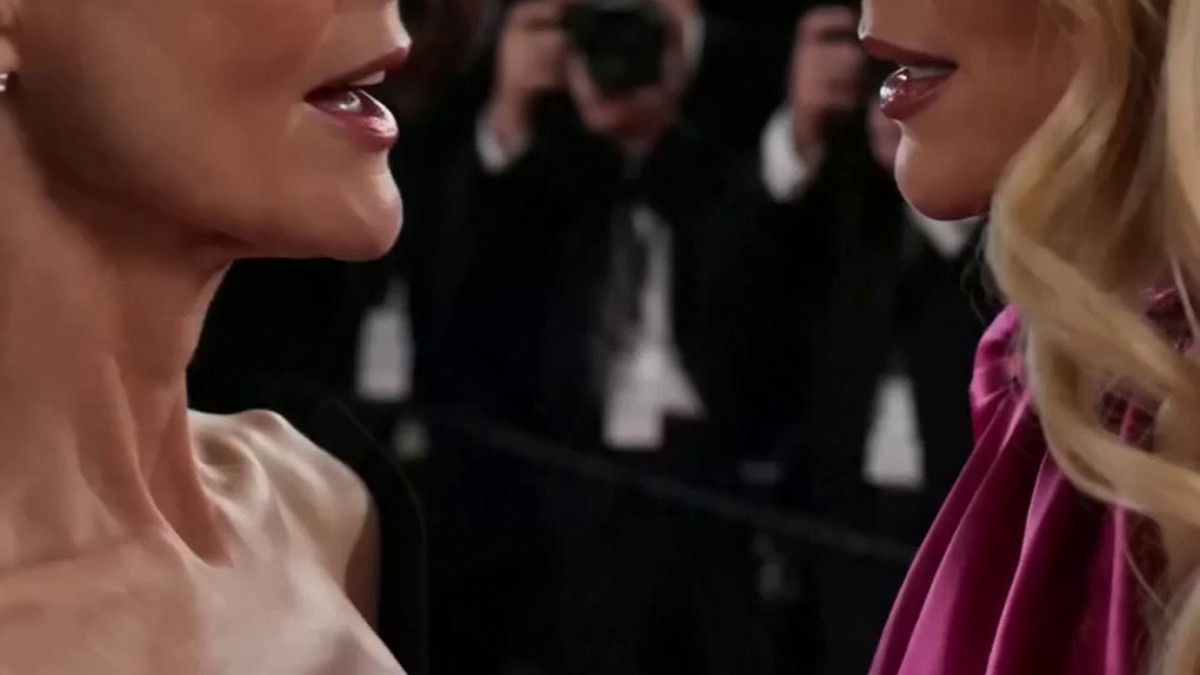
She wore a crimson dress that probably cost more than most people’s rent — three months of it — and carried herself with the kind of arrogance that only borrowed confidence can produce. Every camera at that red carpet event caught her angle perfectly, and she made damn sure of it. She wanted the world to see that he had chosen *her*. That she had won.
What she didn’t realize was that I had already stopped keeping score.
She moved toward me with that smile — slow, deliberate, sharp at the edges. The smile of someone who has rehearsed this moment in the mirror a hundred times. She expected me to flinch. To shrink. To play the role of the discarded wife with her eyes cast down and her dignity already packed away in some box in a storage unit.
I didn’t flinch.
I looked at her the way you look at something you once worried about and then simply… stopped worrying about. Calm. Clear. Unhurried.
Because here’s what she never understood: I didn’t *lose* a man. I *released* a liability.
Her smile flickered. Just for a second. But I saw it.
The cameras were still rolling when I leaned in — close enough that only she could hear me at first — and told her exactly what she was inheriting. Not a prize. Not a victory. A man with a very specific secret tucked behind all that money and all those suits and all that carefully constructed power.
Then I said it again. Louder.
The red carpet went quiet in that particular way crowds go quiet when they sense something irreversible has just happened.
Her face didn’t fall slowly. It dropped.
Because the truth has a way of doing that — arriving not like a whisper but like a verdict. And no designer dress in the world is armor enough against it.
She came to that event to humiliate me in front of everyone who mattered.
She left being the one everyone was talking about.
And not the way she’d planned.
What happened next would take people months to piece together — and some of them never quite got it right.
The cameras caught the moment her expression shattered, but they couldn’t capture the *sound* of it. That particular silence that rolled through the crowd like a pressure change before a storm. Champagne glasses held mid-air. Publicists frozen with their phones. A journalist from a trade magazine who would later tell his editor he’d witnessed something he couldn’t fully explain — only that it *felt* like watching a building come down in controlled demolition. Precise. Inevitable. Not a single wasted charge.
She recovered. Of course she did. Women like her always recover — temporarily. She laughed, touched my arm like we were old friends sharing a joke, angled her face back toward the cameras with that professional grace that takes years of practice to make look natural.
But her eyes were doing something different.
Her eyes were calculating.
I let her laugh. I even smiled back — genuinely, which I think frightened her more than anything else I could have done. Because there is nothing more disarming than a woman who has already decided she doesn’t need to be cruel to win. The battle she thought we were having? I’d forfeited it six months ago the moment I’d found the documents.
—
I should back up. You need to understand what the secret actually was.
Not an affair. Not another woman hiding somewhere in the wings — that would have been almost banal, almost forgivable in the architecture of his particular narcissism. No. What I found, folded inside the lining of a laptop bag he’d asked me to ship to the office one morning, was a series of wire transfer confirmations. Routing numbers. Shell company names that looked like law firms but weren’t. A name — one specific name — that appeared across seven separate transactions spanning four years.
The name belonged to a city contracts officer.
My husband — soon to be ex-husband — had been bribing a municipal official to steer infrastructure projects toward a construction company he quietly co-owned through two layers of holding entities. The projects themselves were real. The buildings went up. The roads got paved. But the margins were ghost-inflated, and the city — which is to say, the *taxpayers* — had been paying a premium for the privilege of being quietly looted.
He was meticulous. He was careful. He had lawyers and accountants who understood exactly how far the line could be pushed before it technically became something prosecutable.
But he’d made one mistake.
He’d trusted me enough to ask me to ship that bag.
And I had trusted him enough, once, not to check inside it.
That morning, something shifted. Call it instinct. Call it four years of small erosions adding up to a single clear-eyed moment in our kitchen. I unzipped the interior pocket, and the documents were just *there*, like they’d been waiting.
I photographed every page with my phone.
I shipped the bag.
I said nothing for six months while I found the right attorney.
—
She was still laughing when her own phone buzzed.
I watched it happen. Her eyes dropped to the screen out of reflex — the way everyone does, the way we’re all trained to respond to that particular vibration like Pavlov’s most modern experiment — and something in her posture changed. It was subtle. A millimeter’s worth of rigidity entering her spine.
Her assistant had texted her.
By now I knew what the text said, because I knew the timeline. My attorney had filed thirty-seven minutes before the red carpet began. I’d timed it that way not out of cruelty — or not *only* out of cruelty — but because I needed her and Marcus both somewhere visible, somewhere documented, somewhere with forty cameras capturing their faces at the exact moment the story broke across the wire services.
Context is everything in these situations.
Her next call — the one she stepped away to take, heels clicking hard against the marble foyer of the event venue — was from Marcus himself.
I know, because I watched her face when she came back.
—
He arrived twenty minutes later.
I’ll give him this: he dressed well for a man who’d just learned his carefully constructed world had developed a fault line. Charcoal suit. No tie. The kind of studied casualness that is itself a form of armor. He walked through that crowd like he owned it — he’d spent a decade learning to walk that way — and he didn’t look at anyone until he found me.
Then he looked at me.
And for the first time in our eleven years together, I saw something in his face that had nothing to do with calculation.
Fear. Clean and unadorned.
“We need to talk,” he said. His voice was quiet. Controlled. But there was a tremor underneath it — the structural kind, the kind that signals something load-bearing has already given way.
“We really don’t,” I said.
He stepped closer. His jaw tightened. “You have no idea what you’ve started.”
“I have a very precise idea,” I said. “I’ve had six months to develop it.”
She appeared at his shoulder then — her hand finding his arm in a gesture that was half territorial and half genuinely seeking something to hold onto. The crimson dress looked different now. Less like a declaration and more like a costume that no longer fit the scene it had been designed for.
“Marcus,” she said. His name in her mouth was a plea disguised as a statement.
He didn’t look at her.
That, I think, was the moment she understood. Not the filing. Not the cameras. Not the wire transfers or the shell companies or the city contracts officer whose own attorney had, by now, received a very interesting package from a courier service.
*That* moment. When he stood next to her and didn’t look at her.
Because that’s how it had always been going to end for her. She’d just been too invested in the myth of her own victory to see it coming.
—
The reporters found him forty-five seconds later.
To his credit, he didn’t run. He stood there and took the first question — something about the filing, about the company name, about whether he had a statement — with that political composure he’d practiced so long it had become reflexive. He started to speak. Something measured. Something that would have bought him twenty-four hours and a crisis PR team.
Then I walked past him toward the exit.
He stopped mid-sentence.
I don’t know why. I’ll never fully know why. But something in the act of me simply *leaving* — unhurried, coat over my arm, not looking back — seemed to break the last thing that had been holding his composure together.
One of the journalists said later that he’d never seen anything like it. A man just *stopping*. Like a watch someone had forgotten to wind.
The cameras were still rolling.
—
Outside, the night air was cool and specific. The kind of air that smells like October and parking garage concrete and the particular freedom of no longer having to perform.
My car was waiting. My attorney had sent a driver.
I got in.
As we pulled away from the curb, I looked back once — not out of sentiment, but the way you look back at a house you’ve sold. Verifying it’s no longer yours. Confirming the transfer is complete.
The red carpet lights were still blazing behind the glass doors. Inside, I could see the shape of a crowd reorganizing itself around a new center of gravity. The story had already changed. The headline they’d all arrived expecting to write — about him, his success, the beautiful woman on his arm — was now something else entirely.
She was still in there somewhere in her crimson dress.
And I found, checking my own chest the way you check a wound to see if it’s still bleeding, that I felt nothing toward her. Not triumph. Not residual anger. Not even pity, particularly.
She had wanted to be the protagonist of someone else’s story.
She had gotten exactly that.
Just not the story she’d written.
—
The case took fourteen months.
His attorneys were expensive and creative, and the city contracts officer had his own lawyers who had their own theories about culpability and cooperation. There were depositions and counter-filings and a particularly grim Tuesday when my attorney called to tell me it was possible the whole thing would settle quietly for a number that felt, to most people, like a lot but was, in context, almost nothing.
I told her to keep going.
She did.
In the end, Marcus pleaded to two counts and paid a fine that represented roughly eight percent of what he’d taken. His license to serve on municipal contract boards was revoked for five years. His name appeared in twelve newspapers, including one national outlet that ran a long feature piece examining the broader pattern of private-public corruption in mid-size American cities.
He was not destroyed. I want to be honest about that.
Men like him rarely are.
But he was diminished. Specifically, precisely, in the arena he’d valued most — the one where he’d been most certain I couldn’t touch him. His professional reputation. His carefully constructed image of untouchable competence.
I had touched it.
With documents and an attorney and six months of very deliberate patience.
—
The woman in the crimson dress?
She left him four weeks after the story broke. I heard this from a mutual acquaintance, delivered with the barely concealed excitement people feel when delivering news they expect will hurt you.
It didn’t hurt me.
I thought about her sometimes, in those fourteen months. Not obsessively. Not with malice. Just occasionally, the way you think about someone who briefly occupied space in your life and then didn’t anymore. I wondered if she’d understood, finally, what she’d actually signed up for. Whether she’d had her own morning in a kitchen somewhere, holding something she hadn’t expected to find.
I hoped, in a general way, that she figured herself out.
That’s about as charitable as I could manage, and I think, given the circumstances, it was enough.
—
I live somewhere smaller now.
That was the choice I made — not the choice made for me, but the one I made deliberately, after the settlement, standing in a real estate agent’s office with a list of numbers that were comfortable and a very clear understanding of what I wanted my life to feel like from here forward.
Smaller. Quieter. Mine.
There’s a window in the kitchen that gets morning light in a way my old house never did, and I drink coffee there sometimes and think about how strange it is — the way certain losses turn out to be the architecture of something better. How you can spend years building something that was never structurally sound, and then one morning, because of a laptop bag and a quiet decision to actually *look*, the whole thing resolves into something you can finally walk away from cleanly.
I didn’t go to that red carpet to burn anything down.
I went because I had decided, after six months of preparation and a very good attorney and a lot of mornings with coffee and that question we’re all afraid to ask ourselves — *what am I actually willing to accept?* — I had decided that I was done being the woman who kept quiet to keep the peace.
The peace, it turned out, had never been real.
Only the quiet was.
And I had learned, finally, to tell the difference.